
You’ve seen the ads. A robot mower glides across a perfect lawn while the owner sips coffee. Then you read the fine print: trench 200 feet of boundary wire, bury it two inches deep, and pray a spade never nicks it. That’s the real reason wire-free mowers now dominate the category.

Cutting the perimeter wire changes everything. Setup drops from a weekend to roughly an hour. You can move zones, add a flower bed, or reroute around a new shed without digging anything up. The catch is navigation. A wire-free mower has to figure out where it is on its own, and how well it does that depends on which positioning system it uses.
This guide ranks five current wire-free mowers by how reliably they navigate real yards, not by spec sheets. You’ll get the honest trade-offs: GPS drift under tree cover, LiDAR limits in tight gaps, blade replacement costs, and which lawns each machine should never be bought for.
Here’s the quick spec comparison before the detailed reviews.
| Features | WORX Robot Mower | ECOVACS Goat O1000 | MOVA LiDAX Ultra 1000 | Sunseeker X5 AWD | LawnMaster OcuMow |
|---|---|---|---|---|---|
| Navigation system | RTK Cloud plus Vision AI | RTK satellite positioning | 360° 3D LiDAR plus AI vision | RTK plus Vision AI and VSLAM | Optical camera navigation |
| Lawn size | 1/4 acre | 1/4 acre | 1/4 acre | 0.5 acre | 1000–2026 sq ft |
| Slope handling | Not specified | Not specified | 45% slope | 30° / 60% slope | 35% (19°) slope |
| Edge cutting | Closer edge-following | Systematic path coverage | Within 2 inches of edges | 8.7-inch floating cut | Not specified |
| Best use case | Shaded complex yards | Long-term low upkeep | Obstacle-heavy terrain | Large sloped properties | Small simple lawns |
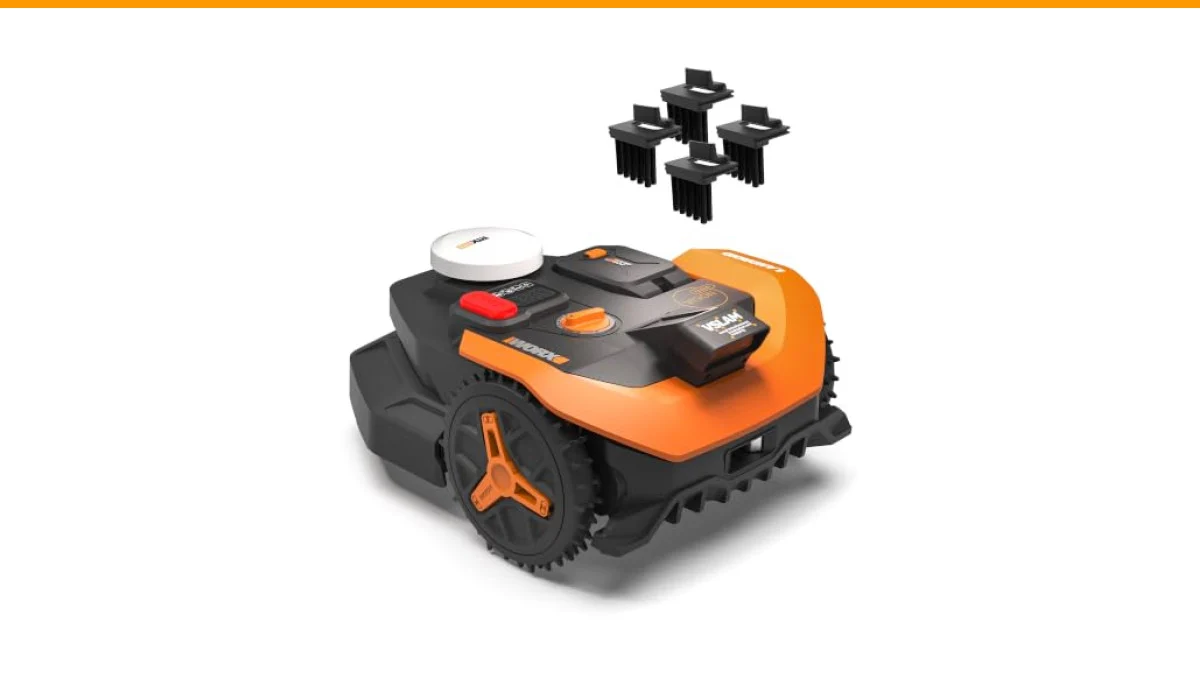
WORX Robot Lawn Mower

WORX
WORX Robot Lawn Mower for 1/4 Acre, Wire-Free with Brushes | Landroid Vision Cloud with App Control, AI Obstacle Avoidance, RTK Cloud Navigation, App Control, Handles 30% Slope
- Centimeter-Level RTK Cloud Accuracy: Commercial-grade RTK Cloud technology delivers centimeter-level positioning for this robotic…
- Auto Mapping for More Complete Coverage: Vision AI helps the robot lawn mower understand lawn shapes and boundary types, then auto…
- AI Obstacle Avoidance with Neural Processing: Vision AI recognizes and understands common yard objects, using a trained neural net…
WORX built this mower around RTK Cloud, which means no local antenna station to install and no ongoing cloud subscription. That last part matters. Several competitors charge a yearly fee for the same positioning data, and those fees add up fast over five years of ownership.
The standout feature is the combination of RTK and V-SLAM sensor fusion. RTK handles open lawn with centimeter-level accuracy. When you walk under a dense maple canopy, satellite signal drops and V-SLAM takes over using visual landmarks. In practice, this is the setup that keeps a mower from wandering into your neighbor’s yard when the sky disappears. The Vision AI obstacle system runs on a trained neural network and processes up to 10 trillion operations per second, which is genuinely fast for a mower. It recognizes common yard objects rather than just bumping into them.
Auto mapping happens on its own through Vision AI, so you don’t drive the mower around the perimeter to teach it the yard. Zone creation is unlimited, and you can edit the map from the app whenever landscaping changes. The trade-off: all that processing power and cloud dependency means this mower leans on a stable Wi-Fi connection. If your yard sits at the far edge of your router’s reach, expect occasional app disconnects. Slope capability isn’t published either, so steep properties are a gamble.
- No local RTK antenna and no cloud subscription fees
- V-SLAM fusion maintains navigation under tree cover
- Unlimited zones with full app map editing
- Vision AI recognizes objects instead of bumping them
- Requires solid Wi-Fi coverage across the yard
Best for: Homeowners with shaded, irregular yards who want zero subscription costs and don’t mind a Wi-Fi dependency.
ECOVACS Goat O1000 RTK Ca…
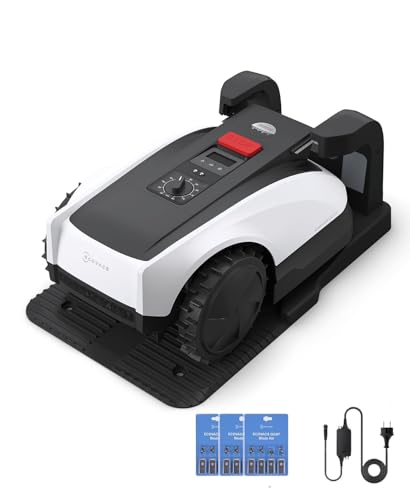
ECOVACS takes a different approach. The Goat O1000 sticks with pure RTK positioning and skips the camera-heavy navigation stack. That keeps the system simpler, and simple systems tend to break less often. It mows in systematic rows rather than random patterns, which produces visible stripes and even coverage without passing over the same strip four times.
The CARE bundle is the real selling point here. ECOVACS includes 36 replacement blades in the box. Robot mower blades dull faster than most buyers expect, especially on sandy or dry lawns, and a dull blade tears grass instead of cutting it. Thirty-six blades covers roughly three years of normal use, which removes a recurring cost most competitors quietly push onto you. The included RTK extension cable lets you place the antenna where satellite reception is strongest, which helps on lots with tall trees or buildings blocking part of the sky.
Multi-zone management through the app works well for front, back, and side yards with separate schedules. The honest limitation: pure RTK struggles under heavy canopy. There’s no vision backup here, so a fully shaded lawn may see positioning drift or incomplete passes. Availability is also flagged as scarce, so this one sells out.
- 36 replacement blades included in the CARE bundle
- RTK extension cable improves antenna placement flexibility
- Systematic row mowing for even, striped coverage
- Multi-zone scheduling through the app
- No vision backup for heavily shaded lawns
Best for: Buyers with open, sunlit lawns who want the lowest long-term blade cost and don’t need camera-based navigation.
MOVA LiDAX Ultra 1000 Rob…

MOVA
MOVA LiDAX Ultra 1000 Robot Lawn Mower Wire Free for 1/4 Acre, RTK-Free+360° 3D LiDAR+AI Vision Auto Mapping, Zero-Edge Cutting, Cutting Height 1.2"-3.9", 45% Slope, Up to 150 Managed Zones Dual Maps
- Wireless, RTK-Free Setup — AI-Assisted Auto-Mapping with 360° 3D LiDAR: With AI vision and 360° 3D LiDAR, LiDAX Ultra 1000 mower a…
- Flawless Edge Precision — < 2inch with Movable Disc: With UltraTrim 1.0, the robot lawn mower cuts within 2inch of walls, hedges a…
- AI-Vision Powered 300+ Obstacle Avoidance: Powered by 3D point cloud data and advanced AI vision, the wireless mower detects and a…
MOVA skips RTK entirely. The LiDAX Ultra 1000 uses 360° 3D LiDAR and AI vision to map the yard in three dimensions. No satellite signal, no antenna station, no subscription. LiDAR also works in dim light and harsh glare, which is where camera-only systems fall apart.
Two numbers stand out. First, edge cutting within 2 inches of walls and hedges, thanks to a movable disc that covers gaps. Most robot mowers leave a 4-to-6-inch strip you have to trim by hand. Second, obstacle recognition covering over 300 object types using 3D point cloud data. That range matters if your yard has kids’ toys, garden hoses, or patio furniture scattered around. The mower adjusts its route instead of plowing through. U-shaped path planning keeps coverage even, and it resumes exactly where it stopped after recharging.
Terrain capability is genuinely strong for the class: 45% slopes, 1.6-inch obstacles, and 23.6-inch narrow passages. The trade-off is that LiDAR mapping takes longer on the first run than RTK auto-mapping. Expect the initial scan to feel slow. Dense, low-hanging foliage can also confuse the point cloud, so heavy shrub borders may need no-go zones defined manually.
- No RTK station and no subscription required
- LiDAR works in low light and harsh glare
- Cuts within 2 inches of walls and raised edges
- Recognizes 300+ obstacle types via 3D point cloud
- First mapping run is slower than RTK systems
Best for: Yards packed with obstacles, mixed light conditions, and slopes where RTK signal reliability is a question mark.
Sunseeker X5 AWD Robot La…
The X5 is the only half-acre mower in this group, and the only one with all-wheel drive. That combination targets a specific buyer: someone with a large property that isn’t flat. Independent front suspension and rugged tires keep it stable across roots, bumps, and thicker turf that stops lighter mowers cold.
Navigation layers RTK, VSLAM, and Vision AI together. The system plans systematic paths and keeps coverage under trees, in shade, or in weak-RTK zones. It also runs at night, which matters if you prefer mowing while everyone sleeps. Slope handling reaches 30° or 60%, the steepest rating here. The 8.7-inch floating cut deck follows ground contours and adjusts from 1.6 to 3.2 inches, and it squeezes through 31.5-inch passages. Noise sits around 60 dB, roughly the level of a normal conversation.
Five maps and virtual boundaries cover front, back, and side zones without trenching. The drawback is complexity. Three navigation systems working together means more to configure, and some owners report the initial setup takes longer to dial in than simpler RTK-only mowers. At half-acre capacity with AWD, it’s also the heaviest machine here, which matters if you ever need to carry it across a driveway.
- Handles up to 0.5 acre with all-wheel drive
- Steepest slope rating at 30° / 60%
- Mows at night and in weak-RTK areas
- Five maps with virtual boundaries and no-go zones
- Setup is more involved than RTK-only models
Best for: Owners of large, sloped, uneven properties who need AWD traction and night mowing capability.
LawnMaster OcuMow Perimet…

LawnMaster
LawnMaster OcuMow Perimeter Wire Free Robot Lawn Mower Cuts Small Lawns 1000-2000 Square Feet with Optical Navigation, Obstacle Avoidance, Low Noise and No Go Functiont
- OPTICAL NAVIGATION TECHNOLOGY: Take the guess work out of yard work. Our robot mower uses sensors and a wide angle, high dynamic r…
- DESIGNED FOR SMALL LAWNS: Mow for up to 3 hours covering 2000 square feet while dropping small clippings on the lawn to feed the g…
- OBSTACLE AVOIDANCE: Two ultrasonic sensors detect obstacles and automatically re-direct the robot mower to avoid obstacles as smal…
LawnMaster goes the opposite direction from everything above. The OcuMow uses optical navigation, a wide-angle high dynamic range camera, and two ultrasonic sensors. No RTK. No LiDAR. No satellite subscription. It’s built for small lawns between 1000 and 2026 square feet.
That simplicity has real appeal. The camera identifies grass even in extreme contrast lighting, and the ultrasonic sensors detect obstacles as small as 6 inches and redirect the mower around them. Setup takes minutes because there’s nothing to map in advance. The included 33 feet of magnetic wire creates a no-go zone without a power source or any digging, which is a clever low-effort solution for protecting flower beds or a sandbox. It climbs 35% slopes with deep tread wheels. Runtime reaches three hours, and it drops fine clippings as fertilizer.
The limits are clear. This mower cannot handle a quarter acre without extra batteries, and optical navigation has no memory of yard layout, so it works by reacting to what the camera sees rather than following a stored map. That means less efficient paths and no multi-zone scheduling. For a small, simple, mostly open yard, none of that matters. For anything complex, it does.
- Optical camera navigation with no mapping required
- Ultrasonic sensors detect obstacles down to 6 inches
- 33 feet of magnetic wire for no-go zones, no digging
- Three-hour runtime covering up to 2026 sq ft
- No stored map, so paths are less efficient
Best for: Small-yard owners who want the simplest possible setup and don’t need mapping or zone scheduling.
How We Chose These Products
We ranked these mowers by navigation reliability across specific lawn conditions, not by feature count. A mower with twelve bullet points that loses GPS under a single oak tree is less useful than one with six features that never gets lost. Tree cover, slope grade, obstacle density, and zone complexity drove the ranking order.
We also weighed total ownership cost. Replacement blades, subscription fees, and antenna hardware all add up over five years. A mower with a lower sticker price can cost more long-term if it needs proprietary blades or a cloud plan. Models that bundle consumables or avoid subscriptions scored higher. For a broader look at how these systems compare across the category, see this wire-free mower comparison.
Buying Guide: What Really Matters
Navigation technology is the single biggest decision. RTK uses satellite positioning for centimeter accuracy in open sky, but signal degrades under dense canopy and near tall buildings. LiDAR maps with lasers and works in any light, though it takes longer on the first scan and can struggle with low, dense foliage. Vision-based systems read the environment with cameras and handle obstacles well, but they need decent lighting and processing power. The best mowers combine two systems so one covers the other’s weakness.
Lawn size ratings assume ideal conditions. A mower rated for a quarter acre will finish that lawn in a day or two of scheduled runs, not one pass. If your yard sits at the top of the rating, expect longer completion times and more battery cycles. Buy one size up if your lawn is close to the limit. Slope ratings matter just as much, and they’re often buried in the specs. A 45% slope is steep enough that many mowers simply stop.
Budget for blades. Sharp blades cut cleanly; dull blades tear grass and leave brown tips. Replacement intervals vary with lawn conditions, but sandy soil eats blades fast. Bundled blade packs, like the one ECOVACS includes, are worth real money over three years. Also check whether the mower needs a subscription for positioning data. Some do, and the annual cost isn’t always obvious at purchase. For small properties, a small yard mower guide covers the lower-capacity options in more depth.
Our Top Recommendation
The WORX Robot Lawn Mower takes the top spot for most buyers. RTK Cloud plus V-SLAM fusion solves the shade problem that trips up pure RTK mowers, and there’s no subscription fee or antenna to install. Unlimited zones and app-based map editing give you room to change the yard layout later without redoing setup.
The MOVA LiDAX Ultra 1000 is the better pick if your yard is obstacle-heavy or sits under heavy tree cover where satellite signals are unreliable. LiDAR doesn’t care about shade, and the 2-inch edge cutting saves real trimming time. The Sunseeker X5 AWD wins for large sloped properties that need all-wheel traction and night mowing. On a tight budget with a small, simple lawn, the LawnMaster OcuMow gets the job done with the least setup fuss.
For a deeper look at how these machines perform on hills specifically, this slope mower breakdown is worth reading before you buy.
Frequently Asked Questions
Do wire-free mowers really need no installation at all? Most need some setup, just not trenching. RTK models may require an antenna placed with a clear sky view, and some include an extension cable to position it better. LiDAR and vision models skip the antenna entirely. Expect 30 minutes to an hour for app pairing, Wi-Fi connection, and a first mapping run. That’s still far less than burying boundary wire.
What happens when GPS signal drops under trees? It depends on the mower. Pure RTK models may pause, drift, or leave gaps in coverage until the signal returns. Models with V-SLAM or LiDAR fusion switch to visual or laser navigation and keep mowing. This is the main reason a hybrid system costs more, and it’s usually worth it on wooded lots.
Are there hidden subscription costs? Sometimes. Some brands charge yearly fees for cloud-based RTK correction data. Others, including the WORX model here, include it at no extra cost. Check the fine print before buying, because a modest annual fee adds up over the life of the mower. Blade replacements are the other recurring cost to plan for.
How often do blades need replacing? It varies with lawn size and soil type. Sandy or dry, dusty lawns wear blades faster than lush ones. A reasonable estimate is every four to eight weeks during growing season. Bundled blade packs, like the 36 included with the ECOVACS CARE bundle, cover roughly three years of typical use and save money over buying singles.
Final Verdict
Wire-free mowing has matured past the point where navigation is a gamble. The question is no longer whether these mowers work, but which navigation system fits your specific yard. Open and sunny favors RTK. Shaded and cluttered favors LiDAR or vision fusion. Large and sloped favors AWD with layered navigation. Match the system to your lawn conditions, budget for blades, and check for subscription fees, and a wire-free mower will handle the lawn for years without a single trench.


