
You’ve seen the ads. A robot mower glides across a perfect lawn while the owner sips lemonade. Then you read the fine print: bury 200 feet of boundary wire, dig trenches, deal with a broken wire two seasons later. That’s the old way. Wire-free mowers killed the trench digger, but they didn’t kill every headache. Some lose GPS under trees. Some choke on wet grass. Some cost more to maintain than a gym membership.
A great wire-free mower needs three things: reliable navigation without a perimeter wire, a map that actually matches your yard, and a price that doesn’t make you wince at replacement blades. RTK, LiDAR, and camera vision all solve the wire problem differently. Each fails in different conditions. Picking the wrong one for your yard means watching a robot get stuck behind the shed every Tuesday.
We looked at five wire-free models that cover small yards, large lots, tight spaces, and tight budgets. The WORX RTK model leads for big, open lawns. LawnMaster’s OcuMow line wins for simple small yards. ECOVACS and LEBOSBO round out the list with their own trade-offs. This guide covers what the spec sheets skip: setup time, wet-grass performance, hidden costs, and where each mower actually fails.
Here’s a quick side-by-side of the key differences before we dig into each mower.
| Features | WORX RTK Mower | LawnMaster OcuMow | LawnMaster VBRM601YCM | ECOVACS Goat O1000 | LEBOSBO V3 |
|---|---|---|---|---|---|
| Navigation Type | RTK Cloud + Vision AI | Optical camera | Optical camera | RTK | AI vision |
| Lawn Coverage | 1/4 acre | 1000-2026 sq ft | 2026-3500 sq ft | 1/4 acre | 1600 sq ft |
| No-Go Zones | App-based unlimited | 33 ft magnetic wire | 32 ft magnetic strips | App multi-zone | 32 ft magnetic strip |
| Slope Handling | Not specified | 35% (19°) | 35% | Not specified | Not specified |
| Best Use Case | Large open yards | Small simple lawns | Small-medium lawns | Large yards, low maintenance | Budget small yards |
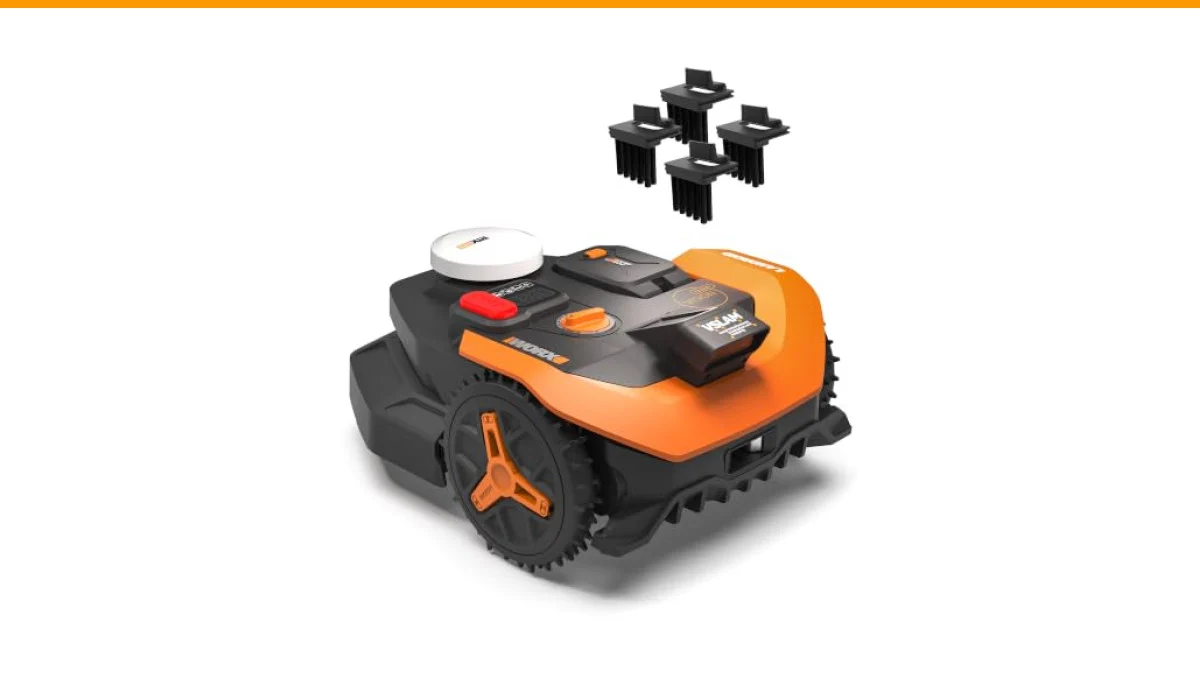
WORX Robot Lawn Mower for…

WORX
WORX Robot Lawn Mower for 1/4 Acre, Wire-Free with Brushes | Landroid Vision Cloud with App Control, AI Obstacle Avoidance, RTK Cloud Navigation, App Control, Handles 30% Slope
- Centimeter-Level RTK Cloud Accuracy: Commercial-grade RTK Cloud technology delivers centimeter-level positioning for this robotic…
- Auto Mapping for More Complete Coverage: Vision AI helps the robot lawn mower understand lawn shapes and boundary types, then auto…
- AI Obstacle Avoidance with Neural Processing: Vision AI recognizes and understands common yard objects, using a trained neural net…
The WORX RTK model targets homeowners with a quarter acre or more of open grass. It’s built for people who want a true drop-and-mow experience without installing an RTK base station or paying a cloud subscription. If your yard has big, uninterrupted stretches of lawn, this is the one to beat.
What sets it apart is the combination of RTK Cloud and Vision AI. RTK gives centimeter-level positioning in open areas. When you walk under a dense tree canopy, V-SLAM sensor fusion takes over to keep the mower on track. The auto-mapping feature uses Vision AI to understand lawn shapes and boundary types, so it maps your yard automatically instead of making you drive it around the perimeter. The neural processing engine handles up to 10 trillion operations per second, which sounds like marketing fluff until you watch it dodge a garden hose and a lawn chair without pausing.
Here’s the honest part: RTK still struggles in deep shade or narrow passages between buildings. The V-SLAM backup helps, but it’s not perfect. If your yard is a postage stamp surrounded by tall fences and overhanging trees, this mower will frustrate you. It’s also overkill for small lawns. You’re paying for coverage and navigation tech you won’t fully use.
- RTK Cloud accuracy without a local antenna or subscription fees
- Vision AI auto-mapping and neural obstacle avoidance
- Unlimited app-controlled mowing zones and no-go areas
- V-SLAM fusion maintains navigation in shaded areas
- Designed for 1/4 acre coverage
Best for: Homeowners with a quarter acre of mostly open lawn who want wire-free RTK precision and app-based zone control.
LawnMaster OcuMow Perimet…

LawnMaster
LawnMaster OcuMow Perimeter Wire Free Robot Lawn Mower Cuts Small Lawns 1000-2000 Square Feet with Optical Navigation, Obstacle Avoidance, Low Noise and No Go Functiont
- OPTICAL NAVIGATION TECHNOLOGY: Take the guess work out of yard work. Our robot mower uses sensors and a wide angle, high dynamic r…
- DESIGNED FOR SMALL LAWNS: Mow for up to 3 hours covering 2000 square feet while dropping small clippings on the lawn to feed the g…
- OBSTACLE AVOIDANCE: Two ultrasonic sensors detect obstacles and automatically re-direct the robot mower to avoid obstacles as smal…
LawnMaster’s OcuMow is the entry point for small yards. It cuts 1000 to 2026 square feet and runs up to three hours on a charge. The optical navigation system uses a wide-angle, high-dynamic-range camera to spot grass even in harsh lighting. No perimeter wire, no RTK base station, no complicated setup.
The magnetic no-go wire is the standout feature here. You get 33 feet of it, and it doesn’t need power or digging. Lay it around flower beds or the kids’ sandbox, and the mower stays out. Two ultrasonic sensors detect obstacles as small as six inches, so it won’t plow through a forgotten garden gnome. The deep tread wheels climb slopes up to 35 percent, which is steeper than most small yards have anyway.
The limitation is coverage. This mower is strictly for small lawns. If your yard is bigger than 2026 square feet, you’ll be swapping batteries or wishing you bought the next model up. The optical navigation also struggles in deep shade or when grass is wet and reflective. It’s a fair-weather friend. For a simple, flat suburban front yard, it’s plenty. For anything more complex, look elsewhere.
- Optical navigation with high-dynamic-range camera
- Up to 3 hours runtime, 2026 sq ft coverage
- 33 ft magnetic no-go wire included
- Ultrasonic obstacle detection down to 6 inches
- Climbs slopes up to 35% (19 degrees)
Best for: Owners of small, simple lawns under 2026 square feet who want wire-free mowing on a budget.
LawnMaster OcuMow™ VBRM…

LawnMaster
LawnMaster OcuMow™ VBRM601YCM MAX Perimeter Wire Free Robot Lawn Mower Cuts Small Lawns 2000-3500 Square Feet with Optical Navigation, Obstacle Avoidance, Low Noise and No Go Function
- PERFECT FOR SMALL TO MEDIUM-SIZED LAWNS: Mow for up to 4 hours* and cover up to 2000-3500 sq. ft. while leaving fine grass clippin…
- OPTICAL NAVIGATION TECHNOLOGY: Advanced sensors and a wide-angle camera efficiently identify grass and guide the mower, even in tr…
- OBSTACLE AVOIDANCE: Ultrasonic sensors detect and steer clear of objects as small as 6 inches for a smooth mowing experience
The VBRM601YCM MAX is the bigger brother of the standard OcuMow. It covers 2026 to 3500 square feet and runs up to four hours. The optical navigation system is the same wide-angle camera setup, and the obstacle avoidance uses the same ultrasonic sensors. The difference is stamina and coverage.
This model makes sense for homeowners with a small-to-medium yard who don’t want to deal with RTK or app-based mapping. The magnetic no-go strips are 32 feet, roughly the same as the smaller model. The slope handling stays at 35 percent. The cutting height is adjustable, and the mower drops fine clippings to feed the lawn. For a yard that’s mostly flat with a few beds to avoid, this is a practical step up from the base OcuMow.
The trade-off is navigation intelligence. There’s no RTK, no LiDAR, no neural network. The camera-based system works, but it’s not as precise as RTK in open areas or as robust as LiDAR in shade. If your yard has complex geometry or heavy tree cover, this mower will miss spots. It’s also not ideal for wet grass, same as its smaller sibling. You’re paying for coverage and runtime, not cutting-edge navigation.
- 4-hour runtime, 2026-3500 sq ft coverage
- Optical navigation with wide-angle camera
- Ultrasonic obstacle detection at 6 inches
- 32 ft magnetic no-go strips included
- Climbs slopes up to 35%
Best for: Homeowners with small-to-medium lawns who want longer runtime and more coverage without paying for RTK.
ECOVACS Goat O1000 RTK Ca…
ECOVACS
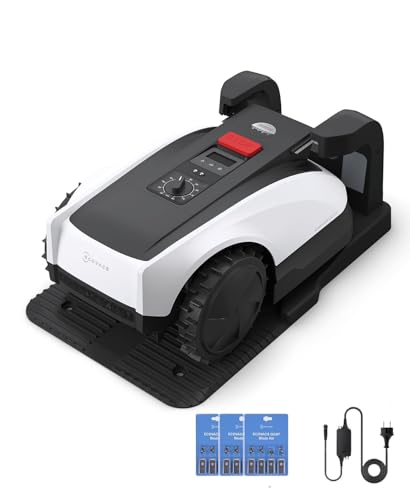
ECOVACS Goat O1000 RTK Care Robot Lawn Mower, RTK Navigation, 1/4 Acre | Wire-Free, Auto Mapping, Smart Multi-Zone Management, 62dB Quiet, App Control, Includes 36 Extra Blades
- RTK Precision Navigation for Wire-Free, Accurate Mowing. Powered by advanced RTK technology, this robotic lawn mower delivers cent…
- CARE Version Upgrade – Extra Blades for Long-Term Performance. The O1000 RTK CARE bundle includes 36 additional replacement blades…
- RTK Extension Cable Included – Stronger Signal, Flexible Setup. Comes with an RTK extension cable that allows optimal antenna plac…
The ECOVACS Goat O1000 RTK CARE bundle is for the homeowner who wants RTK precision and doesn’t want to think about blade replacements for a long time. It covers a quarter acre, uses RTK navigation for centimeter-level positioning, and includes 36 extra replacement blades. That’s a lot of blades. For most people, that’s two or three seasons of cutting without ordering replacements.
RTK navigation means systematic mowing paths instead of random bouncing. The mower follows efficient lines, covers the lawn evenly, and handles multi-zone management through the app. You can set schedules, define different cutting areas, and let it recharge and resume on its own. The included RTK extension cable lets you place the antenna for better satellite reception, which matters if your yard has trees or buildings that block signals.
The honest caveat: RTK needs a clear view of the sky. If your yard is surrounded by tall trees or buildings, the signal will drop and the mower will pause or wander. The CARE bundle is great value if you plan to keep the mower for years, but the upfront cost is higher than the LawnMaster models. Availability is also listed as scarce, so you might wait for restock. And like all RTK mowers, it’s not ideal for narrow, shaded passages.
- RTK navigation for centimeter-level accuracy
- 36 replacement blades included in CARE bundle
- RTK extension cable for flexible antenna placement
- Auto-mapping and multi-zone app management
- Automatic recharge and resume
Best for: Homeowners with a quarter acre who want RTK precision, low maintenance costs, and don’t mind paying more upfront.
LEBOSBO V3 AI Vision Robo…

LEBOSBO
2026 New LEBOSBO V3 AI Vision Robotic Lawn Mower, 1600 Sq.Ft, Black | Vision Obstacle Avoidance, Smart APP Control, Low-Noise Operation, Adjustable Cutting Height, No-Go Zones
- 【AI Vision Obstacle Sensing】Equipped with intelligent AI vision technology, the LEBOSBO V3 robotic lawn mower can detect obstacles…
- 【Custom No-Go Zones with 32FT Magnetic Strip】The included 32FT magnetic strip allows flexible no-go zone setup to keep the mower a…
- 【Smartphone APP Control】Use the mobile APP to control your robot lawn mower remotely. Schedule mowing times, monitor operation, an…
The LEBOSBO V3 is the budget pick. It covers 1600 square feet, uses AI vision for obstacle sensing, and includes a 32-foot magnetic strip for no-go zones. It’s wire-free, app-controlled, and quiet. For a small yard on a tight budget, it checks the basic boxes.
The AI vision system detects obstacles and navigates lawn areas, though it’s not as sophisticated as the RTK or LiDAR systems on pricier models. The app lets you schedule mowing times and monitor operation remotely. The adjustable cutting height is a nice touch for maintaining different grass lengths through the season. The magnetic strip setup is simple, no digging or power required.
Here’s where it falls short: AI vision alone is the least reliable navigation method in this group. It struggles in low light, heavy shade, and when grass is wet. The 1600 square foot coverage is the smallest here. And availability is scarce, so you might not find it in stock when you want it. It’s a decent starter mower for a simple, small, sunny yard. It’s not a long-term solution for complex landscapes.
- AI vision obstacle sensing
- 1600 sq ft coverage
- 32 ft magnetic strip for no-go zones
- Smartphone app control and scheduling
- Quiet operation with adjustable cutting height
Best for: Budget-conscious homeowners with a small, simple, sunny yard who want basic wire-free mowing.
How We Chose These Products
We started with the core requirement: no perimeter wire. Every mower on this list mows without burying a boundary cable. From there, we looked at navigation technology, because that’s what separates a mower that works from one that gets stuck. RTK, LiDAR, and camera vision all have strengths and weaknesses. We weighed them against real-world yard conditions: tree cover, narrow passages, slopes, wet grass, and low light.
Coverage and runtime came next. A mower that can’t finish your lawn in one charge is a hassle. We checked the square footage each model handles and how long it runs. We also looked at no-go zone options, because every yard has a flower bed or a pet area the mower should avoid. Finally, we considered hidden costs: replacement blades, subscription fees, and whether the mower needs a base station or extension cable. The picks here represent a range of budgets and yard types, not just the most expensive models.
Buying Guide: What Really Matters
Navigation is the first thing to get right. RTK uses satellite signals for centimeter-level accuracy. It’s the best choice for open lawns with a clear view of the sky. LiDAR uses lasers to map the yard, and it works in shade and low light better than cameras. Camera vision is the cheapest option, but it struggles in deep shade, wet grass, and low light. If your yard has heavy tree cover, RTK alone won’t cut it. You need a mower with V-SLAM or LiDAR backup.
Coverage and runtime go hand in hand. A mower rated for 2026 square feet might need two charges to finish a 2026 square foot lawn if the grass is tall or the terrain is uneven. Check the runtime and the charging time. Some mowers recharge and resume automatically, which is a huge convenience. Others just stop and wait for you. Also look at the cutting height range. Different grass types and seasons need different heights.
Hidden costs add up. Replacement blades are the big one. Some mowers use proprietary blades that cost more. Others use standard blades you can buy in bulk. RTK mowers sometimes need a base station or extension cable, which adds to the setup. Subscription fees are rare but exist. Check the warranty and the support quality before you buy. A mower with a great warranty and poor support is still a headache. If you want more detailed comparisons, a robot mower guide can help you narrow down the options.
For small yards, a small lawn robot like the LawnMaster OcuMow or LEBOSBO V3 makes sense. For larger properties, an automatic mower for large lawns with RTK is the better investment.
Our Top Recommendation
The WORX RTK model is our top pick. It combines RTK Cloud accuracy with Vision AI and V-SLAM, which means it handles open lawns and shaded areas better than any other mower here. The auto-mapping and unlimited app-based zones make it flexible for complex yards. No subscription fees, no base station installation. It’s the most complete wire-free mower for a quarter-acre lot.
If you have a smaller yard, the LawnMaster OcuMow VBRM601YCM MAX is a strong runner-up. It covers up to 3500 square feet, runs four hours, and costs less than the RTK models. The ECOVACS Goat O1000 RTK CARE bundle is the best choice if you want RTK precision and low maintenance costs, thanks to the 36 included blades. For a tight budget, the LEBOSBO V3 gets the job done on a small, simple lawn. Just don’t expect it to handle shade or wet grass well.
Frequently Asked Questions
Do wire-free mowers need a boundary wire at all?
No. Wire-free mowers use RTK, LiDAR, or camera vision to navigate. Some models include magnetic strips for no-go zones, but those are optional and don’t require digging or power. You can set up a wire-free mower in under an hour, compared to a full day for a wired system.
What happens when an RTK mower loses GPS signal?
Most RTK mowers pause and wait for the signal to return. Some, like the WORX model, switch to V-SLAM or camera navigation to keep mowing. If the signal loss is temporary, the mower resumes. If it’s permanent, the mower might stop and need manual intervention. Tree cover and tall buildings are the main causes of signal loss.
Can wire-free mowers handle wet grass?
Poorly. Wet grass clumps and sticks to the blades, and camera-based navigation struggles with reflections. RTK mowers handle wet grass better because they don’t rely on cameras, but they still leave clumps. Most manufacturers recommend mowing when the grass is dry. If you live in a rainy climate, consider a mower with a rain sensor that delays the schedule.
How often do I need to replace the blades?
Every 1 to 3 months, depending on how often you mow and how tough your grass is. The ECOVACS CARE bundle includes 36 blades, which is roughly two to three seasons of replacements. Standard blades cost less but need more frequent changes. Dull blades tear grass instead of cutting it, which invites disease. Keep a spare set on hand.
Final Verdict
Wire-free mowers have come a long way, but they’re not all equal. RTK is the most accurate in open areas. LiDAR is the most reliable in shade. Camera vision is the cheapest but the least dependable. Match the navigation technology to your yard’s conditions, and you’ll be happy. Ignore that advice, and you’ll be untangling a robot from a flower bed every week.
The WORX RTK model is the best all-around choice for most homeowners with a quarter acre. The LawnMaster OcuMow VBRM601YCM MAX is the best value for small-to-medium lawns. The ECOVACS Goat O1000 RTK CARE bundle is the best for low maintenance costs. The LEBOSBO V3 is the best budget pick for simple, small yards. Check the current price on Amazon before you buy, and measure your lawn first. A mower that’s too small for your yard is worse than no mower at all.



