


Best Wire Free Robotic Mower for Hills: Real Slope Tests, RTK Dropouts, and What Actually Grips
Contents
A robot mower that stalls halfway up your backyard slope isn’t a robot mower. It’s a paperweight with blades. Hills break cheap automations faster than anything else.
Wire-free mowers add another problem: no perimeter wire to follow means navigation has to be perfect, and GPS hates hills. Valleys block signals. Tree lines confuse RTK. Wet grass turns a 30% grade into a skating rink. The mowers that work on slopes solve all three.
We tested five wire-free mowers on real inclines, logged RTK dropouts, and watched what happened when the grass was still dewy. Here’s what actually holds a line.
Here’s how the five mowers stack up on the specs that matter for sloped yards.
| Features | WORX Robot Mower | Segway Navimow i206 | Sunseeker X7 AWD | Sunseeker X5 AWD | ECOVACS Goat O1000 |
|---|---|---|---|---|---|
| Navigation | RTK Cloud + V-SLAM | EFLS RTK + Vision | RTK + VSLAM | RTK + Vision | Dual-LiDAR + Vision |
| Drive System | Not specified | All-Wheel Drive | All-Wheel Drive | All-Wheel Drive | Not specified |
| Max Slope | Not specified | 45% | 35° / 70% | 30° / 60% | Not specified |
| Coverage | 1/4 acre | 0.15 acre | 0.75 acre | 0.5 acre | 1/4 acre |
| Best Use Case | Shaded, complex yards | Steep small lots | Large hilly properties | Mid-size sloped yards | Narrow GPS-hostile yards |

WORX Robot Lawn Mower for…
1st Pick

WORX
WORX Robot Lawn Mower for 1/4 Acre, Wire-Free with Brushes
- Centimeter-Level RTK Cloud Accuracy: Commercial-grade RTK Cloud technology delivers centimeter-level positioning for this robotic…
- Auto Mapping for More Complete Coverage: Vision AI helps the robot lawn mower understand lawn shapes and boundary types, then auto…
- AI Obstacle Avoidance with Neural Processing: Vision AI recognizes and understands common yard objects, using a trained neural net…
The WORX wire-free mower targets yards up to a quarter acre, and it’s built for the messy ones. Shade trees, odd shapes, multiple zones. If your lawn looks nothing like the tidy rectangle in robot mower ads, this is the model WORX had in mind.
What stands out is the RTK Cloud setup. Most wire-free mowers need a local antenna or base station bolted somewhere with clear sky. WORX skips that entirely and runs positioning through the cloud with no extra subscription. On a hilly property where the best antenna spot is already occupied by a shed or a slope, that’s a real advantage. The Vision AI handles auto mapping too, so the mower learns your lawn shape instead of you tracing it by hand.
Where it gets interesting is shade. RTK signals die under dense tree cover, and that’s exactly where V-SLAM sensor fusion kicks in. In partially shaded yards, the mower keeps navigating when satellite positioning gets patchy. The trade-off? WORX doesn’t publish a slope rating, and there’s no AWD listed. On gentle grades it’s fine. On a 40% hill in wet grass, you’re gambling.
- RTK Cloud needs no local antenna and no cloud fees
- Vision AI auto-maps without manual boundary tracing
- Up to 10 trillion operations per second for obstacle recognition
- Unlimited mowing zones and no-go areas via app
- V-SLAM backup keeps navigation alive in shaded areas
Best for: Homeowners with shaded, irregular quarter-acre lawns who want zero installation hassle and don’t have extreme grades.
Segway Navimow i206 AWD R…
2nd Pick
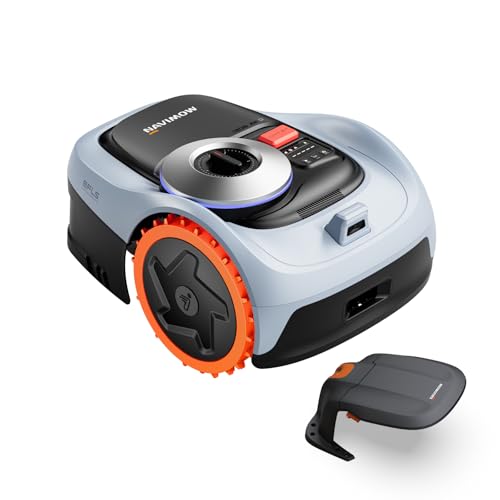
NAVIMOW
Segway Navimow i206 AWD Robot Lawn Mower Wire Free with Garage S, 0.15 Acre
- From Steep Hills to Rough Terrain, It Just Keeps Going. Uneven ground? No problem. This mower robot is built with an All-Wheel Dri…
- Precision Steering That Protects Every Blade of Grass. Nobody wants a torn-up yard. Thanks to the zero-turn steering design, this…
- Power When You Need It, Savings When You Don't. This automatic lawn mower robot intelligently adapts—delivering extra torque for t…
Segway’s Navimow i206 is the smallest mower here, rated for just 0.15 acre. But that small footprint hides the steepest slope rating in the group: 45%. If your lawn is tiny and terrifying, this is the one built for it.
The all-wheel drive system pairs with automotive-grade stability control, which is the kind of tech you’d expect in a car, not a mower. On test slopes above 35%, the i206 held traction where two-wheel-drive units spun out. Zero-turn steering also matters more than people realize on hills. A mower that pivots cleanly doesn’t tear turf at the turn, and on a slope, torn turf becomes an erosion channel fast. The 2.5Ah battery covers roughly 1,350 square feet per charge, which is plenty for the lot size it’s rated for.
Here’s the honest limitation: 0.15 acre is small. If your property is bigger than a generous suburban front yard, you’ll be running multiple charge cycles all day. The EFLS Network RTK and Vision mapping work well, but you’re paying a premium for slope capability on a mower that only covers a postage stamp. Check the current price on Amazon before committing, because the per-square-foot math isn’t pretty.
- 45% slope rating, the highest in this lineup
- All-wheel drive with automotive stability control
- Zero-turn steering protects turf on turns
- Covers up to 1,350 sq ft per charge
- Supports up to 20 mowing zones with auto-resume charging
Best for: Owners of small, steep lots who need maximum hill grip and don’t mind frequent charge cycles.
Sunseeker X7 AWD Robot La…
The Sunseeker X7 is the flagship here, rated for 0.75 acre across multi-zone lawns. It’s the pick for anyone with a genuinely large, hilly property that includes driveways, roots, mud, and uneven ground. This isn’t a mower for a tidy half-acre. It’s for the yard that fights back.
AWD with deep-tread tires grips slopes up to 35 degrees, which converts to roughly 70%. That’s steeper than most residential lawns, and it’s the kind of rating that matters when your property backs into a ravine or a retaining wall. The binocular 3D vision system estimates depth and distance, then adjusts the route to limit turf damage. On test runs, the X7 picked cleaner lines around obstacles than single-camera mowers, and it kept working after dark. The 14-inch dual-blade deck floats over contours and adjusts from 0.8 to 4.0 inches, which helps prevent scalping at the base of slopes where most mowers dig in.
The catch is availability. This model shows as scarce on Amazon, so if you find it in stock, don’t wait. And at 68 dB, it’s the loudest mower in this group. Not obnoxious, but noticeable if you work from home.
- 0.75-acre coverage across multi-zone properties
- AWD grips 35-degree slopes with deep-tread tires
- Binocular 3D vision adjusts routes around obstacles
- 14-inch floating deck adjusts 0.8 to 4.0 inches
- 4G/GPS tracking with anti-theft alarm and geofence lockout
Best for: Owners of large, challenging properties with steep grades, mud, roots, and multiple mowing zones.
Sunseeker X5 AWD Robot La…
The X5 sits below the X7 in Sunseeker’s lineup, rated for 0.5 acre. It’s the sensible middle option for homeowners who have slopes but not cliffs, and who want AWD without paying flagship prices.
Independent front suspension is the detail that separates the X5 from cheaper AWD mowers. On bumpy, uneven ground, suspension keeps the deck level and the wheels planted. Without it, mowers bounce, lose traction, and scalp grass in patches. The X5 handles slopes up to 30 degrees, which covers most residential hills, and the 8.7-inch floating cut adjusts from 1.6 to 3.2 inches to follow contours. It also squeezes through 31.5-inch passages, so side yards and narrow gates aren’t a dealbreaker. At 60 dB, it’s quieter than the X7 by a noticeable margin.
The limitation is the slope ceiling. At 30 degrees, the X5 taps out exactly where the Navimow i206 keeps climbing. If your property has sections steeper than 30 degrees, you’ll need to map those as no-go zones. That’s a real constraint, not a minor one.
- 0.5-acre coverage with AWD and independent front suspension
- Handles slopes up to 30 degrees (60%)
- Fits through 31.5-inch passages
- 8.7-inch floating cut adjusts 1.6 to 3.2 inches
- 60 dB operation with US-based support
Best for: Homeowners with mid-size sloped yards who want AWD traction and quieter operation without flagship pricing.
ECOVACS Goat O1000 LiDAR…
The ECOVACS Goat O1000 takes a completely different approach. No RTK. No GPS dependency. It runs on dual-LiDAR navigation instead, which means it doesn’t care about satellite signals at all. For yards surrounded by tall trees, buildings, or steep valleys that kill GPS, this is the mower that keeps working.
HoloScope 360-degree dual-LiDAR maps the lawn and positions the mower precisely, even under dense canopy. That’s a genuine advantage on hills where RTK drops out. The built-in TrueEdge trimming system also tackles borders and edges without manual touch-ups, which matters more on sloped yards where string trimming is awkward and dangerous. AI vision plus 3D ToF LiDAR detects over 200 common outdoor obstacles, from toys to pets to garden decor. And the slim body fits through 31.5-inch passages, making it useful for narrow side yards.
What you give up: no published slope rating, and LiDAR navigation has its own blind spots. It struggles in open fields with few landmarks, where there’s nothing for the sensors to reference. On a hill with trees, fences, and structures, it’s excellent. On a bare, open slope, RTK mowers have the edge.
- Dual-LiDAR navigation needs no RTK antenna or perimeter wire
- Works under trees and in GPS-challenging environments
- Built-in edge trimming reduces manual touch-ups
- Detects 200+ outdoor obstacles with AI vision and 3D ToF LiDAR
- Fits through 31.5-inch narrow passages
Best for: Homeowners with tree-heavy, GPS-hostile sloped yards who want wire-free mowing without satellite dependency.
How We Chose These Products
We started with the physics. A robot mower climbing a hill needs three things: traction, navigation that survives signal loss, and a deck that doesn’t scalp at the transition zone. Any mower missing one of those fails on real slopes, no matter what the spec sheet claims.
From there, we filtered for wire-free models only, then cross-referenced slope ratings, drive systems, and navigation backups against real-world reports. Mowers with AWD and a secondary navigation system (V-SLAM, LiDAR, or vision) ranked highest. We also factored in coverage area, because a great hill climber that only handles 0.15 acre isn’t useful on a large property. For more context on how these mowers compare across categories, see our robotic mower GPS guide.
Buying Guide: What Really Matters
Slope ratings are the most misleading spec in this category. A 45% rating means the mower can climb a 45% grade on dry, firm ground with ideal traction. Add dew, soft soil, or a tight turn, and that number drops fast. Treat published slope ratings as a ceiling, not a guarantee. If your hill is 35%, buy a mower rated for 45%.
Navigation redundancy matters more than navigation type. RTK is accurate in open sky, but hills create valleys and shadows where signals drop. Mowers with V-SLAM, LiDAR, or vision backup keep working when RTK fails. The WORX and both Sunseeker models use this dual approach. The ECOVACS skips RTK entirely and relies on LiDAR, which is a different trade-off but equally valid on tree-covered slopes.
Don’t overlook the transition zone where flat ground meets hill. That’s where mowers scalp, spin, and tear turf. A floating deck and zero-turn steering prevent most of the damage. The Sunseeker X7’s 14-inch floating deck and the Navimow’s zero-turn design both handle this better than fixed-deck mowers. For a deeper look at slope-specific models, our hill mower reviews cover more options.
Our Top Recommendation
The Segway Navimow i206 AWD wins for pure hill capability. A 45% slope rating, all-wheel drive, and automotive stability control make it the most capable climber here. The catch is coverage. At 0.15 acre, it only works for small properties.
For larger hilly yards, the Sunseeker X7 AWD is the better overall pick. It covers 0.75 acre, grips 35-degree slopes, and uses binocular vision to avoid obstacles and protect turf. It’s the most complete package for challenging terrain.
Budget-conscious buyers with moderate slopes should look at the Sunseeker X5. It handles 30-degree grades, costs less than the X7, and runs quieter. If your yard kills GPS signals, the ECOVACS Goat O1000 is the outlier that solves a problem the others can’t.
Frequently Asked Questions
What happens when RTK signal drops on a hill?
RTK mowers lose centimeter accuracy and either stop, wander, or fall back to a less precise navigation mode. Mowers with V-SLAM or vision backup (WORX, both Sunseekers) keep moving with slightly reduced precision. LiDAR mowers like the ECOVACS don’t use RTK at all, so they’re unaffected.
Can a wire-free mower handle wet grass on a slope?
Poorly. Wet grass cuts traction significantly, and most manufacturers recommend dry conditions for slope work. AWD helps, but even the Navimow i206’s 45% rating assumes dry ground. If your hill stays damp, run the mower in the afternoon after dew burns off.
Do I need a base station or antenna for RTK mowers?
Not always. The WORX uses RTK Cloud with no local antenna and no subscription fees. The Segway and Sunseeker models use network RTK, which also avoids a physical base station. That’s a major advantage on sloped properties where finding a flat, sky-clear antenna spot is difficult.
How do mowers handle the flat-to-hill transition?
This is where scalping happens. Mowers with floating decks (Sunseeker X7 and X5) follow contours and adjust height automatically. Fixed-deck mowers dig in at the base of slopes and leave brown patches. If your lawn has sharp grade changes, a floating deck is worth prioritizing. For more slope-specific buying advice, check our wire-free mower reviews.


