Half an acre of lawn looks great until you realize aeration season is here and your push aerator covers about 1,000 square feet per hour. That’s roughly 20 hours of work for a job a tow-behind unit finishes in an afternoon. The gap between aerator types gets enormous once your lawn passes a quarter acre.


Rolling aerators sit in the middle of that gap. They cover more ground than spike shoes or step aerators, they cost far less than a tow-behind plug aerator, and they don’t require a riding mower to pull them. The trade-off is real, though: spike rollers can worsen compaction on hard clay, and manual push units still demand physical effort on big lawns.
This guide covers five rolling aerators worth considering for large areas. It also breaks down the coverage math, explains when spike aeration actually helps versus hurts, and gives you ballast and timing guidance most spec sheets skip.
Here’s how the five picks compare on the specs that matter most for large-lawn work.
| Features | K.D STONEDGE Coring | SENVERT Spike Roller | Dexirona Core Roller | YihuaTop Spike Roller | Walensee Spike Roller |
|---|---|---|---|---|---|
| Aeration Type | Hollow core (plugs pulled) | Solid spike | Dual-row hollow tine | 42 solid spikes | 42 spiral spikes |
| Ballast Capacity | Not specified | Up to 55 lbs total | Fillable with water or sand | Up to 70 lbs total | Stones only, no sand |
| Drum Width | Not specified | Not specified | Dual-row wide coverage | 13.5 inches | Not specified |
| Handle | Manual push | Manual push | Manual push | Height adjustable | Height adjustable |
| Best For | Small to medium lawns | Small to medium lawns | Large lawns, fewer passes | Compacted and clay soil | General aeration, moist soil |
Patented Rolling Lawn Aer…

K.D STONEDGE
Patented Rolling Lawn Aerator Manual Coring Tool Compacted Soil Loosening | Transport Mobile Wheels, Reinforced Dual Push Rod, Pull Soil Plugs to Relieve Lawn Compaction, Promote Healthier Grass Growth
- Boosts Lawn Condition: Punches holes and extracts soil plugs to improve air, water, and nutrient absorption
- Promotes Root Growth: Helps loosen compacted soil, encouraging deeper and stronger root systems for healthier grass
- Manual Push Operation: Scientifically balanced weight design ensures efficient plug pulling in small to medium lawns, delivering e…
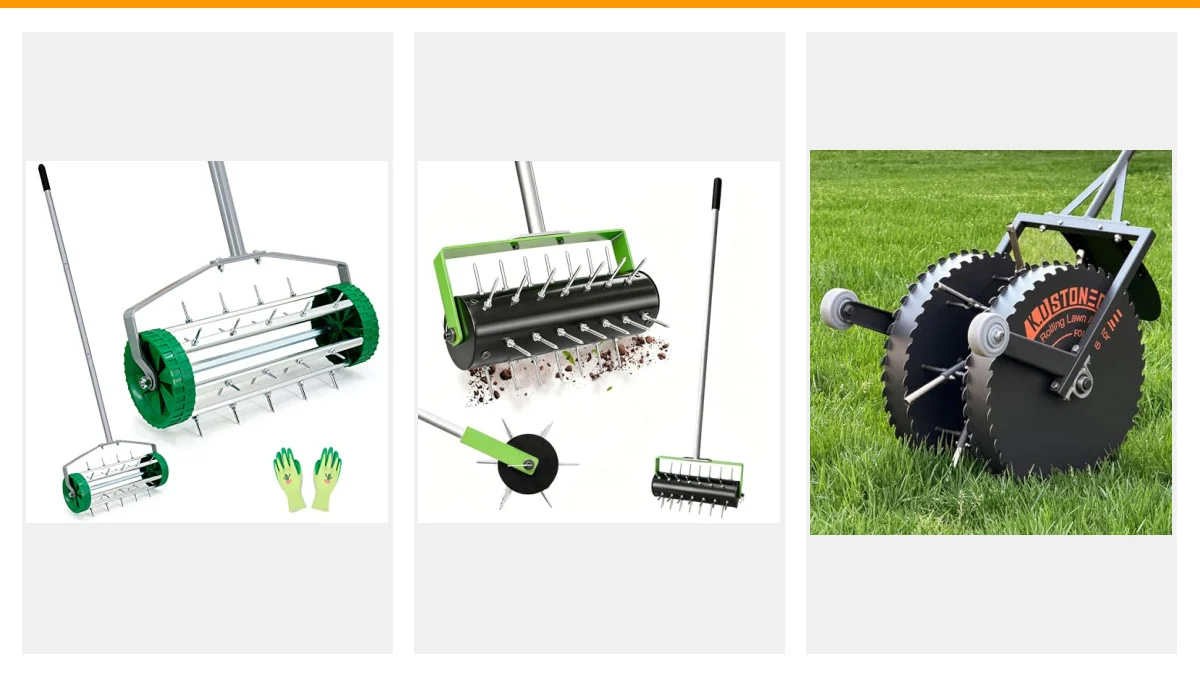
The K.D STONEDGE rolling aerator is a hollow-tine coring tool with a patented rotary design. It pulls actual soil plugs out of the ground rather than poking holes with solid spikes. That distinction matters if your soil has a hard pan layer or heavy thatch.
What sets this one apart is the coring action itself. Plugs come out, which means air, water, and fertilizer move straight into the root zone instead of getting pushed aside. The balanced weight design is meant to do most of the plug-pulling work as you roll, so you’re not fighting the tool on every pass. Buyers who’ve dealt with clay soil know how rare that is in a manual unit.
The honest drawback: the brand doesn’t publish a ballast capacity or drum width. That makes it hard to estimate coverage for a half-acre lawn. This is a small-to-medium lawn tool first, and the manufacturer says so. On a large property you’ll get the job done, but expect more passes than a wider drum would need. It’s also a workout, which the listing cheerfully admits.
- Hollow-tine rotary coring pulls real soil plugs
- Patented balanced weight design assists plug extraction
- Heavy-duty build materials for repeated seasonal use
- Manual push operation, no engine or tow hitch needed
- Best suited to small and medium lawns, not full acreage
Best for: Homeowners with compacted small-to-medium lawns who want true core aeration without renting a plug aerator.
SENVERT Rolling Lawn Aera…
SENVERT’s rolling aerator uses a spiral-spiked drum that rolls smoothly and tracks straight. It ships mostly assembled, so setup is a few minutes with a wrench. The auxiliary wheels are the standout feature here.
Those wheels let you roll the unit across driveways, patios, and sidewalks without the spikes chewing up hard surfaces. If you’ve ever dragged a spiked aerator across concrete, you know how annoying that damage gets. The drum holds 32 pounds dry and accepts sand or stones through a covered opening, pushing total weight to 55 pounds. That’s enough to force spikes into most soils. SENVERT specifically warns against adding water, which is worth noting because water ballast is common advice elsewhere.
The limitation is coverage. The listing positions this for small to medium lawns, and the drum width isn’t published. On a quarter acre or more, you’ll make a lot of passes. The spike design also won’t relieve deep compaction the way a core aerator does; it pokes holes, it doesn’t remove plugs.
- Spiral spike pattern rolls smoother than straight-row designs
- 32 lbs dry, expandable to 55 lbs with sand or stones
- Auxiliary TPR wheels protect hard surfaces during transport
- Main body arrives assembled, only the handle needs attaching
- No water ballast, sand or stones only
Best for: Lawn owners who need to cross pavement to reach the lawn and want a low-effort spike roller for moderate-sized yards.
Heavy-Duty Rolling Core L…
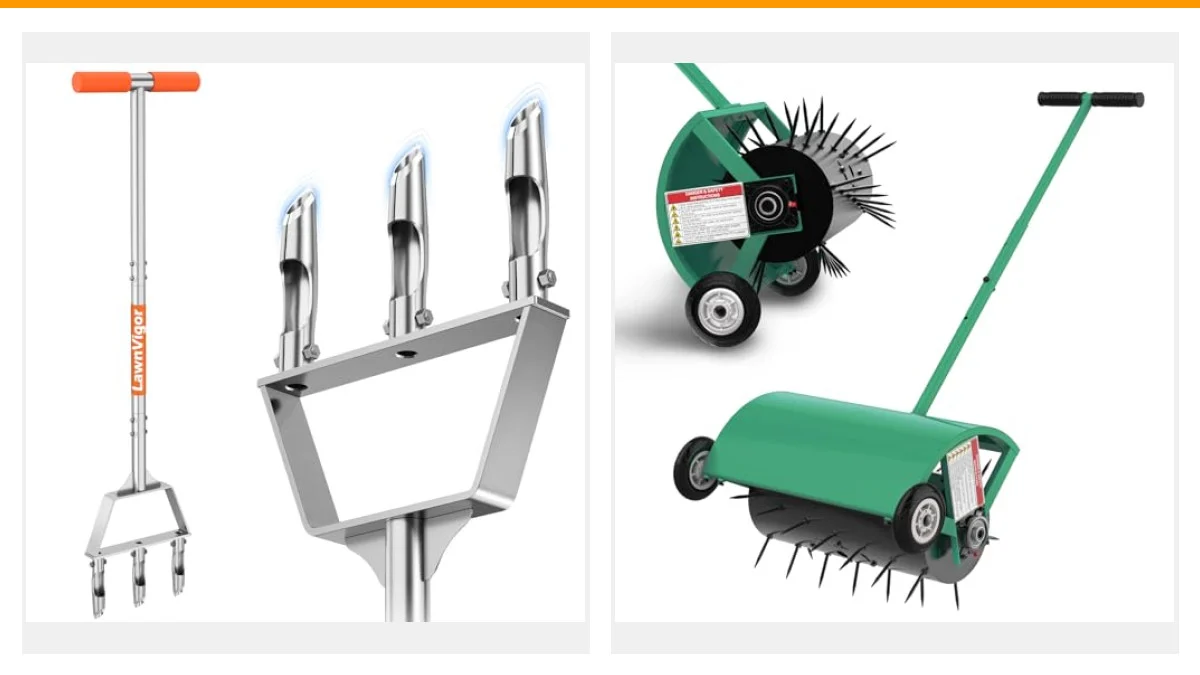
The dexirona rolling core aerator uses dual-row hollow tines, which is the main reason it belongs on a large-area shortlist. Two rows of tines mean each rolling pass covers more ground than a single-row drum. Fewer passes equals less time on the lawn, and on a half-acre that difference compounds fast.
The fillable drum accepts water or sand, so you can dial in weight based on soil conditions. Lighter for soft loam, heavier for clay. That adjustability is genuinely useful because a drum that’s too heavy on wet soil just sinks and clogs. The listing also gives a practical tip most competitors skip: aerate when the soil is slightly moist. Hollow tines enter damp ground far more cleanly than dry, hard ground.
No published drum width or ballast capacity creates the same estimation problem as the K.D STONEDGE. And hollow tines require more push force than spikes, so a large lawn with this unit is real work. Assembly is straightforward but does need basic tools.
- Dual-row hollow tines cover wider ground per pass
- Drum accepts water or sand for adjustable ballast
- Manual push design, no rental equipment required
- Built for seasonal yard and garden maintenance
- Works best when soil is slightly moist
Best for: Large-lawn owners who want core aeration and wider coverage without paying tow-behind prices.
YihuaTop Rolling Lawn Aer…
YihuaTop’s rolling spike aerator packs 42 spikes arranged in a matrix on a 13.5-inch drum. The published drum width is a real advantage here; it’s one of the few listings in this category that tells you exactly how much ground each pass covers. The weight chamber accepts sand and pushes total mass to 70 pounds, the heaviest ballast capacity of the five picks.
Seventy pounds is meaningful on hard or clay-heavy soil. Spikes that bounce off the surface at 32 pounds will punch through at 70. The height-adjustable handle is another practical touch; you can set it to match your posture instead of hunching over for an hour. YihuaTop also gives a genuinely useful tip: once you load the drum with weight, pull the aerator instead of pushing it. That single change makes the job noticeably less tiring.
Two caveats. The 13.5-inch drum is narrower than a tow-behind unit, so a quarter-acre lawn still takes substantial time. And this is a spike aerator, not a core aerator. On severely compacted clay, spikes can push soil sideways and tighten the top layer instead of loosening it. Moist soil and adequate ballast reduce that risk, but they don’t eliminate it.
- 42 spikes in a matrix layout for even hole spacing
- 13.5-inch drum width published, unlike most competitors
- 32 lbs dry, up to 70 lbs with sand ballast
- Height-adjustable handle with ergonomic rubber grip
- Spikes pre-installed for faster setup
Best for: Owners of compacted or clay-heavy lawns who need maximum spike penetration and don’t mind pulling rather than pushing.
Walensee Rolling Lawn Aer…
Walensee’s spike roller uses the same 42-spike count as the YihuaTop but arranges them in a spiral pattern. Viewed from the side, the tines form a circle, which keeps the drum rolling smoothly instead of hopping. Vertical bouncing is the most common complaint about cheap spike aerators, so this design choice addresses a real problem.
The 2-inch tines are heat-treated for hardness and resistance to bending. That matters on rocky or root-heavy ground where cheap spikes snap. The handle adjusts to height, the spikes ship pre-installed, and Walensee includes two spare cotter pins. Small detail, but it signals the company expects the unit to last more than one season.
Walensee’s ballast rules are stricter than the others. Stones only, no sand, and no water. Sand can compact into a brick inside the drum and become nearly impossible to remove. The listing also warns against using this on hard ground, clay, root-covered areas, or gravel. That’s a significant limitation for anyone with genuinely bad soil. This aerator wants moist, reasonably workable ground.
- Spiral tine arrangement for smooth, hop-free rolling
- 42 heat-treated 2-inch spikes resist bending
- Stones-only ballast, sand and water prohibited
- Adjustable handle height, spikes pre-installed
- Two spare cotter pins included
Best for: Lawn owners with moist, workable soil who want a durable spike roller and don’t need heavy ballast options.
How We Chose These Products
We started with the constraint that matters most for this keyword: large areas. That immediately filtered out spike shoes, step aerators, and narrow hand tools. Every pick here rolls, covers ground continuously, and can be ballasted to force penetration into firmer soil.
From there we weighed four factors. Published drum width and tine configuration determined coverage per pass. Ballast capacity and fill material rules determined how well each unit handles clay or compacted ground. Build details like heat-treated tines, spare parts, and auxiliary wheels indicated long-term durability. And we favored listings that gave honest operating guidance, like aerating moist soil or pulling instead of pushing a loaded drum. Products with vague or missing specs got flagged rather than promoted.
Buying Guide: What Really Matters
Tine length and spacing decide how deep and how evenly your lawn gets aerated. Two-inch spikes are common and adequate for most residential turf. Wider spacing means faster coverage but more missed spots between holes. A matrix or spiral layout produces more uniform results than straight rows.
Roller width drives your coverage math directly. A 13.5-inch drum covers roughly 1.1 feet per pass. A 24-inch drum covers double that. On a quarter-acre lawn, that difference is hundreds of extra passes. If the listing doesn’t publish drum width, assume it’s on the narrow side and plan accordingly. For a deeper look at how roller width affects real jobs, the manual aerators for large areas breakdown is worth reading.
Handle ergonomics and durability get overlooked until your back hurts or a weld fails. Height-adjustable handles with rubber grips reduce fatigue on long jobs. Heavy-duty steel frames and heat-treated tines survive repeated seasonal use. Check whether the brand sells replacement tines or includes spares; a $100 aerator with no parts support becomes disposable after two seasons.
Spike vs Core: Which Actually Works on Large Lawns
Spike aerators push solid tines into the soil. They’re fast, they don’t leave plugs on the surface, and they work fine on loamy or slightly compacted ground. The problem is clay. On hard clay, spikes push soil sideways and can tighten the top inch instead of loosening it. You end up with holes that close back up after a rain.
Core aerators remove plugs. That creates actual voids in the soil, which is what roots need for air and water movement. Core aeration is the standard recommendation for compacted clay and heavy thatch. The trade-off is effort and mess. Hollow tines require more push force, and you’ll have plugs sitting on the lawn for a week or two.
For large lawns with genuinely bad soil, core wins. For large lawns with decent soil that just needs seasonal relief, spikes are faster and cheaper. If you’re weighing both options, this comparison of tow-behind plug aerators covers what happens when you scale core aeration up to full acreage.
Coverage Math: Passes, Time, and Lawn Size
Here’s the math nobody publishes. A 13.5-inch drum covers 1.125 feet per pass. A quarter acre is 10,890 square feet. If your lawn is 100 feet wide, you need about 89 passes to cover it once, and each pass is 100 feet long. That’s roughly 8,900 linear feet of pushing.
At a realistic walking pace of 2 mph with a loaded drum, you’re covering about 176 feet per minute. That works out to roughly 50 minutes for a single pass over a 100-by-109-foot lawn, assuming zero turns and no rest breaks. Real-world time is closer to 90 minutes with turns and fatigue.
A 24-inch tow-behind unit pulled by a riding mower covers the same area in about 25 minutes. That’s the honest gap between manual rolling and tow-behind. Rolling aerators make sense up to about a third of an acre. Beyond that, the time cost gets hard to justify unless you split the job across multiple days.
Key Buying Factors
Tine Length and Spacing
Two-inch tines reach the root zone on most residential turf. Longer tines penetrate deeper but require more ballast and more push force. Tighter spike spacing means more holes per square foot and better results, but slower coverage.
Roller Width and Weight
Wider drums cover more ground per pass. Heavier drums penetrate harder soil. The best combination for large areas is the widest drum you can comfortably push with enough ballast to sink the tines. Published ballast capacity tells you the ceiling; 55 to 70 pounds is the practical range for residential spike rollers.
Handle Ergonomics and Durability
Adjustable height matters more than most buyers expect. A handle set two inches too low turns a one-hour job into a two-hour backache. Heat-treated tines, welded steel frames, and available spare parts separate tools that last five seasons from tools that last one.
How to Aerate a Large Lawn Correctly
Water the lawn thoroughly one to two days before aerating. Moist soil lets tines enter cleanly and reduces the force needed to push the drum. Dry, hard ground defeats even a 70-pound aerator.
Make two passes in perpendicular directions. The first pass goes north-south, the second east-west. This crosshatch pattern fills in the gaps between spike rows and gives you far more even coverage than a single direction.
Load the drum incrementally. Start with the unit’s dry weight, roll a few feet, and check penetration. Add ballast only if the tines aren’t reaching depth. Overloading on soft soil causes the drum to sink and clog. Clean the tines after each session; soil packed into hollow tines hardens overnight and blocks the next pass.
Frequently Asked Questions
How many passes does a quarter-acre lawn need with a rolling aerator?
A 13.5-inch drum needs roughly 89 passes in one direction to cover a 100-foot-wide lawn. A crosshatch pattern doubles that to about 178 passes. Budget two to three hours for the full job with a manual unit.
Can a spike aerator make compaction worse?
Yes, on hard clay. Solid spikes push soil sideways instead of removing it, which can tighten the top layer. Water the lawn first, add ballast, and switch to a core aerator if the soil is severely compacted.
How much weight should I add to the drum?
Start with the dry weight and test penetration. Add 10 to 20 pounds at a time until tines reach about 2 inches deep. Most soils need 40 to 55 pounds total; hard clay may need up to 70.
Can I use sand as ballast?
It depends on the model. SENVERT and dexirona allow sand. Walensee prohibits it because sand compacts into a solid block inside the drum. Check your manual before filling.
Our Top Recommendation
The dexirona Heavy-Duty Rolling Core Aerator takes the top spot for large areas. Dual-row hollow tines cover more ground per pass than any single-row design here, and the fillable drum accepts water or sand for adjustable ballast. Core aeration is the right call for compacted soil, and this unit delivers it without tow-behind pricing.
For hard or clay-heavy ground specifically, the YihuaTop rolling aerator is the runner-up. Its 70-pound ballast ceiling and published 13.5-inch drum width make it the most capable spike roller on this list. If budget is the priority and your soil is workable, the Walensee unit offers solid build quality at a lower entry point, provided you stick to stones-only ballast and moist soil.
One more option worth weighing: if your lawn exceeds a third of an acre, a tow-behind unit pulled by a riding mower will save you hours every season. The rolling aerator with high-pressure options cover that category in more detail.