Your lawn is telling you something. Puddles linger after rain. Grass feels spongy underfoot. Patches look tired no matter how much you water or feed them. The soil beneath is packed down so tight that roots can’t breathe, and the good stuff you put on top never reaches them. A manual lawn aerator solves this without firing up a gas engine or renting a machine. It’s a slow, deliberate job, but the payoff is a lawn that drinks in moisture and nutrients the way it should.
A great manual aerator for larger yards comes down to a few honest things: how much ground each step covers, whether it pulls plugs or just pokes holes, and how the tool treats your back and knees over an hour of work. Hollow tines that extract cores do more for compacted soil than spikes. Wider stepping platforms and longer handles cut fatigue. And build quality determines whether you’re buying this once or again next spring.
We tested and compared five distinct approaches to manual aeration — from a classic three-tine core puller to a rolling drum that does the walking for you. Each one earns its place for a different yard situation. Below, the spec table gives you the quick picture, then we get into the real-world details that matter.
Here’s how the top contenders stack up on the features that separate good tools from back-breaking ones.
| Features | LawnVigor Core Aerator | Saker Spike Aerator | Walensee Spike Aerator | K.D STONEDGE Roller | Josmimic Dual Step |
|---|---|---|---|---|---|
| Core Type | Hollow tines, pulls plugs | Solid spikes, pokes holes | Solid spikes, pokes holes | Hollow tines, pulls plugs | Hollow tines, pulls plugs |
| Coverage Per Step | 3 holes | 15 holes | 15 holes | Continuous rolling | 4 holes |
| Best Soil Type | Compacted, clay-prone | Soft, loamy | Lightly compacted | Small to medium lawns | Firm, varied terrain |
| Key User Feature | Non-clog design | Double-layer spring | 3-row spike layout | Patented rotary design | Adjustable height |
| Primary Trade-off | Slowest coverage | Can re-compact edges | Not for heavy clay | Heavier to push | More moving parts |
LawnVigor Manual Core Aerator
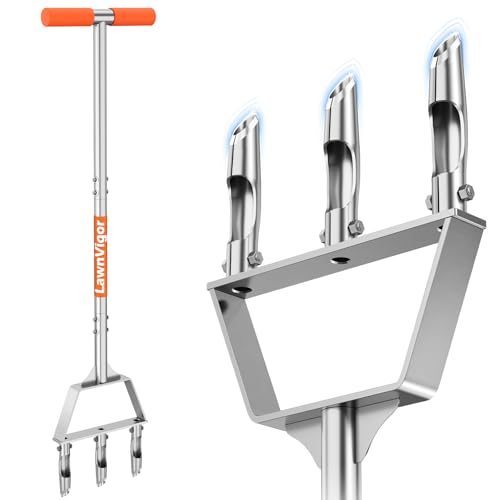
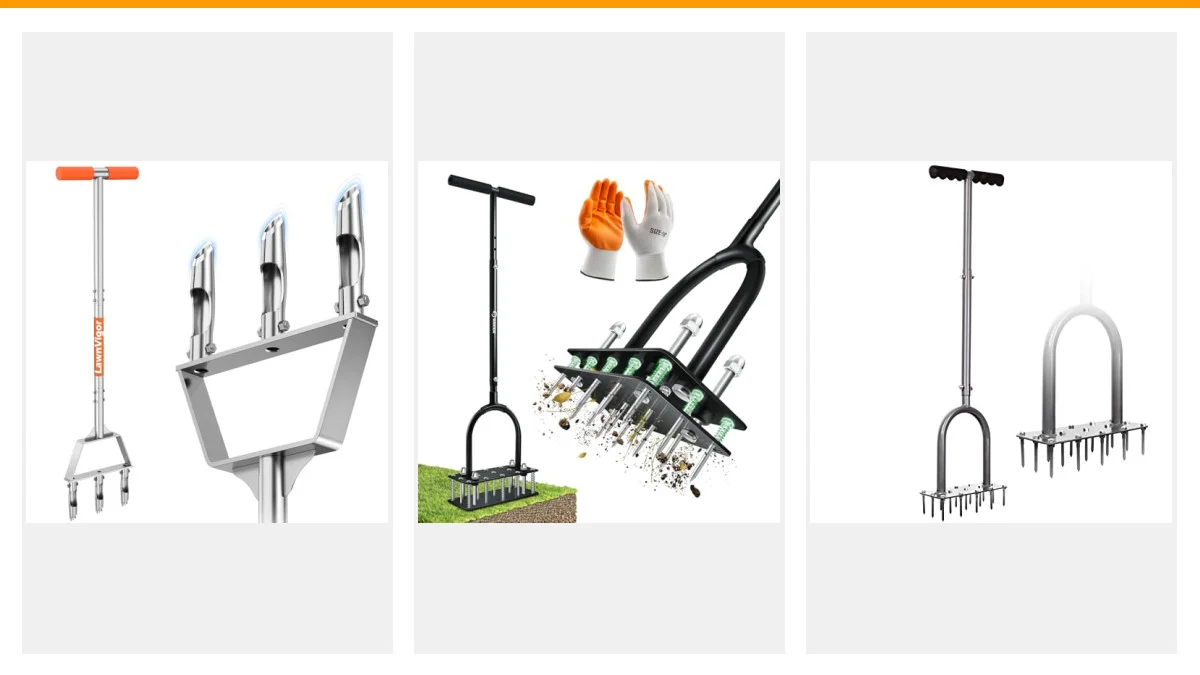
This is the tool for the purist who wants the job done right, even if it takes a while. The LawnVigor is a three-tine step aerator that physically removes cores of soil from your lawn. That’s the gold standard for relieving compaction because it creates real channels for air and water. It suits a homeowner with a genuinely compacted yard who doesn’t mind spending a couple of hours working in sections.
What stands out is the honesty of its design. The hollow tines are heat-treated, which means they stay sharp through rocky or tough ground. The white plastic inserts inside the tines are a clever touch — they help push the soil plugs out as you lift the tool, so you’re not stopping every few steps to poke clay out with a screwdriver. The handle height is set to reduce bending, and the non-slip grip keeps your hands comfortable when the work gets sweaty.
There’s a trade-off, and it’s a big one for large areas: this tool makes just three holes per step. Covering a big lawn with it is a serious workout. The manufacturer also warns against rocking or twisting the tool in the ground, which is tempting to do when the soil is hard. Watering the day before is almost mandatory. If your lawn is massive, this might take multiple sessions.
- Three heat-treated hollow tines for core extraction
- Plastic inserts help eject soil plugs automatically
- Non-slip, ergonomic handle designed to minimize back strain
- Replaceable tines extend the tool’s usable life
- Assembles in minutes with included tools
Best for: The homeowner with a small-to-mid-sized lawn who wants true core aeration and values a durable, maintainable tool over speed.
Saker Manual Spike Aerator
When your lawn isn’t severely compacted but needs a seasonal refresh, the Saker is the fastest way to get it done. This is a step-down spike aerator with 15 iron spikes arranged in a wide pattern. You step on the platform, it sinks in, and you move to the next patch. It’s the manual equivalent of a power rake — perfect for a quick spring workout before fertilizing.
The Saker’s defining feature is its dual-layer spring system. As you lift your foot, the springs push the tool up and help eject any soil that clings to the spikes. That might sound minor, but on a damp day, sticky soil can turn a spike aerator into a mud-caked brick. This design keeps the tines clean and keeps you moving at a steady pace. The 2026 build uses high-strength screws instead of welds on the foot pedal, which addresses the common failure point on cheaper spike aerators.
Spike aeration has a limitation you should know about. Pushing solid spikes into the ground compresses the soil around the hole, which can actually worsen compaction in heavy clay. The Saker works best on soil that’s already reasonably loose. The 2.3-inch spikes are shorter than some competitors, so it’s less effective on deep-rooted turf or very hard ground.
- 15 sharp iron spikes create 15 holes per step
- Double-layer spring system prevents clogging
- Rust-resistant coating on thickened iron frame
- Foot pedal secured with high-strength screws
- Requires pre-watering on dry or hard soil
Best for: The practical gardener who wants to cover a large area quickly for routine maintenance, not deep soil therapy.
Walensee Manual Spike Aerator

Walensee
Walensee Manual Lawn Aerator Tool with 15 Iron Spikes, Garden Spike Aerator
- 【EFFECTIVE MANUAL LAWN AERATOR TOOL】: Walensee spike lawn aerator helps loosen soil and create small channels so air, water, and n…
- 【15 SHARP IRON SPIKES FOR BETTER COVERAGE】: Designed with 15 sturdy iron spikes, each about 2.8 inches long, this manual lawn aera…
- 【NO MORE SPIKED SHOE HASSLES】: Unlike plastic or metal lawn aerator shoes that may require strap adjustments, shoe-size matching,…
The Walensee takes the spike aerator concept and refines it for comfort and edge work. It has 15 spikes like the Saker, but they’re longer at 2.8 inches, which lets them reach deeper into the root zone. The three-row layout means you’re covering a wider path with each step, so you’ll finish a large lawn with fewer passes. It’s a solid middle-ground choice for yards that need regular, light aeration.
Where this tool shines is in its ergonomics. The 34.6-inch handle is taller than many competitors, which means less bending. The cushioned T-handle gives you two-handed control, and the foot pedal is wide enough that you can apply force evenly without wobbling. The powder-coated finish resists rust better than painted metal. Assembly is tool-free, and it breaks down for easy storage in a shed or garage.
The honest caveat is printed right in the product description: it’s not recommended for heavy sticky clay, rocky ground, or large-scale aeration jobs. The spikes will penetrate soft loam easily, but they’ll bounce off hard, dry dirt. You’ll need to water the lawn a day ahead to soften it. For a big property, this is better used for spot-treating bare patches and edges than for aerating the whole expanse.
- 15 spikes at 2.8 inches long for deeper penetration
- Three-row layout covers more ground per step
- Tall, cushioned T-handle reduces back strain
- Detachable design for compact storage
- Ideal for edges, narrow strips, and spot treatment
Best for: The homeowner with a medium lawn who wants a comfortable, versatile tool for regular maintenance and precise work in tight spaces.
K.D STONEDGE Rolling Aerator
This one breaks the mold. Instead of stepping down, you push the K.D STONEDGE like a lawn mower. A patented rotary drum with hollow tines rolls across the turf, punching holes and pulling plugs as it goes. It’s the closest you’ll get to a powered core aerator without the engine. For a large area, this design saves your back from the up-and-down motion of a step aerator.
The key advantage is efficiency. With a step aerator, you lift and press hundreds of times. With the roller, you walk at a steady pace and the drum does the work. The weight is scientifically balanced to help the tines penetrate without you having to lean your whole body weight on it. It’s genuinely a full-body workout, but it’s a smooth, continuous effort rather than repetitive strain.
Rolling aerators have their quirks. They’re heavier to maneuver than a step tool, especially when turning at the end of a row. The hollow tines can still clog in wet, sticky soil, and clearing them is slower than with a simple spike tool. It’s also not ideal for small, intricate flower beds or tight corners where a compact step aerator is easier to manage. This is a tool for open expanses of lawn.
- Patented rotary coring design extracts soil plugs
- Push-operated, eliminating repetitive stepping motion
- Balanced weight for efficient penetration
- Heavy-duty construction for long-term use
- Best suited for small to medium open lawns
Best for: The gardener with a large, open yard who wants true core aeration but lacks the space or budget for a gas-powered machine.
Josmimic Knee-Friendly Aerator
If you dread the back pain that comes with lawn work, the Josmimic is designed with you in mind. This is a four-tine core aerator with an open-frame design that lets you stand upright while you work. The handle extends from 43.3 to 48.5 inches, so you can dial in the perfect height for your stance. No more hunching over a short handle.
The wide dual foot platform is the standout feature. Instead of a small pedal that forces you to balance on one foot, this gives you a stable, two-position step. You can put your weight on both feet and push down evenly, which directs force to all four tines simultaneously. That makes a real difference when you’re working through firm soil. The tines are made of brushed stainless steel with a flow-through ejection design — soil exits from the side of the tube rather than getting stuck inside.
Let’s be clear about one thing: this tool makes four holes per step. That’s more than the LawnVigor’s three, but it’s still a slow process for a very large yard. The adjustable height mechanism adds a bit of complexity, and the open frame means there’s less material to absorb shock if you hit a rock. It’s a precision tool best used for targeted aeration of compacted high-traffic areas, not for sweeping across an entire acre.
- Adjustable height from 43.3 to 48.5 inches
- Wide dual-position step platform for even pressure
- Four hollow stainless steel tines pull soil cores
- Side-exit ejection prevents tine clogging
- Upright handle design reduces back and knee strain
Best for: The older gardener or anyone with joint issues who needs a comfortable, adjustable tool for aerating problem spots without aggravating their back.
How We Chose These Products
Our selection process started with a simple question: what does a manual aerator actually need to do for a large lawn? We looked for tools that offered a genuine solution to soil compaction, not just a gimmick. That meant prioritizing hollow tine core aerators where possible, while acknowledging that spike aerators have a place for lighter maintenance. We weighed coverage per step against physical effort, because a tool that wears you out after ten minutes won’t get the whole lawn done.
Build quality was the next filter. We examined materials, construction methods, and the small details that prevent frustration — like ejection systems for soil plugs and rust-resistant coatings. We also considered ergonomics, specifically handle height, foot platform size, and overall weight distribution. A tool that forces you to bend or twist is a tool that will end up unused in the garage. Each product here earned its spot by solving a specific problem for a specific type of lawn and gardener.
Buying Guide: What Really Matters
Core aerators pull plugs of soil out of the ground. Spike aerators push solid tines in, creating holes but also compacting the soil around them. For heavily compacted clay soil, core aeration is the real fix. For sandy or loamy soil that just needs a seasonal perk-up, spikes are faster and perfectly adequate. If you’re not sure which you need, do the screwdriver test: if you can’t push a screwdriver into the soil easily after watering, you need core aeration.
Consider the sheer physical math of your yard. A three-tine step aerator on a 5,000-square-foot lawn means thousands of individual steps. That’s a marathon, not a chore. Look at the tool’s coverage per step and think about whether the design lets you work in a rhythm. Rolling aerators trade weight for speed. Step aerators trade speed for precision. Match the tool to your yard’s size and your own physical tolerance.
Check the tine length and material. Longer tines reach deeper roots, but they require more force to push in. Heat-treated steel or stainless steel resists bending and staying sharp. Look at the handle height relative to your own height. A simple rule: if you have to bend your knees significantly to use it, it’s too short. And pay attention to how the tool clears soil. Clogged tines are the number one reason people abandon manual aeration mid-project.
Our Top Recommendation
For most homeowners with a larger lawn, the K.D STONEDGE Rolling Aerator is the winner. It’s the only tool here that delivers true core aeration without turning the job into a repetitive-motion injury. The rolling action covers ground faster and more consistently than any step tool, and the patented design pulls actual plugs. It’s a workout, but it’s a smooth one. If your lawn is open and your soil is compacted, this is the tool that will actually get the job done.
If your budget is tight or your soil is only lightly compacted, the Saker Spike Aerator is a strong runner-up. It covers a lot of ground quickly, and the spring ejection system keeps you moving. For those with back or knee problems, the Josmimic Knee-Friendly Aerator is the smart pick. It’s slower, but it lets you work in a standing, upright position that won’t leave you crippled the next day. For related options, look at our guide to the best rolling lawn aerator for more on that style, or check out manual aerators for grass for additional context.
Frequently Asked Questions
How often should I aerate a large lawn manually?
Once a year is plenty for most lawns. If you have heavy clay soil or high foot traffic from kids and pets, twice a year is justified — once in early spring and once in early fall. Aerating more often than that can stress the grass and disrupt root growth. The manual effort required is another reason to keep it to an annual ritual.
Is it better to aerate when the soil is wet or dry?
Neither extreme works well. Aerating mud just creates messy holes that collapse and smear. Aerating bone-dry soil is nearly impossible with a manual tool — you’ll bounce off the surface. The sweet spot is soil that’s slightly moist, like a sponge that’s been wrung out. Water the lawn thoroughly the day before you plan to aerate, then wait until the surface isn’t soggy.
Should I overseed right after aerating?
Yes, and it’s one of the best times to do it. The holes give grass seeds direct contact with the soil, which dramatically improves germination rates. Spread the seed after aerating, then go over the lawn lightly with a rake to work the seed into the holes. Water gently and keep the top inch of soil moist for the next two weeks. This combination can transform a thin, patchy lawn faster than anything else.
Can I use a spike aerator on clay soil?
You can, but you won’t like the results. Spikes push soil aside, which compresses the clay further around each hole. Over time, this can make compaction worse. Clay soil needs core aeration — removing plugs to create space for roots and water. If you have significant clay, skip the spike tools and invest in a hollow tine aerator like the LawnVigor or the K.D STONEDGE roller. For more severe cases, consider a tow-behind plug aerator if you have a tractor.