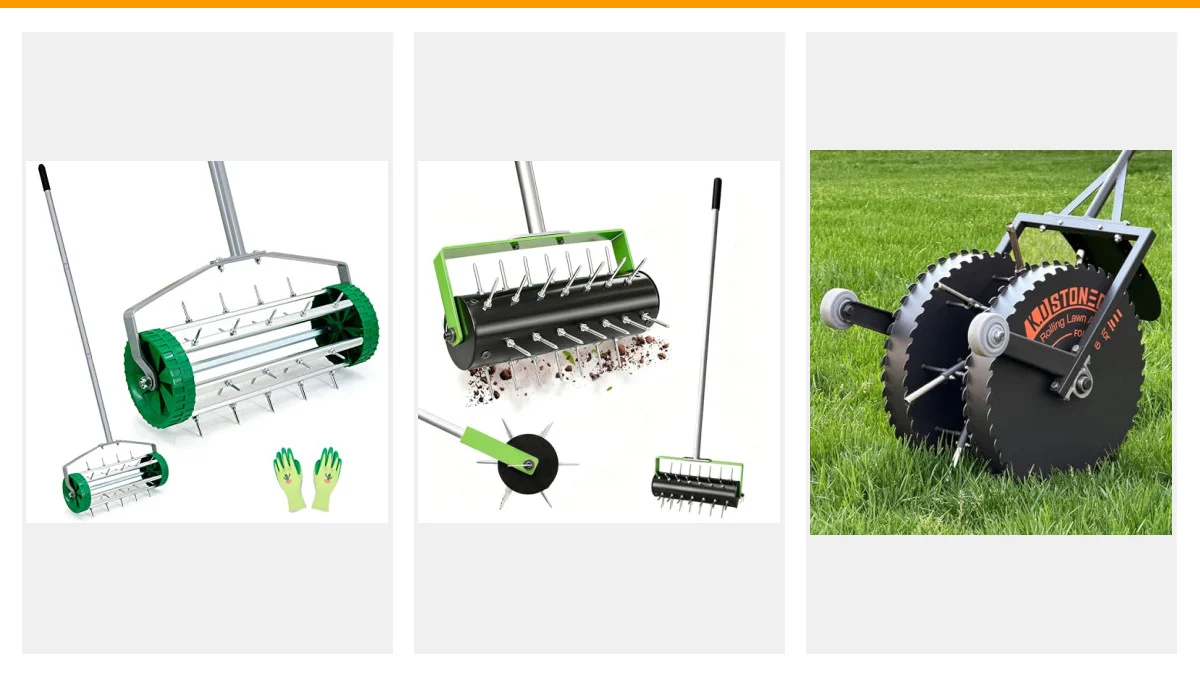
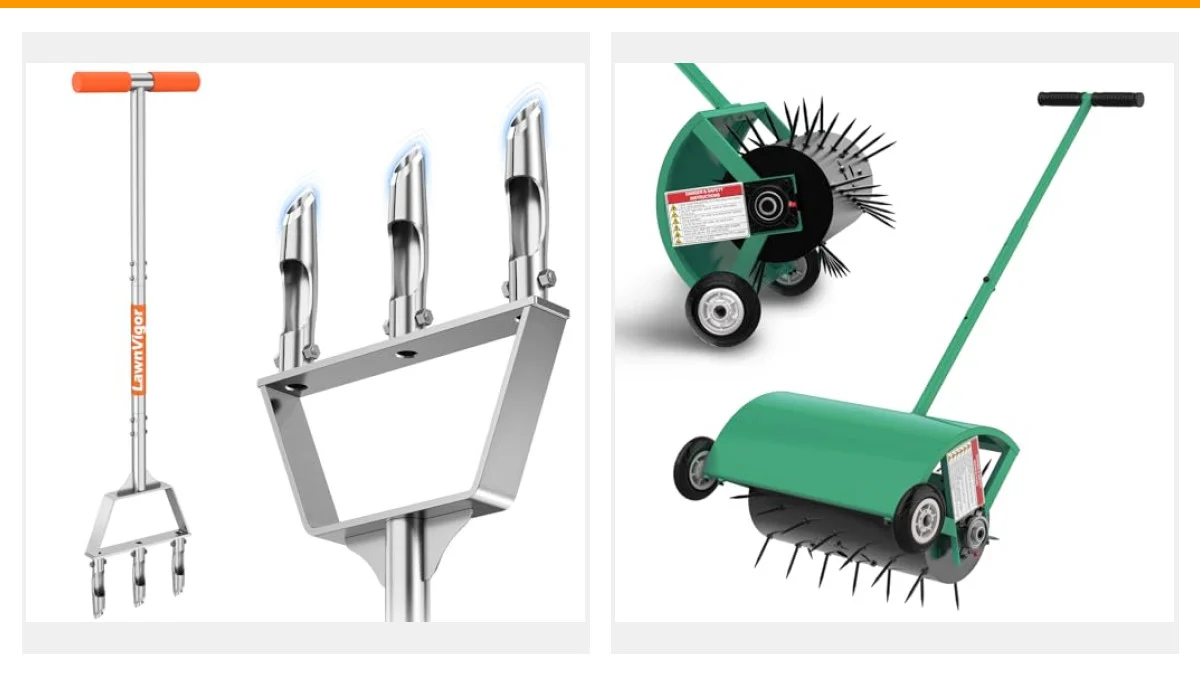
Two summers ago I stood on a quarter-acre of lawn that felt like a parking lot. Water pooled on top, fertilizer ran off into the flower beds, and the grass thinned out in patches nobody could explain. I bought an aerator online. It was the wrong one. The spikes barely scratched the surface, the handle wobbled, and after forty minutes I had covered maybe a tenth of the yard.

That mistake taught me what actually matters for big lawns. Tine length, roller width, ballast weight, and whether you need core or spike aeration all change the math fast. A tool that works fine on a 20-foot patch can be useless on half an acre.
Below are five rolling aerators I’d actually recommend for large areas, sorted by how they handle different soil types and lawn sizes. I’ve included the coverage math most reviews skip, plus honest tradeoffs on spike vs core designs.
Here’s a quick spec comparison to help you narrow it down before the full reviews.
| Features | K.D STONEDGE Coring | SENVERT Spike Roller | dexirona Core Roller | Walensee 42-Spike | Failenfeivp 42-Spike |
|---|---|---|---|---|---|
| Aeration Type | Hollow core plugs | Spike (solid) | Dual-row hollow tines | Spike (solid) | Spike (solid) |
| Roller Width | Compact single row | Standard drum | Wider dual-row | Standard 42-spike | Standard 42-spike |
| Ballast Option | Balanced weight design | Sand or stones to 55 lbs | Water or sand fill | Stones only | Sand or rocks |
| Handle Length | Standard push | Standard push | Standard push | Adjustable, 4-piece | 55-inch fixed |
| Best Use Case | Small-to-mid lawns | Small-to-mid lawns | Large lawns, clay | Mid-size, moist soil | Any soil, big yards |
In this article
- Patented Rolling Lawn Aer…
- SENVERT Rolling Lawn Aera…
- Heavy-Duty Rolling Core L…
- Walensee Rolling Lawn Aer…
- Failenfeivp Rolling Lawn…
- How We Chose These Products
- Buying Guide: What Really Matters
- Spike vs Core: Which Actually Works on Large Lawns
- Coverage Math: Passes, Time, and Lawn Size
- How to Aerate a Large Lawn Correctly
- Frequently Asked Questions
- Our Top Recommendation
Patented Rolling Lawn Aer…
The K.D STONEDGE coring tool is the pick for someone with a modest lawn who wants real plug extraction, not just holes poked in the dirt. It’s built around a patented rotary coring design that pulls actual soil plugs. That matters because core aeration relieves compaction in a way spikes can’t match on hard ground.
What sets it apart is the balance. The weight distribution is tuned so the tines bite into the soil without you having to lean your whole body weight onto the handle. For a manual coring tool, that’s rare. Most cheap plug pullers require a wrestling match. This one rolls and lifts plugs with a steady push. The construction feels heavy-duty enough to survive several seasons of spring and fall aeration.
Honest limitation: this is a small-to-medium lawn tool. The working width is narrow, so on a quarter-acre you’ll be making a lot of passes. It’s also a workout, as the brand openly admits. If you have clay soil baked hard by summer, you’ll need to water deeply the day before or the tines will just skate across the surface.
- Rotary coring design pulls real soil plugs
- Balanced weight reduces the pushing effort
- Heavy-duty build for repeated seasonal use
- Narrow working width means more passes on big lawns
- Best results when soil is moist, not bone dry
Best for: Homeowners with small-to-mid lawns who want genuine core aeration without renting a machine.
SENVERT Rolling Lawn Aera…

SENVERT
SENVERT Rolling Lawn Aerator, Heavy Duty Push Spike Aeration Tool Up to 55 lbs, Manual Rotary Grass Aerator for Garden and Yard Use
- EFFECTIVE LAWN REVITALIZER : Achieve optimal turf health with our rolling lawn aerator. Its effective design promotes better air c…
- EFFICIENT LAWN AERATION : Compared to aerator shoes and step-style aerators, the rolling aerator offers higher efficiency, making…
- HEAVY DUTY PERFORMANCE : The aerator weighs 32 pounds, allowing the spikes to penetrate most soils effectively. You can also add e…
The SENVERT is the practical middle-ground pick. It’s a spike roller, not a core tool, which means it punches holes rather than pulling plugs. For lawns that aren’t severely compacted, that’s enough to open up air and water channels. The 32-pound base weight does most of the work.
Two features stand out. First, the drum has a covered opening so you can add sand or stones and push total weight up to 55 pounds. That extra mass is what forces spikes into firmer soil. Second, there’s a pair of auxiliary wheels made from quiet TPR material. You flip those down to roll the unit across your driveway or into the garage without the spikes chewing up concrete. Anyone who’s dragged a spike roller across a paved path knows why that matters.
The tradeoff is spike design itself. On heavily compacted or clay-heavy ground, solid spikes can push soil sideways and slightly worsen the compaction layer over time. The drum also shouldn’t be filled with water, only dry ballast. And the spiral-spiked tread rolls smoothly but won’t pull plugs, so thatch breakdown is slower than with a core tool.
- 32 lbs base weight, expandable to 55 lbs with sand or stones
- Auxiliary TPR wheels protect driveways and patios
- Spiral spike pattern rolls smoothly with less bouncing
- Drum must not be filled with water
- Main body arrives assembled, only the handle needs attaching
Best for: Homeowners with small-to-mid lawns who want a low-effort spike roller and easy transport between yard and storage.
Heavy-Duty Rolling Core L…

dexirona
Heavy-Duty Rolling Core Lawn Aerator with Dual-Row Hollow Tines | Adjustable Weight Core Lawn Aerator with Pre-Attached Hollow Tines for Compacted Soil & Lawn Care
- Wider Working Coverage: The dual-row hollow tine design helps cover a wider area with each rolling pass, making it easier to aerat…
- Fillable Drum for Added Weight: The roller drum can be filled with water or sand to add weight and help the hollow tines penetrate…
- Manual Rolling Operation: No expensive rental equipment needed. Simply push the rolling lawn aerator across your yard to aerate co…
The dexirona is the one I’d point large-lawn owners toward first. It uses dual-row hollow tines, which means two rows of plug-pulling tines instead of one. That wider working coverage is the whole point. Fewer passes, less time, and actual core aeration rather than surface spiking.
The fillable drum accepts water or sand, so you can dial in the weight based on your soil. Lighter for sandy loam, heavier for clay. That adjustability is what separates a tool that works in one yard from a tool that works in most yards. The manual rolling operation keeps you off rental equipment, which for a large lawn saves real money over a few seasons.
Assembly is straightforward with basic tools, though it’s not a five-minute job. The bigger caveat is timing. Hollow tines need slightly moist soil to enter cleanly. Aerate right after rain or a deep watering, or the tines will clog and refuse to penetrate. On bone-dry clay, even a heavy drum won’t save you.
- Dual-row hollow tines cover more ground per pass
- Drum fills with water or sand for adjustable ballast
- Manual push operation avoids rental costs
- Best performance on slightly moist soil
- Designed for seasonal maintenance on compacted areas
Best for: Large-lawn owners dealing with compacted soil who want core aeration without a tow-behind machine.
Walensee Rolling Lawn Aer…

Walensee
Walensee Rolling Lawn Aerator, Heavy Duty Manual Aerator with 42 Spikes
- Promoting Lawn Health: Our rolling lawn aerator can effectively resolve soil compaction issues and promote the growth of lawn root…
- Spiral Arrangement for Tines: The tines feature a unique spiral pattern, forming a perfect circle when viewed from the side during…
- Durable Steel Material: Our rolling lawn spike aerator adopts high-grade steel for sturdy durability and long service life. The so…
Walensee built this one around 42 reinforced 2-inch tine spikes arranged in a spiral. Viewed from the side, those spikes form a near-perfect circle, which is why the roller moves smoothly instead of hopping. That stability matters on long passes across a big lawn. A jumping roller wears you out fast.
The spikes are heat-treated for hardness, so they resist bending when they hit a rock or a root. The handle adjusts across four sections, and the rubber grip is comfortable enough for extended work. Walensee also pre-installs the spikes, which saves the fiddliest part of assembly. Two spare cotter pins ship in the box.
Now the honest part. Walensee specifies stones only for ballast, no sand. That’s an unusual restriction and worth respecting, since sand can compact into a brick inside the drum. The brand also warns against using it on hard ground, clay, root-covered areas, or gravelly soil. So this is a spike aerator for lawns that are already reasonably workable, not a rescue tool for a parking-lot-hard yard.
- 42 heat-treated 2-inch spikes resist deformation
- Spiral pattern minimizes vertical jumping
- Adjustable four-piece handle with non-slip grip
- Stones only for ballast, never sand
- Not recommended for clay or root-heavy ground
Best for: Homeowners with mid-size lawns on reasonably soft soil who want a durable spike roller with an adjustable handle.
Failenfeivp Rolling Lawn…
The Failenfeivp covers similar ground to the Walensee but leans harder into soil versatility. It also runs 42 heat-treated 2-inch spikes in a spiral pattern, and the frame is galvanized steel, which resists rust better than painted mild steel. For anyone who stores equipment in a shed or leaves it out between uses, that coating matters.
The drum accepts sand or rocks for extra ballast, and the brand claims the sharp spikes penetrate dense soil. The 55-inch handle means most users won’t bend over during a session, and the ergonomic rubber grips are built for long work periods. If your lawn is genuinely large, that handle height alone changes how long you can keep going.
The catch is the spike design itself. Solid spikes don’t remove soil, so on truly compacted clay they can make the top layer tighter rather than looser. The brand’s claim of handling any soil type is optimistic. On hard ground you’ll want the drum fully loaded and the soil watered first. Also, 42 spikes across a standard drum width means more passes than a dual-row core tool.
- 42 heat-treated 2-inch spikes in spiral arrangement
- Galvanized steel frame resists rust and corrosion
- 55-inch handle with non-slip rubber grips
- Drum accepts sand or rocks for deeper penetration
- Spike design works best on already-workable soil
Best for: Large-yard owners on mixed soil who want a rust-resistant spike roller with a taller handle.
How We Chose These Products
I started by filtering out anything that couldn’t realistically handle more than a small patch of grass. Working width, spike or tine length, ballast capacity, and handle design were the four specs I weighed hardest. A tool that can’t be weighted down won’t penetrate firm soil, no matter how many spikes it has.
Then I looked at what breaks. Rust, bent spikes, and wobbly handles kill rolling aerators faster than anything else. Galvanized or heat-treated components got priority. I also favored tools with adjustable or tall handles, since a large lawn means an hour or more of pushing. Finally, I cross-checked against what actual large-lawn owners report, not just the marketing copy.
Buying Guide: What Really Matters
Tine length decides whether your aerator does anything at all. Two inches is the practical minimum for lawn grass. Shorter spikes barely scratch the surface. Spacing matters too. Wider spike gaps mean fewer holes per square foot, so you’ll need more passes to get the same effect.
Roller width drives your time on the job. A wider drum covers more ground per pass, but it’s also heavier to push and harder to turn. For anything over a quarter acre, a dual-row or wide-drum design saves real hours. For smaller lawns, a narrow drum is easier to maneuver around beds and trees.
Ballast capacity is the spec most buyers ignore. A 30-pound roller works fine on soft loam. On clay, you’ll want 50 pounds or more to force spikes in. Check what the drum accepts. Some take water, some take sand, some take stones only. Getting that wrong can ruin the drum.
Handle quality matters more than people expect. A four-piece adjustable handle with a rubber grip is worth the extra cost if you’re covering a big lawn. Cheap welded handles flex and eventually snap at the joint. And if you’re comparing manual against powered options, our guide to the best tow-behind plug aerator covers the bigger-machine route.
Spike vs Core: Which Actually Works on Large Lawns
Spike aerators punch holes. Core aerators remove plugs. That difference drives everything else.
On a large lawn with mild compaction, spikes are faster and cheaper. They roll smoothly, cover ground quickly, and don’t leave plugs scattered around for you to rake up. The downside is real though. Solid spikes push soil sideways as they enter, and on heavily compacted ground that sideways pressure can tighten the layer just below the surface. You end up with holes on top and a hard pan underneath.
Core aerators pull a plug out. That removes material, creates a channel for air and water, and relieves compaction at depth. On clay soil especially, core aeration is the only method that genuinely fixes the problem. The tradeoff is speed. Hollow tines need moist soil, they clog if conditions aren’t right, and they leave plugs on the surface. For a quarter-acre or more, a dual-row core roller like the dexirona is the best manual compromise.
If your lawn is soft and only mildly compacted, a spike roller is fine. If it’s hard, clay-heavy, or water pools on top, go core. No amount of ballast fixes the wrong design. For a deeper comparison of manual options, see this roundup of the best manual lawn aerators.
Coverage Math: Passes, Time, and Lawn Size
Here’s the part most reviews skip. A standard rolling aerator covers roughly 12 to 16 inches of width per pass. On a quarter-acre lawn, that’s about 10,890 square feet. At 14 inches wide, you’re looking at roughly 9,300 linear feet of pushing, minus overlap.
Realistically, with 20 percent overlap, that’s around 11,000 linear feet of walking. At a steady pace of 2.5 mph, that’s about 50 minutes of pure pushing. Add turning time, refilling, and rest breaks, and you’re looking at 1.5 to 2 hours for a single pass. Two passes for proper coverage means a full afternoon.
A dual-row core roller cuts that time by roughly a third because it covers more width per pass. A tow-behind unit cuts it further, but you need a riding mower or ATV and a bigger budget. For half an acre or more, manual rolling becomes a serious commitment. That’s when you should seriously consider a tow-behind option or accept doing the lawn in sections across two weekends.
Spike spacing matters too. A 42-spike roller with 2-inch spikes spaced a few inches apart delivers decent hole density. Fewer spikes means more passes. If a brand doesn’t list spike count, that’s a red flag.
How to Aerate a Large Lawn Correctly
Water the lawn deeply the day before. Not the morning of. You want soil that’s moist a few inches down, not soggy on top. Dry clay will defeat any manual aerator, no matter how heavy the drum.
Load the drum with the right ballast. Water for core rollers that accept it, stones or sand for spike rollers, and follow the brand’s restrictions exactly. Fill it before you start, not halfway through.
Work in overlapping passes. Go one direction, then a second pass perpendicular to the first. That crosses the holes and gives you even coverage. Don’t rush the turns. Sharp turns on a loaded drum stress the frame and can bend spikes.
Leave core plugs on the lawn. They break down in a couple of weeks and return organic matter to the soil. Raking them up wastes the benefit. For spike aeration, follow up with a light compost topdressing to work material into the holes. And if your lawn also has a thatch problem, a dedicated lawn aerator scarifier handles that separately.
Frequently Asked Questions
How many passes does a large lawn actually need?
Two passes minimum, one in each direction. On severely compacted soil, three passes with the third diagonal. Budget two to three hours per pass on a quarter acre with a manual roller.
Can a spike aerator make compaction worse?
Yes, on hard or clay-heavy soil. Solid spikes push soil sideways instead of removing it. If the ground is firm enough that the spikes barely enter, switch to a core aerator or water deeply first.
How much ballast should I add?
Enough that the spikes or tines sink about 2 inches into moist soil. On sandy loam that might be 30 pounds. On clay, 50 or more. Check your drum’s material restrictions first. Sand in a stones-only drum can set like concrete.
How often should I aerate a large lawn?
Once a year for most lawns, twice for heavy clay or high-traffic areas. Early fall is ideal because grass recovers fast and weeds are less active. Spring works too, but avoid aerating right before a heat wave.
Our Top Recommendation
The dexirona Heavy-Duty Rolling Core Aerator wins for large areas. Dual-row hollow tines cover more ground per pass, the drum takes water or sand for adjustable weight, and it pulls real plugs instead of just spiking holes. For compacted or clay-heavy lawns, that combination is the best manual option available.
If your lawn is soft and only mildly compacted, the SENVERT saves money and effort. The auxiliary wheels and 55-pound ballast capacity make it a genuinely practical spike roller for smaller jobs. And if you’re on a tighter budget with a mid-size lawn, the Walensee is a solid, well-built spike roller with an adjustable handle, as long as your soil isn’t clay.
Match the tool to your soil first, then your lawn size. That order prevents the mistake I made two summers ago.