


Best Rake for Tilling Soil: 5 Tested Picks and an Honest Guide to What Actually Works
Contents
You’ve probably stood in a garden bed with a rake in your hands, wondering why the soil isn’t breaking up the way it does in YouTube videos. The rake skips across the surface. Clods stay hard. Weeds come back in a week.
Here’s the thing most garden articles skip: a rake is not a tiller. It breaks clods, levels ground, and loosens the top few inches. That’s it. The right rake does those jobs brilliantly. The wrong rake fights you the whole way. Tine count, handle length, head material, and tine shape all matter more than brand.
Below are five rakes and cultivators that actually work for soil prep, plus a short guide on technique, soil-type matching, and when to grab a different tool entirely. If you’re dealing with heavy clay or rocky ground, you may want to check our guide to the best garden tiller for clay soil before committing to a rake-only approach.
Compare the key specs side by side before you buy:
| Features | KLDOLLAR Hand Rake | Lilyvane 4FT Bow Rake | Jardineer Hand Tiller | Gardenia Weeding Rake | Fiskars Ergo Cultivator |
|---|---|---|---|---|---|
| Build Material | Alloy steel, rust-proof | All-metal, triple-welded | Powder-coated steel | Forged iron, rust-resistant | Cast aluminum |
| Tine Count | 5 tines | 17 tines | Twist claw tines | 6 tines | 3 tines |
| Handle Length | 16.3 / 31.7 / 47.2 in | 21 / 35 / 49 in | Long curved handle | 43 in wooden | Short ergonomic grip |
| Main Job | Tight-space weeding | Clod breaking, leveling | Twist tilling, aeration | Weed uprooting | Precision digging |
| Best Use Case | Raised beds, borders | Large yards, gravel | Compacted clay beds | Weedy lawns, beds | Container, small beds |
KLDOLLAR Hand Rake, Adjus…
1st Pick

KLDOLLAR
KLDOLLAR Hand Rake, Adjustable Handle Garden Small Rake Garden Tool
- Highly Effective Work: small rake head with 5 tines is 4.1 inch wide, which is narrow enough to get into small and tighter spaces,…
- Adjustable Handle Length: the hand rake garden tool features a 3 adjustable lengths designed to fit your body: 16.3 INCH / 31.7 IN…
- Sturdy for Long Term Use: garden rake made of reinforced alloy steel with rust-proof coating, the Φ1" steel handle is sturdy enoug…
The KLDOLLAR hand rake is a five-tine cultivator with a handle you can break down into three lengths: 16.3, 31.7, or 47.2 inches. It’s built for tight spaces where a full-size rake won’t fit, like between rows of lettuce or along the edge of a raised bed.
What stands out is the telescoping design. You can work on your knees with the short handle for precision weeding, then snap on both extensions and stand upright for soil loosening. The foam grip is genuinely comfortable after an hour of work. The 4.1-inch head is narrow enough to slip between established plants without tearing roots.
The trade-off: five tines won’t break up large clods or cover much ground fast. This is a detail tool, not a bulk soil-prep tool. If your bed is 10 feet wide and full of hard clumps, you’ll be there all afternoon. Also, the twist-lock sections can loosen over time if you’re rough with them.
- Three handle lengths: 16.3, 31.7, and 47.2 inches
- Five tines on a 4.1-inch head
- Reinforced alloy steel with rust-proof coating
- Soft foam non-slip grip
- Detachable handle sections for storage
Best for: Gardeners working narrow beds, raised boxes, or tight rows who want one tool that adapts to kneeling or standing work.
4FT Bow Rake,Heavy Duty M…
2nd Pick

Lilyvane
4FT Bow Rake,Heavy Duty Metal Garden Rake for Moving Gravel Loosening Soil Leveling Ground Gathering Leaf Debris Spreading Mulch, 17 Tines,Adjustable Handle, for Lawn Garden Farm Landscape Work
- All Metal Rake, Heavy Duty to Handle Tough Jobs:Reinforced all-metal rake head with 17 strong tines easily breaks up compacted soi…
- Dual-Sided 2-in-1 Design,Efficient Soil and Debris Control: 17 long sharp metal tines on one side for breaking up compacted soil a…
- Adjustable Stainless Steel Handle, Works For Different Users: You can customizable splicing extension handle length (21", 35", or…
The Lilyvane bow rake is the closest thing on this list to a real soil-prep tool. It has 17 steel tines on one side for breaking compacted ground and a flat side with shorter tines for leveling and smoothing. That dual-sided design is uncommon at this size.
Where it earns its keep is clod busting. The reinforced all-metal head takes real downward force without bending. Triple-welded joints and an anti-rust coating mean it survives being left out in the rain, though you still shouldn’t make a habit of it. The handle assembles in three sections (21, 35, or 49 inches), so you can shorten it for close work or extend it for full standing height.
Downsides exist. The sectional handle wobbles slightly at full extension compared to a one-piece wooden shaft. And 17 tines can clog with wet, heavy clay if you don’t clean them as you go. It’s also heavier than a hand cultivator, so it’s not the tool for tight beds.
- 17 long tines plus a flat leveling side
- Adjustable handle: 21, 35, or 49 inches
- Triple-welded all-metal head
- Stainless steel shaft resists rust
- Tool-free screw-together assembly
Best for: Homeowners prepping large beds, leveling ground, or spreading gravel and mulch who need one rake to do several jobs.
Jardineer Hand Tiller for…
3rd Pick
Jardineer
Jardineer Hand Tiller for Gardening, Manual Twist Tiller Cultivator, Heavy Duty Garden Claw, Soil Loosener & Lawn Aerator for Soil Mixing, Garden, Flower Box and Raised Bed
- 【Anti-Slip Foot Plate - Penetrate Soil with One Tread】- This manual hand tiller comes with anti-slip foot plate, maximize downward…
- 【Razor-sharp Tines for Aggressive Soil Penetration】- Twist this garden tiller with the force of body, suitable for crushing soil,…
- 【Till for Ventilated Soil & Healthy Plants】- This hand-held tiller garden tool loosens, turns, tills and aerates the soil, promoti…
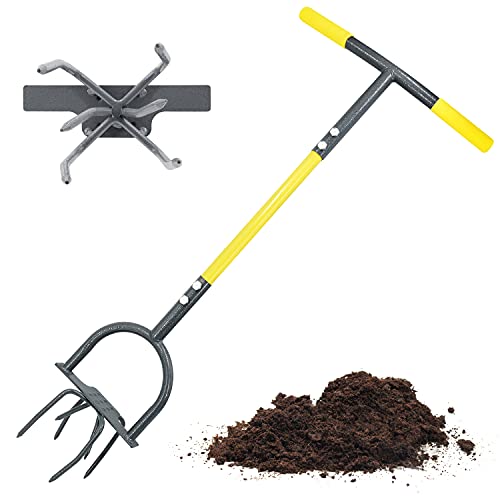
The Jardineer twist tiller is a different animal. It’s a manual cultivator with a foot plate and curved claw tines. You step down on the plate to drive the tines into soil, then twist the handle to churn and aerate. No bending, no rake-and-hope.
The foot plate is the standout feature. It lets you apply real downward force with your body weight instead of your arms. That matters in compacted or clay-heavy beds where a standard rake just skates across the surface. The curved handle reduces wrist strain during the twisting motion, which is why it’s often recommended for older gardeners or anyone with joint issues.
It’s not fast. Twisting a manual tiller over a 4×8 bed takes patience. And the powder-coated steel tines will dull over seasons of use. Also, this tool needs reasonably soft or pre-watered soil. Dry clay will stop it cold, so plan to water the bed a day before you till.
- Anti-slip foot plate for downward force
- Curved handle reduces twisting strain
- Powder-coated steel claw tines
- Works on compacted, hard, or clay soil
- Assembles in minutes with included wrenches
Best for: Gardeners with back or joint concerns who need to loosen compacted soil in raised beds without bending over.
Gardenia Weeding Rake 2.0…
The Gardenia Weeding Rake 2.0 is a forged iron tool with six tines and sharp cutting edges on three sides. It’s designed primarily for weeding, but the tines also loosen soil and level small areas. Think of it as a multi-purpose bed maintenance tool.
The sharpened tines are the real story. They slice through roots and cut into hard, dry soil that would stop a standard rake. The 43-inch one-piece wooden handle is a deliberate choice over telescoping poles. It doesn’t wobble, doesn’t slip, and doesn’t collapse mid-swing. For anyone tired of bending over to pull weeds by hand, this changes the job entirely.
Two honest warnings. The blade is genuinely sharp, so gloves are not optional. And the one-piece handle, while sturdy, makes storage awkward in a small shed. It also won’t replace a bow rake for large-scale leveling.
- Six forged iron tines with cutting edges
- 43-inch solid wooden handle
- Rust-resistant coating on head
- Combines weeding, loosening, tilling, leveling, sweeping
- Thickened anti-curling tines for hard soil
Best for: Weedy beds and lawns where you want one tool to uproot tough roots and loosen the top layer of soil.
Fiskars Ergo Garden Culti…
5th Pick

Fiskars
Fiskars Ergo Garden Cultivator, Hand Tool for Digging, Aerating & Weeding
- GARDENING ESSENTIAL: Heavy duty, ergonomic hand cultivator with sharp tines ideal for a variety of gardening tasks like digging in…
- MAXIMUM POWER AND PRECISION: Cast-aluminum head and tines boost power for digging in tough soil and enhance rust resistance; Ergon…
- LONG-LASTING AND RELIABLE: Polished aluminum tines stay sharp through heavy use and provide excellent durability for lasting value…
Fiskars makes a compact three-tine cultivator with a cast-aluminum head and an ergonomic handle. It’s the smallest tool here, and that’s the point. This is for container gardening, small beds, and precision work where a long handle gets in the way.
The cast-aluminum head is the selling point. It’s light, won’t rust, and the tines stay sharp through heavy use. Fiskars backs it with a lifetime warranty, which tells you something about how they expect it to hold up. The handle shape puts your wrist in a neutral position, so you get more control and less fatigue during repetitive digging.
Limitations are obvious. Three tines cover very little ground. It won’t break hard clods. And the short handle means you’re on your knees or crouching. For a large bed, this is a supplement, not a primary tool. But for pots, window boxes, and tight herb gardens, it’s hard to beat.
- Cast-aluminum head and tines
- Three sharp tines for digging and aerating
- Ergonomic handle reduces fatigue
- Polished aluminum resists rust
- Lifetime warranty from Fiskars
Best for: Container gardeners and small-bed growers who need a durable hand cultivator for digging, aerating, and weeding.
How We Chose These Products
We started with one question: does this tool actually till soil, or does it just move dirt around? That filter eliminated a lot of pretty rakes with weak tines and hollow handles. From there, we looked at build material, tine count, handle adjustability, and how each tool handles real-world soil conditions like clay, compacted ground, and rocky patches.
We also weighed ergonomics. A rake you can’t use for more than 20 minutes without back pain is a bad rake, no matter how well it’s made. Handle length options, grip material, and weight distribution all factored in. Finally, we checked whether each product’s claimed features matched its actual design. A five-tine hand rake and a 17-tine bow rake do completely different jobs, and we’ve labeled them accordingly.
Buying Guide: What Really Matters
Tine count is the first spec to check. Five to six tines suit tight spaces and weeding. Fifteen or more tines suit breaking clods and covering ground. There’s no universal best number, only the right number for your bed size and soil type. If your soil is sandy, fewer tines work fine because the ground gives way easily. If it’s clay, you want more tines and a heavier head to generate force.
Handle length should match your height and your posture. A 47-inch handle lets most adults stand upright while working. A 16-inch handle means kneeling or crouching. Telescoping and sectional handles offer flexibility, but they can wobble under load. One-piece wooden handles are sturdier but harder to store. Pick based on whether you value adjustability or rigidity more.
Material matters for longevity. Cast aluminum resists rust and stays light. Forged or reinforced steel takes more abuse but needs drying after use. Powder coatings and rust-proof finishes help, but they wear off at the tines first. If you garden in wet conditions or leave tools outside, rust resistance should be near the top of your list. For sandy soil specifically, our best soil tester for sandy soil guide can help you confirm what you’re working with before you buy.
Our Top Recommendation
The Lilyvane 4FT Bow Rake is the best all-around choice for tilling soil with a rake. The dual-sided head handles both clod breaking and leveling, the 17 tines cover ground efficiently, and the adjustable handle fits most users. It’s the tool that comes closest to doing real soil prep without a powered tiller.
For smaller beds and tight spaces, the KLDOLLAR Hand Rake is the better pick. Its three handle lengths and narrow head make it far more versatile in raised beds and between rows. If you’re dealing with compacted clay and back pain, the Jardineer Hand Tiller is the one to get. The foot plate does the hard work so your arms and back don’t have to. And if weeds are your main problem, the Gardenia Weeding Rake 2.0 will out-cut everything else here.
Frequently Asked Questions
Can you till soil with a garden rake?
You can loosen the top two to four inches, break small clods, and level the surface. You cannot turn soil over or reach subsoil depth the way a tiller does. A rake is a finishing tool for soil prep, not a primary tillage tool. Use it after a tiller, hoe, or broadfork has done the heavy lifting.
How many tines should a tilling rake have?
For breaking clods and covering ground, 15 or more tines work best. For weeding and working between plants, five to six tines give you the control you need. Match the tine count to the job, not to a spec sheet. A 17-tine rake in a narrow raised bed is frustrating. A 5-tine rake on a half-acre plot is exhausting.
What handle length is best?
Standing upright while you work means a handle around 47 to 49 inches for most adults. If you’re kneeling or working in tight beds, 16 to 21 inches gives better control. Adjustable handles split the difference, but they can feel less solid than a one-piece shaft. Measure from your hand to the ground while standing relaxed, then pick the closest fixed length.
Do I need a different rake for clay soil versus sandy soil?
Yes. Clay soil needs a heavier head, more tines, and sharp edges to bite in. Sandy soil needs less force, so a lighter rake with fewer tines works fine and is easier on your arms. Rocky soil is a separate problem entirely. A standard rake will skip and bend on rocks. For that, you may want to look at a garden tiller for rocky soil instead. If you’re not sure what kind of soil you have, a quick pH and texture test will tell you more than any product description.


