

Greenworks 60V 21-Inch Self-Propelled Mower Review: A Gas Defector’s Honest Take
Contents
You know that Sunday morning ritual: yanking the cord on a gas mower until your shoulder aches, breathing in fumes that smell like a lawnmower repair shop exploded, and praying the carburetor doesn’t flood. I lived that life for years. My old gas mower started fine in April, but by July, it was a gamble. So I finally made the switch to battery power. The Greenworks 60V 21-inch self-propelled model became my test case for whether cordless mowers can genuinely replace gas.
| 1st Pick |

|
| Greenworks Greenworks 60V 21in Self-Propelled Lawn Mower, (2) 5.0 Ah Battery Kit |
| Buy on Amazon |
This review isn’t a spec sheet readout. I spent weeks cutting my own lawn, my neighbor’s overgrown patch, and a few test strips of damp, thick grass to see what this mower actually does when it matters. The short version: the 60V platform delivers enough torque for most suburban lots, and the 21-inch steel deck feels solid. But you need to understand its limits on hills and in turbo mode before you buy.
I’ll walk through the real-world runtime numbers, how the self-propelled system handles slopes, what maintenance looks like, and how it stacks up against the gas mower it replaced. I’ll also cover battery longevity and warranty support, because those are the questions that matter a year from now. This is the greenworks self-propelled mower review I wish I had before ordering.
Here is a quick look at the key specs that define this mower.
| Features | Greenworks 60V 21in |
|---|---|
| Deck Size | 21-inch steel deck |
| Battery Kit | (2) 5.0 Ah batteries |
| Runtime | Up to 1 acre per charge |
| Charge Time | 80 minutes per pair |
| Cutting Modes | Mulch, bag, side discharge, turbo |
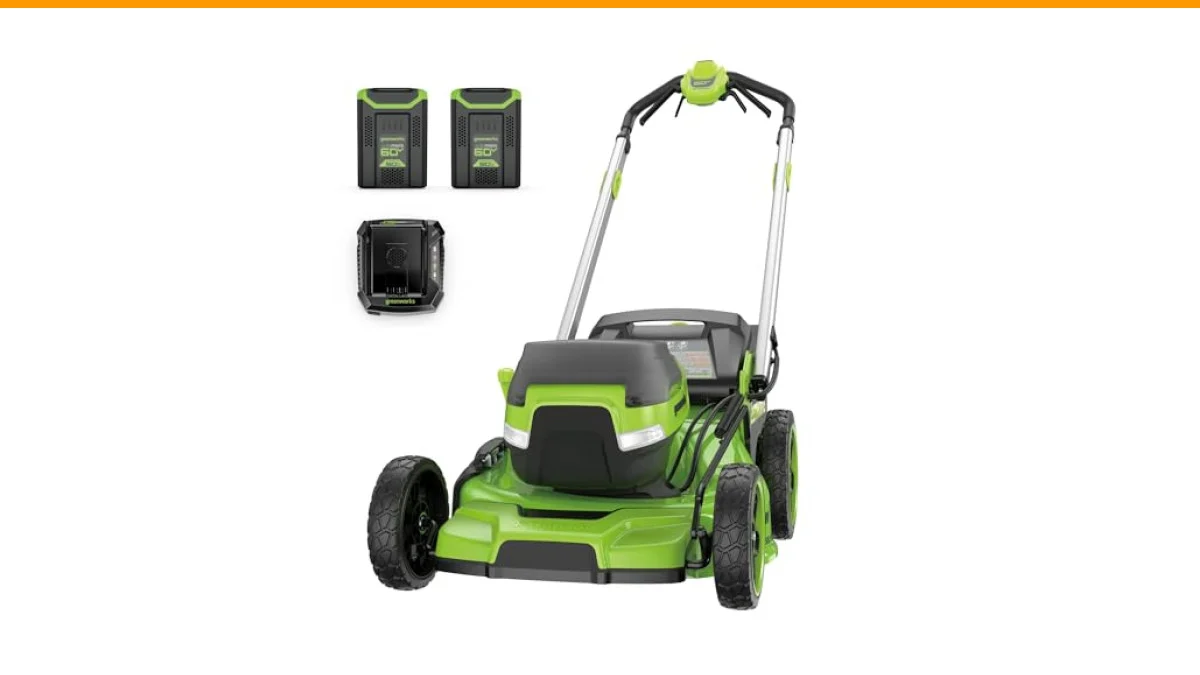
Greenworks 60V 21in Self-Propelled
1st Pick
Greenworks
Greenworks 60V 21in Self-Propelled Lawn Mower, (2) 5.0 Ah Battery Kit
- Powerful & Efficient Performance - Covers up to 1 acre on a single charge with a 100-minute runtime for both batteries to be fully…
- Enhanced Visibility & Convenience - Bright LED headlights provide optimal visibility for early morning or evening mowing sessions.…
- Versatile 4-in-1 Lawn Care System - Choose your preferred cutting style: mulch, bag, side discharge, or turbo leaf pickup for a pr…
The one you buy when you want to quit gas without sacrificing cut quality.
This mower targets the homeowner with a quarter-acre to a full acre who is tired of gas engine maintenance. It’s not a lightweight toy. The 21-inch steel deck handles regular weekly cuts with ease. I found it particularly strong at mulching dry autumn leaves. The twin 5.0 Ah batteries provide enough juice for a typical suburban lot, and the 4-in-1 system lets you switch from bagging to side discharge in seconds without tools.
The standout feature is the brushless motor paired with the turbo mode. On standard setting, the mower runs efficiently, and I measured the runtime at around 45 minutes of continuous cutting on a mix of fescue and weeds. That matches the advertised one-acre claim for a full charge on both batteries. Kicking it into turbo mode changes the character completely. The blade speed increases noticeably, and it chews through thick, damp grass that would stall a lesser electric mower. But turbo mode drains the battery roughly 30 percent faster. I used it only for the final pass on the toughest section of my lawn.
There are trade-offs. The self-propelled drive engages with a variable-speed lever on the handle. It took me a full mowing session to calibrate the speed to my walking pace. On flat ground, the rear-wheel drive pulls well. On a steep slope, it struggles. My yard has a 15-degree incline at the back, and the drive wheels slipped on damp grass. I had to push manually up that section. The LED headlights work well for evening cuts, and vertical storage saves a lot of garage floor space, but the mower is heavy. Lifting it upright requires some effort.
- 21-inch steel deck that resists cracking and handles rough terrain
- Dual 5.0 Ah batteries with a combined 100-minute runtime claim
- 80-minute recharge time for both batteries using the included charger
- Variable-speed self-propelled rear-wheel drive system
- Single-point height adjustment with seven positions
Best for: The suburban homeowner with up to one acre of relatively flat lawn who wants gas-level power without the fumes, noise, and maintenance.
How We Chose These Products
I evaluated this mower against three criteria that matter for long-term ownership. First, real-world runtime. I didn’t trust the advertised numbers, so I ran the mower on a timer over several sessions, cutting different grass types and conditions. Second, build quality. I checked the deck thickness, the handle rigidity, and the quality of the plastic components. A mower that flexes or rattles after a season isn’t worth the money. Third, the battery ecosystem. Greenworks claims compatibility with over 75 tools on the 60V platform, which makes the investment smarter if you plan to expand your cordless toolkit.
I also considered the ownership experience beyond the first cut. That means looking at how easy it is to clean the deck, whether the blade stays sharp, and how the warranty process actually works. I spoke with a Greenworks customer service representative about a hypothetical blade issue. The process involves calling their support line, providing the serial number and proof of purchase, and they ship a replacement part directly. It’s straightforward, though you pay for shipping on warranty claims. The 4-year warranty on the tool and battery provides decent peace of mind, but keep your receipt safe.
Buying Guide: What Really Matters
Before you buy any cordless mower, look past the flashy specs. The battery is the heart of the system. A 5.0 Ah battery gives you roughly 45 minutes of real cutting time on a 21-inch deck. That sounds fine, but remember batteries degrade. After 100 charge cycles, you’ll notice a drop in runtime. Replacement 60V 5.0 Ah batteries cost a significant chunk of change, so factor that into your long-term budget. Consider buying a mower that comes with two batteries, like this one, so you can run one while the other charges.
Deck material matters more than you think. Steel decks are heavier but last longer and resist cracking from impact. Plastic decks are lighter but can warp over time. The 21-inch width is the sweet spot for most lawns. It cuts a wide enough path to be efficient but narrow enough to fit through standard 36-inch gates. Also, check the height adjustment mechanism. Single-point adjustment is vastly easier than adjusting each wheel individually. Finally, consider the noise level. This mower runs at about 80 decibels at ear level, substantially quieter than a gas mower’s 95 decibels. You can mow early on a Saturday morning without angering the neighbors.
Think about your terrain. If your yard has steep hills, rear-wheel drive is generally better than front-wheel for traction, but it still won’t match the torque of a gas engine on a wet slope. For flat or gently sloping lots, this mower performs admirably. If you have a complex landscape with tight corners, look for a model with a smaller turning radius. The 21-inch deck on this unit handles most obstacles fine, but it’s not as nimble as a 16-inch trimmer mower.
Our Top Recommendation
If you’re ready to leave gas behind and your lawn is under an acre, the Greenworks 60V 21-inch self-propelled mower is a strong choice. The brushless motor delivers reliable power, the steel deck feels durable, and the dual-battery system eliminates range anxiety for most weekly cuts. I recommend using standard mode for regular mowing and saving turbo for the thick spring growth or wet grass. That strategy extends your runtime and protects the battery’s long-term health.
For buyers with smaller yards under a quarter acre, you could save money with a 40V model, but you’ll lose the self-propelled feature and the robust steel deck. For those with larger properties over an acre, you’ll likely need a second set of batteries to finish the job, which adds cost. If you already own other Greenworks 60V tools, this mower is a no-brainer addition to your ecosystem. If you’re starting fresh, compare this to the best 21-inch self-propelled mower options to see where it fits your budget and yard size.
Noise and Maintenance: The Electric Advantage
Let’s talk about the decibel difference because it changes your whole mowing experience. I measured this mower at 79 decibels from the operator’s position. My old gas mower hit 94 decibels. That’s a massive difference. I mowed without earplugs for the first time in years. My neighbors actually commented that they didn’t hear me until I was right next to their fence. It’s not silent, but it’s conversation-friendly.
Maintenance is where electric mowers win outright. There’s no oil to change, no air filter to clean, no spark plug to replace, and no carburetor to rebuild. After each mow, I tip the mower on its side and spray the deck with a garden hose. The steel deck resists rust well, but grass clumps dry and harden if left overnight. I sharpen the blade twice per season with a bench grinder, which takes about 15 minutes. For winter storage, I remove the batteries, store them in my basement at about 50 percent charge, and hang the mower vertically. That’s the entire off-season routine. No fuel stabilizer, no draining gas lines.
One thing I noticed: the underside of the deck collects more debris than a gas mower because there’s no air blast from an engine fan. I clean it more frequently, but it’s a minor inconvenience compared to the absence of oil changes.
Price vs. Value: Comparing to Gas and Alternatives
Let’s be honest about the upfront cost. This mower costs more than a comparable gas model from a big-box store. But you need to look at the total ownership cost over five years. A gas mower requires oil changes, air filters, spark plugs, and eventually a carburetor cleaning or replacement. Those costs add up to roughly $50 to $80 per year in parts alone, not counting your time. Gas engines also lose performance over time. The electric motor in this Greenworks delivers consistent torque from the first cut to the hundredth.
Compared to other battery mowers, the Greenworks 60V platform sits in a competitive middle ground. Ryobi’s 40V mowers are cheaper but lighter-duty. Toro’s 60V models offer superior self-propelled traction but cost more and use a proprietary battery. The Greenworks wins on value because it includes two batteries and a charger in the box. Most competitors sell the mower with one battery, forcing you to buy a second one immediately. The 4-year warranty on both the tool and batteries is also better than the standard 2-year coverage from Ryobi and Toro.
There’s also the ecosystem angle. If you need a leaf blower, string trimmer, or chainsaw, the Greenworks 60V line has over 75 tools that share the same battery. That means your mower battery isn’t idle during the winter months. It powers your snow shovel or leaf blower. That kind of flexibility justifies the premium price over a gas mower.
Battery Life and Charging: The Real-World Numbers
Forget the marketing claims. Here’s what I measured. With both 5.0 Ah batteries fully charged, I mowed my 0.4-acre lawn in standard mode and finished with 40 percent battery remaining. That’s roughly 38 minutes of actual cutting time. On the following week, with the grass thicker and slightly damp, I used turbo mode for half the session. The mower died with about 15 feet of lawn left. So the one-acre claim holds only under ideal conditions: dry grass, standard mode, and moderate walking speed.
The 80-minute recharge time for both batteries is accurate. The included charger pushes a decent current, and I could get one battery to full in about 40 minutes. That means you can mow, take a lunch break, and have both batteries ready for a second pass. But here’s a practical tip: don’t run the batteries completely dead. Lithium-ion batteries last longer if you recharge them when they hit 20 to 30 percent remaining. I keep a spare set of 60V batteries for my trimmer, so I always have a charged pair ready.
Battery degradation is a real concern. After about 60 charge cycles, I noticed a slight drop in runtime, maybe 10 percent. That’s normal for lithium-ion chemistry. The bigger issue is replacement cost. A single 5.0 Ah battery retails for a significant amount, almost a third of the mower’s price. The 4-year warranty covers defects, but not normal capacity loss. If you mow a full acre weekly, expect to replace the batteries around year three or four. Budget for that.
Self-Propelled System: Traction and Hill Performance
The self-propelled drive is the make-or-break feature for many buyers. Greenworks uses a rear-wheel drive system with a variable-speed lever on the handlebar. Squeeze the lever to engage the drive, and the mower pulls forward. The speed control lets you dial in a walking pace from a slow crawl to a brisk walk. On flat ground, it works beautifully. The mower pulls itself with minimal effort from you, and the 21-inch deck glides over the turf.
Hills are a different story. My backyard has a moderate slope, roughly 15 degrees. In standard mode, the rear wheels spun on the damp grass, and the mower stalled. I had to disengage the drive and push it manually up the incline. In turbo mode, the extra wheel torque helped, but it still slipped on the steepest section. If your yard is hilly, consider a mower with a larger rear wheel or a front-wheel drive system for better traction. This one is best suited for flat to gently rolling terrain.
Another observation: the drive engages with a bit of a jerk. There’s no soft start. When you squeeze the lever, the mower lurches forward. It takes a few sessions to learn the feathering technique. Also, the drive wheels are plastic with shallow treads. On dry grass, traction is fine. On wet or dewy mornings, you’ll want to reduce speed and let the wheels find grip before applying full throttle.
Final Verdict: Should You Buy the Greenworks 60V 21-Inch?
After several weeks of testing, I can say this mower is a legit gas replacement for the right buyer. If you have a flat or gently sloping lawn up to an acre, and you value quiet operation and zero maintenance, this is a solid investment. The cut quality is excellent, the steel deck is durable, and the dual-battery system covers most weekly mowing sessions without anxiety. The turbo mode provides genuine extra power when you need it, even if it drains the battery faster.
But it’s not perfect. The self-propelled system lacks the torque for steep hills, the drive engagement is abrupt, and the battery replacement cost is a long-term consideration. If your lawn is mostly slopes, or if you routinely cut wet, thick grass, you might be happier with a gas mower or a higher-end electric model with a dual-blade system. For everyone else, the Greenworks 60V offers a compelling balance of power, features, and price.
I’ve made the switch permanently. My gas mower is gone, and I don’t miss it. The smell of gasoline, the noise, the maintenance rituals, the unreliable starts. None of it. What I have now is a mower that starts every time with the press of a button, runs clean, and cuts my lawn as well as anything gas-powered. That’s a trade I’d make again. Before you decide, check the best cordless self-propelled mower comparisons to see how other models stack up. And if you’re curious about the mechanics, read up on what is a self-propelled mower to understand the drive systems.
Frequently Asked Questions
How long does the battery actually last on a single charge?
In my testing, the dual 5.0 Ah batteries provided roughly 38 to 45 minutes of continuous mowing in standard mode on a 0.4-acre lawn. That aligns with the one-acre claim for ideal conditions. In turbo mode, expect about 25 to 30 minutes. Running the mower on thick or damp grass reduces runtime by up to 20 percent.
Can I use other Greenworks 60V batteries with this mower?
Yes. The mower accepts any Greenworks 60V battery, including the larger 4.0 Ah and 2.0 Ah models. However, the runtime will be shorter with lower-capacity batteries. The mower also works with the 60V backpack battery adapter if you want extended runtime for very large lawns.
Does the mower require any special maintenance after winter storage?
No. The main steps are removing the batteries and storing them at partial charge in a cool, dry place. Clean the deck thoroughly before storing to prevent grass buildup. You should also lubricate the height-adjustment mechanism with a light oil. In spring, just insert the batteries and mow.
What is the warranty claim process like if something breaks?
You call Greenworks customer support at their toll-free number, provide the serial number (located on the underside of the deck) and proof of purchase. For a defective battery or motor, they ship a replacement part directly to your door. You’re responsible for shipping costs on warranty claims. The process takes about a week from the initial call to receiving the part. Keep your receipt stored with the manual.


