
Clay is the soil that fights back. It dries into something closer to concrete than dirt, and it grabs tines the way mud grabs a boot. Most tillers sold as general-purpose machines stall within minutes on ground like this.
The reason comes down to physics. Clay particles are flat and tiny, so they pack together with almost no air space. A front-tine tiller drags its tines through that mass while the wheels push forward, which means the machine wants to walk on top of the soil instead of biting in. Rear-tine counter-rotating tillers work differently. The tines spin against the forward motion, cutting fresh ground while the engine weight sits over the digging head. That opposing rotation is what lets a rear-tine unit chew through compacted clay instead of bouncing across it.
Moisture matters just as much as the machine. Till clay when it’s wet and you’ll turn it into brick-like clods that dry hard and stay hard for months. The right approach is a moisture test first, then two or three passes at increasing depth rather than one heroic run.
This guide covers five tillers that genuinely handle clay, from a cordless model for small plots to a manual twist tiller for raised beds. There’s also a buying guide on torque, tines, and depth, plus the multi-pass method and amendment ratios that make tilling clay worth the effort. If you want to see how these compare against other soil types, the tiller for rocky soil roundup covers similar ground with different constraints.
Here’s a quick side-by-side of the specs that matter most when the ground is heavy.
| Features | SOARFLY Cordless | Sun Joe TJ604E | Jardineer Hand Tiller | LawnMaster TE1318M | CKLT Rotary Cultivator |
|---|---|---|---|---|---|
| Power Source | 2x 4.0Ah batteries | 13.5-amp corded | Manual twist | 13.5-amp corded | Manual rotary push |
| Tilling Width | 9 inches | 16 inches | Small bed width | 18 inches | Star-wheel width |
| Max Depth | 6.6 inches | 8 inches | Top few inches | 9 inches | Surface layer |
| Run Time / Power | Up to 120 minutes | Continuous corded | Body force only | 380 RPM motor | Push and twist |
| Best Use Case | Small plots, no outlet | Mid-size beds | Raised beds, seniors | Large gardens | Light weeding, mixing |
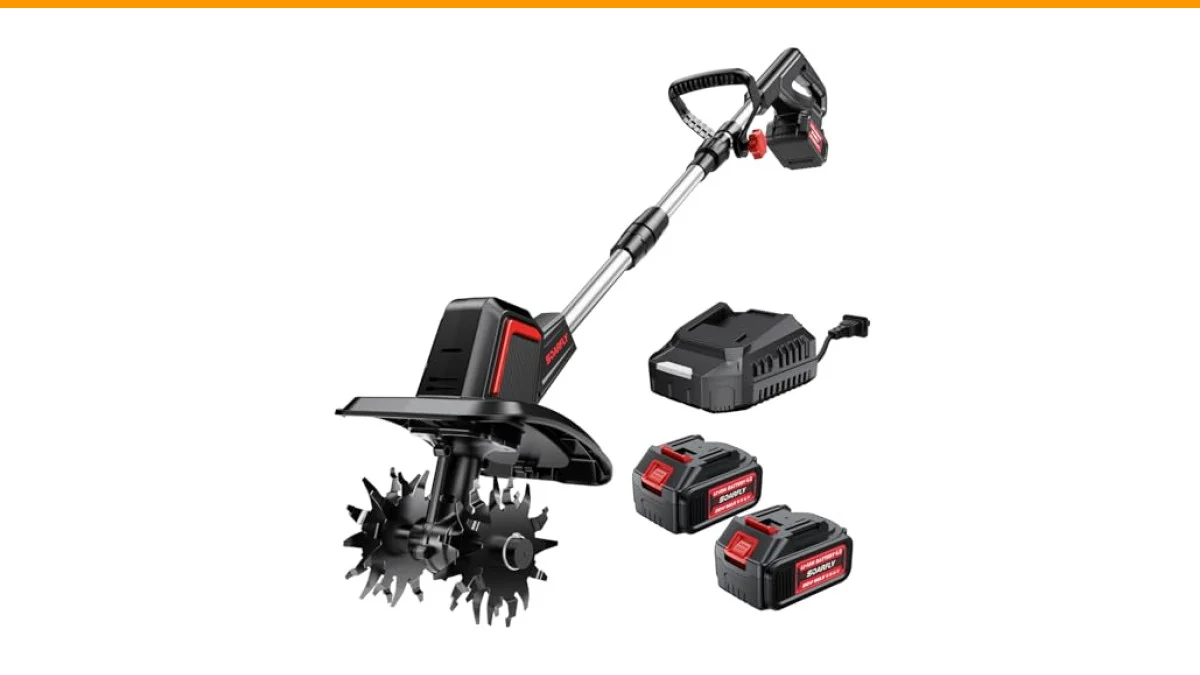
SOARFLY Cordless Tiller Cultivator

SOARFLY
SOARFLY Cordless Tiller Cultivator 9" Width 6.6" Depth, 2×4.0Ah Batteries | 48 Steel Tines, 360RPM, Lightweight Battery Powered Small Garden Rototiller for Lawn Gardening Soil Cultivation
- 👍【UPGRADED 4.0AH LONG-LASTING BATTERIES】Comes with two upgraded 4.0AH Li-ion batteries—double the capacity of typical 2.0AH models…
- 👍【UPGRADED ADJUSTABLE COMFORT DESIGN】Equipped with an upgraded height-adjustment system and ergonomic auxiliary handle, offering a…
- 👍【UPGRADED ELECTRIC MOTOR】Upgraded motor delivers a stable 360 RPM operating speed for consistent cultivation performance and impr…
The cordless option that punches above its size. This is for gardeners with small plots, tight rows, or a yard with no outdoor outlet within reach. Two 4.0Ah batteries ship in the box, and the machine runs at a steady 360 RPM with a 9-inch width and 6.6-inch depth. That’s not a big footprint, but it’s enough for a kitchen garden or a few raised beds.
What stands out is the runtime. Most cordless tillers in this class come with 2.0Ah packs that die after 20 minutes. SOARFLY doubled the capacity, so you get up to 120 minutes of continuous work across both batteries. Swap one out and keep going. The height-adjustment system is another upgrade most competitors skip — you can set the handle to your frame instead of hunching over. The auxiliary handle helps on turns.
The trade-off is depth and width. At 6.6 inches, this won’t break new ground on virgin clay. It’s a cultivator first, a tiller second. On hard, unworked clay you’ll need to water the bed a day ahead and go over it twice. The motor is stable but not a torque monster, so expect it to slow in dense patches. It’s also battery-dependent — if you forget to charge both packs, you’re done for the day.
- Two 4.0Ah batteries included, roughly double the typical capacity
- 360 RPM motor with 9-inch width and 6.6-inch depth
- Height-adjustable handle and ergonomic auxiliary grip
- No cord, no outlet, no gas — works anywhere
- Best on established beds rather than raw clay
Best for: Small-plot gardeners who want cordless freedom and don’t need to break untouched clay.
Sun Joe Corded Electric Garden Tiller

Sun Joe
Sun Joe Corded Electric Garden Tiller & Cultivator with Steel Tines, TJ604E
- Powerful Electric Tiller: Electric rototiller with a 13.5-amp motor easily tills up to 16 inches wide and 8 inches deep for effici…
- Durable Steel Tines: This corded electric tiller features 6 rust-proof, steel-angled tines for long-lasting performance and durabi…
- Compact and Convenient: This small garden tiller with a folding handle ensures easy storage and transport for gardeners and homeow…
A workhorse for the money. The Sun Joe TJ604E runs on a 13.5-amp motor with six rust-proof steel tines, tilling up to 16 inches wide and 8 inches deep. That combination makes it a serious contender for mid-size vegetable gardens and first-year beds where clay needs real loosening.
The three-position wheel adjustment is the feature clay gardeners should care about. You can set the wheels high for a shallow first pass, then drop them for a deeper second run. That’s exactly how you should attack compacted ground. The folding handle helps if storage space is tight, and there’s no gas, oil, or emissions to deal with. Plug in and go.
Corded means unlimited runtime, but it also means you’re tethered. A 100-foot outdoor extension cord is basically mandatory, and you’ll want to route it away from the tines. The 13.5-amp motor has enough torque for clay but not endless reserves — in very dense patches it will bog down and you’ll need to lift and reset. Six tines on a 16-inch width also means clay can pack between them, so clean the tines after each session.
- 13.5-amp motor with six angled steel tines
- 16-inch width and 8-inch maximum depth
- Three-position wheel adjustment for depth control
- Folding handle for compact storage
- Corded for continuous power, no battery swaps
Best for: Home gardeners with mid-size beds and a nearby outlet who want maximum tilling power per dollar.
Jardineer Hand Tiller for Gardening
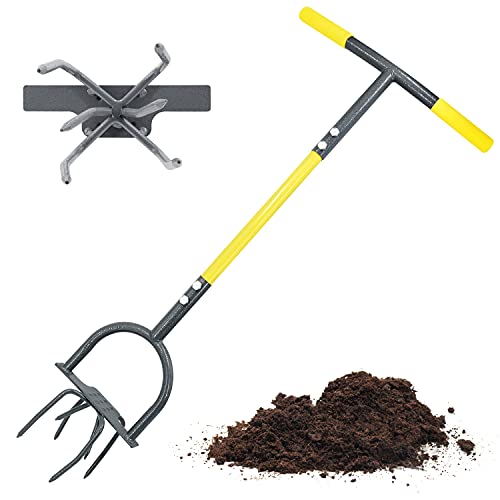
Jardineer
Jardineer Hand Tiller for Gardening, Manual Twist Tiller Cultivator, Heavy Duty Garden Claw, Soil Loosener & Lawn Aerator for Soil Mixing, Garden, Flower Box and Raised Bed
- 【Anti-Slip Foot Plate - Penetrate Soil with One Tread】- This manual hand tiller comes with anti-slip foot plate, maximize downward…
- 【Razor-sharp Tines for Aggressive Soil Penetration】- Twist this garden tiller with the force of body, suitable for crushing soil,…
- 【Till for Ventilated Soil & Healthy Plants】- This hand-held tiller garden tool loosens, turns, tills and aerates the soil, promoti…
The manual option that earns its place. This is a twist tiller with an anti-slip foot plate, designed to penetrate clay with body weight and a sharp twist rather than an engine. It’s ideal for raised beds, flower boxes, and small plots where a powered tiller is overkill or won’t fit.
The foot plate is the smart part. Step down to drive the tines in, then twist the curved handle to break the soil loose. That motion uses your legs and torso instead of your lower back, which makes it far more usable for seniors or anyone with joint strain. The powder-coated steel tines are sharp enough to crush clods and mix in fertilizer, peat moss, or compost as you go.
Honest limitations: this is slow work, and it only reaches the top few inches. On dry, rock-hard clay you must water the bed in advance or the tines won’t penetrate. It also won’t replace a powered tiller for a large garden — a 20×20 foot plot would take hours. But for a raised bed or two, it’s the tool that actually gets used.
- Anti-slip foot plate for easy soil penetration
- Curved handle reduces twisting effort and back strain
- Powder-coated steel tines for crushing and aerating
- Assembles in minutes with included wrenches
- Needs pre-watering on dry clay
Best for: Raised-bed gardeners, seniors, and anyone with a small plot who wants no fuel, no cord, and no noise.
LawnMaster 13.5 Amp 18” Electric Tiller

LawnMaster
LawnMaster 13.5 Amp 18” Electric Tiller – TE1318M
- EFFICIENT SOIL CULTIVATION: 6 rust-resistant steel blades cut through rough terrain at 380-RPM
- 18-INCH MAX CUTTING WIDTH: Designed for medium to large sized gardens with an impressive 9-inch depth for effective tilling
- MECHANICAL OVERLOAD PROTECTION: Cultivator will automatically turn off if it gets blocked by a foreign object
The largest electric option here, and the one to pick if your clay problem covers serious ground. The LawnMaster TE1318M uses a 13.5-amp motor driving six rust-resistant steel blades at 380 RPM, with an 18-inch cutting width and a 9-inch maximum depth. Those numbers put it in a different class for medium to large gardens.
Mechanical overload protection is the standout feature. If the tines hit a rock or jam in dense clay, the machine shuts itself off instead of burning out the motor. That’s a real safeguard on heavy ground where stalls are common. The 380 RPM speed also gives it a faster bite than the 360 RPM SOARFLY, which matters when you’re making multiple passes across a big bed.
Trade-offs are weight and cord dependence. An 18-inch tiller with a 13.5-amp motor is heavier than the smaller models, and wrestling it through clay for an hour is a workout. It’s corded, so range is limited by your extension cord. And while the 9-inch depth is the deepest here, clay still needs two or three passes to reach it — the machine won’t do it in one go.
- 13.5-amp motor with six steel blades at 380 RPM
- 18-inch width and 9-inch maximum depth
- Mechanical overload protection shuts off on jams
- Foldable handles for tight storage
- No gas, oil, or emissions
Best for: Owners of medium to large gardens who need the widest, deepest electric pass and want overload protection.
CKLT 66in Rotary Cultivator

CKLT
CKLT 66in Rotary Cultivator Garden Tool with Tempered Spring Steel Tines | Adjustable Stainless Steel Handle Manual Hand Tiller for Gardening, for Loosening Soil, Mixing Fertilizer, Garden Beds
- Sturdy Spring Steel Blades: Crafted from tempered spring steel, the rotary blades offer outstanding strength and flexibility—resis…
- Efficient Star-Shaped Tines: Featuring multi-angled, serrated star wheels, this cultivator bites deep into compacted soil, loosens…
- 66-Inch Adjustable Stainless Steel Handle: The full tool length extends to 66 inches and includes a 4-section detachable stainless…
A push-and-roll cultivator built for surface work and weeding. The CKLT rotary cultivator uses tempered spring steel star-shaped tines on a 66-inch adjustable stainless steel handle. It’s not a tiller in the engine sense — you push it, the star wheels rotate, and the serrated spikes bite into the top layer of soil.
The spring steel is the reason it survives clay. Tempered blades flex under pressure instead of snapping, and the multi-angled star wheels resist bending even when you hit a hard patch. It’s effective at breaking surface crust, uprooting weeds, and mixing fertilizer or compost into the top few inches. The four-section handle detaches for storage and adjusts to your height.
Don’t expect this to replace a powered tiller on raw clay. It works the surface layer only, and on dry, rocky ground you’ll need to water first and remove larger stones. The rubber grip and powder-coated head hold up well, but this is a maintenance and mixing tool, not a ground-breaker. For keeping clay beds workable between seasons, it’s genuinely useful.
- Tempered spring steel star tines resist bending and breaking
- 66-inch adjustable stainless steel handle, four detachable sections
- Serrated spikes bite into compacted surface soil
- Rust-resistant powder coating and ergonomic rubber grip
- Surface work only — not for deep tilling
Best for: Gardeners who need a durable surface cultivator for weeding and mixing amendments into clay beds.
How We Chose These Products
We started with the soil, not the spec sheet. Clay punishes weak motors, dull tines, and light frames, so anything without real torque or steel cutting edges got cut early. Each pick had to solve a specific clay problem: breaking new ground, maintaining beds, or working small spaces where a big tiller won’t fit.
Then we weighed the practical stuff. Runtime or cord length, depth control, tine material, and how the machine handles a stall. We also factored in who each tool actually suits — a 13.5-amp corded tiller is wrong for someone with a balcony bed, and a hand twist tiller is wrong for a half-acre plot. The five here cover the realistic range of clay gardeners without overlap.
Buying Guide: What Really Matters
Torque beats raw speed on clay. A motor with higher amp draw or engine displacement keeps turning when the tines hit dense ground. Look at amps for electric models — 13.5 amps is the practical floor for clay, and anything under 10 amps will stall constantly. For gas, displacement and rear-tine counter-rotation matter more than horsepower claims.
Tine design decides how well the machine bites. Angled steel tines with a sharp edge slice through clay; stamped flat tines smear it. Six tines on a 16-inch width is a good ratio. Fewer tines over a wider span means each one carries more load and clogs faster. Adjustable depth control is also non-negotiable — you need shallow first passes before going deep.
Weight and balance affect control. A heavier tiller digs better but tires you faster. Rear-tine models put the engine over the digging head, which improves bite and reduces the bouncing that front-tine machines do on hard ground. For small plots, a lighter cordless or manual tool makes more sense than fighting a heavy machine in tight rows. If you’re working clay in containers or raised beds, the small tiller for clay options are worth a look before you buy full-size.
How to Till Clay Soil Without Ruining It
Moisture Test Before You Start
Grab a handful of clay and squeeze it into a ribbon. If it holds together and feels slick, it’s too wet — tilling now creates brick-like clods. If it crumbles and won’t form a ribbon, it’s dry enough to work but may be too hard. The sweet spot is slightly moist, like a wrung-out sponge. A simple jar test also works: fill a jar a third with soil, top with water, shake, and let it settle. The clay layer at the top tells you how heavy your soil is.
Passes, Depth, and Amendments
Never try to hit full depth in one pass. Set the tiller shallow, around 2 to 3 inches, and go over the bed. Then drop to 4 to 5 inches and cross the bed at a right angle. A third pass at maximum depth finishes the job. Two or three passes is normal on clay — single-pass results are a myth.
After tilling, spread 2 to 3 inches of compost or aged manure over the bed and till it into the top 4 to 6 inches. Gypsum helps break down clay structure over time, though it works slowly. Cover crops like daikon radish send roots deep and improve drainage. Tilling alone won’t fix clay — it’s the combination of aeration, organic matter, and time. A good compost bin for garden soil makes that amendment cycle easier to keep up with.
Clay Soil Maintenance and Troubleshooting
Clay packs between tines faster than any other soil. Clean them after every session with a putty knife or stiff brush — wet clay sets like cement overnight. Check the tine bolts too, since vibration on hard ground loosens them.
Belt strain and motor overload are the two failure points on powered tillers in clay. If your machine shuts off mid-pass, let it cool and clear the tines before restarting. On corded models, use a heavy-gauge extension cord to avoid voltage drop that makes the motor work harder. On gas models, keep the air filter clean — clay dust clogs it quickly and robs power.
Watch for glazing. If the tilled surface looks smooth and shiny, you’ve overworked wet clay and sealed the surface. Stop, let it dry, and break the crust with a hand tool or rotary cultivator before planting.
Frequently Asked Questions
Can a small electric tiller handle clay at all?
A corded 13.5-amp model can, if you make multiple shallow passes and work the soil when it’s slightly moist. Cordless and low-amp models work best on clay that’s already been broken once. Raw, untouched clay needs more torque than a small tiller can deliver in a single session.
How deep should I till clay for a vegetable garden?
Aim for 6 to 8 inches of loosened soil for most vegetables. On heavy clay, build up to that depth over two or three passes rather than forcing it. Root crops like carrots want deeper, looser soil, so add extra compost to those beds.
Does tilling clay make it worse?
It can. Tilling wet clay destroys its structure and creates hard clods. Tilling the same bed every year at the same depth also forms a compacted layer just below the tines. Alternate tilling with no-till methods and always add organic matter.
How often should I till clay soil?
Once a year at most for established beds, usually in spring or fall. Between tilling, use a rotary cultivator or hand fork to keep the surface loose. Over-tilling breaks down organic matter faster and damages soil life.
Our Top Recommendation
The LawnMaster TE1318M is the best garden tiller for clay soil overall. Its 18-inch width, 9-inch depth, 380 RPM motor, and mechanical overload protection make it the most capable electric option for real clay work. The overload cutoff alone saves the motor on heavy ground where stalls are routine. Check the current price on Amazon before you commit, since corded tillers in this class move around.
The Sun Joe TJ604E is the runner-up for smaller budgets and mid-size beds — 16 inches wide, 8 inches deep, and the three-position wheel adjustment is genuinely useful for staged passes. For small plots or raised beds, the SOARFLY cordless and Jardineer hand tiller cover the low end without sacrificing usability. And if you mostly need to maintain clay rather than break it, the CKLT rotary cultivator is the durable surface tool to keep on hand. For a wider look at electric options, the best electric tiller for clay soil guide digs into motor and battery differences.



