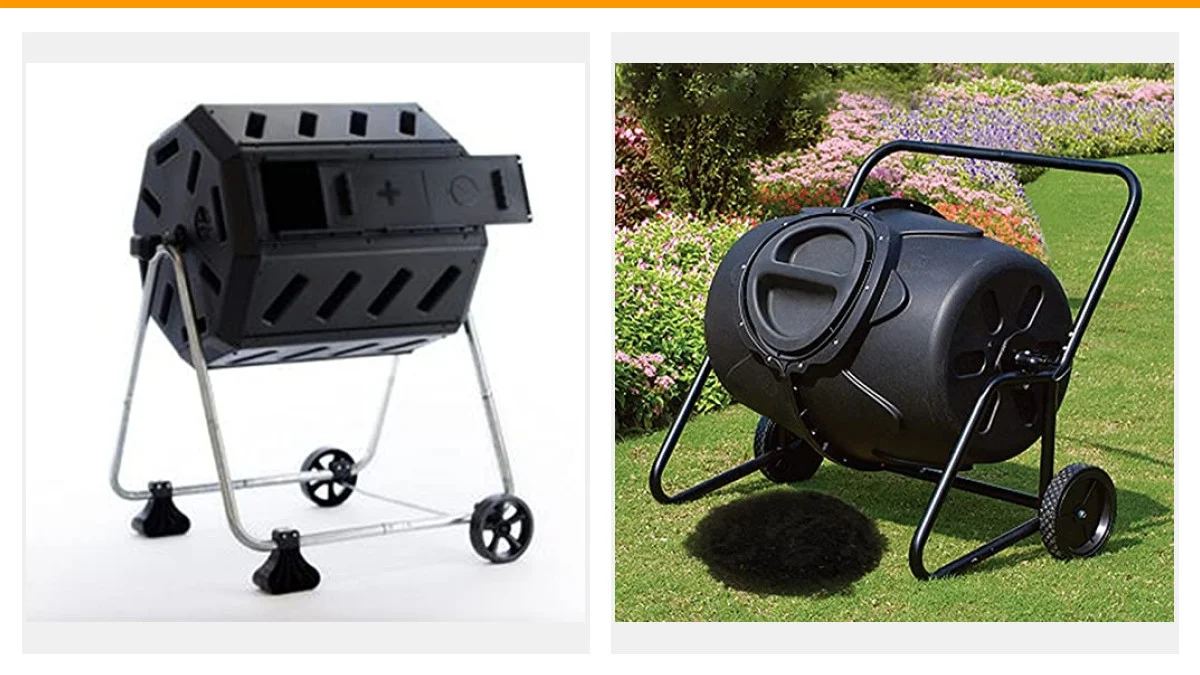
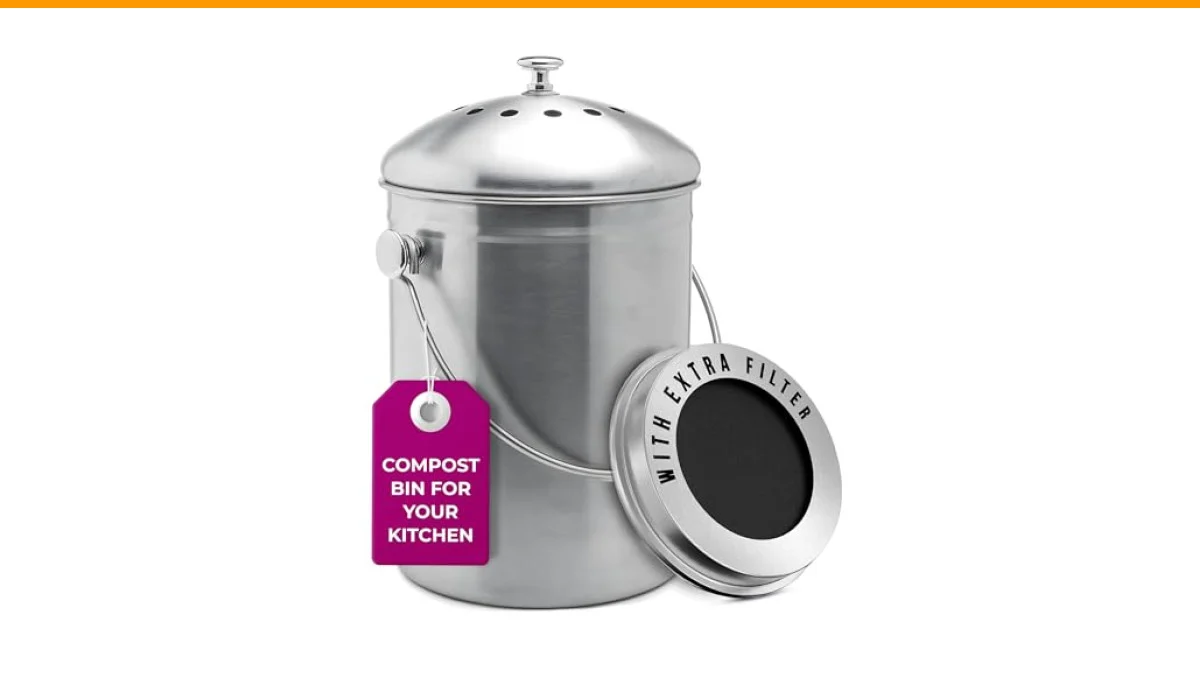
Your propagation schedule depends on a steady supply of clean, mature compost. But the bin you used for backyard scraps is likely producing uneven batches — some too wet, some not hot enough to kill weed seeds, and none ready when you need to pot up that next run of cuttings. A nursery isn’t a garden. Your compost needs to be predictable, repeatable, and safe for young root zones.
A great nursery compost bin delivers consistent thermophilic temperatures, simple aeration, and enough volume to keep up with your potting mix demands. It also needs to handle the specific carbon-to-nitrogen ratio of your green waste without turning into an anaerobic mess. You’re not just recycling — you’re producing a biological input that affects pathogen suppression, nutrient density, and the overall health of every plant you sell.
We tested and compared five bins that serve different parts of the nursery workflow. The VIVOSUN 43-gallon dual-chamber tumbler takes the top spot for its balance of capacity, aeration, and practical design. The VEVOR offers similar volume with a few different features. For kitchen scrap collection feeding your main pile, the Utopia Kitchen and KIBAGA countertop bins earn their place. The OXO Good Grips is a solid, cleanable option. Below, we break down each unit, what it does well, where it falls short, and how to match it to your specific growing operation.
Here is a quick look at how the key specs compare across our five picks.
| Features | VIVOSUN 43 Gal | Utopia Kitchen | VEVOR 43 Gal | KIBAGA Countertop | OXO Good Grips |
|---|---|---|---|---|---|
| Primary Use | Outdoor batch composting | Kitchen scrap collection | Outdoor batch composting | Kitchen scrap collection | Kitchen scrap collection |
| Capacity | 43 Gallons (dual) | 1.3 Gallons | 43 Gallons (dual) | 1.1 Gallons | 1.75 Gallons |
| Material | PP plastic, metal frame | Stainless steel | PP plastic, metal frame | Powder-coated carbon steel | Plastic with soft-close lid |
| Key Mechanism | 360-degree tumbling | Charcoal filter lid | 360-degree tumbling | Charcoal filter compartment | Bag-tuck design, stay-open lid |
| Best For | High-volume nurseries | Small kitchens | Large families, avid gardeners | Odor-sensitive kitchens | Busy kitchens, easy cleaning |
VIVOSUN Outdoor Tumbling Composter

VIVOSUN
VIVOSUN Outdoor Tumbling Composter Dual Rotating Batch Compost Bin, 43 Gallon Black Door
- Twin chambers: Two separate chambers allow one side to finish composting while leaving the other side available to add fresh waste…
- 360⁰ Tumbling Design: The rotating design prevents you from digging or mixing the pile by hand; And the deep fins on eight panels…
- Excellent Aeration: Air vents can make the air fully circulate and will not cause an explosion due to excessive internal pressure;…
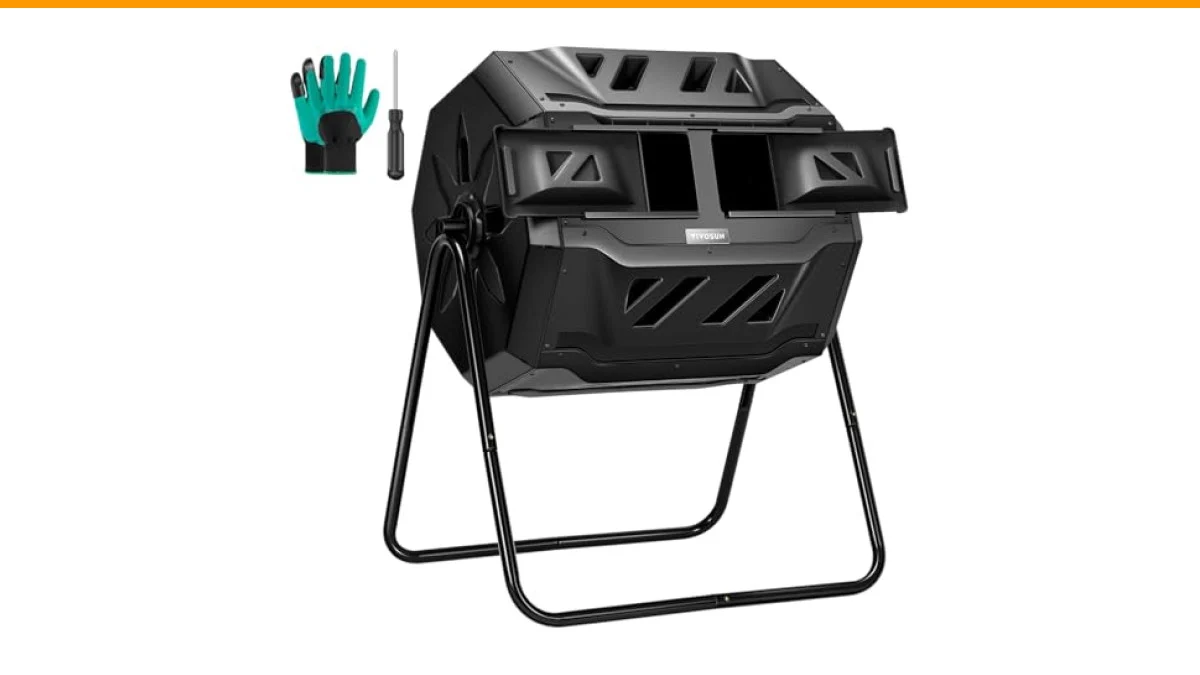
The VIVOSUN 43-gallon tumbling composter is the closest thing on this list to a piece of propagation equipment. Its twin chambers let you run two separate batches on different timelines. You can fill one side with a fresh mix of carbon-rich and nitrogen-rich material while the other side finishes its curing phase. That continuous alternation means you always have compost moving through the system.
This bin is built for the nursery manager who needs volume and consistency. The 360-degree tumbling design replaces the back-breaking work of turning a static pile with a pitchfork. The deep fins on the interior walls break up clumps as you rotate the drum. You get even aeration without having to dig into the pile, which is critical for maintaining aerobic decomposition and hitting those thermophilic temperatures that kill pathogens and weed seeds.
The construction feels solid. A premium metal frame supports the drum, and the high-quality PP plastic body resists corrosion and weathering from direct sun and rain. Air vents run along the panels to keep oxygen flowing and prevent pressure buildup. VIVOSUN even includes a pair of waterproof garden gloves with ABS plastic claws, which is a small bonus but genuinely useful for handling fresh scraps.
There are trade-offs. A 43-gallon tumbler requires physical effort to rotate when fully loaded — it’s not a no-turn system. Also, tumbling composters generally produce smaller batches than a large static pile, so if you need to fill dozens of pots per week, you might need two units running in sequence. And while the plastic body is durable, it won’t hold heat as well as an insulated composter during cold winter months.
- Dual 21.5-gallon chambers for continuous batch processing
- Deep interior fins break clumps and improve oxygen flow
- Vented panels prevent excess pressure and support aerobic activity
- Powder-coated metal frame with weather-resistant PP plastic body
- Includes waterproof garden gloves and ABS digging claws
Best for: Nursery operators who need a moderate-volume, low-effort system for producing consistent, aerated compost batches.
Utopia Kitchen Countertop Compost Bin

Utopia Kitchen
Utopia Kitchen Countertop Compost Bin 1.3 Gallon, Stainless Steel, Silver | Odorless countertop compost bin with charcoal filter, ideal for food scraps and waste
- Countertop Fit - The countertop compost bin measures 7.2 inches wide and 11.2 inches high, offering a slightly larger capacity whi…
- Durable Build - Made with stainless steel, the composter resists scratching, cracking, and chipping, so it can handle onion skins,…
- Stylish Design - With a sturdy, sleek design that complements most kitchen decor, the compost bucket with lid looks like it belong…
The Utopia Kitchen countertop bin serves a different role in the nursery ecosystem. It sits by the sink in the break room or the germination lab, collecting coffee grounds, vegetable peels, and other nitrogen-rich scraps that will eventually feed your main outdoor compost pile. It’s a collection point, not a processing unit.
What stands out here is the material. Stainless steel resists the scratching, cracking, and chipping that plastic bins suffer after months of daily use. It also doesn’t absorb odors the way some plastics do. The cylindrical shape holds 1.3 gallons — slightly larger than many competing countertop bins — without taking over valuable prep space. The charcoal filter in the lid traps odors naturally, so a week’s worth of scraps won’t announce itself every time someone walks into the room.
Cleaning is straightforward. The manufacturer recommends lining the bottom with newspaper or cardboard to absorb excess liquid, then giving the bin a quick rinse with mild soap or vinegar weekly. The steel interior doesn’t hold onto residue, which is a genuine advantage over cheaper plastic models.
The honest criticism: a countertop bin is only as useful as your discipline in emptying it. If you let scraps sit for two weeks, even the charcoal filter will struggle. And the 1.3-gallon capacity means frequent trips to the main pile for a busy nursery kitchen. It’s a supporting player, not a standalone solution.
- 1.3-gallon capacity fits neatly on standard countertops
- Stainless steel body resists stains, scratches, and odors
- Charcoal filter traps smells for up to a week
- Compact 7.2-inch width and 11.2-inch height
- Easy to clean with soap, water, or vinegar
Best for: Nursery teams that want a durable, odor-controlled collection bin for kitchen scraps destined for a larger outdoor composting system.
VEVOR Compost Bin, 43-Gal

VEVOR
VEVOR Compost Bin 43 Gallon Dual Chamber Compost Tumbler 110 lbs Capacity | for Families and Gardeners, with 360° Tumbling, Sliding Door, Air Vents, PP Body and Metal Frame for 4-6 Week Composting
- Dual Chamber, High Capacity: Our compost bin features a dual chamber with a generous capacity of 43 gallons. Perfect for large fam…
- Convenient Access: The dual-chamber composter tumbler features a detachable sliding door with a large opening, making it effortles…
- Built to Last: Crafted from high-quality PP materials and supported by sturdy metal components, our compost bin outdoor boasts a r…
The VEVOR 43-gallon dual-chamber tumbler shares the same core concept as the VIVOSUN: two separate compartments allow one side to finish while the other collects fresh material. The key difference is in the details, and those details matter depending on your specific workflow.
VEVOR uses a sliding door design with a large opening. That makes it easier to load bulky material like spent potting soil or pruned stems without fighting a small hatch. The door seals securely to keep out mice, insects, and other pests — a real concern in a nursery environment where rodents can find their way into almost anything. The frame is built from sturdy metal components, and the drum is BPA-free, UV-resistant, and weatherproof. VEVOR rates the load capacity at 110 pounds, which is substantial.
The tumbling action is smooth. Internal grooves break up clumps as the drum rotates, and strategically placed vents promote air circulation. VEVOR claims you can have finished compost in four to six weeks under ideal conditions. That timeline is realistic only if you maintain the right moisture content and carbon-to-nitrogen ratio — the bin can’t do that work for you.
Where this unit falls short of the VIVOSUN is in the overall polish. The sliding doors are convenient but can be prone to jamming if material gets caught in the track. The plastic feels slightly thinner, though still durable for residential or light commercial use. And like any tumbler, you’ll need to commit to rotating it every few days to keep the pile aerobic.
- Dual 43-gallon chambers with large sliding doors for easy access
- Secure seals keep pests out during the composting process
- BPA-free PP plastic with UV-resistant, weatherproof construction
- 360-degree tumble design for thorough mixing and faster decomposition
- Internal grooves break up clumps for uniform material consistency
Best for: Gardeners and small nursery operations that prioritize easy loading, pest resistance, and high capacity at a competitive price point.
Beautiful Kitchen Compost Bin with Smell Proof Lid

KIBAGA
Beautiful Kitchen Compost Bin with Smell Proof Lid for Your Countertop | Rust Proof and Odorless 1.1 Gallon Bucket with No Smell Filters - Easy to Clean and Looks Great on Any Kitchen Counter
- Effortless Recycling: Revolutionize your kitchen with KIBAGAs’ countertop compost bin, designed for recycling food & other organic…
- Odorless Composting: The compost bin for the kitchen comes with a built-in charcoal filter compartment ensuring odor-free composti…
- Practical Premium Design: Built to last with rust-free, powder-coated carbon steel, the kitchen compost bin for your countertop el…
The KIBAGA countertop bin takes a different visual approach than the utilitarian Utopia model. Its beige powder-coated carbon steel body and wooden handle bring a warmer, more design-forward look to the nursery break room or office kitchen. But this bin isn’t just about appearances — the build quality is genuinely solid.
The powder-coated finish resists rust, which is a real advantage in a humid greenhouse environment. The 1.1-gallon capacity is modest, but the compact footprint (10.2 x 7 inches) means it won’t crowd your countertop. A built-in charcoal filter compartment sits in the lid, with air holes that provide necessary aeration while trapping odors. Two filters are included, which extends the time before you need to order replacements.
The wooden handle makes it easy to carry out to the main compost pile, and the smooth interior rinses clean without much effort. For a nursery that wants to maintain a professional aesthetic while collecting scraps, this bin fits the bill.
The limitations are similar to any small countertop bin. At 1.1 gallons, it fills quickly in a busy kitchen. The charcoal filter needs regular replacement to stay effective — roughly every two to three months with daily use. And while the powder-coated steel is rust-resistant, it can chip if dropped, exposing the bare metal underneath.
- 1.1-gallon capacity with a compact 10.2 x 7-inch footprint
- Rust-free powder-coated carbon steel construction
- Charcoal filter compartment with lid air holes for odor control
- Wooden handle and knob for easy carrying and a polished look
- Includes two charcoal filters for extended use
Best for: Eco-conscious nursery teams that want a durable, attractive countertop bin with effective odor control for daily food scrap collection.
OXO Good Grips Easy-Clean Compost Bin
OXO
OXO Good Grips Easy-Clean Compost Bin, Charcoal , 1.75 Gal/6.62 L | Food Waste, Organic, Trash Disposal, Clean, Low-Effort, Conceals Bags, Locks in Odors, Smooth Interior, Kitchen Countertop
- Unique design keeps bags tucked inside for a neat look
- 1.75-gallon/6.62-liter capacity perfect for busy kitchens
- Smooth interior makes Bin easy to clean
The OXO Good Grips bin rounds out our list, and it earns its place through thoughtful design details that make daily use genuinely easier. The 1.75-gallon capacity is the largest of our countertop picks, which means fewer trips to the main pile during a busy week.
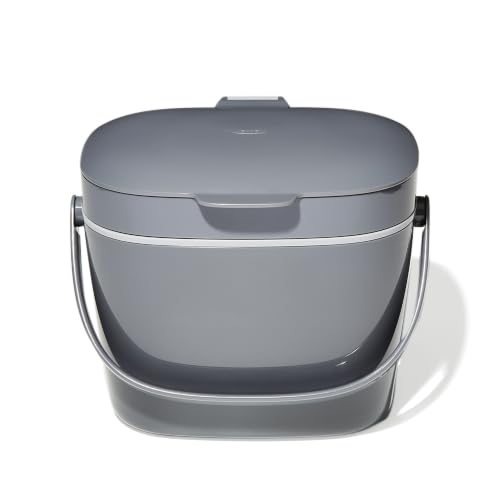
The standout feature is the bag-tuck design. The lid has a unique mechanism that keeps the compost bag tucked inside the bin, so the bag doesn’t flop over the rim or get in the way when you’re adding scraps. That sounds minor, but it’s a real quality-of-life improvement when you’re working with one hand while holding a cutting board in the other. The smooth interior is easy to wipe out, and the soft-close lid prevents slamming while still allowing oxygen to flow through, which reduces odors and deters pests.
The stay-open lid is another practical touch. It props open while you’re working, so you can toss scraps in without holding the lid up. When you’re done, a gentle push closes it. The charcoal color hides stains well, and the plastic body is lightweight enough to carry easily.
Honest criticism: the plastic construction doesn’t feel as premium as the stainless steel Utopia or the powder-coated KIBAGA. It’s also a bit taller than some countertop bins, so check your clearances under upper cabinets. But for a busy nursery kitchen where the bin gets used dozens of times a day, the functional design wins out over material snobbery.
- 1.75-gallon / 6.62-liter capacity for busy kitchens
- Bag-tuck design keeps liners neatly hidden inside the bin
- Soft-close lid contains odors while allowing oxygen flow
- Stay-open lid enables one-handed scrap disposal during food prep
- Smooth interior is easy to clean with minimal effort
Best for: High-traffic nursery kitchens that need a larger, user-friendly collection bin with smart lid mechanics and simple cleanup.
How We Chose These Products
We evaluated each bin against the specific demands of a professional nursery operation, not a backyard garden. That means we prioritized factors like batch consistency, ease of aeration, material safety, and the ability to integrate into a potting and transplanting schedule. We looked for bins that could support thermophilic composting temperatures, which are essential for pathogen suppression and weed seed elimination in growing media.
We also considered the full workflow. A nursery doesn’t just need a place to dump waste — it needs a system that produces a consistent, cured compost for potting mix. That’s why we included both outdoor processing units and countertop collection bins. The outdoor tumblers handle the biological work; the countertop bins make it easy to gather nitrogen-rich kitchen scraps without creating odor problems in shared spaces. Our methodology weighed capacity, build quality, ease of maintenance, and real-world usability over marketing claims.
Buying Guide: What Really Matters
Before you buy, think about your production cycle. If you’re potting up thousands of plugs each spring, you need a system that delivers finished compost on a predictable timeline. Batch composting with a dual-chamber tumbler gives you that control — you can fill one chamber, let it process for four to six weeks, then harvest while the other chamber starts a new batch. Continuous systems, where you keep adding material to a single pile, are harder to manage for consistent output.
Material safety matters more in a nursery than in a backyard. If you’re growing edible crops or using compost in propagation trays, you need to know what your bin is made of. BPA-free plastics are a baseline requirement. Galvanized steel can leach zinc and other heavy metals into acidic compost, which can harm young root zones. Powder-coated carbon steel and food-grade stainless steel are safer options for bins that will come into contact with material destined for edible plants.
Finally, consider the physical demands of the bin. A fully loaded 43-gallon tumbler is heavy — you’ll need to rotate it every few days to keep the pile aerobic. If you have staff who will be doing this work, make sure the bin’s mechanism is smooth and the height is ergonomic. For larger operations, linking multiple units can provide the continuous compost supply you need without investing in a commercial-scale system.
Our Top Recommendation
The VIVOSUN Outdoor Tumbling Composter is our clear winner for professional nurseries. Its dual-chamber design supports true batch composting, which gives you the timeline control that static piles can’t offer. The deep fins and vented panels promote the aerobic decomposition you need to reach thermophilic temperatures. And the metal frame with weather-resistant plastic body is built to survive years of outdoor use.
If your operation is smaller or you’re working with limited space, the VEVOR 43-Gallon Compost Bin is a strong alternative. The sliding doors make loading easier, and the pest-resistant seals are a genuine advantage in a nursery environment. For teams that just need a reliable countertop bin to collect kitchen scraps for a larger system, the OXO Good Grips model is the most user-friendly option we tested.
Whichever bin you choose, remember that the equipment is only half the equation. Your compost’s quality depends on maintaining the right carbon-to-nitrogen ratio, moisture content, and aeration schedule. A good bin makes that work easier — it doesn’t eliminate it.
Frequently Asked Questions
Can a compost tumbler reach high enough temperatures to kill pathogens?
Yes, but only if you manage the pile correctly. A tumbler needs a minimum volume — usually around 40 gallons — to generate and hold heat. You also need a balanced mix of carbon-rich and nitrogen-rich material, plus adequate moisture. Under those conditions, a well-designed tumbler can sustain thermophilic temperatures above 131°F for several days, which kills most weed seeds and plant pathogens. But you must monitor the internal temperature and turn the drum regularly to maintain aerobic conditions.
How does compost from a tumbler compare to commercial potting mix?
Compost is a soil amendment, not a direct substitute for potting mix. Mature compost adds beneficial microbes, improves water retention, and contributes slow-release nutrients. But it’s too dense and potentially too high in soluble salts to use as a standalone potting medium. A common nursery blend is 20-30% compost mixed with a peat or coir base, perlite, and a balanced fertilizer. The compost’s nutrient-rich compost profile enhances the mix without overwhelming young root zones.
How long does it actually take to produce usable compost in a tumbler?
With daily turning and the right material balance, you can have finished compost in four to six weeks during warm weather. But that’s not the full story. The material needs a curing phase of another two to four weeks after the active decomposition slows. Curing allows the compost to stabilize, pH to balance, and beneficial fungi to colonize. Plan for a total timeline of eight to ten weeks from filling the chamber to using the compost in your potting mix.
Is it worth collecting kitchen scraps separately for a nursery compost operation?
Kitchen scraps are a valuable source of nitrogen-rich material, which is often the limiting factor in a nursery’s compost pile. If your operation generates a lot of green waste from pruning and spent plants, you might have enough nitrogen already. But if your waste stream is mostly cardboard, straw, or woody stems, adding kitchen scraps helps balance the carbon-to-nitrogen ratio. A countertop bin makes that collection process clean and odor-free, which is worth the small investment.
For a deeper look at how to manage the curing phase and integrate compost into your potting schedule, check out our guide on compost bins for landscape professionals.