

Best Compost Bins with Wheels: 5 Tumbling Composters That Move Where You Need Them
Contents
You’ve filled the same plastic bin for three months, and now it sits in the far corner of the yard because dragging it across wet grass is miserable. A compost bin with wheels fixes that problem. You roll it to the kitchen door, load it, and roll it back to the sunniest spot on the property. No wheelbarrow, no buckets, no back strain.
The best wheeled composters balance three things: how much they hold, how easily they turn, and whether they can handle a full load without tipping. Capacity matters less than you’d think if the thing is impossible to rotate when it’s half full. Aeration holes, deep fins, and a solid frame do more for decomposition speed than a bigger barrel.
We looked at five wheeled tumblers with different strengths. The FCMP Outdoor Dual-Chamber is our top pick for most households. The 170L tumbler suits anyone who wants maximum volume on a budget. The Mantis Back Porch ComposTumbler is the one to get if raccoons have been raiding your pile. Here’s how they compare.
Quick comparison of the key specs that separate these five tumblers:
| Features | FCMP Dual-Chamber | Compost Tumbler 170L | KoolScapes Wheeled | Mantis Back Porch | FCMP HOTFROG Mobile |
|---|---|---|---|---|---|
| Capacity | 37 gallons | 45 gallons | 50 gallons | Not specified | 37 gallons |
| Chambers | Dual | Single | Single | Single | Dual |
| Frame | Galvanized steel | PP plastic body | Powder-coated steel | Enclosed barrel | Painted galvanized steel |
| Wheel Setup | Integrated wheels | Two wheels | Steel frame wheels | Not specified | Wheel kit included |
| Best Use Case | Continuous composting | Large volume batches | Pest-prone yards | Small urban spaces | Patio and garden |
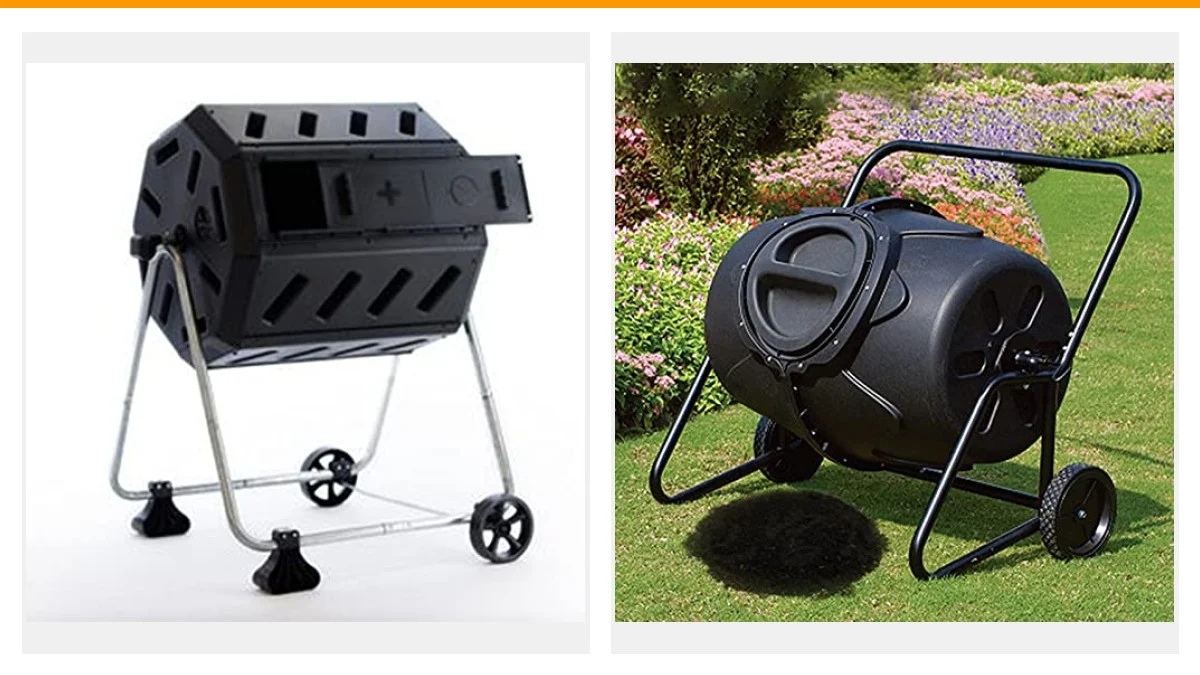
FCMP Outdoor Dual-Chamber
1st Pick

FCMP Outdoor
FCMP Outdoor Dual-Chamber Tumbling Composter with Wheels, Black, 37 Gallon
- Rolls Where You Need It: Integrated wheels and deep moulded handholds let 1 person walk the compost tumbler from the back door out…
- Dual Chamber Flow: Fill 1 chamber while the second matures, and an 8-sided barrel with deep interior fins shears clumps apart ever…
- 37 Gallon Working Volume: 2 chambers share 37 gallons, or 140 litres, of trimmings, coffee grounds, eggshells, shredded leaves and…
This is the composter for the household that generates kitchen scraps every single day and wants a steady supply of finished compost rather than one big batch per season. The dual-chamber design means you fill one side while the other side cures. When the first side is ready, you empty it and start filling that side again. The cycle never stops. If you cook at home most nights and also bag grass clippings on weekends, this is the one that keeps up.
What sets it apart is the eight-sided barrel with deep fins. Those fins aren’t just for grip when you rotate it. They break up clumps inside the chamber as the barrel turns, which means you’re not opening the door to find a solid brick of matted leaves stuck to the walls. The aeration holes run along the body, so oxygen gets into the mix every time you spin it. Five or six turns every two or three days is all it takes. In hot weather with the right carbon-to-nitrogen ratio, you can have finished compost in about two weeks.
The 37-gallon total capacity splits into two chambers, so each side holds roughly 18 gallons. That’s fine for a household of two to four people, but a large family producing buckets of scraps might find each chamber fills faster than expected. The integrated wheels help you reposition it, though they’re not designed for long-distance hauling over rough terrain. Think of them as repositioning wheels, not transport wheels. It’s also worth noting the door openings are large, which makes emptying easier, but you still need to reach in with a scoop or small shovel to get the last bit out.
- 37-gallon total capacity across two chambers
- Eight-sided barrel with deep fins for clump breaking
- UV-inhibited recycled polypropylene construction
- Integrated wheels for yard repositioning
- Removable door for easy loading and emptying
Best for: Households that want a continuous supply of compost and generate kitchen waste daily.
Compost Tumbler 170L – Large
2nd Pick
Generic
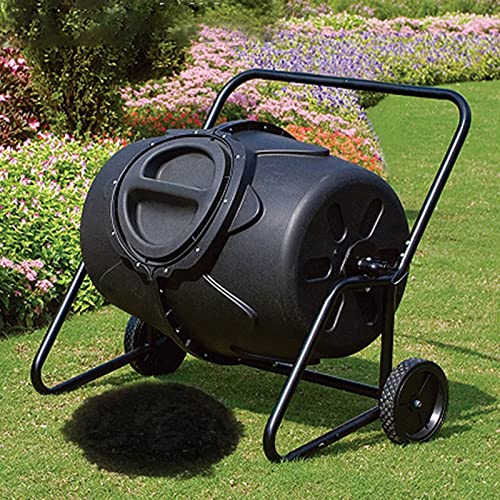
Compost Tumbler 170L - Large Outdoor Composter Bin with Wheels for Easy Movement, Perfect for Garden Yard Leaves and Kitchen Waste
- 【 Easy to Move 】 The capacity of the compost tumbler is large enough ( 170 L / 45 Gallons ), has 2 wheels, strong load-bearing cap…
- 【 Convenient Aeration & Rotating Design 】 The compost barrel have air vents that break up clumps in the chamber and mix lots of ox…
- 【 Durable Compost Bin 】 The main body of this compost bucket is made of durable PP, weather-resistant, waterproof, UV-proof, no od…
Someone with a big garden, a lot of leaves in autumn, and a tight budget will get the most out of this tumbler. The 170-liter (45-gallon) capacity is the largest single-chamber option here, and the two-wheel design lets you push it around the yard without lifting. Picture a homeowner raking up bags of leaves in October who wants to turn all of it into compost by spring. This barrel holds enough to make that realistic.
The rotating design is straightforward. You give it a spin every few days, and the internal vents mix oxygen through the pile. No digging, no pitchfork, no turning by hand. The PP plastic body is weather-resistant and UV-proof, so it won’t crack after a summer in direct sun. Assembly is quick, which matters if you’re not handy with tools. The sliding door on the side makes removing finished compost less awkward than reaching through a top hatch.
Here’s the trade-off: a single chamber means you can’t add fresh scraps while the batch is curing. Once you stop adding material and let it finish, you’re not composting anything new until you empty it. That’s a real limitation for anyone who composts year-round. The plastic body is durable but not as rigid as a steel-framed unit, so overloading it with wet, heavy material could stress the frame over time. And the generic branding means replacement parts aren’t easy to find if something breaks.
- 45-gallon single-chamber capacity
- Two-wheel design for pushing around the garden
- Durable PP construction, waterproof and UV-proof
- Sliding door for compost removal
- Quick assembly with minimal tools
Best for: Budget-conscious gardeners with large yards who compost in batches rather than continuously.
KoolScapes Wheeled Tumbling
3rd Pick

Koolatron
KoolScapes Wheeled Tumbling Composter, 50-Gallon, Black
- EFFICIENT TUMBLING ACTION Rotary design with deep fins and an internal steel bar breaks up clumps and mixes in oxygen with no hand…
- FASTER DECOMPOSITION Black double-walled panels absorb and retain heat and air vents promote aeration for faster and more effectiv…
- RODENT-PROOF TWIST-LOCK ACCESS The enclosed design reduces pest-attracting odors and the twist-lock lid keeps animals out and your…
If raccoons, rats, or possums have been treating your compost pile like a buffet, this is the tumbler to look at. The enclosed barrel and twist-lock lid keep animals out and odors in. Someone living near a wooded area or on the edge of town knows exactly how frustrating it is to find scraps scattered across the lawn every morning. The KoolScapes solves that problem with a locking mechanism that’s simple but effective.
The 50-gallon capacity is the biggest here. Black double-walled panels absorb heat, which speeds up decomposition compared to lighter-colored bins. An internal steel bar runs through the barrel and works with the deep fins to break up clumps as you rotate. The steel frame has an upper handle and wheels, so moving it around the yard is manageable even when it’s full. The 18-gauge powder-coated steel frame is corrosion-resistant, and the barrel is made from BPA-free recycled plastic. This thing is built to sit outside year-round.
It’s heavy when loaded. A 50-gallon barrel full of wet compost weighs a lot, and the wheels help but don’t make it effortless. You’ll want to position it near where you’ll use the compost before you fill it, rather than planning to move it afterward. Availability can be spotty, so check stock before you get set on this model. And the single-chamber design means the same batch-composting limitation as the 170L unit above.
- 50-gallon capacity, largest in this roundup
- Twist-lock lid keeps rodents out
- Black double-walled panels absorb heat
- Internal steel bar breaks up clumps
- 18-gauge powder-coated steel frame
Best for: Homeowners in rural or semi-rural areas who need a pest-proof, high-capacity tumbler.
Mantis Back Porch ComposTumbler
4th Pick
Mantis
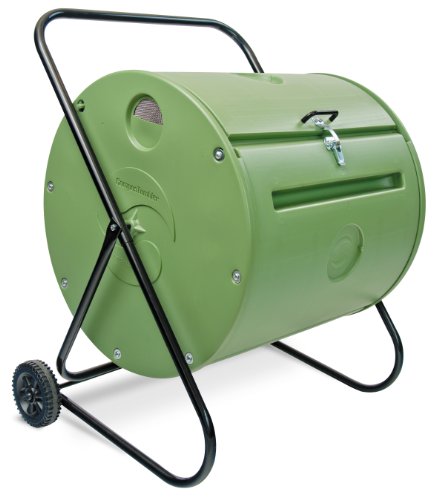
Mantis Back Porch ComposTumbler
- Perfect for Urban Spaces and Small Properties
- Fully Enclosed Composter Design Eliminates Odors and Keeps Animals Out
- ComposTumbler Barrel Features Removable Door for Easy Filling and Emptying
Apartment dwellers with a balcony, condo owners with a small patio, and anyone with a postage-stamp yard will appreciate what Mantis built here. This composter is designed for tight spaces. It’s fully enclosed, which means no odors and no animals digging through your pile. The barrel has a removable door for filling and emptying, and the air vent at the top keeps oxygen flowing into the mix. Drainage vents let excess moisture escape, which prevents the soggy, smelly mess that plagues poorly ventilated bins.
The enclosed design is the main selling point. You can keep this on a back porch or beside a garage without worrying about smells or pests. For urban composters, that’s huge. The barrel rotates, so you’re not digging or turning by hand. The removable door makes it easier to get finished compost out compared to bins with small hatches.
Capacity isn’t specified in the product data, which is frustrating if you’re trying to compare it directly to the others. Based on the “back porch” positioning, it’s likely smaller than the 37-gallon and 50-gallon options. That’s fine for a single person or couple composting kitchen scraps, but a family generating large volumes of yard waste will outgrow it quickly. Availability is also limited, so you may need to check stock regularly if this is the one you want.
- Fully enclosed design eliminates odors
- Removable door for easy access
- Top air vent for oxygen flow
- Drainage vents prevent excess moisture
- Compact footprint for small spaces
Best for: Urban and small-space composters who need an odor-free, pest-proof option for a patio or porch.
FCMP Outdoor HOTFROG Mobile
5th Pick
FCMP Outdoor
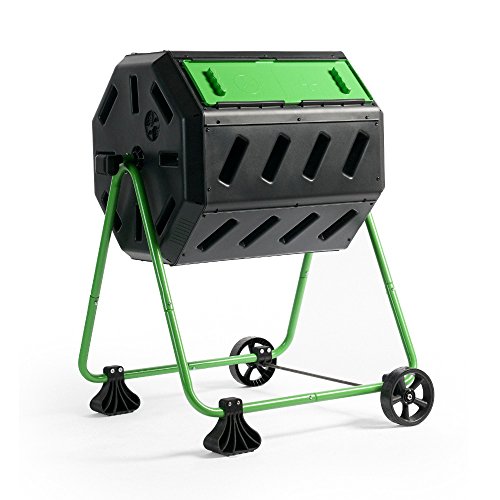
FCMP Outdoor HOTFROG Mobile Dual Chamber Tumbling Composter with Wheels - Outdoor Rotating Garden Compost Bin (HF-IM4000-WK) Black & Green (37-Gallon)
- Tumbling Composter – Avoid digging and mixing your compost pile by hand. The tumbling design makes mixing easy and efficient. Just…
- Easy To Use – Fantastic for beginners! The large openings and removable door make it easy to add scraps/clippings and remove finis…
- Two Composter Chambers Are Better Than One – Two separate sides allow the first side to finish while leaving the second side avail…
This is essentially the FCMP Dual-Chamber with a wheel kit added, and that makes it the most flexible option in the group. You get the same 37-gallon dual-chamber design that lets you compost continuously, plus a wheel kit with stability feet and a handle. The idea is simple: move the composter to where you need the compost instead of hauling buckets of finished material across the yard. Someone with a large property and multiple garden beds will appreciate that feature more than they expect.
The dual-chamber setup works the same way as the standard FCMP model. Fill one side, let it cure, empty it, and start again. The aeration holes and deep fins handle the mixing as you tumble. The barrel is made in Canada from BPA-free, UV-inhibited recycled polypropylene, and the painted galvanized steel frame resists corrosion. The wheel kit includes stability feet, which is a small detail that matters. Without them, a wheeled composter can rock or tip when you’re turning a heavy load.
The wheel kit adds cost compared to the standard FCMP model, and if you don’t actually need to move the composter around, you’re paying for a feature you won’t use. The 37-gallon capacity is the same as the first pick, so if you need more volume, neither FCMP model will satisfy you. And like all tumblers, it works best when you maintain the right moisture level and carbon-to-nitrogen ratio. A tumbler speeds things up, but it doesn’t compost for you.
- 37-gallon dual-chamber capacity
- Wheel kit with stability feet and handle
- BPA-free, UV-inhibited recycled polypropylene
- Painted galvanized steel frame
- Made in Canada
Best for: Gardeners with multiple beds who want to wheel finished compost directly to where it’s needed.
How We Chose These Products
We started with a simple filter: does this composter have wheels, and do those wheels actually serve a purpose? Plenty of bins bolt on a pair of tiny casters that can’t handle a full load. We looked for models where the wheel design matched the capacity, so you’re not fighting the thing every time you move it.
From there, we weighed capacity against chamber design, build materials, and aeration features. Dual-chamber models got extra attention because they solve the batch-composting problem that frustrates so many first-time composters. We also considered pest resistance, odor control, and how easy each unit is to empty. The result is a mix of tumblers for different living situations, from balcony composters to rural homeowners with serious yard waste.
Buying Guide: What Really Matters
Capacity is the first number people look at, but it’s not the most important one. A 50-gallon single-chamber tumbler sounds impressive until you realize you can’t add fresh scraps for weeks while the batch cures. A 37-gallon dual-chamber unit gives you less total space but lets you compost continuously. Think about how you actually generate waste. If it’s a steady daily trickle, dual-chamber wins. If it’s seasonal bursts of leaves and clippings, a big single chamber works fine.
Build quality matters more than most buyers expect. Plastic barrels are fine, but the frame and axle take the real stress. Steel frames with powder coating last longer than plastic frames, especially in wet climates. Check whether the wheels are integrated into the frame or bolted on as an afterthought. Integrated wheels handle weight better. And look for a locking lid if animals are a concern in your area.
Aeration is what separates a tumbler that produces compost in weeks from one that sits there rotting for months. Deep fins inside the barrel break up clumps. Aeration holes let oxygen in. Some models add an internal steel bar for extra mixing. More aeration features generally mean faster decomposition, though you still need to maintain proper moisture. A tumbler that’s too dry or too wet won’t compost well no matter how many vents it has. If you’re new to composting, a beginner-friendly compost bin with clear instructions and a simple design will serve you better than a complex unit.
Our Top Recommendation
The FCMP Outdoor Dual-Chamber takes the top spot because it solves the biggest problem in home composting: what to do with fresh scraps while the current batch finishes. The dual-chamber design keeps the cycle going, and the eight-sided barrel with deep fins does the mixing work for you. It’s not the biggest option here, but it’s the most practical for a typical household that composts year-round. You can check the current price on Amazon to see if it fits your budget.
If you need more capacity and don’t mind batch composting, the Compost Tumbler 170L gives you 45 gallons for less money. For pest-prone areas, the KoolScapes with its twist-lock lid and 50-gallon barrel is the safer bet. And if you’re working with a balcony or small patio, the Mantis Back Porch ComposTumbler is built for exactly that situation. Anyone composting on an allotment plot should also look at compost bins for allotments, since space and security needs differ from a home garden.
Frequently Asked Questions
How often do I need to turn a wheeled tumbler?
Five or six full rotations every two to three days is the standard recommendation. More frequent turning adds oxygen and speeds things up, but over-turning can cool the pile. In hot weather, you might turn it every other day. In winter, once or twice a week is enough.
Can I put meat or dairy in a tumbler?
Most manufacturers advise against it because those items attract pests and create odors. The enclosed design of a tumbler reduces the risk, but it doesn’t eliminate it. Stick to fruit and vegetable scraps, coffee grounds, eggshells, grass clippings, and dry leaves for the best results.
Why is my compost not heating up?
The usual culprits are too much moisture, not enough nitrogen-rich material, or a pile that’s too small. Aim for a mix that feels like a wrung-out sponge. Add grass clippings or kitchen scraps if it’s too dry and carbon-heavy. A tumbler needs a decent volume of material to generate heat, so don’t expect fast results from a half-empty barrel.
Do wheels make a composter less stable?
They can if the design is poor. Look for models with stability feet or a wide base that prevents tipping when you rotate a full barrel. The FCMP HOTFROG includes stability feet for exactly this reason. If a wheeled composter feels wobbly when empty, it’ll feel worse when loaded.
For more options on kitchen waste and backyard setups, our guide to backyard compost bins with wheels covers additional models and configurations.


