Every March, the same scene plays out in garden centers and on Amazon. A homeowner stares at a wall of bags, all promising a greener lawn, and grabs whichever one has the boldest number on the front. Two weeks later, the grass looks the same — or worse, it’s yellow at the tips and the crabgrass is already winning.


A great spring fertilizer does three things well. It delivers nitrogen in a form the grass can actually use at the current soil temperature, it matches the nutrient ratio your soil is missing, and it won’t sabotage a pre-emergent or a spring overseeding. Get those three right and the brand matters far less than the timing.
I tested and compared five products that cover the main spring scenarios: a fast green-up formula, a fall-to-spring root builder, a general all-season feeder, a liquid concentrate for precision work, and a large-coverage option for big properties. The Scotts Green Max takes the top spot for most lawns, but the right pick depends on your grass type, your soil test, and whether you’re seeding this spring.
Here’s a quick spec comparison to help you narrow it down before the full reviews.
| Features | Scotts Green Max | Turf Builder WinterGuard 10 lb | Turf Builder Lawn Food | Advanced 16-4-8 Liquid | Turf Builder WinterGuard 32 lb |
|---|---|---|---|---|---|
| Primary Use | Fast spring green-up | Fall root building | All-season feeding | Spring and summer spray | Fall root building |
| Form | Granular | Granular | Granular | Liquid concentrate | Granular |
| Coverage | 5,000 sq ft | 4,000 sq ft | 5,000 sq ft | 32 oz concentrate | 12,000 sq ft |
| Key Nutrient | Nitrogen plus iron | Slow-release nitrogen | Balanced NPK | 16-4-8 NPK | Slow-release nitrogen |
| Best Season | Early spring | Late fall | Spring, summer, fall | Late spring, summer | Late fall |
Scotts Green Max Lawn Food
Green Max is the bag you grab when the lawn looks tired and you want visible results before the weekend guests arrive. The dual-action formula pairs nitrogen with an iron supplement, which is why it can push color in about three days instead of the usual two weeks. It works on every grass type, and the iron is what drives that deep green without forcing a flush of top growth.
What separates this from a generic spring blend is the staining guarantee. Iron-heavy fertilizers can leave rust-colored streaks on concrete, and Scotts formulated this one to avoid that when you follow the label. You can also walk back on the lawn immediately after applying, which matters if you have kids or a dog that treats the yard like a racetrack.
The catch is timing. This is a fast-release, high-nitrogen product, so applying it before the grass is actively growing wastes the nitrogen and risks runoff. Wait until soil temps are consistently in the mid-50s. It’s also not sold in Florida, so warm-season homeowners in the South need a different option. And if you’re overseeding this spring, skip it until the new grass has been mowed at least three times.
- Iron supplement drives deep color without excessive top growth
- Guaranteed not to stain concrete when used as directed
- Safe to re-enter the lawn immediately after application
- Works on all grass types, but not sold in Florida
- Fast-release nitrogen means timing matters more than with slow-release
Best for: Homeowners with established cool-season lawns who want a fast visual green-up in early spring.
Scotts Turf Builder WinterGuard 10 lb
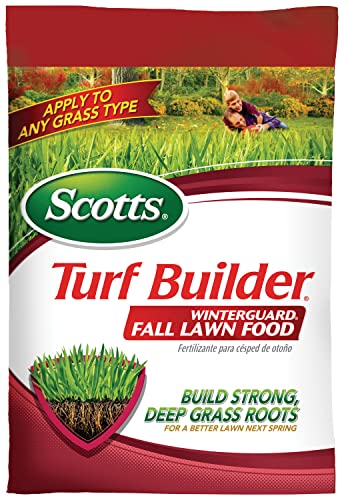
Scotts
Scotts Turf Builder WinterGuard Fall Lawn Food, 10 lbs. | Lawn Fertilizer for All Grass Types, Covers 4,000 sq. ft., Autumn Lawn Care
- FALL LAWN FERTILIZER: Scotts Turf Builder WinterGuard Fall Lawn Food is a fertilizer that builds strong, deep grass roots for a be…
- SUMMER LAWN RECOVERY: Our fertilizer provides nutrients lawns need to help recover from summer heat, drought, and regular activity…
- APPLY IN FALL TO PREPARE YOUR LAWN FOR WINTER: Apply this grass fertilizer to a wet or dry lawn in the fall
This one is technically a fall fertilizer, but it belongs in a spring article because it’s the product that determines how your lawn looks in March. WinterGuard builds root mass in late fall so the grass has stored energy to green up on its own when spring arrives. If your lawn always looks sluggish in April, the fix probably started last October.
The 10-pound bag covers 4,000 square feet, which suits a typical suburban front yard or a small combined front-and-back. It’s a slow-release nitrogen formula, so there’s little burn risk and no rush to water it in. Apply it to a wet or dry lawn and let the fall rains do the rest.
Here’s the honest limitation: if you didn’t apply it in fall, buying it in spring won’t help much. The root-building window has closed. You’d be better off with Green Max or a balanced spring feeder. This is a product you buy in September, not April, but it’s worth knowing about now so you plan ahead.
- Slow-release nitrogen builds roots without top-growth flush
- Covers 4,000 sq ft, ideal for small to mid-size lawns
- Helps grass recover from summer heat and drought stress
- Apply in fall to a wet or dry lawn, any grass type
- Won’t deliver spring results if you skip the fall application
Best for: Homeowners planning a full-year lawn care schedule who want stronger spring green-up next year.
Scotts Turf Builder Lawn Food

Scotts
Scotts Turf Builder Lawn Food, 12.5 lbs. | Fertilizer for Grass, For All Grass Types, Covers 5,000 sq. ft.
- WHERE TO USE: Lawn fertilizer for grass can be used on any grass type
- GRASS FERTILIZER FOR LAWNS: Scotts Turf Builder Lawn Food feeds and strengthens your grass to help protect against future problems
- STRONG ROOTS: Our pesticide-free lawn food for grass builds strong, deep roots, improving your lawn's ability to absorb water and…
Turf Builder Lawn Food is the plain vanilla of lawn fertilizers, and that’s a compliment. It’s a balanced granular feed you can apply in spring, summer, or fall without overthinking it. The 12.5-pound bag covers about 5,000 square feet, and the formula builds deep roots that help the grass absorb water and nutrients more efficiently than an unfed lawn.
The biggest advantage here is flexibility. If you’re new to lawn care and don’t know your soil test results yet, this is a safe starting point. It won’t push excessive growth, it won’t burn, and it plays well with most pre-emergent schedules. The pesticide-free formula also means you’re not accidentally killing beneficial insects while feeding the grass.
What it lacks is punch. You won’t see the three-day color shift that Green Max delivers. Results are steady and gradual over two to three weeks. For a lawn that’s already in decent shape, that’s fine. For a lawn coming out of a rough winter, you may want something with more immediate nitrogen.
- Balanced NPK suitable for spring, summer, and fall
- Builds deeper roots for better water and nutrient uptake
- Pesticide-free formula, safe around beneficial insects
- Covers 5,000 sq ft per 12.5 lb bag
- Gradual results, not a fast green-up product
Best for: Beginners and anyone who wants one bag that works across multiple seasons without risk.
Advanced 16-4-8 Balanced NPK
Liquid fertilizer solves a problem granular can’t: precision. Simple Lawn Solutions’ 16-4-8 concentrate lets you dial in the exact rate per zone, which matters if your front yard and back yard have different soil or different grass. The 16-4-8 ratio leans nitrogen-heavy with modest phosphorus and solid potassium, which suits spring growth without overloading phosphorus where it isn’t needed.
The formula includes seaweed and fish, both of which add micronutrients and soil biology benefits you won’t get from a straight salt-based granular. It’s manufactured in the US by a family-owned company with commercial turf experience, and it works on every warm- and cool-season grass, from Bermuda and St. Augustine to fescue and Kentucky bluegrass.
Liquid isn’t for everyone. You need a sprayer, you need to mix correctly, and you need to time applications around rain. The 32-ounce bottle treats a limited area compared to a 12,000-square-foot granular bag, so large properties will burn through it fast. It’s also easier to over-apply if you’re careless, and liquid nitrogen can burn blades in high heat.
- 16-4-8 NPK ratio with seaweed and fish micronutrients
- Works on all warm- and cool-season grass types
- Precise dosing per zone, ideal for mixed lawns
- Made in the USA by a family-owned company
- Requires a sprayer and careful mixing, not a broadcast spreader
Best for: Detail-oriented homeowners with mixed grass types or irregular lawns who want zone-by-zone control.
Scotts Turf Builder WinterGuard 32 lb
Scotts
Scotts Turf Builder WinterGuard Fall Lawn Food, 32.3 lbs. | Lawn Fertilizer for All Grass Types, Covers 12,000 sq. ft., Autumn Lawn Care
- FALL LAWN FERTILIZER: Scotts Turf Builder WinterGuard Fall Lawn Food is a fertilizer that builds strong, deep grass roots for a be…
- SUMMER LAWN RECOVERY: Our fertilizer provides the plant food nutrients lawns need to help recover from summer heat, drought, and r…
- APPLY IN FALL TO PREPARE YOUR LAWN FOR WINTER: Apply this grass fertilizer to a wet or dry lawn in the fall
The 32.3-pound version of WinterGuard is the same formula as the 10-pound bag, scaled up to cover 12,000 square feet. That’s roughly a third of an acre, which makes it the practical choice for rural properties, large suburban lots, or anyone who maintains a lawn plus a side pasture.
Buying the bigger bag drops the cost per square foot considerably, and the slow-release nitrogen means you’re not making multiple trips to reapply. One fall application covers the whole property. The root-building benefit carries through winter and shows up as stronger spring green-up without any spring fertilizer at all.
Storage is the trade-off. A 32-pound bag takes up real shelf space, and if you don’t use it all in one season, it can absorb moisture and clump. Keep it sealed in a dry spot. And again, this is a fall product. Buying it in April is a planning move, not an immediate fix.
- Covers 12,000 sq ft, best value per square foot
- Same slow-release root-building formula as the 10 lb bag
- Works on any grass type, wet or dry application
- Helps lawns recover from summer heat and drought
- Bulk bag needs dry storage to prevent clumping
Best for: Owners of large properties who want one fall application to cover the whole lawn.
How We Chose These Products
I started with the timing question, because spring fertilizer is worthless if it goes down at the wrong soil temperature. Each product was evaluated against the soil-temp window for cool-season and warm-season grasses, and against the pre-emergent and overseeding conflicts that trip up most homeowners.
From there, I looked at nutrient form. Slow-release nitrogen earns points for safety and steady feeding. Fast-release earns points for speed but loses ground on burn risk and runoff. I also weighed coverage area against bag size to see which products actually deliver value, and I flagged anything with a regional restriction or a compatibility issue with seeding.
Buying Guide: What Really Matters
Soil temperature beats the calendar every time. Cool-season grasses like fescue and Kentucky bluegrass want to be fed when soil hits 50 to 55 degrees Fahrenheit, which is usually when forsythia blooms. Warm-season grasses like Bermuda and St. Augustine want 65 degrees and up, typically four to six weeks later. A $15 soil thermometer removes all the guesswork.
Get a soil test before you buy anything. A basic test from your county extension office tells you pH, phosphorus, and potassium levels. If phosphorus is already high, a 16-4-8 or a phosphorus-free blend is the right call. If it’s low, you need something with more P. Buying blind is how people end up with lush grass and algae-filled ponds.
Watch the pre-emergent conflict. Most spring pre-emergents go down before soil hits 55 degrees. Fertilizing at the same time can push weed growth before the pre-emergent has formed its barrier. If you’re using a crabgrass preventer, wait two to four weeks after application before feeding. And if you’re overseeding, use a starter fertilizer, not a standard spring blend, until new grass has been mowed three times.
For more detail on matching ratios to your soil, see this guide to the best ratio for lawn fertilizer. If you’re specifically working with heavy clay, this breakdown of clay soil lawn fertilizer covers the nutrient-holding issues that change your application strategy.
Our Top Recommendation
Scotts Green Max Lawn Food wins for most homeowners because it solves the most common spring problem: a lawn that looks dull and needs visible improvement fast. The iron supplement delivers color without forcing excessive growth, the no-stain guarantee removes the biggest risk of iron-based products, and the immediate re-entry makes it practical for families with pets.
If you’re on a tight budget or new to lawn care, Turf Builder Lawn Food is the safer, cheaper starting point. It won’t wow you in three days, but it won’t burn your lawn either. For large properties, the 32-pound WinterGuard is the value play, provided you apply it in fall. And if you have mixed grass types or want precise control, the Advanced 16-4-8 liquid is worth the extra effort.
Frequently Asked Questions
Can I fertilize and apply pre-emergent at the same time?
No. Pre-emergent needs to form a barrier before weed seeds germinate, and fertilizer pushes growth that can break through it. Apply pre-emergent first, then wait two to four weeks before feeding.
What soil temperature should I wait for in spring?
Cool-season grasses need 50 to 55 degrees Fahrenheit. Warm-season grasses need 65 degrees or higher. Measure at a 2-inch depth in the morning for the most accurate reading.
Will spring fertilizer kill new grass seed?
Standard spring blends can, because the nitrogen is too strong for tender seedlings. Use a starter fertilizer instead, and wait until you’ve mowed the new grass at least three times before switching to a regular spring feed.
How do I avoid burning my lawn with spring fertilizer?
Water the lawn lightly before applying granular, use a spreader calibrated to the label rate, and water in after application. Never fertilize wet grass blades in full sun, and avoid fast-release nitrogen when temperatures are above 85 degrees.