I spent last Saturday standing in the fertilizer aisle, staring at a wall of bags that all promised a greener lawn. The labels looked identical. The prices varied wildly. And every bag claimed to be the best lawn care fertilizer on the shelf. It felt like a trap designed for people who just want their grass to look decent without a degree in soil science.

The truth is simpler than the marketing suggests. A good fertilizer matches three things: your grass type, the season, and what your soil is actually missing. Get those right, and you can ignore 90% of the noise on the packaging. Get them wrong, and you’ll either burn your lawn or feed weeds you didn’t know you had.
I narrowed this list to five Scotts products that cover the major use cases: fall root-building, rapid greening, summer insect control, liquid feeding for small yards, and fall weed-and-feed. The Scotts Turf Builder WinterGuard Fall Lawn Food is my top pick for most homeowners because it solves the most common problem in lawn care, which is a weak spring lawn caused by neglect in October. But the right choice depends on what your grass is doing right now.
| Features | Scotts WinterGuard Fall | Scotts Green Max | Scotts SummerGuard | Scotts Liquid Turf Builder | Scotts WinterGuard Weed & Feed |
|---|---|---|---|---|---|
| Primary Use | Fall root building | Rapid greening | Summer stress relief | Quick liquid feeding | Fall weed control |
| Coverage | 4,000 sq ft | 5,000 sq ft | 5,000 sq ft | 2,000 sq ft | 4,000 sq ft |
| Key Ingredient | Slow-release nitrogen | Iron supplement | Insect killer | Liquid nutrients | Weed killer |
| Application | Fall only | Growing season | Summer | Growing season | Fall only |
| Best For | Winter prep | Quick color | Bug problems | Small yards | Weedy fall lawns |

Scotts Turf Builder Winte…
Scotts
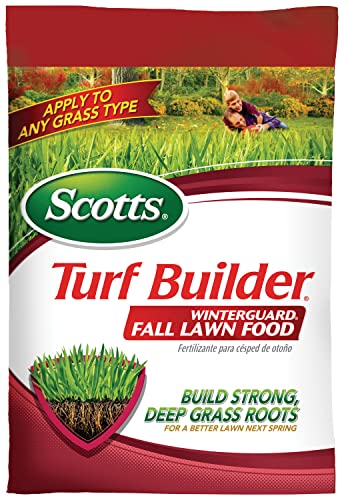
Scotts Turf Builder WinterGuard Fall Lawn Food, 10 lbs. | Lawn Fertilizer for All Grass Types, Covers 4,000 sq. ft., Autumn Lawn Care
- FALL LAWN FERTILIZER: Scotts Turf Builder WinterGuard Fall Lawn Food is a fertilizer that builds strong, deep grass roots for a be…
- SUMMER LAWN RECOVERY: Our fertilizer provides nutrients lawns need to help recover from summer heat, drought, and regular activity…
- APPLY IN FALL TO PREPARE YOUR LAWN FOR WINTER: Apply this grass fertilizer to a wet or dry lawn in the fall
This is the bag you buy in September or October when you want a better lawn next spring. It’s a fall fertilizer designed to push nutrients down into the roots before the grass goes dormant. Homeowners with cool-season grasses like fescue or bluegrass will see the biggest benefit. Warm-season grass owners in the South can use it too, but the timing window is tighter.
What sets this apart from a generic fall fertilizer is the slow-release nitrogen. That matters because quick-release nitrogen in cool weather can sit in the soil and leach away before the grass can use it. The slow-release formula feeds the roots gradually over weeks, which is exactly what you want when the top growth has stopped but the roots are still active. One 10-pound bag covers 4,000 square feet, so a typical quarter-acre lawn needs about two and a half bags.
The main limitation is that this product does nothing for weeds. If your fall lawn is full of dandelions and clover, you’ll need a separate weed control step or a different product. Also, applying it too late (after the ground is cold) wastes money because the grass won’t take up the nutrients. Aim for early to mid-fall when daytime temperatures are still in the 60s.
- Slow-release nitrogen feeds roots for weeks, not days
- Works on any grass type, including fescue, bluegrass, and bermuda
- One 10 lb bag covers 4,000 sq ft
- Apply to a wet or dry lawn in the fall
- No weed control included
Best for: Homeowners who want a stronger spring lawn without dealing with weeds yet.
Scotts Green Max Lawn Foo…

Scotts
Scotts Green Max Lawn Food, 16.67 lbs. | Lawn Fertilizer for Grass Plus Iron Supplement, Grass Fertilizer, Covers 5,000 sq. ft.
- Feeds for deep greening in just 3 days
- Dual-action, 2-in-1 formula feeds and supplements with iron
- Guaranteed not to stain when used as directed
Green Max is the product you grab when your lawn looks tired and you have guests coming this weekend. It’s a dual-action formula that feeds grass and adds iron for deep greening. Scotts claims you’ll see color in three days, and that’s realistic if the grass is actively growing and the soil is moist. This isn’t a fall or winter product. It’s for spring and summer when the grass is hungry.
The iron supplement is the standout feature. Iron doesn’t feed the grass directly, but it helps with chlorophyll production, which is what makes grass look dark green. Many lawns are iron-deficient without the owner realizing it. A quick application of Green Max can fix that yellow tint faster than a standard nitrogen fertilizer. It’s also guaranteed not to stain when used as directed, which matters if you have a concrete driveway or patio nearby.
Here’s the catch: Green Max is a quick fix, not a long-term soil builder. It doesn’t do much for root depth or soil health. If you use it every month, you’ll get a green lawn that’s shallow-rooted and dependent on constant feeding. Use it strategically, maybe once in early spring and once after summer stress, and rely on a slow-release product for the rest of the year. Also note it’s not sold in Florida, so Sunshine State residents need a different option.
- Feeds and supplements with iron for deep greening
- Visible color change in about three days
- Won’t stain concrete when applied as directed
- Safe for any grass type
- Not available in Florida
Best for: Homeowners who need fast color before an event or after a rough summer.
Scotts Turf Builder Summe…
Scotts
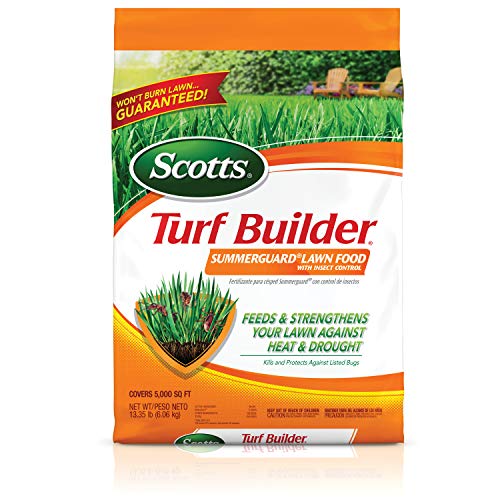
Scotts Turf Builder SummerGuard Lawn Food with Insect Control - Lawn Fertilizer and Insect Killer, 5,000 sq. ft., 13.35 lbs.
- Feeds and strengthens your lawn against heat and drought
- Kills and protects against listed bugs
- Won't burn lawn—guaranteed
SummerGuard is a two-in-one product that feeds your lawn and kills surface insects at the same time. It’s aimed at homeowners who deal with chinch bugs, sod webworms, or fleas in the summer. The fertilizer part strengthens grass against heat and drought, while the insect control handles the bugs that chew through stressed turf. One bag covers 5,000 square feet.
The biggest selling point is convenience. You don’t have to buy a separate insecticide and a separate fertilizer, then figure out how to apply both without double-dosing. SummerGuard does it in one pass. The formula won’t burn your lawn, which is a real concern in July and August when grass is already heat-stressed. Scotts also notes that a healthy lawn can clean the air, produce oxygen, and reduce runoff, which is a nice bonus if you care about the environmental side.
The trade-off is that this product is season-specific. Using it in spring or fall is a waste of money because the insect control targets summer pests. Also, it kills listed bugs on contact, but it won’t prevent grubs or underground pests. If you have a grub problem, you need a different product. And if you’re trying to grow a organic lawn, this isn’t for you. It’s a synthetic fertilizer with chemical insect control.
- Feeds grass and kills listed surface insects
- Won’t burn lawn when applied as directed
- Covers 5,000 sq ft per bag
- Helps grass survive heat and drought
- Does not control grubs or underground pests
Best for: Homeowners who want to feed the lawn and handle summer bugs in one step.
Scotts Liquid Turf Builde…
Scotts
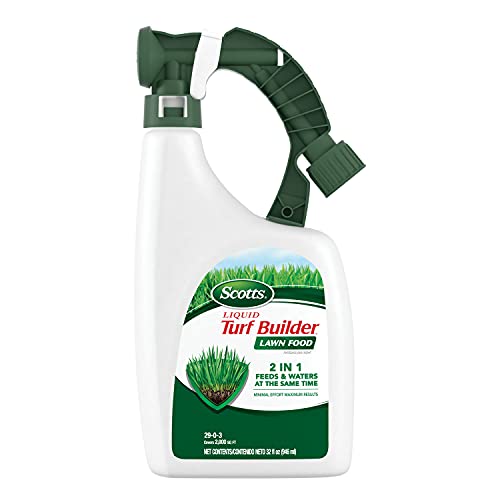
Scotts Liquid Turf Builder Lawn Food, 2,000 sq. ft. | Feeds and Waters Lawn at Same Time
- Feeds and greens while watering your lawn
- Apply to any grass type
- Use when turf is actively growing
Liquid Turf Builder is the odd one out in this list because it’s a hose-end sprayer, not a granular spreader product. You attach it to your hose, turn on the water, and spray. It feeds and greens while you water, which saves a step. The coverage is 2,000 square feet, so it’s best for small yards, townhomes, or renters who don’t want to buy a spreader.
The convenience factor is high. You don’t need to measure granules or calibrate a spreader. You just spray and go. It works on any grass type and is safe to use when turf is actively growing. Scotts improved the greening compared to the previous version, so it’s a decent option for a quick pick-me-up. It also feeds and strengthens the grass to help protect against future problems, though that’s more of a general benefit than a specific claim.
The downside is cost per square foot. A 2,000-square-foot bottle costs more per application than a granular bag that covers 5,000 square feet. If you have a large lawn, liquid gets expensive fast. Also, availability is listed as scarce on Amazon, so you may need to check other retailers. And because it’s a liquid, you need to apply it more often than a slow-release granular product. It’s a good tool for small spaces, not a whole-yard solution.
- Hose-end sprayer feeds and waters at the same time
- Covers 2,000 sq ft per bottle
- Works on any grass type
- Improved greening versus previous formula
- Availability can be limited
Best for: Renters, townhome owners, or anyone with a small lawn who wants to skip the spreader.
Scotts Turf Builder Winte…
This is the fall product for lawns that have a weed problem. It combines the root-building benefits of WinterGuard with a broadleaf weed killer that targets over 50 common weeds, including clover, dandelion, plantain, and morningglory. You apply it in fall when weeds are actively growing and temperatures are between 60 and 90 degrees Fahrenheit. One 11.43-pound bag covers 4,000 square feet.
The key advantage is timing. Fall is the best time to kill perennial broadleaf weeds because they’re storing energy in their roots for winter. A fall application of weed and feed hits them when they’re vulnerable. It’s also convenient because you’re feeding the grass and killing weeds in one pass. The product is labeled for use on bahiagrass, bermudagrass, bluegrass, centipedegrass, fescue, ryegrass, and zoysiagrass, though you should check the label for restrictions in your area.
The limitation is that weed and feed products are blunt instruments. They broadcast herbicide across the entire lawn, including spots where you might not have weeds. If you only have a few dandelions, spot-treating with a liquid herbicide is more precise and uses less chemical. Also, you need to apply this to a moist lawn when weeds are actively growing. If you apply it to dry grass or in cold weather, it won’t work well. And it’s not for use on newly seeded lawns.
- Kills over 50 listed weeds, including clover and dandelion
- Feeds grass for fall root development
- Covers 4,000 sq ft per bag
- Apply when temps are 60-90°F and weeds are growing
- Not for use on newly seeded lawns
Best for: Homeowners with a weedy fall lawn who want to feed and kill weeds in one application.
How We Chose These Products
I started by looking at what homeowners actually struggle with: timing, coverage, and matching the product to the season. A fertilizer that’s perfect in October is useless in June. So I prioritized products that solve specific, common problems rather than generic all-purpose bags. The Scotts lineup made sense because the company publishes clear application windows and coverage numbers, which makes it easier to compare.
I also weighed cost per 1,000 square feet. A bag that covers 5,000 square feet for roughly the same price as a bag that covers 2,000 square feet is a better value for most people. Liquid products lose on that math, but they win on convenience for small yards. I noted where each product fits and where it falls short. No single bag does everything, and pretending otherwise would be unhelpful.
Buying Guide: What Really Matters
The first number on a fertilizer bag is the NPK ratio: nitrogen, phosphorus, and potassium. Nitrogen pushes leaf growth and green color. Phosphorus supports roots and blooms, but most established lawns don’t need much of it. Potassium helps with stress tolerance and disease resistance. A typical lawn fertilizer has a ratio like 30-0-3 or 27-0-6. If you see a middle number higher than 5, you’re probably looking at a starter fertilizer for new seed, not a maintenance product.
Slow-release nitrogen costs more but feeds longer and reduces burn risk. Quick-release nitrogen is cheaper and works fast, but it can burn grass if you over-apply or apply in heat. For most homeowners, a blend of both is ideal. Granular products are easier to spread evenly and are better for large lawns. Liquid products are faster-acting and easier for small yards, but they need more frequent application.
Weed and feed products save time, but they limit your control. If you have a few weeds, spot-treat them. If your lawn is overrun, a broadcast weed and feed makes sense. Always read the label for your grass type and temperature restrictions. And if you’re not sure what your soil needs, a soil test from your local extension office takes the guesswork out. For organic options, check out this best organic fertilizer guide. If you have pets, the best pet-safe lawn fertilizer options are worth reviewing before you buy.
Our Top Recommendation
The Scotts Turf Builder WinterGuard Fall Lawn Food is the best lawn care fertilizer for most people because it addresses the most impactful season. Fall feeding builds roots that carry your lawn through winter and into spring. It’s hard to overstate how much difference a good fall feeding makes. The slow-release nitrogen feeds for weeks, the coverage is solid at 4,000 square feet, and it works on any grass type.
If you need fast greening, the Scotts Green Max Lawn Food is the runner-up for spring and summer color. For summer insect problems, SummerGuard is the practical choice. Small yards and renters should look at the Liquid Turf Builder. And if weeds are your main issue, the WinterGuard Fall Weed & Feed handles both problems in one pass. For a deeper look at winterizing products, see this best lawn winterizer fertilizer roundup.
Frequently Asked Questions
Can I use a fall fertilizer in the spring? You can, but it’s not ideal. Fall fertilizers are formulated for root growth, not top growth. In spring, grass needs more nitrogen for leaf development. Using a fall product in spring won’t hurt the lawn, but you won’t get the greening response you expect.
How do I know if my lawn needs phosphorus? A soil test is the only reliable way. Most established lawns have plenty of phosphorus, and adding more can run off into waterways. If you’re seeding a new lawn, phosphorus helps roots establish. For maintenance, a fertilizer with a middle number of 0 or close to it is usually fine.
What happens if I apply fertilizer to wet grass? Most granular fertilizers are safe on wet grass, but some can clump or stick to the blades. Liquid fertilizers are designed to be applied to wet or dry grass. Always check the label. If the product says apply to dry grass, wait for a dry day.
Can I mix fertilizer brands or types? You can, but you risk over-applying nutrients. If you use a weed and feed and then add a separate fertilizer, you might double up on nitrogen. Keep track of what you’ve applied and when. A simple notebook or spreadsheet helps. For more regional advice, this best lawn fertilizer for New Jersey guide covers specific soil conditions.