You stick a cheap probe into the dirt, it reads 6.8, and you fertilize. Three weeks later your tomatoes are yellow anyway. The probe was reading the top inch of soil, which had dried out, while the roots sat in something closer to 5.4. That’s the gap between guessing and knowing.
A good soil tester removes the guesswork, and a solar-powered one removes the battery hassle on top of it. The catch is that solar trackers in soil meters are still a niche feature, and plenty of listings use the term loosely. What matters is whether the panel actually charges in your garden’s light conditions, whether the probe reaches root depth, and whether the readings hold up against a lab test. This guide covers all three.
Below you’ll find five testers that earned their spot, from a $15 capsule kit to a mail-in lab analysis that beats every handheld meter on accuracy. Two of them use solar or light-based metering. Three don’t, and I’ll explain why they still belong on a shortlist built around solar trackers.
| Features | Rapitest Capsule Kit | MySoil Lab Kit | AgraTronix Compaction Tester | LUVCOSY pH Meter | Luster Leaf 4-in-1 |
|---|---|---|---|---|---|
| Power source | None needed | None needed | None needed | 3 AA batteries | Light-powered, no batteries |
| What it measures | pH, N, P, K | 13 nutrients plus pH | Soil compaction only | pH only | Light, moisture, pH, fertility |
| Result speed | Minutes | 6-8 days by mail | Instant | Instant | Instant |
| Probe type | Capsule and vial | Soil sample bag | Steel rod | Double stainless needles | Three stainless probes |
| Best use case | Budget spot checks | Serious growing | Lawn aeration | Quick pH checks | All-around garden use |
Rapitest Soil Test Kit for Gardens

Luster Leaf
Rapitest Soil Test Kit for Gardens, Vegetables, Flowers and Lawns. USA designed and assembled soil tester completely, quickly and accurately measures/analyzes soil pH acidity and garden nutrients.
- Quick, at home results for Soil pH, Nitrogen, Phosphorous and Potash Innovative and inexpensive soil test kit features an easy-to-…
- Contains all components needed for 20 tests. 5 for each of pH, N, P and K
- Contains all components needed to test all variables in several spots in the yard or garden
The one you buy when you want real numbers for under twenty dollars. Luster Leaf’s capsule kit is the oldest design on this list and still the cheapest way to get actual pH, nitrogen, phosphorus, and potassium readings rather than a needle that swings vaguely toward “moist.”
You mix soil with water, drop in a capsule, shake, and match the liquid color against a comparator chart. It sounds crude. In practice, the color comparators are patented for a reason: they block out surrounding light so your eye reads the same shade every time. Twenty tests come in the box, five for each variable, which is enough to sample four or five spots in a yard at different depths.
Here’s the honest part. Capsule kits give you a range, not a decimal. You’ll know your soil is acidic or roughly neutral, not that it’s 6.42. The pH preference list covering 450+ plants is genuinely useful, and the whole kit costs less than one lab test. But you’ll burn through capsules fast if you test monthly, and refills add up over a season.
- 20 tests included: 5 each for pH, nitrogen, phosphorus, potassium
- Patented color comparators reduce light interference
- Plant pH preference list for over 450 species
- No batteries, no calibration, no electronics to fail
- Refill capsules sold separately
Best for: Beginners and budget gardeners who want to sample multiple spots without spending much.
MySoil Soil Test Kit

My Soil
MySoil Soil Test Kit, Unlock Your Lawn & Garden Potential, Complete & Accurate Nutrient and pH Analysis with Recommendations Tailored to Your Soil and Plant Needs
- KNOW BEFORE YOU GROW | Grow the healthiest, sustainable lawn and garden with the most accurate and easy to use professional soil t…
- FAST & ACCURATE | Unlike at-home pH meters and test strips, our mail-in professional lab analysis accurately measures 13 plant-ava…
- FOR ANY GROWING SCENARIO | Tests any soil type and growing condition - lawn & turf, vegetable gardening, flowers, compost, trees,…
The accuracy benchmark. MySoil skips the handheld meter entirely: you collect a soil sample, mail it in, and a professional lab measures 13 plant-available nutrients including nitrogen and pH. Results come back in 6-8 days with fertilizer recommendations tailored to what you’re growing.
This is the only option here that tells you how much to apply and when. Both organic and synthetic recommendations are included, which matters if you’re trying to build soil biology rather than just dump urea on it. The kit handles any growing scenario: lawn, raised beds, compost, trees, houseplants, even hydroponic media.
Waiting a week for results feels slow when you’re standing in the garden with a problem. And you can’t retest on a whim, since each sample costs money and postage. Still, no handheld meter at any price matches lab-grade nutrient analysis. If you’ve been guessing at fertilizer for years, one lab test will likely save you more than it costs.
- Lab analysis of 13 plant-available nutrients plus pH
- Custom organic and non-organic amendment recommendations
- Works for lawns, gardens, compost, trees, and houseplants
- Results returned in 6-8 days
- No meter to calibrate or batteries to replace
Best for: Serious gardeners and lawn owners who want precise, actionable nutrient data.
AgraTronix 08180 Soil Compaction Tester

Mytee Products
AgraTronix 08180, Soil Compaction Tester Made in USA SCT
- Durable Molded Housing and Rubber-Grip Handles
The odd one out, and deliberately so. This tool measures soil compaction, not pH or nutrients. A steel rod pushes into the ground while a gauge reads resistance in PSI, telling you whether roots can actually penetrate your soil. Compacted soil is the hidden problem behind a lot of “my fertilizer isn’t working” complaints.
Build quality is the selling point. The molded housing and rubber-grip handles survive being driven into hard clay repeatedly, which cheaper probes won’t. For lawn care, this pairs well with aeration scheduling: test before and after aerating, and you’ll see the difference in numbers rather than guessing.
It won’t tell you anything about chemistry. Zero nutrient data, zero pH. Buy it alongside a capsule kit or lab test, not instead of one. It’s also a specialty tool, so casual container gardeners won’t get much use from it.
- Measures soil compaction resistance in PSI
- Steel rod penetrates hard, dry ground
- Molded housing with rubber-grip handles
- Made in the USA
- No batteries or calibration required
Best for: Lawn owners and growers dealing with hard, compacted soil who already test nutrients separately.
LUVCOSY Digital Soil pH Meter
A dedicated pH pen for people who care about one number and want it fast. The LUVCOSY uses double-needled stainless steel probes and an LCD display, with no calibration step before use. Industrial-grade internals and embedded algorithms push it above the typical $12 garden-center meter.
It weighs 160 grams and runs on three AA batteries that ship in the box. The company claims five years of use per set, which is plausible given how little power an LCD pH readout draws. A one-year warranty backs it up, and the vendor offers replacement if quality issues appear.
Single-purpose tools have a real downside. You get pH and nothing else, so moisture and nutrient questions stay unanswered. Availability is also thin, so check stock before planning around it. The stainless needles resist corrosion, but they’re still thin enough that rocky soil needs a pre-dug hole.
- Double-needled stainless steel probes resist corrosion
- Calibration-free with LCD readout
- Three AA batteries included, roughly 5-year lifespan
- Weighs 160 grams for handheld use
- One-year warranty with replacement option
Best for: Growers who need quick, repeated pH checks and don’t want a multi-function meter.
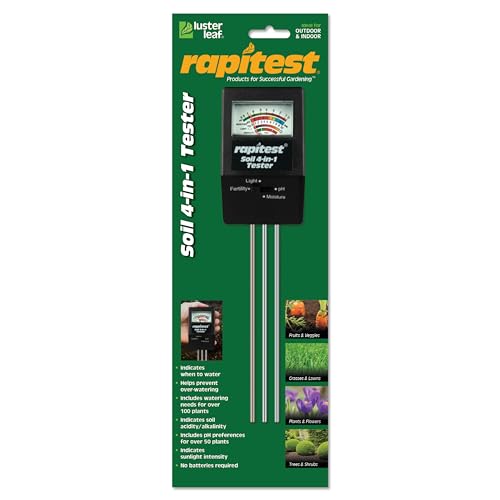
Luster Leaf 1818 Rapitest 4-in-1
Luster Leaf
Luster Leaf 1818 Rapitest 4-in1 Soil pH/Moisture/Fertility/Light Tester, Fertility
- Helps provide a healthy growing environment
- Measures sunlight, soil fertility, soil moisture, and soil pH
- Three stainless steel probes
The closest thing on this list to a solar-style tester. The 1818 uses no batteries at all. Its photovoltaic cell generates power from ambient light, which means it behaves like a solar meter in practice: point it at the sun, and it works. It reads sunlight, soil moisture, soil fertility, and pH through three stainless steel probes.
Four functions in one handheld tool is the appeal. You can check whether a spot gets enough sun, whether the soil is too wet, whether fertility is low, and whether pH is off, all in one walk around the yard. No batteries to leak, no charging cable to lose, and nothing to replace.
The light-dependence cuts both ways. In deep shade or on an overcast evening, the meter may not generate enough power for a clean reading. Fertility readings are also coarse, closer to low-medium-high than actual NPK values. And it’s designed for soil only, so don’t try it in potting mix or water.
- Four functions: sunlight, moisture, fertility, pH
- Photovoltaic cell means no batteries ever
- Three stainless steel probes for soil contact
- Designed for in-ground soil use only
- Instant analog readings with no warm-up
Best for: Gardeners who want a battery-free all-rounder and don’t need lab-grade precision.
How We Chose These Products
Every pick here solves a different problem, which is why the list looks mismatched at first glance. A capsule kit, a mail-in lab test, a compaction gauge, a pH pen, and a light-powered 4-in-1 don’t compete directly. They cover the full range of what “soil testing” actually means in a garden.
Selection criteria came down to four things: whether the tool produces readings you can act on, whether it holds up over a season, whether the cost matches the value delivered, and whether it fills a gap the other four don’t. Products with vague specs or no clear use case got cut. So did anything claiming solar charging without explaining how the panel works. For deeper comparisons on probe reach, see our guide to the best soil tester with long probe.
Buying Guide: What Really Matters
Solar trackers in soil testers are mostly marketing shorthand. What the term usually means is a photovoltaic cell that powers the display, not a motorized panel that follows the sun. Real solar tracking exists in large-scale agriculture, not in a $30 handheld meter. So when a listing promises a “solar tracker,” read the specs to see whether it’s solar-assisted, light-powered, or just battery-free.
Panel placement decides whether solar charging works at all. A meter left face-down in a shed won’t charge. One left in a south-facing garden bed will. If your growing area sits in deep shade or you garden in a cloudy climate, a battery-free light-powered meter is a gamble. Hybrid models with a backup battery make more sense there.
Accuracy claims deserve scrutiny too. Handheld meters typically carry a margin of error of plus or minus 0.2 to 0.5 pH, and cheap ones drift further over time. Lab kits sit closer to plus or minus 0.1. If you’re managing blueberries at pH 4.5 or adjusting a lawn, that gap matters. For a broader look at test kits and their accuracy trade-offs, the expert-tested soil test kit reviews are worth reading.
Probe depth is another quiet factor. Most handheld meters read the top 2-4 inches. Root zones for tomatoes, roses, and mature shrubs go far deeper. Testing shallow soil tells you about the surface, not where plants feed. If that’s your main concern, our breakdown of lab-quality soil testers covers the options built for deeper sampling.
Our Top Recommendation
For most gardeners, the Rapitest capsule kit wins on value. It gives you real pH, nitrogen, phosphorus, and potassium numbers for the price of a sandwich, and the 20 included tests cover a full season of spot checks. It’s not precise to the decimal, and refills cost money, but nothing else at this price produces actionable data.
If accuracy is the priority, MySoil is the clear upgrade. A lab test costs more per sample, but it returns 13 nutrient values and tells you exactly what to apply. One test often pays for itself by preventing unnecessary fertilizer purchases.
Budget-conscious buyers who want battery-free operation should look at the Luster Leaf 1818. It’s the closest thing here to a solar meter, and the four-function design covers sun, moisture, fertility, and pH in one pass. Just don’t expect lab precision from it.
Frequently Asked Questions
Do solar soil testers actually charge from sunlight, or is it a gimmick?
Some do, some don’t. A true photovoltaic cell in a meter will generate enough power for an LCD display in decent light. What you won’t find at consumer prices is a motorized panel that tracks the sun. When a listing says “solar tracker,” assume it means solar-assisted or light-powered until the specs prove otherwise.
Can I use a solar meter in a shaded garden or during winter?
Poorly. Solar and light-powered meters need direct light to generate voltage. Deep shade, heavy overcast, and short winter days all reduce output. In those conditions, a battery-powered meter or a capsule kit will serve you better. Hybrid models with a backup battery split the difference.
How accurate are handheld meters compared to lab tests?
Handheld meters typically land within 0.2 to 0.5 pH of true values when new, and drift as probes age. Lab analysis runs closer to 0.1 pH and also measures nutrient levels handhelds can’t touch. For casual pH checks, a meter is fine. For fertilizer decisions, a lab test is worth the wait.
How often should I replace or recalibrate a soil tester?
Stainless probes last years with a rinse after each use. Budget meters with coated probes may drift after a season or two. Lab kits are single-use by design. If your meter’s readings stop matching what plants tell you, replace it rather than trusting it. For models with swap-in probes, see our picks for testers with replacement probes.