You water the surface, the top inch looks damp, and three days later the leaves on your fiddle leaf fig are curling anyway. That’s the classic long-probe problem. Standard moisture meters only reach about an inch or two down, so they read the wet top layer while the root zone stays bone dry.

A good long-probe tester fixes this by reaching five to twelve inches into the soil, right where the roots actually drink. Look for a probe long enough for your deepest pot, a dial or readout you can see without crouching, and a build that won’t corrode after a season of use. Battery-free analog models are the simplest, while 4-in-1 units add pH, fertility, and light readings for people who want more data.
Below are five options that cover very different buyers: a two-pack for multi-plant owners, a single deep-use meter, a 4-in-1 with a removable probe, a heavy-duty soil sampler for lawn and farm work, and an extra-long 12-inch model for large houseplants. The XLUX two-pack is our top pick for most home gardeners, but the right choice depends on whether you need moisture only or a full soil profile.
Here’s a quick side-by-side of the key specs that separate these five testers.
| Features | XLUX 2 Pack Long Probe | XLUX Long Probe Deep Use | Hersven 4-in-1 Long Probe | AUZEKER 12 Inch Sampler | Gouevn Long Probe Meter |
|---|---|---|---|---|---|
| Probe Length | 5.5 inches | 5.5 inches | 4-6 inch insertion depth | 12 inches | 11.96 inches |
| Functions | Moisture only | Moisture only | Moisture, pH, fertility, light | Soil core sampling | Moisture only |
| Power Source | Battery-free | Battery-free | Battery-free | Manual tool | Battery-free |
| Build | Single metal probe | Single metal probe | Removable single probe | Stainless steel, T-handle | Single long probe |
| Best Use Case | Multiple pots and beds | Deep single pots | Full soil analysis | Lawn and farm sampling | Large houseplants |
XLUX 2 Pack Long Probe Plant Meter
This is the pick for the person with a windowsill full of pots and a raised bed out back. You get two identical meters in one box, so one can live by the indoor plants and the other can stay in the shed. The 5.5-inch probe reaches the bottom of most standard 8 to 12-inch pots, which is exactly where surface checks fail.
The single-probe design is the quiet win here. Double-prong meters tear through fine root hairs and drag up a plug of soil every time you pull them out. This one slides in, reads, and comes out clean. The dial is large enough to read from standing height, and there’s no waiting for a reading to settle. Insert it, glance at the needle, done.
Two-pack math is the main draw, but it’s worth knowing the limits. The metal tip corrodes if you leave it sitting in damp soil, so this is a check-and-remove tool, not a permanent monitor. And it won’t push into bone-dry, compacted clay without some effort. For loose potting mix and normal garden soil, it’s fine.
- Two complete meters in one purchase, useful for splitting between indoor and outdoor plants
- 5.5-inch probe reaches deeper than standard 1-2 inch models
- No batteries, no calibration, no setup
- Single probe minimizes root damage and soil disturbance
- Wipe the tip after each use to slow corrosion
Best for: Plant owners with several pots and beds who want one simple tool they can grab in two places at once.
XLUX Long Probe Deep Use Meter

XLUX
XLUX Long Probe Deep Use Soil Moisture Meter, Water Monitor Indicator Sensor, Hygrometer for Outdoor Indoor Large Pot Plants, Flower, Gardening, Farming
- Accurate Soil Moisture Detection: The XLUX Soil Moisture Meter can tell you if the soil deep inside your pot or garden is dry, moi…
- Easy-to-Read Large Dial: The large dial is easy to read and includes three zones with ten scales, making it very straightforward t…
- Immediate Moisture Reading: Insert the probe into the soil, and without waiting, the dial will immediately display the moisture le…
Buy this one if you have a single monster plant — a mature monstera, a large ficus, a deep outdoor planter — and you don’t need a second meter. It’s the same proven XLUX design as the two-pack, sold as one unit, so the money goes into the tool rather than a spare you may never use.
What makes it useful is honesty at depth. Surface soil can read damp for days after watering while the bottom third of the pot is still dry. The 5.5-inch probe lets you check the lower root zone directly. That single data point stops the two most common houseplant mistakes: overwatering a plant that was never thirsty and underwatering one that was.
The trade-offs are the same as any analog probe meter. It reads moisture only, so pH and nutrient questions stay unanswered. Very hard or rocky soil resists the tip. And the five-minute rule matters — leaving it in the ground will pit the metal over time.
- Same 5.5-inch deep-reach probe as the two-pack, sold as a single unit
- Large color-zone dial with ten moisture scales
- Instant reading, no batteries required
- Suited to large indoor pots and outdoor planters
- Not designed for liquids or extremely hard ground
Best for: Someone with one or two big plants who wants a dedicated deep-reading moisture meter and nothing more.
Hersven 4-in-1 Long Probe Tester

Hersven
Hersven Long Probe Soil Moisture Meter, 4-in-1 Soil pH Tester,Soil Moisture
- 4 IN 1 FUNCTION - Soil tester fastly to monitor soil moisture, fert and pH, illuminance, to improve plant growing conditions in ti…
Here’s the pick for the gardener who wants the full picture, not just a water check. This meter reads moisture, pH, fertility, and sunlight intensity from a single probe. If you’ve been guessing why one tomato plant thrives while its neighbor sulks, the extra readings give you something concrete to work with.
The removable probe is the standout feature. Analog meters die slowly because the metal sensor oxidizes and readings drift. Hersven’s design lets you detach the sensor for a proper clean after each session, which protects accuracy over the long run. That’s a real engineering difference, not a marketing line. The rotating head also bends from flat to 75 degrees, so you can read the dial without kneeling in the dirt.
It’s not a lab instrument. Fertility readings are a rough relative scale, not a nitrogen number, and pH accuracy is ballpark rather than precise. Treat the extra three functions as directional signals. For a home gardener deciding whether to feed or lime, directional is usually enough.
- Four functions: moisture, pH, fertility, and light intensity
- Removable metal probe for thorough cleaning between uses
- Oversized color-coded dial readable at a glance
- Adjustable head rotates 0-30-75 degrees to reduce bending
- Battery-free operation via soil conductivity
Best for: Gardeners who want moisture plus pH, nutrient, and light data in one tool and don’t mind approximate readings.
AUZEKER 12 Inch Soil Sampler Probe
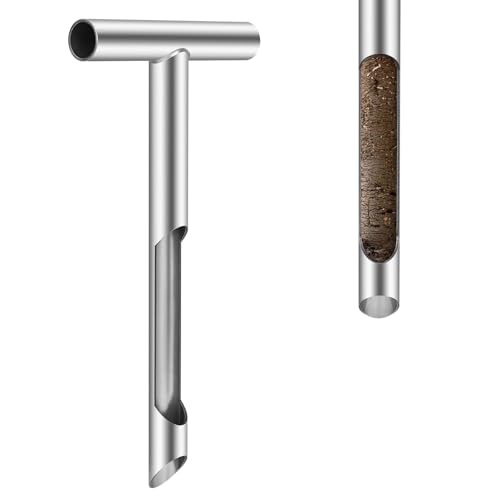
This is a different animal. The AUZEKER isn’t a moisture meter — it’s a soil core sampler for people who need to pull actual soil out of the ground and send it for testing or examine it themselves. Think lawn care, raised bed planning, farm plots, and anyone working with a lab or extension service.
Stainless steel construction is the reason it earns a spot here. Twelve inches of corrosion-resistant tube with a T-handle gives you real leverage to push through compacted turf and pull a clean, consistent core. Repeated sampling across a yard or field is what this tool is built for. A plastic-handled sampler would snap on the second or third push.
The catch is obvious once you hold it: it doesn’t tell you anything on its own. You sample, then you test the core separately. It’s also a manual tool, so rocky or extremely dry ground will fight you. And it’s overkill if all you want is a quick moisture reading for a houseplant.
- 12-inch stainless steel tube for reaching deeper soil layers
- T-handle grip provides leverage and control during sampling
- Collects clean, consistent cores for testing and analysis
- Built for repeated use in lawn, garden, and farm soil
- Pairs with lab or home soil test kits, not a standalone reader
Best for: Lawn owners, landscapers, and growers who need representative soil cores for testing rather than a moisture reading.
Gouevn Long Probe Soil Moisture Meter

Gouevn
Gouevn Long Probe Soil Moisture Meter for Plants, Plant Moisture Meter for House Plants, Plant Water Meter for Indoor & Outdoor Large Potted Plants, Hygrometer Gardening Gifts - No Battery Needed
- MUST-HAVE FOR LARGE HOUSEPLANTS: The 11.96 inch long probe sensor is specifically designed to measure water at the root level. The…
- SIMPLIFY YOUR LIFE: If you have multiple types of houseplants, you no longer need to remember when you watered each one. Just chec…
- EASY TO READ, NO BATTERY NEEDED: The plant hygrometer has a large dial for clear readings. Just insert it into the soil to get imm…
The Gouevn targets one specific buyer: the person with a very large houseplant in a very deep pot. Its probe measures just under 12 inches, which is roughly double the reach of the XLUX models. For a floor-standing tree in a 16-inch container, that extra length is the difference between guessing and knowing.
Multiple-plant owners get a practical benefit beyond depth. Instead of tracking a watering calendar in your head, you check each pot on its own schedule and water only what’s actually dry. That habit alone prevents most root rot cases. The single-probe design also means less mess — it slides out without dumping half a cup of soil on the floor.
Two honest caveats. An 11.96-inch probe is awkward in small or shallow pots, so this isn’t the tool for a 4-inch succulent. And like every analog meter in this roundup, it needs wiping after use and shouldn’t stay in the soil. It’s a diagnostic tool, not a permanent sensor.
- Nearly 12-inch probe reaches root level in deep containers
- Large dial with instant, battery-free readings
- Single probe preserves roots and keeps soil in the pot
- Works for both indoor and outdoor large plants
- Not suited to shallow pots or liquid testing
Best for: Owners of large floor plants and deep outdoor containers who need moisture data at the very bottom of the pot.
If you’d rather skip the analog needle entirely, our guide to the best soil tester with digital readout covers meters that show numbers instead of zones.
How We Chose These Products
We started with probe length, because that’s the whole point of this category. Every pick here reaches meaningfully deeper than a standard 1-2 inch meter, whether that’s 5.5 inches for pots or 12 inches for floor plants and field sampling. Anything shorter didn’t make the cut.
From there, we weighed build quality and long-term accuracy. Analog probes fail when the metal sensor corrodes, so we favored designs that address it — replaceable probes, single-prong tips, stainless steel bodies, and clear cleaning instructions. We also separated true moisture meters from soil samplers, because they solve different problems and buyers deserve to know which they’re getting.
Finally, we matched each tool to a realistic buyer. A two-pack makes sense for someone with plants in two locations. A 4-in-1 makes sense for a gardener chasing pH problems. A 12-inch sampler makes sense for a lawn owner working with a lab. No single product wins for everyone, so we organized the picks around situations instead of a ranking.
Buying Guide: What Really Matters
Probe length should match your deepest container, not your average one. Measure from the rim to the bottom of your largest pot. If it’s 12 inches deep, a 5.5-inch probe only reaches the midpoint. Buy for the worst case, then use it everywhere. If you want to compare options with different sensor designs, a look at the best soil tester with replacement probes is worth ten minutes.
Decide whether you need moisture alone or a broader soil profile. Moisture-only meters are cheaper, simpler, and more accurate at the one job they do. Multi-function meters trade some precision for pH, fertility, and light data. Neither is better — it depends on whether you’re solving a watering problem or a soil-health problem.
Pay attention to probe count and material. A single metal probe disturbs less soil and damages fewer roots than a two-prong design. Stainless steel outlasts plated tips in damp conditions. And if you plan to test frequently, a removable or replaceable probe extends the tool’s useful life considerably. Analog meters need wiping after every use no matter what they’re made of.
Our Top Recommendation
The XLUX 2 Pack Long Probe Plant Soil Moisture Meter is the best overall choice for most home gardeners. Two meters, 5.5 inches of reach, no batteries, and a single-probe design that keeps roots and floors clean. It handles indoor pots and outdoor beds without fuss, and the second unit means you’re not carrying one meter between the kitchen and the garden.
If you own one large floor plant instead of many pots, the Gouevn Long Probe Soil Moisture Meter is the better fit — its near-12-inch probe reaches the bottom of deep containers the XLUX can’t touch. Gardeners who want pH and nutrient data alongside moisture should look at the Hersven 4-in-1. And if your goal is collecting soil cores for actual lab testing, the AUZEKER 12 Inch Soil Sampler Probe is the only tool here built for that job.
Frequently Asked Questions
Can I leave a long-probe moisture meter in the soil permanently?
No. The metal tips on analog meters corrode when they sit in damp soil, which is why manufacturers cap readings at around five minutes. Use it, read it, pull it out, and wipe the probe dry. If you want continuous monitoring, you need a different class of device entirely.
Why does my long-probe meter read dry right after I water?
Water channels down the sides of the pot and pools at the bottom before it spreads evenly. If you test the same spot immediately after watering, you may hit a dry pocket. Wait an hour, then test two or three spots around the pot at the same depth for a truer picture.
Do these meters work in hard, compacted clay soil?
Not well. Analog probes need to push through loose or moderately firm soil to get a reading. Bone-dry clay or rocky ground will stop the tip or bend it. Water the area lightly first, or use a dedicated stainless steel sampler like the AUZEKER to break the surface.
Is a 4-in-1 meter as accurate as a single-function moisture meter?
For moisture, roughly yes. For pH and fertility, expect directional readings rather than precise numbers. The pH scale is coarse and the fertility reading is relative. That’s still useful for spotting trends, but don’t treat either as a substitute for a proper soil lab test.
For a broader look at meters with screens and app features, browse our full soil tester LCD screen comparisons before you buy.