You are on your knees, finger jammed two inches into a pot of soil, trying to guess if your fiddle leaf fig needs a drink. We have all been there. The guesswork leads to root rot, or worse, a plant that turns crispy because you waited too long. A soil tester removes that doubt, but the digital ones come with a catch: batteries. They die at the worst moments, and you are left blind again.
A battery free soil tester sidesteps that problem entirely. It runs on a simple electrochemical reaction between two metal probes and the moisture in the dirt. No charging cables, no AAA batteries to hunt for, and no digital screens to crack. Just a dial and a probe you stick in the ground. For houseplant owners, vegetable gardeners, and anyone tired of replacing gadgets every few years, these analog tools are a reliable, low-cost solution.
We looked at two of the most popular battery-free models on the market right now. The first is a 3-in-1 unit from JLENOVEG that measures moisture, pH, and fertility. The second is a GeeRic 3-in-1 that swaps fertility for light intensity. Both are solid, but they serve different gardeners. Below, we break down who should buy which, how to get accurate readings, and why skipping the battery is better for your plants and the planet.
Here is a quick look at how the two contenders stack up on paper.
| Features | JLENOVEG 3-in-1 | GeeRic 3-in-1 |
|---|---|---|
| Primary Measurements | Moisture, pH, fertility | Moisture, pH, light |
| Probe Design | Single probe | Dual metal probes |
| Power Source | None required | None required |
| Best Use Case | Indoor pots & raised beds | Garden beds & greenhouses |
| Response Time | Instant readings | Wait a few seconds |
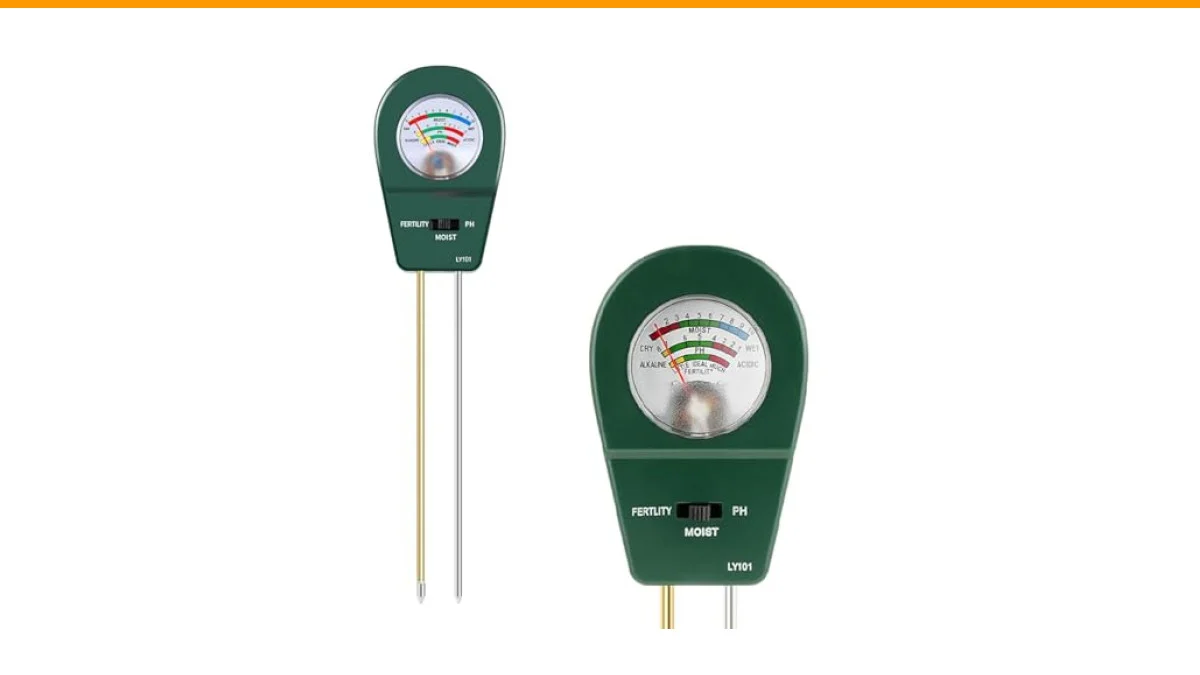
JLENOVEG 3-in-1 Soil Meter

JLENOVEG
3-in-1 Soil Moisture Meter pH & Fertility Tester, No Battery Needed Plant Soil Test Kit for Houseplants, Garden, Lawn & Farm, Plug-and-Read Soil Acidity Meter for Indoor Outdoor Potted Plants (Green)
- 3-in-1 Accuracy – Moisture, pH & Fertility: Measure soil moisture level, soil pH, and soil fertility in one tool. This upgraded si…
- Plug & Read – No Battery or Power Required: Eco-friendly design works without batteries. Simply insert the probe 4–6 inches into t…
- Fast Response, High Sensitivity Probe: Made with high-conductivity alloy, the probe provides more accurate moisture, acidity, and…
This is the meter for the indoor plant parent who owns a moisture meter that broke after six months. The JLENOVEG is built around a single, high-conductivity alloy probe that you push four to six inches into the soil. It measures three things: moisture, pH, and fertility. That last one is rare in this category. Fertility here is a proxy for dissolved salts and nutrient availability, not a specific NPK breakdown, but it gives you a useful trend line over time.
The single-probe design is a genuine advantage. It disturbs less root mass than a dual-prong fork, which matters when you are testing a crowded pot of pothos or a mature bonsai. The response is fast, and the dial is simple to read. You do not need a degree in agronomy to interpret the needle position. It works across a broad range of plants, from succulents that hate wet feet to tropicals that want consistent moisture.
There are limitations. The fertility reading is a general guide, not a lab test. If your plant is showing severe yellowing or stunted growth, this meter will tell you the soil is low, but it will not tell you exactly which nutrient is missing. Also, the instructions are clear that you should not use it in liquids or hard, rocky soil. Forcing the probe into compacted ground can bend the tip. You will need to wipe the probe clean after every use to prevent mineral buildup from skewing future readings.
- Single probe minimizes root disturbance in tight pots
- Measures fertility, a feature many analog meters lack
- High-conductivity alloy for faster, more stable readings
- Requires a 4–6 inch insertion depth for accuracy
- Not for use in liquids or extremely hard, compacted soil
Best for: The houseplant enthusiast and raised-bed gardener who wants a moisture, pH, and fertility check in one tool, without the risk of damaging delicate root systems.
GeeRic Soil Moisture 3-in-1
The GeeRic takes a different approach. Instead of fertility, it measures light intensity alongside moisture and pH. That makes it a better fit for the gardener who moves plants around to chase the sun, or who is constantly second-guessing whether that south-facing window is too harsh for their fern. The dual metal probes are longer and sturdier, designed for outdoor soil that is a bit more compact than fluffy potting mix.
Operation is straightforward, but it requires a little more attention than the JLENOVEG. A slide switch on the unit selects the mode: left for moisture, middle for light, and right for pH. You push the probes into the soil, wait a few seconds for the needle to settle, and read the dial. The light meter sits on the top of the unit, so you point it toward the sky to get a reading. It is a handy feature for optimizing plant placement on a patio or in a greenhouse.
The trade-off is the learning curve. The switch is easy to knock out of position while you are wiggling the probes into the ground. You might think you are reading pH when you are actually on the moisture scale. It also lacks the fertility metric, so you will need a separate plan for nutrient management. The dual probes are more robust for outdoor use, but they do displace more soil, so be careful when testing small seedlings or shallow-rooted plants.
- Three separate modes: moisture, light, and pH
- Dual probes offer better contact in outdoor garden soil
- Light meter helps with plant placement decisions
- Durable shell and rust-resistant probes for longevity
- Requires a few seconds of patience for the needle to settle
Best for: The outdoor gardener and greenhouse operator who needs to monitor sunlight exposure and soil conditions across a larger growing area.
How We Chose These Products
We focused on a simple criterion: does the meter work reliably without any external power source? Both of these units pass that test, but we dug deeper into their construction and feature sets. We prioritized devices with solid metal probes that resist corrosion, clear analog dials that do not require backlights, and a design that does not feel like a disposable toy. We also weighed the specific combination of measurements each unit offers, since a moisture-only meter serves a different purpose than a full 3-in-1.
Real-world feedback from gardening communities shaped our picks. We looked for complaints about flimsy probes, inaccurate readings, and dead-on-arrival units. The two meters here have a track record of durability, but they are not perfect. The JLENOVEG is better for indoor precision work, while the GeeRic is the workhorse for outdoor conditions. We also considered how easy it is to clean and maintain each unit, because a battery-free meter only stays accurate if you care for the probes.
Buying Guide: What Really Matters
Before you click buy, think about the probe depth. A meter that only reads the top two inches of soil is useless for a deep-rooted tomato plant. You need to reach the root zone, which for most potted plants is four to six inches down. Both meters here hit that mark, but shorter units on the market often do not. Match the probe length to the size of your pots or garden beds.
Consider what you are actually trying to measure. A moisture-only meter is cheap and effective for preventing overwatering. But if you are fighting blossom end rot in your peppers or yellowing leaves on your hydrangeas, you need a pH reading to diagnose the issue. The fertility and light sensors on these two models are bonuses, but they are not lab-grade instruments. Use them to track trends, not to make split-second decisions on fertilizer application.
Finally, think about the maintenance. These meters work via a galvanic reaction between the two metals in the probe and the moisture in the soil. That reaction wears the metal down over time. You need to wipe the probes dry after each use and store the unit indoors. Leaving it outside in the rain or in wet soil will corrode the metal and ruin the calibration. With proper care, a good analog meter can last a decade.
How Battery-Free Testers Actually Work
These devices are not magic. They use a simple electrochemical cell. Two different metals, often copper and zinc, are inserted into the moist soil. The soil acts as an electrolyte, allowing ions to flow between the metals. That flow generates a tiny voltage, typically in the millivolt range, which moves the needle on the analog dial. More moisture means a stronger reaction and a higher reading on the moisture scale.
The pH scale works on a similar principle. The voltage generated by the probe changes based on the acidity or alkalinity of the soil solution. The meter is calibrated to translate that tiny electrical signal into a pH value on the dial. This is why the probe must make good contact with the soil. If there is an air gap or the soil is bone dry, the circuit is broken and you get a false reading.
Because there are no digital components, there is nothing to drain. No battery to replace, no circuit board to fry, and no screen to crack. The simplicity is the selling point. These are mechanical tools, closer to a thermometer than a smartphone. They are also easier to recycle at the end of their long life, since they are mostly metal and a bit of plastic.
How to Get Accurate Readings Every Time
Getting a good reading is not just about jamming the probe in the dirt. There is a technique to it. First, make sure the soil is slightly moist. If it is bone dry, the electrochemical reaction will not happen, and the needle will not move. Water the plant, wait about 30 minutes for the water to distribute, and then test. This is the most common reason a battery-free meter gives a false reading.
Second, test at the right depth. For shallow-rooted plants like lettuce or herbs, test at two to three inches. For deep-rooted vegetables, shrubs, or trees, you need to go deeper. Insert the probe to at least four inches, ideally six, to reach the active root zone. Take a reading at the surface and at depth to map out the moisture gradient.
Third, clean the probe between tests. Wipe it with a dry cloth to remove any clinging soil particles. If you are testing multiple pots, clean the probe between each one to avoid cross-contamination. Over time, mineral deposits can build up on the metal. A light sanding with fine-grit sandpaper every few months will restore the surface and keep the readings accurate.
Maintaining Your Meter: Cleaning, Storage, and Lifespan
A battery-free tester is a buy-it-for-life tool, but only if you treat it right. The biggest enemy is corrosion. The galvanic reaction that powers the meter also eats away at the metal probes. After every single use, wipe the probes completely dry with a soft cloth. Do not leave the meter standing in a pot of wet soil overnight. That accelerates corrosion and will eventually ruin the probe.
Store the meter indoors, away from extreme temperatures and humidity. A kitchen drawer or a gardening toolbox is fine. If you notice the readings becoming erratic or the needle sticking, the probe likely has a buildup of mineral salts. Gently clean the probes with a mild vinegar solution or a very fine abrasive pad, then rinse and dry thoroughly. This simple step can add years to the meter’s life.
With regular care, these analog tools can easily last five to ten years, often longer. That is a stark contrast to digital meters, which might last two years before the battery contacts corrode or the LCD screen fades. The durability is a major reason why many sustainable gardeners prefer the old-school approach. You are not just avoiding a battery; you are avoiding an entire device replacement cycle.
The Environmental ROI: Skipping the Batteries
The environmental argument for these meters is straightforward. Every digital soil tester on the market requires batteries, either disposable AAs or a rechargeable lithium-ion pack. Disposable batteries are a notorious source of heavy metal contamination in landfills. Rechargeable batteries have a finite lifespan and eventually need replacing too. A battery-free meter eliminates that waste stream entirely.
Consider the math over a decade. If a digital meter uses two AA batteries every six months, that is forty batteries over ten years. Multiply that by the millions of gardeners who own these devices, and you are talking about hundreds of millions of batteries that never need to be manufactured, shipped, or disposed of. The carbon footprint of a simple analog meter is a fraction of a digital one, mostly from the initial metal extraction and plastic molding.
There is also a resilience angle. A battery-free meter never fails because you forgot to charge it. It is always ready to go, season after season. For gardeners who want to reduce their reliance on disposable tech, this is a meaningful step. It is one less gadget in your life that needs a wall wart and a charging cable.
Frequently Asked Questions
Why does my meter give different readings in the same pot?
Soil moisture is not uniform. There are dry pockets and wet pockets, especially in larger pots. The probe only measures the soil it is directly touching. Take two or three readings in different spots around the pot and average them. Also, make sure the probe is making full contact with the soil and not hitting an air pocket or a rock.
Can I use this meter to test my compost pile?
You can, but the results will be skewed. Compost is high in organic matter and often very acidic during the active breakdown phase. The meter will give you a reading, but it is more useful for checking moisture levels than pH. The high salt content in some compost can also corrode the probes faster, so clean them thoroughly afterward.
How do I know if the fertility reading is accurate?
You do not, and that is the honest answer. The fertility function measures the electrical conductivity of the soil solution, which correlates with dissolved salts, including nutrients. It is a proxy, not a direct measurement of nitrogen, phosphorus, or potassium. For a precise NPK breakdown, you need a lab test. Use the fertility dial to track relative changes over time, not as an absolute value.
My meter is stuck on one reading. What went wrong?
This usually means the probe is corroded or dirty. First, try cleaning the metal tips with a fine abrasive pad or a vinegar solution. If that does not work, check the connection between the probe and the dial housing. Sometimes the internal wire can loosen. If the unit is still under warranty, contact the seller. If not, it may be time for a replacement, but try the cleaning fix first.
The Bottom Line: Which One Should You Buy?
If you are growing mostly indoors, in pots, and you want to keep tabs on moisture, pH, and general nutrient health, the JLENOVEG 3-in-1 is the better fit. The single probe is gentler on roots, and the fertility reading gives you a heads-up when your plants need a feed. It is a complete package for the container gardener.
If you are working outside in a vegetable patch or managing a greenhouse, the GeeRic 3-in-1 is the stronger choice. The light meter is genuinely useful for tracking sun exposure, and the dual probes handle outdoor soil better. The lack of a fertility reading is a minor miss, but the light sensor makes up for it in specific growing scenarios. For those dealing with specific soil conditions, you might also want to check our guides on the best soil tester for acidic soil or the best soil tester for sandy soil to see if your ground needs special attention. Both of these meters are excellent zero-waste tools, but they excel in different environments. Pick the one that matches your garden, not just the one with the most features.