You’ve probably bought a cheap probe meter, jabbed it into the dirt, and watched the needle swing wildly depending on how hard you pushed. Those things are basically guessing. If you actually want to know what your soil is missing, you need lab-grade data — or at least something close to it.

This guide covers five soil testers that range from true mail-in lab analysis to a solid budget chemical kit. We’ll explain what ‘lab-quality’ really means, where cheap meters fail, and how to turn a soil report into an actual fertilizer plan.
MySoil Soil Test Kit, Unl…

My Soil
MySoil Soil Test Kit, Unlock Your Lawn & Garden Potential, Complete & Accurate Nutrient and pH Analysis with Recommendations Tailored to Your Soil and Plant Needs
- KNOW BEFORE YOU GROW | Grow the healthiest, sustainable lawn and garden with the most accurate and easy to use professional soil t…
- FAST & ACCURATE | Unlike at-home pH meters and test strips, our mail-in professional lab analysis accurately measures 13 plant-ava…
- FOR ANY GROWING SCENARIO | Tests any soil type and growing condition - lawn & turf, vegetable gardening, flowers, compost, trees,…
MySoil is the pick for anyone who wants a genuine laboratory report without driving to a county extension office. You collect a soil sample, mail it in, and get a digital report covering 13 plant-available nutrients including nitrogen and pH. Lawn owners, vegetable gardeners, and even hydroponic growers can use it because the kit handles any growing medium.
The standout feature is the custom recommendation engine. Instead of just handing you numbers, MySoil tells you what to apply, how much, and when — with both organic and synthetic fertilizer options. Results land in about 6 to 8 days, which is faster than most university labs. The accuracy difference between this and a $15 probe meter is night and day.
The trade-off is that you can’t reuse the kit. Each test requires a new purchase, so seasonal testing adds up. There’s also a wait period, which feels long if you’re mid-project and want answers immediately. And the recommendations, while tailored, still assume you’re willing to buy specific amendments rather than work with what you already have.
- Measures 13 plant-available nutrient levels plus pH
- Works for lawns, gardens, compost, trees, and hydroponic media
- Results delivered in 6-8 days via digital report
- Includes both organic and non-organic fertilizer recommendations
- Single-use kit — you’ll need a fresh one for each test
Best for: Gardeners who want professional lab data and specific fertilizer instructions without leaving home.
Buladeke Moisture Meter f…
Buladeke
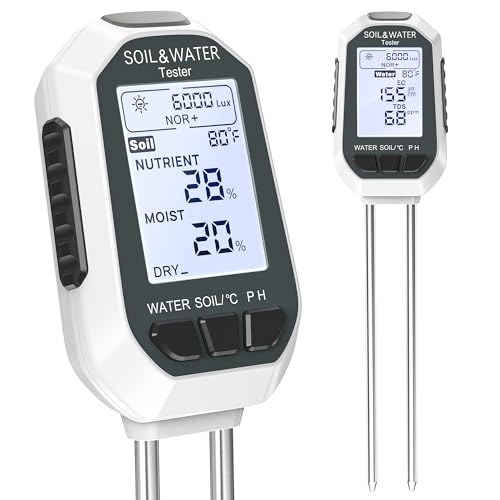
Buladeke Moisture Meter for Plants,7-in-1 Digital Soil Tester Kit | Soil pH Tester with LCD - Measures pH, EC, TDS, Fertility, Temp, Moisture & Sunlight, Garden Tools for Indoor & Outdoor
- 【7-in-1 Features】This is a 7-in-1 multi-function soil tester. Our soil tester quickly measures soil moisture, pH, temperature and…
- 【Large Screen & LCD Backlight】The Soil Moisture Meter has a large LCD display with white backlight that clearly shows the numerica…
- 【Fast and accurate measurement】With the latest 2025 probe technology, it can quickly and accurately measure soil pH, moisture, tem…
The Buladeke 7-in-1 is a digital meter, not a lab test. It reads moisture, pH, temperature, light intensity, EC, TDS, and soil fertility through a probe you stick in the ground. If you’re managing houseplants, raised beds, or a small greenhouse and want instant readings without mailing anything, this fits that niche well.
What sets it apart from cheap analog probes is the large backlit LCD screen and the 2026 probe technology, which the brand claims improves response speed. Readings appear in about 10 seconds. The EC and TDS functions are genuinely useful if you’re mixing nutrient solutions or checking water quality. You get seven data points from one device, which is more than most competitors at this level offer.
Here’s the honest limitation: this is not a lab. Probe meters measure electrical conductivity and infer pH and nutrient levels from that. They drift, they need calibration, and they can’t detect micronutrients like calcium or magnesium. If you want true lab-quality results, this won’t replace a mail-in kit. It’s a monitoring tool, not a diagnostic one.
- 7 functions: moisture, pH, temperature, light, fertility, EC, TDS
- Large backlit LCD for dark or bright conditions
- Readings in roughly 10 seconds at 10cm depth
- Runs on 4 AAA batteries with low-power warning
- Not for direct liquid measurement — soil only
Best for: Indoor growers and container gardeners who want fast, repeatable readings without lab wait times.
Rapitest Soil Test Kit fo…

Luster Leaf
Rapitest Soil Test Kit for Gardens, Vegetables, Flowers and Lawns. USA designed and assembled soil tester completely, quickly and accurately measures/analyzes soil pH acidity and garden nutrients.
- Quick, at home results for Soil pH, Nitrogen, Phosphorous and Potash Innovative and inexpensive soil test kit features an easy-to-…
- Contains all components needed for 20 tests. 5 for each of pH, N, P and K
- Contains all components needed to test all variables in several spots in the yard or garden
Luster Leaf’s Rapitest is the budget option that still gives you real chemical data. It uses a capsule system with color comparators to measure pH, nitrogen, phosphorus, and potassium. You get 20 tests total — five for each variable — which makes it the cheapest per-test option on this list if you’re testing multiple garden beds.
The kit includes a soil pH preference list covering over 450 plants, which is genuinely handy when you’re deciding what to grow where. Setup takes minutes. You mix soil with water, add a capsule, shake, and compare the liquid color to a chart. No batteries, no apps, no mailing.
Accuracy is the weak point. Color comparison is subjective, and results are approximate ranges rather than precise numbers. You won’t get micronutrient data or contaminant screening. For a home gardener checking whether the tomato bed is acidic or alkaline, that’s fine. For anyone trying to fine-tune a fertilizer program, it’s too coarse.
- Tests pH, nitrogen, phosphorus, and potassium
- 20 total tests — 5 per variable
- Patented color comparator system
- Includes pH preference list for 450+ plants
- No batteries or lab mailing required
Best for: Beginners and budget-conscious gardeners who want a quick read on soil pH and NPK.
EarthWorks for Home Soil…

EarthWorks for Home
EarthWorks for Home Soil Test Kit, pH and Nutrient Lab Analysis, 1 kit | Complete Analysis, Mail-in Sample for Fast Results, Ideal for Garden, Lawn, Turf & Home Use
- COMPLETE NUTRIENT AND pH ANALYSIS: Understand your soil’s full health profile with tests for pH, calcium, magnesium, phosphorus, p…
- FAST LAB RESULTS WITH ACTIONABLE GUIDANCE: Partner lab delivers results quickly through a secure digital dashboard; receive tailor…
- ALL-INCLUSIVE COLLECTION KIT FOR EASY SAMPLING: Includes soil collection bag, prepaid return mailer envelope, and online registrat…
EarthWorks is a mail-in lab kit that covers a broader nutrient panel than most competitors. You get pH plus calcium, magnesium, phosphorus, potassium, sulfur, and eight additional micronutrients. That’s a full health profile, not just the basics. The kit includes a collection bag, prepaid return envelope, and online registration instructions.
The lab delivers results through a secure digital dashboard with tailored fertilizer advice and nutrient balancing tips. EarthWorks also flags issues like compaction, poor water retention, and excess sodium — problems most home kits ignore entirely. If your plants are struggling and you can’t figure out why, this level of detail helps.
One important catch: you must register the kit before mailing your sample, or the lab won’t process it. That’s a step people skip, and it causes delays. Also, the kit is single-use. If you want to track changes over a season, you’ll need to buy multiple kits or look at the lab kit comparison for multi-test options.
- Tests pH plus 12 additional nutrients including micronutrients
- Flags compaction, water retention, and sodium issues
- Digital dashboard with fertilizer guidance
- Prepaid return mailer included
- Registration required before mailing — don’t skip this
Best for: Gardeners dealing with unexplained plant problems who need a full nutrient and soil structure analysis.
Yard Mastery Soil Testing…
Yard Mastery targets lawn care specifically, though it works for gardens, compost, trees, and non-soil media too. The kit measures 13 nutrient levels and returns customized fertilizer recommendations based on your soil composition. Prepaid return postage is included, and the product is made in the USA with a 2-year shelf life if stored properly.
What makes this one stand out is the focus on actionable results. The report tells you exactly what to apply for your specific soil, not generic advice. Dedicated customer support is available if you have questions about your results, which is more than most mail-in kits offer. For lawn owners who want that thick, even green without guessing, this is a solid choice.
The limitation is the same as any mail-in kit: you wait for results. Turnaround isn’t specified in the product data, so expect a week or more. And while the recommendations are customized, they lean toward Yard Mastery’s own product line — you may need to translate the advice if you prefer different brands.
- 13 essential nutrient levels tested
- Customized fertilizer recommendations
- Prepaid return postage included
- USA-made with 2-year shelf life
- Dedicated customer support for result questions
Best for: Lawn owners who want professional-grade analysis and don’t mind waiting a week for tailored results.
How We Chose These Products
We prioritized accuracy first. Mail-in lab kits beat probe meters and chemical kits on precision every time, so they dominate the top of this list. But we also included a digital meter and a budget chemical kit because not everyone needs a full lab report — some people just want to know if their soil is too wet or too acidic.
We looked at nutrient range, turnaround time, cost per test, and whether the results translate into actionable steps. A kit that gives you numbers without telling you what to do with them isn’t helpful. We also checked for hidden requirements like registration steps or single-use limitations that buyers often discover too late.
Buying Guide: What Really Matters
Lab-quality results come from one of two sources: a mail-in lab or a chemical test kit. Probe meters are convenient but they measure conductivity, not actual nutrient levels. They can’t detect calcium, magnesium, or micronutrients. If you want to know your soil’s true NPK profile, you need either a chemical kit or a lab.
Turnaround time matters more than most people think. A 6-8 day wait is fine in early spring. It’s frustrating in mid-season when you’re trying to fix a deficiency now. If you need fast answers, a digital meter gives you instant readings — just understand the accuracy limits. For a deeper look at how different kits perform, fertilizer compatibility is worth checking before you buy.
Cost per test is the hidden factor. A $30 lab kit that tests once is more expensive per use than a $15 chemical kit with 20 tests. If you test four beds twice a year, the math changes fast. Figure out how often you’ll actually test before choosing.
Our Top Recommendation
MySoil wins for most people. It delivers genuine lab analysis, covers 13 nutrients, and gives you specific fertilizer instructions with both organic and synthetic options. The 6-8 day turnaround is reasonable, and it works for lawns, gardens, and containers alike.
If you want a broader nutrient panel including micronutrients and soil structure issues, EarthWorks is the better pick. For instant readings on moisture and pH without waiting, the Buladeke meter fills that gap. And if budget is the main concern, the Rapitest kit gives you real chemical data for the lowest cost per test.
No single tester does everything. The best setup for serious gardeners is a mail-in lab kit for seasonal deep analysis plus a digital meter for weekly monitoring. That combination covers both precision and speed. You can also read more about smartphone sync options if you want to track readings over time.
Frequently Asked Questions
Can a cheap probe meter give lab-quality results?
No. Probe meters measure electrical conductivity and estimate pH and nutrients from that. They can’t detect specific nutrient levels or micronutrients. They’re useful for quick moisture checks, but they don’t replace a lab test.
How many soil samples should I take from one garden?
For a typical home garden, take 8-10 subsamples from different spots, mix them in a clean bucket, and send one composite sample. This gives an average reading for the area. Testing each spot separately gets expensive fast.
Do any of these kits test for heavy metals or contaminants?
None of the kits on this list screen for heavy metals like lead or arsenic. That requires a specialized lab test, usually through a university extension office. If you’re growing food in urban soil or near old buildings, consider a separate contaminant test.
How often should I retest my soil?
Once a year is enough for most gardens. Test in early spring before you fertilize, or in fall after harvest. If you’re making big amendments like adding lime or sulfur, retest after 3-4 months to see how the soil responded.