


Best Soil Tester for Raised Deck Containers: 5 Honest Picks for 2026
Contents
You drag a bag of potting mix up three flights of stairs, fill your deck containers, and watch your tomatoes sulk for a month. The leaves yellow. The blooms drop. You water more, then less, then more again. Nothing works because you are guessing. Deck containers dry out faster than ground beds, their soil pH drifts as you feed, and the root zone heats up in direct sun. A cheap soil tester takes the guesswork out of all three.
A good tester for deck containers needs to do a few things well. It must read moisture at root depth, handle the faster wet-dry cycles of container life, and survive being jammed into a pot that might be half bark, half compost. Analog meters win on simplicity. Digital meters win on data. Lab-style kits win on accuracy for pH and nutrients. Which one you need depends on how many containers you keep and how much you care about the numbers.
Below are five testers that cover the realistic range of deck-gardener needs, from a $12 analog stick to a full nutrient test kit. The SONKIR MS02 is the best all-rounder for most decks. The Buladeke 7-in-1 is the pick if you want digital readouts for moisture, pH, and temperature in one go. The Rapitest kit is the one to buy if you actually want to know your nitrogen and phosphorus levels.
Here is a quick side-by-side of the five picks before we get into the details.
| Features | SONKIR MS02 | Dewilde pH Strips | Buladeke 7-in-1 | YAMRON 4-in-1 | Rapitest Kit |
|---|---|---|---|---|---|
| Type | Analog 3-in-1 | Paper pH strips | Digital 7-in-1 | Digital 4-in-1 | Capsule lab kit |
| Measures | Moisture, pH, light | pH only | Moisture, pH, temp, light, EC, TDS, fertility | Moisture, pH, temp, light | pH, N, P, K |
| Power | None needed | None needed | 4 AAA batteries | 4 AAA batteries | None needed |
| Readout | Analog needle | Color chart | Backlit LCD | Backlit LCD | Color comparator |
| Best Use | Quick checks, many pots | pH-only spot checks | Data-driven container care | Everyday deck watering | Full nutrient analysis |
SONKIR MS02 Soil pH Meter
The SONKIR MS02 is the tester most deck gardeners should start with. It is an analog stick with a single probe and a three-way switch for moisture, pH, and light. No batteries, no calibration, no app. You push it into the pot, wait a couple of minutes, and read the needle. For someone with six to ten containers on a balcony, this is plenty of information to stop overwatering.
What makes it work for deck containers is the no-battery design. You can leave it in a bucket on the deck all season and it will still work in October. The light sensor is a nice extra for anyone deciding whether a tomato pot gets enough direct sun before committing to a trellis. The moisture reading is the most useful function day to day, and it is accurate enough to tell you when a pot has dried down two inches below the surface.
Here is the honest catch. The pH needle on this meter is a rough guide, not a lab result. It reads in broad bands and it will not move at all if the soil is bone dry. You also cannot test the pH of your tap water or your liquid fertilizer with it, which is a real limitation if you are trying to diagnose a nutrient lockout. Treat the pH function as a directional hint, not a diagnosis.
- Three functions in one probe: moisture, pH, light
- No batteries, no calibration, no setup
- Single stainless probe reaches deep into containers
- Analog needle reads in broad bands, not precise numbers
- Must water dry soil before pH testing or the needle will not move
Best for: Deck gardeners with several containers who want quick, no-fuss moisture and light checks without buying batteries.
Dewilde Trading 100 pH Strips
2nd Pick

Dewilde Trading Co
Soil Test Kit – 100 Soil pH Test Strips (3.5–9 Range) for Garden, Lawn & Indoor Plants – Easy At-Home Soil Testing
- Accurate Soil pH Testing: Dewildetradingco Soil pH Test Strips offer measurements of soil pH levels (pH 3.5-9). As an essential to…
- User-Friendly Testing Procedure: The testing process is simple and efficient. Mix the sample soil with water, let the solution sit…
- Cost-Effective and Versatile: With 100 Soil PH checker strips included in each package, Dewildetradingco provides a cost-effective…
These are not a meter. They are 100 paper pH strips in a bottle, and they do one job: tell you the pH of a soil slurry. For deck containers, that is actually a useful job. Container soil drifts acidic over a season as you feed with liquid fertilizer, and a strip test every few weeks keeps you ahead of it. The 3.5 to 9 range covers almost everything a home grower will run into.
The method is simple but not instant. You mix soil with water, wait half an hour, dip a strip for three seconds, then hold it flat for a minute and match the color against the chart on the bottle. The whole thing takes about 35 minutes per sample. That is slow compared to a probe, but the reading is more reliable than a cheap analog pH needle, and you get 100 tests for the price of one digital meter.
The trade-off is obvious. These strips tell you nothing about moisture, light, or temperature. You still need a separate moisture meter for watering decisions. And the color matching depends on decent lighting and decent eyesight. If you are colorblind or testing at dusk, you will struggle. For a deck gardener who already has a moisture probe and just wants a better pH read, these are a smart add-on.
- 100 strips per bottle, pH 3.5 to 9 range
- Requires mixing soil with water and a 30-minute wait
- Color chart printed on the bottle for matching
- No batteries, no electronics, no calibration
- pH only, no moisture or light data
Best for: Growers who already own a moisture meter and want a more trustworthy pH reading than an analog needle provides.
Buladeke 7-in-1 Digital Soil Tester
3rd Pick
Buladeke
Buladeke Moisture Meter for Plants,7-in-1 Digital Soil Tester Kit
- 【7-in-1 Features】This is a 7-in-1 multi-function soil tester. Our soil tester quickly measures soil moisture, pH, temperature and…
- 【Large Screen & LCD Backlight】The Soil Moisture Meter has a large LCD display with white backlight that clearly shows the numerica…
- 【Fast and accurate measurement】With the latest 2025 probe technology, it can quickly and accurately measure soil pH, moisture, tem…
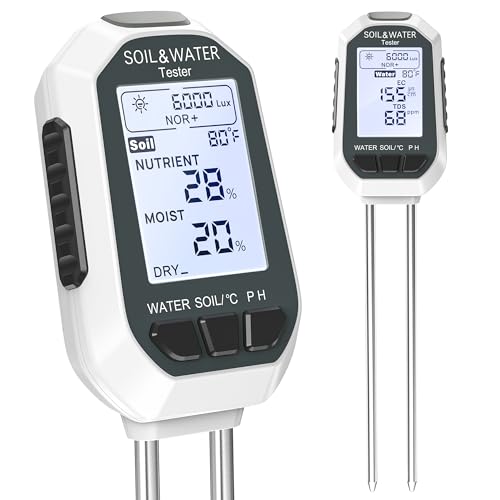
The Buladeke 7-in-1 is the most feature-dense tester on this list. It reads moisture, pH, temperature, light, EC, TDS, and fertility on a backlit LCD screen. For a serious deck gardener running tomatoes, peppers, and herbs in containers, that is a lot of data in one handheld tool. The 10-second read time is genuinely fast compared to the analog meters that need a couple of minutes to settle.
The large screen and white backlight are the standout features in practice. You can read it at 6am before work or at 9pm after the kids are down. The fertility and EC functions are unusual at this price point and useful if you are mixing your own potting blend or reusing last year’s soil. The probe reaches about 10cm deep, which is the right depth for most deck containers.
Two real caveats. It runs on four AAA batteries, which are not included, and you will want rechargeables because it eats them faster than you expect with the backlight on. The bigger issue is durability. This is an electronic tool with a probe, and if you force it into dry, compacted container soil, you can damage the sensor. The manual says to moisten dry soil and wait 10 minutes before testing. Follow that or you will be replacing it mid-season.
- Seven functions: moisture, pH, temp, light, EC, TDS, fertility
- Large backlit LCD readable in daylight or dark
- 10-second read time after inserting probe 10cm deep
- Powered by 4 AAA batteries, not included
- Probe can be damaged by forcing into dry, hard soil
Best for: Data-driven deck gardeners who want moisture, pH, temperature, and nutrient indicators in one digital tool.
YAMRON 4-in-1 Digital Moisture Meter
The YAMRON 4-in-1 sits between the SONKIR analog stick and the Buladeke 7-in-1. It measures moisture, pH, temperature, and sunlight on a backlit LCD. The 45-degree rotating head is the feature that separates it from the pack. You can angle the screen toward your face without bending over the pot, which sounds like a small thing until you are checking eight containers in a row on a low deck rail.
Read time is about 10 seconds, same as the Buladeke. The instructions recommend averaging readings from at least five spots in the soil for pH and moisture, which is a more honest approach than most cheap meters take. That five-spot method gives you a real picture of what is happening in a large container instead of a single point reading that might hit a wet pocket or a dry clump.
The downside is the same as any digital meter at this price. It needs four AAA batteries, and the probe is not indestructible. The manual warns against inserting it into dry, hard soil, and it cannot be used to test liquids directly. If you want a tool you can abuse without thinking, the SONKIR is a better fit. If you want numbers and a screen you can actually read, the YAMRON earns its place.
- Four functions: moisture, pH, temperature, sunlight
- 45-degree rotating head for easier screen viewing
- Recommends averaging readings from 5 soil locations
- 10-second read time, 10cm probe depth
- Requires 4 AAA batteries and careful probe handling
Best for: Deck gardeners who want digital moisture and temperature readings with a screen angle that works on low containers.
Luster Leaf Rapitest Soil Kit
5th Pick

Luster Leaf
Rapitest Soil Test Kit for Gardens, Vegetables, Flowers and Lawns. USA designed and assembled soil tester completely, quickly and accurately measures/analyzes soil pH acidity and garden nutrients.
- Quick, at home results for Soil pH, Nitrogen, Phosphorous and Potash Innovative and inexpensive soil test kit features an easy-to-…
- Contains all components needed for 20 tests. 5 for each of pH, N, P and K
- Contains all components needed to test all variables in several spots in the yard or garden
The Rapitest kit is the only product here that tests nutrients, not just pH and moisture. It measures pH, nitrogen, phosphorus, and potassium using a capsule system and patented color comparators. Each kit contains enough for 20 tests, five for each variable. For a deck gardener trying to figure out why tomato leaves are yellowing or why pepper plants stall, this is the tool that actually answers the question.
The kit includes a soil pH preference list for over 450 plants, which is more useful than it sounds. You can look up what your specific container crops want and compare it to what you measured. The color comparator system is more accurate than paper strips because the capsules produce a clearer color change and the comparator holds the sample next to a standard. Results come in minutes, not hours.
The honest limitation is that this is a consumable kit. Once you use the 20 tests, you buy refills or a new kit. It also does not measure moisture or light, so you still need a separate probe for watering decisions. And the color matching, while better than strips, still depends on your eyes and the lighting where you do the test. This is a diagnostic tool, not a daily-use meter.
- Tests pH, nitrogen, phosphorus, and potassium
- 20 total tests, 5 for each variable
- Capsule system with patented color comparators
- Includes pH preference list for over 450 plants
- Consumable kit, refills needed after 20 tests
Best for: Deck gardeners diagnosing nutrient problems who need to know actual N-P-K levels, not just moisture and pH.
How We Chose These Products
We looked at what deck container gardening actually demands from a tester. Container soil is different from ground soil. It dries faster, heats up more, and gets flushed more often by watering. A tester that works fine in a raised bed might struggle in a 12-inch pot. We prioritized tools that handle the faster wet-dry cycle and the shallower root zones of container life.
We also weighed the trade-offs honestly. Analog meters are durable but imprecise. Digital meters are precise but fragile and battery-dependent. Strip and capsule kits are accurate for pH and nutrients but slow and consumable. No single product wins on every axis, so we picked five that cover the realistic range of deck-gardener needs and explained where each one falls short.
Buying Guide: What Really Matters
The first question is what you actually need to measure. If you just want to stop overwatering, a moisture meter is enough. If your plants are yellowing despite regular feeding, you need pH and possibly nutrient testing. Most deck gardeners start with moisture, add pH when problems appear, and only reach for a full nutrient kit when they are troubleshooting a specific issue. Buy for the problem you have, not the problem you might have.
Build quality matters more for containers than for ground beds. You will be inserting the probe into the same pot repeatedly, often in compacted soil. A flimsy probe bends or breaks. Analog meters with a single sturdy probe tend to outlast cheap digital meters in this environment. If you go digital, handle the probe carefully and never force it into dry soil.
Readability is underrated. A meter you cannot read in bright sun or at dusk is a meter you will not use. Backlit LCD screens solve this for digital meters. Analog needles depend on ambient light. Paper strips depend on color vision and good lighting. Think about when you actually check your containers, and pick a readout that works at that time of day.
For a deeper look at how tester choice changes with different container setups, see our guide to the best soil tester for raised beds. If you are growing herbs specifically, the best soil tester for herbs covers the pH ranges those plants prefer.
Our Top Recommendation
The SONKIR MS02 is the best soil tester for most raised deck containers. It costs less than a bag of potting mix, needs no batteries, and gives you the two readings that matter most day to day: moisture and light. The pH function is rough, but it is enough to flag a problem before it kills a plant. For a deck gardener with a handful of containers, this is the tool that stops the guessing.
If you want digital numbers and temperature data, the Buladeke 7-in-1 is the upgrade pick. It costs more and needs batteries, but the backlit screen and 10-second read time make it easier to use in real conditions. The YAMRON 4-in-1 is a solid middle option if the rotating head appeals to you.
For nutrient troubleshooting, the Luster Leaf Rapitest kit is the only product here that tells you why a plant is struggling, not just that it is dry. Pair it with a cheap moisture probe and you have a complete diagnostic setup for under the cost of a single replacement plant.
Frequently Asked Questions
Can I leave a soil tester in the pot permanently?
No. Leaving any probe in soil long-term corrodes the metal and skews readings. Insert it, take your reading, wipe it clean, and store it dry. This is the single biggest reason cheap meters fail early.
Why does my pH reading not change even when I add lime?
Container soil buffers slowly. Lime takes weeks to shift pH, and a cheap analog meter may not register small changes at all. If you need to track pH movement over time, use the Rapitest kit or pH strips instead of an analog needle.
Do I need to test every container separately?
Yes, if they hold different plants or different soil mixes. A tomato pot and a herb pot can read very differently even sitting side by side on the same deck. Test each one before watering, especially in summer when drying rates vary.
Is a digital meter always better than analog?
No. Digital meters give precise numbers but break more easily and need batteries. Analog meters are rougher, simpler, and last longer in harsh conditions. For deck containers, the best choice depends on whether you want precision or durability more.

