I killed a fiddle leaf fig last spring. Not from neglect, but from overwatering it because a cheap analog moisture stick told me the soil was bone dry when it was actually soaked. That one dead plant sent me down a rabbit hole of testing digital soil meters, reading spec sheets, and trying to figure out which readouts actually mean something in a real pot of soil.
A good digital soil tester needs three things: a probe that reads consistently across multiple spots, a screen you can actually see outdoors, and a feature set that matches what you grow. pH matters more for vegetables and acid-loving shrubs than it does for a pothos on a windowsill. Moisture matters for almost everything. Temperature and light are nice add-ons that help you diagnose problems faster.
Below are five meters I’d hand to a friend without hesitating. The Buladeke 7-in-1 takes the top spot for its overall coverage, but the YAMRON is a smarter buy if you just want the basics, and the Tadeto is the pick for anyone who needs real pH calibration. Here’s how they stack up.
Quick comparison of the key differences between these five meters before we dig into each one.
| Features | Buladeke 7-in-1 | YAMRON 4-in-1 | LAWNFUL pH Meter | Tarocat 6-in-1 | Tadeto pH Tester |
|---|---|---|---|---|---|
| Measurements | 7 functions incl. EC and TDS | 4 functions: moisture, pH, temp, light | Soil pH only | 6 functions incl. humidity and fertility | pH plus temperature, multiple media |
| Display | Large LCD, white backlight | LCD with 45-degree rotating head | LCD, calibration-free | LCD with color-coded scales | LCD backlight with alarm |
| Probe Type | 2026 probe technology | Standard detection probe | Double-needled stainless steel | Voltage-stabilized sensor | Alloy-capped electrode |
| Power | 4 x AAA, not included | 4 x AAA, not included | 3 x AA included, 5-year life | Battery with stabilizer circuit | Battery powered |
| Best Use Case | Detailed soil and water analysis | Everyday indoor and outdoor plants | pH-focused garden and lab work | Full garden condition snapshot | Soil, water, food pH testing |
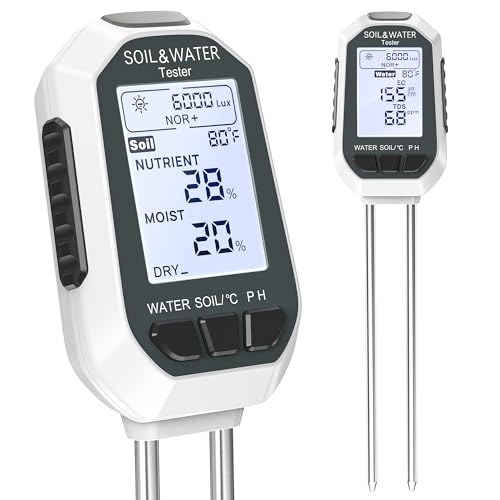
Buladeke Moisture Meter for Plants
Buladeke
Buladeke Moisture Meter for Plants,7-in-1 Digital Soil Tester Kit | Soil pH Tester with LCD - Measures pH, EC, TDS, Fertility, Temp, Moisture & Sunlight, Garden Tools for Indoor & Outdoor
- 【7-in-1 Features】This is a 7-in-1 multi-function soil tester. Our soil tester quickly measures soil moisture, pH, temperature and…
- 【Large Screen & LCD Backlight】The Soil Moisture Meter has a large LCD display with white backlight that clearly shows the numerica…
- 【Fast and accurate measurement】With the latest 2025 probe technology, it can quickly and accurately measure soil pH, moisture, tem…
The Buladeke 7-in-1 is the most feature-dense meter on this list. It reads soil moisture, pH, temperature, light intensity, fertility, EC, and TDS. That last pair is unusual. EC and TDS tell you about dissolved salts in water, which matters if you’re mixing nutrient solutions or checking whether your tap water is leaving residue behind in pots. Hydroponic growers and anyone running a fertilizer schedule will get real use out of those readings.
The screen is the standout. A large white-backlit LCD shows numbers and icons together, so you can glance at it in a dim garage or at dusk and still read the values. Insertion is straightforward: push the probe about 10cm into moist soil, wait roughly 10 seconds, and the numbers settle. Battery warnings show up before the meter dies, which saves you from a dead-reading surprise mid-season.
Here’s the honest part. The probe cannot go into liquid, and dry, compacted soil will fight back. If you jam it into hard ground, you risk bending or cracking the sensor. The manual tells you to moisten the test area and wait ten minutes before measuring, and it means it. That’s a real workflow adjustment, not a suggestion. The four AAA batteries also aren’t included, so factor that into your first order.
- Reads seven parameters including EC and TDS, uncommon at this level
- Large backlit LCD readable in daylight and after dark
- Low-battery warning built into the display
- Requires 4 AAA batteries sold separately
- Needs moist, loose soil for accurate readings
Best for: Growers who want the widest possible data set from a single handheld meter, especially anyone tracking nutrient levels.
YAMRON 4-in-1 Soil Moisture Meter

YAMRON
4-in-1 Soil Moisture Meter Digital Plant Temperature/Soil Moisture/PH Meter/Sunlight Intensity Backlight LCD Display Soil Test Meter for Gardening, Farming and Outdoor Plants
- 【4 in 1 function】This is a 4-in-1 multifunctional soil tester.Our soil tester fastly to measure soil moisture, pH, temperature and…
- 【Large Screen & Backlight LCD Display】The Soil Tester uses a large LCD screen and white backlight to conveniently display and read…
- 【Quick Accurate measurement】The latest probe detection technology in 2026 can quickly and accurately measure the pH, moisture and…
If the Buladeke felt like overkill, this next pick is the opposite. The YAMRON 4-in-1 covers moisture, pH, temperature, and sunlight. That’s the core set most home gardeners actually use. Nothing about it feels complicated, and the 45-degree rotating head is a genuinely thoughtful touch. You can angle the screen toward your face instead of crouching over a raised bed like you’re inspecting a crime scene.
Accuracy is solid for a hobbyist tool. YAMRON recommends taking readings from at least five spots in the soil and averaging them for pH and moisture, which is smart advice regardless of which meter you buy. Soil isn’t uniform, and a single probe reading can be misleading. Follow that guidance and you’ll get numbers you can trust for watering decisions. The 2026 probe tech responds in about 10 seconds, same as most meters in this class.
The limitation is scope. No fertility reading, no EC, no TDS. If you’re managing a vegetable garden where nutrient balance matters, you’ll want more. The 10cm depth is also shallow for deep-rooted plants, so you’re sampling the top layer only. And like the Buladeke, it won’t tolerate dry, hard soil or liquid testing. Water the spot first and give it ten minutes.
- Four core readings: moisture, pH, temperature, sunlight
- 45-degree rotating head for comfortable viewing angles
- Backlit LCD works in low light
- Average five readings per area for best accuracy
- No fertility, EC, or TDS functions
Best for: Casual indoor and outdoor gardeners who want reliable basics without paying for features they’ll never touch.
LAWNFUL Digital Soil pH Meter
LAWNFUL built this one for a narrow job: measuring soil pH, and measuring it well. There’s no moisture reading, no temperature, no light sensor. What you get instead is an industrial-grade pH meter with double-needled stainless steel probes that resist corrosion and hold up to repeated use in damp soil. If your main concern is whether your blueberries are sitting in acidic enough ground or your lawn has drifted alkaline, this is the tool.
The calibration-free design is the real selling point. Most pH meters in this price range make you fuss with buffer solutions before you trust a reading. LAWNFUL’s embedded algorithms handle that internally, so you pull it out of the box and start testing. It weighs 160 grams, which is light enough to carry around a large property without noticing it in your hand. And the three included AA batteries are rated for up to five years of use, which is a nice bit of peace of mind.
The trade-off is obvious. You’re paying for precision in one measurement and getting nothing else. A gardener who wants to know moisture and pH together will need a second tool. The lack of a backlight also means dim conditions make the LCD harder to read. And while LAWNFUL backs it with a one-year warranty and will replace a defective unit, the single-purpose design won’t suit everyone.
- Industrial-grade pH accuracy with built-in algorithms
- Double-needled stainless steel probes resist corrosion
- Calibration-free out of the box
- Only 160 grams, easy to carry across a property
- 3 AA batteries included, rated for 5 years
Best for: Lawn care specialists and gardeners whose primary concern is soil pH rather than a full condition report.
6-in-1 Digital Soil Tester by Tarocat
Tarocat’s 6-in-1 sits between the YAMRON and the Buladeke in terms of coverage. It reads soil moisture, pH, temperature, fertility, ambient humidity, and sunlight intensity. That ambient humidity reading is different from the others here. It measures the air around the plant, not the soil, which helps you understand whether a humidity-loving fern is getting what it needs.
The screen uses color-coded pH and moisture scales, so you don’t have to memorize which numbers are good. A red zone tells you the soil is too acidic; green means you’re in range. For beginners, that visual shortcut cuts down on the guesswork. Tarocat also added a voltage-stabilizing circuit, which keeps readings steady as the battery drains. That’s a small engineering detail that prevents the slow drift you get from cheaper meters as their power drops.
Where it falls short is documentation and probe depth. The 45-degree rotating head helps with viewing, but the probe still only reaches the top few inches of soil. Deep-rooted shrubs and trees won’t get a meaningful reading. The fertility measurement is also a rough indicator rather than a precise nutrient breakdown, so don’t expect lab-grade soil chemistry from it.
- Six readings including ambient humidity and soil fertility
- Color-coded pH and moisture scales for quick interpretation
- Voltage-stabilizing circuit reduces reading drift
- 45-degree rotating head improves screen visibility
- Fertility reading is approximate, not a nutrient analysis
Best for: Gardeners who want a broad condition snapshot with visual cues that make sense at a glance.
Tadeto Soil pH Tester

Tadeto
Tadeto Soil pH Tester, High Accuracy Digital pH Meter for Soil, Garden, Water, Plants, Solution and Food, Soil pH Test Kit with Thermometer LCD Display, Calibration Powder and Alloy Protective Cap
- Versatile & Accurate pH Measurement: This pH meter quickly and reliably reads pH values for a wide range of liquids, including soi…
- 3‑Point Calibration Method & Manual Value Adjustment: This pH test kit uses a scientific 3‑point calibration method (acidic, neutr…
- Clear Display & Smart Alerts: Equipped with a large LCD backlit screen for clear readings even in low‑light conditions, plus real‑…
Tadeto’s meter breaks the mold because it isn’t strictly a soil tester. It measures pH in soil, water, food, and solutions. That versatility makes it useful in a kitchen as much as a garden. Anyone who ferments, brews, cans, or checks water quality will find reasons to keep it within reach. The three-point calibration method covers acidic, neutral, and alkaline zones, which gives you confidence across the full pH range rather than just around neutral.
Two features stand out. First, the real-time temperature display sits alongside the pH reading, so you can judge whether conditions are affecting your measurement. Second, the alarm function triggers a red backlight when pH drops below 3.5 or climbs above 12, warning you that you’re in strongly acidic or alkaline territory. That’s a safety feature for food and water testing as much as a gardening one.
The alloy protective cap is the kind of detail that extends the probe’s life. It screws over the electrode and has a hard conical zinc tip that lets you push into firmer materials without damaging the sensor. But this meter demands more maintenance than the others. You need to calibrate with 4.01, 7.0, and 10.01 buffer solutions before first use, and after each session you should inject a small amount of potassium chloride solution into the cap to keep the electrode active. Skip that step and accuracy suffers over time.
- Measures pH in soil, water, food, and solutions
- Three-point calibration for accuracy across the full range
- Red backlight alarm for extreme pH values
- Alloy protective cap with conical zinc tip
- Requires buffer solution calibration and KCl storage maintenance
Best for: Multi-purpose users who test pH in the garden, kitchen, and water supply, and don’t mind the maintenance routine.
How We Chose These Products
Every meter on this list was evaluated against four criteria: measurement range, display readability, probe durability, and real-world usability. I weighted accuracy and consistency heavily because a soil tester that gives you different numbers on the same pot is worse than useless. Meters with calibration requirements were judged on how clearly those requirements were documented and how manageable the routine is for a typical user.
Display quality mattered more than I expected. A backlit screen isn’t a luxury when you’re checking soil at dusk or in a greenhouse with shaded benches. Rotating heads, color-coded scales, and clear iconography all earned points because they reduce the chance of misreading a value. Probes made from corrosion-resistant materials scored higher, since soil is a hostile environment for cheap metal. I also considered what each meter doesn’t do, because a tool that overpromises and underdelivers is worse than one with a narrow, honest feature set.
Buying Guide: What Really Matters
Start with what you grow. Vegetables, acid-loving shrubs, and lawns benefit from accurate pH readings, so a dedicated pH meter or a multi-function unit with a reliable pH sensor is worth the investment. Houseplants and succulents mostly need moisture data, and a simpler meter will serve you fine. If you’re running a hydroponic setup or mixing nutrients, EC and TDS readings move from nice-to-have to essential.
Probe depth is the spec most buyers overlook. A 10cm probe only samples the top layer of soil, which may be drier or wetter than the root zone. For shallow-rooted plants in pots, that’s fine. For established garden beds and trees, you need a deeper reach or you’re measuring the wrong thing. Check the probe length before you buy, not after.
Maintenance requirements separate the low-effort meters from the high-accuracy ones. Calibration-free designs are convenient but may drift over months of use. Meters that require buffer solutions and storage in potassium chloride hold their accuracy longer but demand discipline. Decide which trade-off fits your habits. A meter that sits in a drawer because you dread the upkeep helps nobody. For more on matching features to your specific needs, this soil tester LCD guide covers display options in more detail, and if you grow acid-loving plants, the fertilizer compatibility breakdown is worth a read.
Our Top Recommendation
The Buladeke 7-in-1 earns the top spot because it covers the widest range of measurements without sacrificing display quality or ease of use. The EC and TDS functions set it apart from every other meter here, and the large backlit screen makes it practical in real conditions. It’s the meter I’d recommend to anyone who wants one tool that handles soil, water, and nutrient questions in a single device.
The YAMRON 4-in-1 is the better choice if you want simplicity and don’t need fertility or EC data. Its rotating head and five-reading averaging method make it a reliable everyday tool. For pH-specific work, the LAWNFUL is the most accurate single-purpose option, and the Tadeto is the pick for anyone testing pH across soil, water, and food. Budget-conscious buyers should check the current price on Amazon for each, since these meters fluctuate.
Frequently Asked Questions
Can I leave the probe in the soil permanently?
No. None of these meters are designed for continuous burial. Soil moisture and minerals will corrode the probe over time. Insert, take your reading, wipe the probe clean, and store it dry. The Tadeto specifically needs its protective cap with potassium chloride solution to stay accurate between uses.
Why do I get different pH readings from the same pot?
Soil pH varies by location, depth, and moisture level. A single probe reading is a snapshot, not a verdict. Take at least five readings from different spots and average them. YAMRON recommends this in its manual, and it applies to every meter on this list.
Do I really need to moisten dry soil before testing?
Yes, and skipping this step is the most common way people damage their meters. Dry, compacted soil puts enormous resistance on the probe. Water the area, wait about ten minutes, then insert the probe gently. Forcing it into hard ground can bend the sensor and ruin accuracy.
Is a calibration-free pH meter as accurate as one that needs calibration?
For home gardening, usually yes. The LAWNFUL uses internal algorithms to maintain accuracy without user calibration, which is convenient. The Tadeto requires three-point calibration with buffer solutions but holds tighter accuracy over time, especially across extreme pH ranges. If you’re testing food or water for safety, calibrate. If you’re checking garden soil, calibration-free is fine.