I killed three basil plants before I admitted the problem wasn’t me. It was my soil. One pot stayed soggy for a week, another dried out overnight, and a third had a pH so far off the leaves turned yellow. A cheap moisture stick from the hardware store told me nothing useful, so I started testing every soil meter I could get my hands on.
Herbs are picky in ways vegetables aren’t. Basil, cilantro, and dill want slightly acidic to neutral soil. Rosemary and thyme swing the other way and hate wet feet. A tester that only reads moisture leaves you guessing on pH, and a tester that only reads pH leaves you guessing on water. The best tool for the job reads at least two of those, gives you numbers you can trust, and doesn’t cost more than the plants it’s supposed to save.
Below are five testers I’d actually recommend, ranging from a $12 analog stick to a mail-in lab kit that returns 13 nutrient readings. The SONKIR MS02 is the best all-around pick for most herb growers. The Buladeke 7-in-1 is the one to buy if you want digital readouts and don’t mind batteries. And if you’re serious about soil health across a whole garden, the MySoil lab kit is worth the wait.
Here’s a quick side-by-side of the specs that matter most.
| Features | SONKIR MS02 | Buladeke 7-in-1 | Rapitest Kit | YAMRON 4-in-1 | MySoil Lab Kit |
|---|---|---|---|---|---|
| Measurement Type | Analog needle | Digital LCD | Color comparator | Digital LCD | Mail-in lab |
| Reads | Moisture, pH, light | 7 soil and water metrics | pH, N, P, K | Moisture, pH, temp, light | 13 nutrients plus pH |
| Power Source | None needed | 4 AAA batteries | None needed | 4 AAA batteries | None needed |
| Results Time | Minutes | 10 seconds | Minutes | 10 seconds | 6 to 8 days |
| Best Use Case | Quick pot checks | Detailed home testing | Nutrient analysis | Indoor herb gardens | Whole-garden planning |
SONKIR Soil pH Meter, MS02

SONKIR
SONKIR Soil pH Meter, MS02 3-in-1 Soil Moisture/Light/pH Tester Gardening Tool Kits for Plant Care, Great for Garden, Lawn, Farm, Indoor & Outdoor Use (Green)
- Kindly NOTE: This soil tester can not be applied to test pH value of any other liquid. If the soil is too dry the indicator will n…
- 3 METERS IN ONE: Soil moisture level, Soil pH value and Sunlight level could be tested easily according to your need by switching…
- NO BATTERY NEEDED: Simply insert the meter into soil, wait few minutes, accurate test results will be displayed on the readout pan…
The SONKIR MS02 is the tester most herb growers should start with. It’s a three-in-one analog stick that reads moisture, pH, and light with a flip of a switch on the front. No batteries, no calibration, no app. You push it into the soil, wait a few minutes, and read the needle. That simplicity is the whole point, and it’s why this meter works well for kitchen herb pots, raised beds, and anyone who just wants a fast answer before watering.
What stands out is how little can go wrong. There’s nothing to charge, nothing to pair, and nothing to update. The metal probe is sturdy enough for repeated use in potting mix, and the readout panel is large enough to read without squinting. For a beginner growing basil on a windowsill, this covers the two questions that actually matter: is the soil wet enough, and is the pH in a reasonable range for herbs?
The catch is accuracy. Analog meters like this give you a ballpark, not a lab number. If your soil is bone dry, the needle won’t move at all, so you have to water first and retest. And it can’t test liquids, so don’t dunk it in your watering can to check pH. Treat it as a quick sanity check, not a precision instrument. For more on matching a meter to specific soil chemistry, this guide to the best soil tester for acidic soil covers the pH side in more depth.
- Three functions in one probe: moisture, pH, and light
- No batteries or power source required
- Works in potting mix, garden beds, and lawns
- Needs moist soil to give a pH reading
- Analog needle, so expect approximate values
Best for: Beginners and casual herb growers who want a no-fuss stick that answers the watering question in under a minute.
Buladeke Moisture Meter for Plants
Buladeke
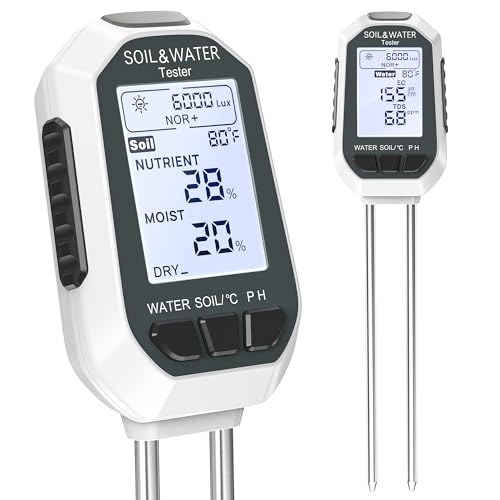
Buladeke Moisture Meter for Plants,7-in-1 Digital Soil Tester Kit | Soil pH Tester with LCD - Measures pH, EC, TDS, Fertility, Temp, Moisture & Sunlight, Garden Tools for Indoor & Outdoor
- 【7-in-1 Features】This is a 7-in-1 multi-function soil tester. Our soil tester quickly measures soil moisture, pH, temperature and…
- 【Large Screen & LCD Backlight】The Soil Moisture Meter has a large LCD display with white backlight that clearly shows the numerica…
- 【Fast and accurate measurement】With the latest 2025 probe technology, it can quickly and accurately measure soil pH, moisture, tem…
The Buladeke 7-in-1 is what you buy when you want numbers instead of a wobbling needle. It reads soil moisture, pH, temperature, light intensity, EC, TDS, and fertility, all on a backlit LCD screen. That’s more data than most herb growers need, but the extra readings are genuinely useful if you’re troubleshooting why a plant is struggling. The fertility and EC functions, in particular, tell you whether your potting mix has run out of nutrients.
The screen is the standout feature. It’s large, backlit in white, and readable in a dim garage or at night. Readings come back in about 10 seconds after you push the probe roughly 10 cm into the soil. Four AAA batteries power it, and the unit warns you when they’re running low, which is a small touch that saves you from misreading a dead screen as a bad result.
Two honest caveats. First, batteries aren’t included, so budget for those on day one. Second, the probe is more delicate than the analog sticks. Forcing it into dry, hard soil can damage it, and the manual specifically says to moisten the test area and wait 10 minutes before measuring. That’s a real workflow change if you’re used to jabbing a stick into a dry pot. The payoff is digital precision you won’t get from a needle. If you’re testing multiple soil types across a property, the best soil tester for sandy soil breakdown is worth a look before you commit.
- Seven functions including EC, TDS, and fertility
- Large backlit LCD readable in low light
- Results in about 10 seconds at 10 cm depth
- Runs on four AAA batteries, not included
- Probe can be damaged by dry, compacted soil
Best for: Detail-oriented growers who want digital readings and don’t mind a small battery investment.
Rapitest Soil Test Kit for Gardens

Luster Leaf
Rapitest Soil Test Kit for Gardens, Vegetables, Flowers and Lawns. USA designed and assembled soil tester completely, quickly and accurately measures/analyzes soil pH acidity and garden nutrients.
- Quick, at home results for Soil pH, Nitrogen, Phosphorous and Potash Innovative and inexpensive soil test kit features an easy-to-…
- Contains all components needed for 20 tests. 5 for each of pH, N, P and K
- Contains all components needed to test all variables in several spots in the yard or garden
The Rapitest kit takes a completely different approach. Instead of a probe, you get a capsule system with color comparators that measure pH, nitrogen, phosphorus, and potassium. Twenty tests are included, five for each variable, which is enough to sample several spots in a garden bed or compare your herb pots against each other. This is the only pick here that gives you actual nutrient data without mailing anything off.
The kit includes a soil pH preference list covering more than 450 plants, which is genuinely handy when you’re deciding where to plant what. Instructions are detailed and written for beginners. Results come back in minutes, and the color comparison method is more accurate than a cheap analog needle for pH specifically. If your herbs are yellowing and you suspect a nutrient deficiency rather than a watering issue, this is the tool that tells you which nutrient is missing.
The trade-off is consumables. Once the 20 tests are used up, you buy refill capsules. That ongoing cost adds up if you test frequently. The color matching also takes a little practice, and results are read by eye, so two people might score the same sample slightly differently. It’s not a one-and-done purchase like the SONKIR, but it’s the most informative option under the lab-kit tier.
- Tests pH, nitrogen, phosphorus, and potassium
- 20 tests included, five per variable
- Capsule system with patented color comparators
- Plant pH preference list covers 450+ species
- Refill capsules required after initial tests
Best for: Gardeners who need nutrient data, not just moisture, and want to diagnose deficiencies at home.
YAMRON 4-in-1 Soil Moisture Meter

YAMRON
4-in-1 Soil Moisture Meter Digital Plant Temperature/Soil Moisture/PH Meter/Sunlight Intensity Backlight LCD Display Soil Test Meter for Gardening, Farming and Outdoor Plants
- 【4 in 1 function】This is a 4-in-1 multifunctional soil tester.Our soil tester fastly to measure soil moisture, pH, temperature and…
- 【Large Screen & Backlight LCD Display】The Soil Tester uses a large LCD screen and white backlight to conveniently display and read…
- 【Quick Accurate measurement】The latest probe detection technology in 2026 can quickly and accurately measure the pH, moisture and…
The YAMRON 4-in-1 sits between the SONKIR and the Buladeke in both price and capability. It measures moisture, pH, temperature, and sunlight on a backlit LCD screen, and it has one feature the others don’t: a 45-degree rotating head. That sounds gimmicky until you’re crouched over a low herb pot trying to read a screen at a bad angle. The bendable head lets you tilt the display toward your eyes without contorting yourself.
Readings take about 10 seconds at roughly 4 inches of depth. The screen uses visual icons alongside numbers, which helps beginners interpret whether a value is high, low, or in range. The manual recommends sampling at least five locations and averaging the results for pH and moisture, which is good advice for any meter but rarely spelled out this clearly.
The limitation is the same as the Buladeke: it can’t touch liquids, and dry, hard soil can damage the probe. The five-location sampling requirement also means a full test takes longer than you’d expect. It’s not a grab-and-go tool. But for indoor herb gardens where you’re testing the same few pots regularly, the rotating head and clear display make it pleasant to use. If your herbs share space with a lawn, the best soil tester for lawn care guide covers meters built for turf conditions.
- Four functions: moisture, pH, temperature, light
- 45-degree rotating head for easier viewing
- Backlit LCD with visual icons and numbers
- Requires five-location sampling for accuracy
- Four AAA batteries, not included
Best for: Indoor herb growers who test the same pots often and want a comfortable, readable display.
MySoil Soil Test Kit

My Soil
MySoil Soil Test Kit, Unlock Your Lawn & Garden Potential, Complete & Accurate Nutrient and pH Analysis with Recommendations Tailored to Your Soil and Plant Needs
- KNOW BEFORE YOU GROW | Grow the healthiest, sustainable lawn and garden with the most accurate and easy to use professional soil t…
- FAST & ACCURATE | Unlike at-home pH meters and test strips, our mail-in professional lab analysis accurately measures 13 plant-ava…
- FOR ANY GROWING SCENARIO | Tests any soil type and growing condition - lawn & turf, vegetable gardening, flowers, compost, trees,…
The MySoil kit isn’t a meter at all. You collect a soil sample, mail it to a lab, and get back a report covering 13 plant-available nutrient levels plus pH. Results arrive in six to eight days. That turnaround sounds slow compared to a 10-second probe reading, but the data quality is in a different league. Home meters estimate. This measures.
The report includes custom recommendations for what to apply, how much, and when, with both organic and non-organic fertilizer options. It works for any growing scenario: raised beds, containers, compost, houseplants, even hydroponics. If you’re growing herbs across multiple beds and want to stop guessing which amendment to buy, this eliminates the trial-and-error cycle entirely.
The obvious downside is the wait. You can’t test today and fix tomorrow. It’s also a one-time test per sample, so monitoring changes over a season means buying multiple kits. And it’s overkill for someone with three basil pots on a windowsill. This is a tool for people managing real garden space who want a baseline they can trust for years.
- Lab analysis of 13 plant-available nutrients plus pH
- Results returned in 6 to 8 days
- Custom fertilizer recommendations, organic and conventional
- Works for soil, compost, containers, and hydroponics
- One test per sample; no reusable probe
Best for: Serious gardeners who want lab-grade accuracy and a full nutrient picture before amending soil.
How We Chose These Products
Every pick here was evaluated on four things: what it actually measures, how easy it is to use without a manual, how it holds up over repeated testing, and whether the results are trustworthy enough to act on. Analog meters got credit for simplicity and penalized for imprecision. Digital meters got credit for readable numbers and penalized for battery dependence and fragile probes. Lab kits got credit for accuracy and penalized for turnaround time and per-test cost.
We also weighed the herb-growing use case specifically. Herbs in containers have different needs than herbs in ground beds. Container soil dries faster, pH drifts more with fertilizer, and the volume is small enough that a single bad reading can send you in the wrong direction. A tester that works well for a 50-foot garden row isn’t automatically the right choice for six pots on a balcony, and we factored that distinction into every recommendation.
Buying Guide: What Really Matters
Start with what you’re actually trying to learn. If your only question is when to water, a moisture-only meter is fine and cheaper. If your herbs are yellowing, stunted, or dropping leaves, you need pH and nutrient data, which means stepping up to a multi-function meter or a test kit. Buying more capability than you’ll use just adds batteries and menus you’ll never open.
Accuracy expectations matter too. Analog needles are approximate. Digital meters are more precise but still not lab-grade. Only a mail-in kit gives you numbers you can base a fertilizer plan on. Know which tier you’re buying into before you spend. And check the probe design: thin probes bend, thick probes resist dry soil, and any probe can be ruined by forcing it into hard, dry ground.
Finally, think about how often you’ll test. A one-time purchase like the SONKIR makes sense for casual growers. A kit with consumables like the Rapitest or MySoil makes sense if you’ll test multiple beds or track changes over a season. The cheapest option upfront isn’t always the cheapest over a full growing year.
Our Top Recommendation
The SONKIR MS02 wins for most herb growers. It covers the three readings that matter most, needs no batteries, and costs little enough that you can buy one for the kitchen and one for the patio. It won’t give you lab numbers, but it will stop you from overwatering basil, which is the single most common way home herb growers kill plants.
If you want digital precision and don’t mind buying batteries, the Buladeke 7-in-1 is the stronger pick. Its fertility and EC readings add real diagnostic value, and the backlit screen is the easiest to read of the bunch. For anyone managing a full garden and willing to wait a week for results, the MySoil lab kit delivers accuracy no handheld meter can match.
Frequently Asked Questions
Can I use a soil tester on herbs grown in water or hydroponics?
Most probe meters can’t be submerged in liquid, so they won’t work for straight hydroponics. The MySoil lab kit does support soil-less media and hydroponic samples, which makes it the only pick here suited to that setup.
Why does my pH reading barely move when I test dry potting mix?
Analog meters need moisture to conduct a reading. Bone-dry soil gives a dead needle. Water the pot, wait about 10 minutes, then test again. Digital meters have the same limitation and can be damaged if you force the probe into dry, hard soil.
How often should I test my herb pots?
Once a week during active growth is plenty for moisture and pH. Nutrient testing only needs to happen every few weeks or when you see symptoms like yellowing leaves or stalled growth. Testing daily gives you noise, not insight.
Do I need to test multiple spots in one pot?
Yes, and it matters more than most people expect. Soil conditions vary across even a small container. The YAMRON manual recommends sampling at least five locations and averaging the results, which is good practice for any meter you use.