City gardens are a different beast. You’re working with containers, raised beds, or a patch of rooftop soil that bakes in the afternoon sun. The soil in these spaces changes fast, and guessing whether your tomatoes need water or your basil needs a pH adjustment usually ends with dead plants and wasted money.
A good soil tester takes the guesswork out. But the category is messy. You’ll find $10 analog probes next to $40 digital meters and mail-in lab kits. The best choice depends on what you’re growing, how much space you have, and whether you want a quick reading or a full nutrient breakdown.
We looked at five tools that actually work for small-space growing. The Rapitest kit is the best all-around pick for most city gardeners. The MySoil lab kit gives you professional-level data. The SONKIR is the budget analog option, and the Buladeke and YAMRON are digital meters with different strengths. Here’s how they compare.
Use this table to compare the key specs side by side before you read the full reviews.
| Features | Rapitest Kit | MySoil Lab Kit | SONKIR Meter | Buladeke Tester | YAMRON Tester |
|---|---|---|---|---|---|
| Test Method | Capsule + color comparator | Mail-in lab analysis | Analog probe | Digital probe | Digital probe |
| Measures | pH, N, P, K | 13 nutrients + pH | Moisture, light, pH | Moisture, pH, temp, light, EC, TDS | Moisture, pH, temp, light |
| Results Time | Minutes | 6-8 days | Minutes | 10 seconds | 10 seconds |
| Power Source | None | None | None | 4 AAA batteries | 4 AAA batteries |
| Best Use Case | Quick home testing | Detailed nutrient planning | Budget basic checks | Full digital analysis | Easy-read digital checks |
Rapitest Soil Test Kit for Gardens
The one you buy when you want real nutrient data without mailing anything away. Luster Leaf’s Rapitest kit is a capsule-based system that measures pH, nitrogen, phosphorus, and potassium right at your kitchen counter. It’s built for beginners who want to understand their soil, and for experienced gardeners who test multiple spots without spending a fortune.
What stands out is the 20-test capacity. You get five tests for each of the four variables, which is enough to check several containers, a raised bed, and a few problem spots. The patented color comparators are easier to read than generic test strips, and the included pH preference list covers over 450 plants. That list alone saves you a dozen web searches.
The trade-off is that capsule kits require careful measuring and clean water. Results are accurate enough for home gardening, but they won’t match a lab. You also need to wait a few minutes per test, so testing ten containers takes real time. It’s not a tool for someone who wants a reading in ten seconds.
- Tests pH, nitrogen, phosphorus, and potassium
- 20 total tests included (5 per variable)
- No batteries or calibration needed
- Includes pH preference list for 450+ plants
- Works for containers, raised beds, and lawns
Best for: City gardeners who want a complete nutrient picture without paying for lab analysis.
MySoil Soil Test Kit

My Soil
MySoil Soil Test Kit, Unlock Your Lawn & Garden Potential, Complete & Accurate Nutrient and pH Analysis with Recommendations Tailored to Your Soil and Plant Needs
- KNOW BEFORE YOU GROW | Grow the healthiest, sustainable lawn and garden with the most accurate and easy to use professional soil t…
- FAST & ACCURATE | Unlike at-home pH meters and test strips, our mail-in professional lab analysis accurately measures 13 plant-ava…
- FOR ANY GROWING SCENARIO | Tests any soil type and growing condition - lawn & turf, vegetable gardening, flowers, compost, trees,…
The one you use when you’re done guessing and want a professional opinion. MySoil is a mail-in lab kit. You collect a soil sample, send it off, and get back a detailed report covering 13 plant-available nutrients, pH, and tailored recommendations for your specific plants and soil type.
The real value is the custom advice. The report tells you what to apply, how much, and when, with both organic and non-organic options. That’s a different level of guidance than a color chart. Results come back in 6-8 days, and the analysis works for lawns, vegetable beds, compost, trees, houseplants, and even hydroponic media. For a city gardener with a balcony full of containers, that range matters.
The obvious downside is the wait. You won’t get instant feedback, so this isn’t a tool for daily watering decisions. It’s also a one-time test per sample, so you’ll need to buy refills if you want to retest seasonally. The upfront cost is higher than a probe, though the detailed report can save money on unnecessary fertilizers.
- Lab analysis of 13 plant-available nutrients
- Results in 6-8 days via mail
- Custom organic and non-organic recommendations
- Works for soil, compost, and hydroponic media
- Includes pH measurement
Best for: Serious city gardeners who want lab-grade data and a clear amendment plan.
SONKIR Soil pH Meter, MS02

SONKIR
SONKIR Soil pH Meter, MS02 3-in-1 Soil Moisture/Light/pH Tester Gardening Tool Kits for Plant Care, Great for Garden, Lawn, Farm, Indoor & Outdoor Use (Green)
- Kindly NOTE: This soil tester can not be applied to test pH value of any other liquid. If the soil is too dry the indicator will n…
- 3 METERS IN ONE: Soil moisture level, Soil pH value and Sunlight level could be tested easily according to your need by switching…
- NO BATTERY NEEDED: Simply insert the meter into soil, wait few minutes, accurate test results will be displayed on the readout pan…
The one you grab when you want a quick answer and don’t want to think about batteries. The SONKIR MS02 is a 3-in-1 analog meter that reads moisture, light, and pH with a simple switch. It’s the classic budget tool you’ll find in garden centers, and it works well enough for basic checks.
No batteries is the headline feature. You push the probe into damp soil, wait a few minutes, and read the needle. The build is sturdier than most cheap meters, and the multipurpose design means you can check light levels for a windowsill herb pot or moisture for a raised bed. For city gardeners with a handful of containers, it covers the essentials.
Accuracy is the weak point. Analog probes like this are best for trends, not precise numbers. The pH reading is rough, and dry soil won’t move the needle at all. You have to water first and wait. It also can’t test liquids, so don’t try to check your nutrient solution with it. Treat it as a quick guide, not a lab instrument.
- 3-in-1: moisture, pH, and light
- No batteries required
- Analog readout with function switch
- Works indoors and outdoors
- Compact and portable
Best for: Budget-conscious growers who want a simple, battery-free tool for basic checks.
Buladeke Moisture Meter for Plants
Buladeke
Buladeke Moisture Meter for Plants,7-in-1 Digital Soil Tester Kit | Soil pH Tester with LCD - Measures pH, EC, TDS, Fertility, Temp, Moisture & Sunlight, Garden Tools for Indoor & Outdoor
- 【7-in-1 Features】This is a 7-in-1 multi-function soil tester. Our soil tester quickly measures soil moisture, pH, temperature and…
- 【Large Screen & LCD Backlight】The Soil Moisture Meter has a large LCD display with white backlight that clearly shows the numerica…
- 【Fast and accurate measurement】With the latest 2025 probe technology, it can quickly and accurately measure soil pH, moisture, tem…
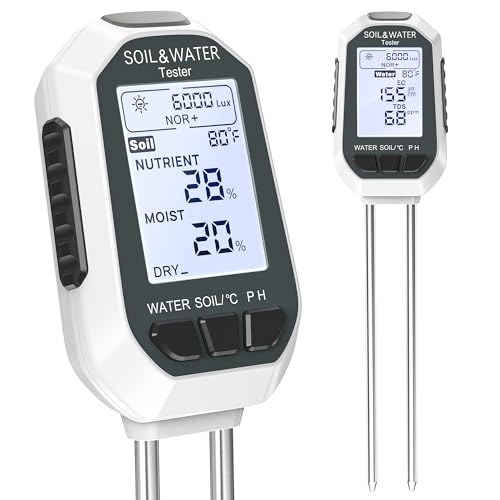
The one you buy when you want a digital dashboard for your soil. Buladeke’s 7-in-1 tester measures moisture, pH, temperature, light intensity, fertility, EC, and TDS. It’s a lot of functions in one handheld device, and the large backlit LCD makes readings easy to see in bright sun or at night.
The digital display is the standout. You get clear numbers instead of a wobbly needle, and the backlight means you can check your rooftop garden after work without a flashlight. The fertility and EC/TDS functions are unusual at this price point, and they help you decide when to feed and when to flush. Readings come in about 10 seconds after inserting the probe 10 cm deep.
It needs four AAA batteries, which aren’t included. The probe also requires damp soil. If your container mix is bone dry, you’ll need to water and wait 10 minutes before testing. And while the 7-in-1 label sounds impressive, the EC and TDS functions are more useful for hydroponics than for standard potting soil. For most city gardeners, moisture, pH, and light will be the daily go-to readings.
- 7-in-1: moisture, pH, temp, light, fertility, EC, TDS
- Large backlit LCD display
- Readings in about 10 seconds
- Low battery warning
- Requires 4 AAA batteries (not included)
Best for: Tech-friendly gardeners who want a digital readout and multiple soil metrics in one tool.
YAMRON 4-in-1 Soil Moisture Meter
The one you buy when reading the screen shouldn’t require bending over. YAMRON’s 4-in-1 tester measures moisture, pH, temperature, and sunlight. The 45-degree rotating head is the feature that sets it apart. You can angle the display toward you without crouching, which matters when you’re checking low raised beds or floor-level containers.
The large LCD with white backlight is easy to read, and the visual design uses simple graphics alongside numbers. That helps beginners understand what the readings mean without memorizing ranges. Setup is straightforward: insert the probe about 4 inches deep, wait 10 seconds, and read. For pH and moisture, YAMRON recommends averaging readings from at least five spots in the soil, which is good advice for any meter.
Like the Buladeke, it needs four AAA batteries and won’t work in dry, hard soil. You have to water first and wait. The 4-in-1 feature set is narrower than the Buladeke’s 7-in-1, so if you want EC and TDS, look elsewhere. But for basic city garden checks, the four core metrics cover what most plants need.
- 4-in-1: moisture, pH, temperature, sunlight
- 45-degree rotating head for easy viewing
- Large backlit LCD with visual graphics
- Readings in about 10 seconds
- Requires 4 AAA batteries (not included)
Best for: Gardeners with low beds or containers who want an easy-to-read digital meter without crouching.
How We Chose These Products
We focused on tools that solve real problems for small-space growers. That means testing speed, accuracy for container soil, and whether the device works without a lab or a degree in soil science. We skipped anything that requires calibration solutions or complex setup. City gardens are often on balconies, rooftops, or community plots, so portability and battery life mattered too.
We also weighed the type of data each tool provides. Capsule kits and lab tests give you nutrient breakdowns. Analog and digital probes give you instant readings for moisture, pH, and light. Both approaches have a place, and we included options from each category so you can match the tool to your growing style. For more specific soil conditions, see our guide to the best soil tester for acidic soil.
Buying Guide: What Really Matters
Start with what you actually need to measure. If your plants look tired and you suspect a nutrient problem, a capsule kit or lab test will tell you more than a probe. If you just want to stop overwatering your herbs, a moisture meter is enough. Don’t pay for 13 nutrient readings if all you need is a pH check.
Consider your soil type. Container mixes dry out fast and can be fluffy, which makes some probes struggle to get a good reading. Raised bed soil is usually denser and easier to test. If you’re working with sandy soil, look for a meter with a longer probe that can reach the root zone. Our article on the best soil tester for sandy soil covers that in more detail.
Finally, think about maintenance. Analog meters need cleaning after each use. Digital meters need batteries. Lab kits need you to collect and mail a sample. None of these are hard, but the one you’ll actually use is the one that fits your routine. A tool that sits in a drawer helps nobody.
Our Top Recommendation
The Rapitest Soil Test Kit is our top pick for most city gardeners. It covers the four variables that matter most for container and raised bed growing, gives you 20 tests, and doesn’t need batteries or calibration. The included plant pH list is a genuine bonus. If you want to understand your soil without mailing samples or trusting a wobbly needle, this is the one to get.
For a different approach, the MySoil lab kit is the runner-up for anyone who wants professional-grade nutrient data and a custom amendment plan. The SONKIR MS02 is the budget pick if you just need quick moisture and light checks. The Buladeke and YAMRON digital meters split the middle ground, with the Buladeke offering more functions and the YAMRON offering a more comfortable viewing angle. Check the current price on Amazon for each before you decide.
Frequently Asked Questions
Can I use a soil tester for both my indoor pots and my rooftop garden?
Yes, most of these tools work for both. The SONKIR, Buladeke, and YAMRON meters are designed for indoor and outdoor use. The Rapitest kit works anywhere you can collect a small soil sample. Just clean the probe between uses to avoid spreading pests or disease.
How often should I test my city garden soil?
For moisture, check before each watering, which might be daily in summer. For pH and nutrients, test at the start of the season and again mid-season if plants show problems. Lab kits like MySoil are best used once or twice a year because of the turnaround time.
Why does my soil tester give different readings in the same pot?
Soil isn’t uniform. Moisture, pH, and nutrients vary from spot to spot, especially in containers. Take readings from several locations and average them. The YAMRON instructions recommend at least five spots, which is good practice for any meter.
Do I need a lab test if I already have a digital meter?
Not necessarily. A digital meter gives you instant feedback for watering and pH adjustments. A lab test gives you a detailed nutrient profile and specific fertilizer recommendations. If your plants are healthy, a meter is enough. If you’re struggling with deficiencies or want to optimize yields, a lab test is worth the cost.