

The Best Soil Tester for Raised Beds: 5 Testers That Actually Work
Contents
Raised beds are a different beast from in-ground gardens. The soil warms faster, drains quicker, and dries out in ways that can catch you off guard. You water on a schedule, but the tomatoes still look stressed. Or the leaves turn yellow and you can’t tell if it’s a nutrient problem or too much water.
A good soil tester removes the guesswork. It tells you what’s actually happening below the surface, so you stop drowning your plants or starving them. The right one depends on what you need: basic moisture, full pH and nutrient analysis, or a digital readout with temperature and light.
We looked at five testers that cover the full range. The YAMRON 4-in-1 is our top pick for most raised beds because it balances speed, accuracy, and readability without costing a fortune. The Rapitest kit is the choice for gardeners who want lab-style nutrient data. And the SONKIR is the reliable no-battery backup that just works.
| Features | YAMRON 4-in-1 | Rapitest Kit | Buladeke 7-in-1 | SONKIR MS02 | HSLGOVE 7-in-1 |
|---|---|---|---|---|---|
| Measurement Type | Digital 4-in-1 | Chemical capsule tests | Digital 7-in-1 | Analog 3-in-1 | Digital + analog dial |
| Power Source | 4 AAA batteries | None (capsules) | 4 AAA batteries | None | 3 batteries |
| Key Metrics | Moisture, pH, temp, light | pH, N, P, K | Moisture, pH, temp, light, EC, TDS, fertility | Moisture, pH, light | Moisture, pH, fertility, temp, light, air humidity |
| Best Use Case | Fast daily checks | Seasonal soil analysis | Advanced growers | Budget reliability | Comprehensive monitoring |
| Display | Backlit LCD | Color comparator | Backlit LCD | Analog needle | LCD + analog dial |
YAMRON 4-in-1 Soil Moisture Meter
1st Pick

YAMRON
YAMRON 4-in-1 Soil Moisture Meter Digital Plant for Indoor & Outdoor Plants
- 【4 in 1 function】This is a 4-in-1 multifunctional soil tester.Our soil tester fastly to measure soil moisture, pH, temperature and…
- 【Large Screen & Backlight LCD Display】The Soil Tester uses a large LCD screen and white backlight to conveniently display and read…
- 【Quick Accurate measurement】The latest probe detection technology in 2026 can quickly and accurately measure the pH, moisture and…
The one you buy when you want reliable data without a steep learning curve. This tester suits raised bed gardeners who check their soil a few times a week and want clear numbers, not vague needle wobbles. It’s also a solid pick for anyone growing vegetables in containers on a deck or patio.
What stands out is the speed. Insert the probe about four inches, wait ten seconds, and you get moisture, pH, temperature, and light readings on a backlit screen. The 45-degree rotating head means you don’t have to crouch down to read it, which sounds minor until you’re testing six beds in a row. The visual icons on the display help beginners interpret what the numbers mean without memorizing a chart.
The trade-off is that it needs batteries, and you’ll want to keep a spare set on hand. Also, the probe doesn’t like bone-dry soil. If your raised bed has dried out completely, water it first and wait ten minutes before testing. That’s a real limitation if you’re trying to diagnose a drought-stressed bed, but it protects the sensor from damage.
- Measures moisture, pH, temperature, and sunlight in one pass
- Backlit LCD screen with intuitive icons for quick reading
- Rotating head adjusts up to 45 degrees for comfortable viewing
- Requires four AAA batteries (not included)
- Needs moist soil to get accurate readings
Best for: Raised bed gardeners who want fast, digital readings without paying for advanced features they won’t use.
Rapitest Soil Test Kit for Gardens
2nd Pick
Luster Leaf
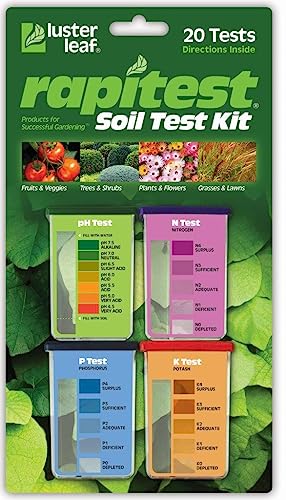
Rapitest Soil Test Kit for Gardens, Vegetables, Flowers and Lawns. USA designed and assembled soil tester completely, quickly and accurately measures/analyzes soil pH acidity and garden nutrients.
- Quick, at home results for Soil pH, Nitrogen, Phosphorous and Potash Innovative and inexpensive soil test kit features an easy-to-…
- Contains all components needed for 20 tests. 5 for each of pH, N, P and K
- Contains all components needed to test all variables in several spots in the yard or garden
The one for gardeners who think in nutrients, not just moisture. This kit is different from the digital meters. It uses chemical capsules and color comparators to measure pH, nitrogen, phosphorus, and potassium. If you’re trying to figure out why your tomatoes are cracking or your lettuce is bolting, this gives you the actual nutrient profile.
The capsule system is straightforward. You mix soil with water, add a capsule, shake, and match the color to a chart. Each kit includes enough for twenty tests: five each for pH, N, P, and K. The included pH preference list covers over 450 plants, which is genuinely useful when you’re rotating crops in raised beds. It’s made in the USA and designed for home gardeners, not lab technicians.
The obvious downside is that it’s not instant. You’re mixing and waiting, not just sticking a probe in the ground. And once the capsules run out, you need to buy refills. For quick daily checks, a digital meter is faster. But for understanding what your soil actually needs before you fertilize, this is more informative.
- Tests pH, nitrogen, phosphorus, and potassium levels
- Includes supplies for 20 tests total
- Patented color comparator system for accurate results
- Comes with a pH preference list for over 450 plants
- No batteries or electronics to worry about
Best for: Gardeners who want to diagnose nutrient deficiencies and adjust soil composition before planting season.
Buladeke Moisture Meter for Plants
3rd Pick
Buladeke
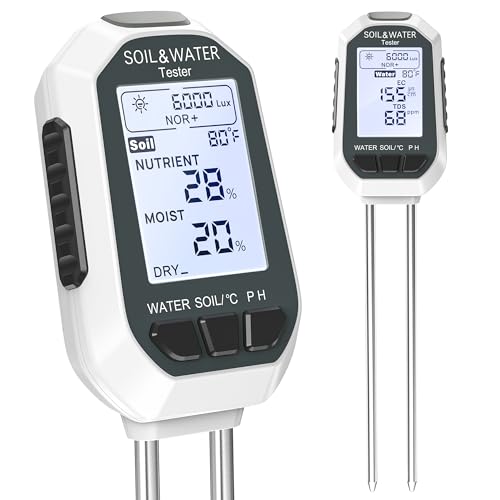
Buladeke Moisture Meter for Plants,7-in-1 Digital Soil Tester Kit
- 【7-in-1 Features】This is a 7-in-1 multi-function soil tester. Our soil tester quickly measures soil moisture, pH, temperature and…
- 【Large Screen & LCD Backlight】The Soil Moisture Meter has a large LCD display with white backlight that clearly shows the numerica…
- 【Fast and accurate measurement】With the latest 2025 probe technology, it can quickly and accurately measure soil pH, moisture, tem…
The one for growers who want every data point in a single device. This 7-in-1 tester goes beyond standard moisture and pH. It also measures EC (electrical conductivity), TDS (total dissolved solids), and soil fertility. If you’re managing a raised bed with intensive planting or experimenting with different compost blends, this gives you a fuller picture.
The large LCD screen is easy to read, and the backlight works well for early morning or evening checks. The probe technology is updated for 2026, and the response time is quick. Insert it about four inches, wait ten seconds, and you have your numbers. The fertility function is the standout here. It helps you understand whether your soil has enough nutrients to support heavy feeders like squash or corn.
Here’s the catch: the EC and TDS functions measure water quality, not soil directly. You’ll need to do a soil slurry test to get those readings, which adds a step. And like the YAMRON, it doesn’t handle dry soil well. The probe can be damaged if you force it into hard, dry ground. For the price, though, you’re getting a lot of functionality.
- Measures moisture, pH, temperature, light, fertility, EC, and TDS
- Large backlit LCD display for clear readings in any light
- Fast 10-second response time with updated probe technology
- Requires four AAA batteries (not included)
- EC and TDS require a slurry test, not direct soil insertion
Best for: Advanced raised bed gardeners who want to track nutrient density and water quality alongside basic soil metrics.
SONKIR Soil pH Meter, MS02
4th Pick

SONKIR
SONKIR Soil pH Meter, MS02 3-in-1 Soil Moisture/Light/pH Tester Gardening Tool Kits for Plant Care, Great for Garden, Lawn, Farm, Indoor & Outdoor Use (Green)
- Kindly NOTE: This soil tester can not be applied to test pH value of any other liquid. If the soil is too dry the indicator will n…
- 3 METERS IN ONE: Soil moisture level, Soil pH value and Sunlight level could be tested easily according to your need by switching…
- NO BATTERY NEEDED: Simply insert the meter into soil, wait few minutes, accurate test results will be displayed on the readout pan…
The one you keep in the shed for years without thinking about it. This analog meter doesn’t need batteries. It doesn’t need calibration. You stick it in the soil, wait a few minutes, and read the needle. That simplicity makes it a great backup tool or a primary tester for gardeners who hate dealing with electronics.
The three functions cover the essentials: moisture, pH, and light. The probe is sturdy and designed for long-term use. It works in raised beds, pots, lawns, and garden rows. The lack of batteries is a genuine advantage. You never get caught mid-test with a dead meter. The analog display is also immune to the lag and flickering that sometimes affects digital screens in bright sunlight.
The trade-off is precision. Analog needles give you a range, not an exact number. You won’t know if your pH is 6.2 or 6.8, just that it’s in the acidic range. That’s fine for most gardeners, but if you’re fine-tuning soil for blueberries or azaleas, you’ll want a digital meter. Also, the needle won’t move at all in dry soil, so you need to water first.
- Measures moisture, pH, and light with a simple function switch
- No batteries required, ever
- Analog display works in bright sunlight without glare issues
- Sturdy probe designed for repeated use
- Less precise than digital meters for pH readings
Best for: Gardeners who want a dependable, no-fuss tester that works every time without battery anxiety.
HSLGOVE Soil Test Kit, 7-in-One
5th Pick

HSLGOVE
HSLGOVE Soil Test Kit, 7-in-One Soil Moisture Meter/Soil PH Meter/Fertility, Dual Screen Soil Tester w/Digital Soil Temp/Air Temp&Humidity for Plants Gardening,Lawn,Farm Indoor&Outdoor-Lvory White
- ✅ 1Dial & 1 LCD Screen - Replace/install all 3 batteries each time. Put button to %RH/°F to - Turn On, and put to LIGHT to - Turn…
- 7Meter-in1 Comprehensive Maintenace: Specially designed for beginners, the built-in 1.6" chips board, can meet all your needs for…
- Design Patented US & Utility Patented US: Origin Dual-Dial Design -combined with both soil meter and LCD-display soil/air temperat…
The one for gardeners who want a control panel for their raised beds. This tester combines a traditional analog dial with a digital LCD screen. It measures soil moisture, pH, fertility, temperature, and light, plus air temperature and humidity. The dual-display design is genuinely unusual and useful for monitoring conditions above and below the soil line.
The probe uses three different metals for better conductivity and accuracy. It’s about 6.8 inches long, which is long enough for medium to large raised beds. The single-probe design is less damaging to plant roots than multi-probe models. The LCD screen shows soil and air temperature plus humidity, while the analog dial handles moisture, pH, and fertility. It’s a lot of information in one handheld device.
The learning curve is steeper than the other options. You need to switch between modes and understand which display shows what. The instructions help, but it took a day to get comfortable with the workflow. Also, it requires three batteries, and the battery compartment is a bit fiddly to open. For the comprehensive data set, though, it’s worth the adjustment period.
- Dual display: analog dial for soil metrics, LCD for temperature and humidity
- Measures soil moisture, pH, fertility, temp, light, air temp, and humidity
- Single 6.8-inch probe with three-metal construction
- Designed for medium to large raised beds and potted plants
- Requires three batteries and has a steeper learning curve
Best for: Detail-oriented gardeners who want to monitor both soil and air conditions in one device.
How We Chose These Products
We focused on what actually matters for raised bed gardening. Raised beds dry out faster than in-ground soil, so moisture accuracy was a top priority. We also looked at how each tester handles the unique conditions of raised beds: higher soil temperatures, faster drainage, and the need for regular monitoring during growing season.
Ease of use played a big role. A tester that’s confusing or slow won’t get used. We favored models with clear displays, quick response times, and straightforward operation. We also considered durability. Raised bed gardeners test soil repeatedly, often in wet conditions, so the probe and housing need to hold up. Finally, we weighed the value of each feature set against its complexity. More data isn’t always better if it makes the tool harder to use.
Buying Guide: What Really Matters
Start with what you actually need to measure. If you just want to know when to water, a basic moisture meter is enough. If you’re troubleshooting yellow leaves or poor growth, you need pH and nutrient data. Digital meters give you precise numbers, while analog meters give you ranges. Neither is inherently better, but they suit different gardening styles.
Consider your soil type. Raised beds often contain a mix of topsoil, compost, and amendments. That blend can affect how a probe reads moisture and pH. Some testers struggle with high-compost soils because of the organic content. Reading reviews for your specific soil mix helps. Also, think about probe length. A probe that’s too short won’t reach the root zone in a deep raised bed.
Don’t overlook battery life and calibration. Digital meters need batteries, and some drain faster than others. Analog meters never need batteries but can lose calibration over time. If you’re testing frequently, a digital meter with a low-battery indicator saves frustration. If you test occasionally, an analog meter is simpler to maintain. For more specific soil conditions, check out our guide to the best soil tester for raised deck containers.
Our Top Recommendation
The YAMRON 4-in-1 is our top pick for most raised bed gardeners. It hits the sweet spot between price, features, and usability. You get moisture, pH, temperature, and light readings in ten seconds, and the rotating head makes it comfortable to use across multiple beds. It’s not the most advanced tester on this list, but it’s the one most gardeners will actually use regularly.
If you want nutrient data instead of just moisture and pH, the Rapitest kit is the better choice. It takes more effort, but it tells you why your plants are struggling, not just that they are. For budget-conscious gardeners, the SONKIR MS02 is the reliable backup that never needs batteries. And if you want the most comprehensive data set, the HSLGOVE 7-in-1 covers everything from soil fertility to air humidity.
Frequently Asked Questions
Can I leave my soil tester in the raised bed permanently?
No. Most soil testers are designed for spot checks, not continuous monitoring. Leaving a probe in the soil exposes it to moisture and temperature fluctuations that can corrode the metal or damage the sensor. Insert it, take your reading, then clean and store it dry.
Why does my soil tester give different readings in the same bed?
Soil conditions vary across a raised bed. Moisture pools in low spots, and nutrient levels differ where you’ve added compost. Take readings from at least five locations and average them. This is especially important for pH and moisture, which can swing widely in a single bed.
Do I need to calibrate a digital soil tester?
Most consumer-grade digital testers come pre-calibrated and don’t require user calibration. However, they can drift over time. If your readings seem off compared to a lab test or a known reference, check the manufacturer’s instructions for calibration steps. Analog meters sometimes have a calibration screw, but many budget models don’t.
What’s the best time of day to test soil in a raised bed?
Morning is usually best. Soil moisture is most stable before the sun heats the bed and evaporation kicks in. Testing in the afternoon can give you artificially low moisture readings. For pH and nutrients, time of day matters less, but consistent timing helps you track changes accurately. For more tips on specific soil types, see our guide to the best soil tester for raised planter boxes.

