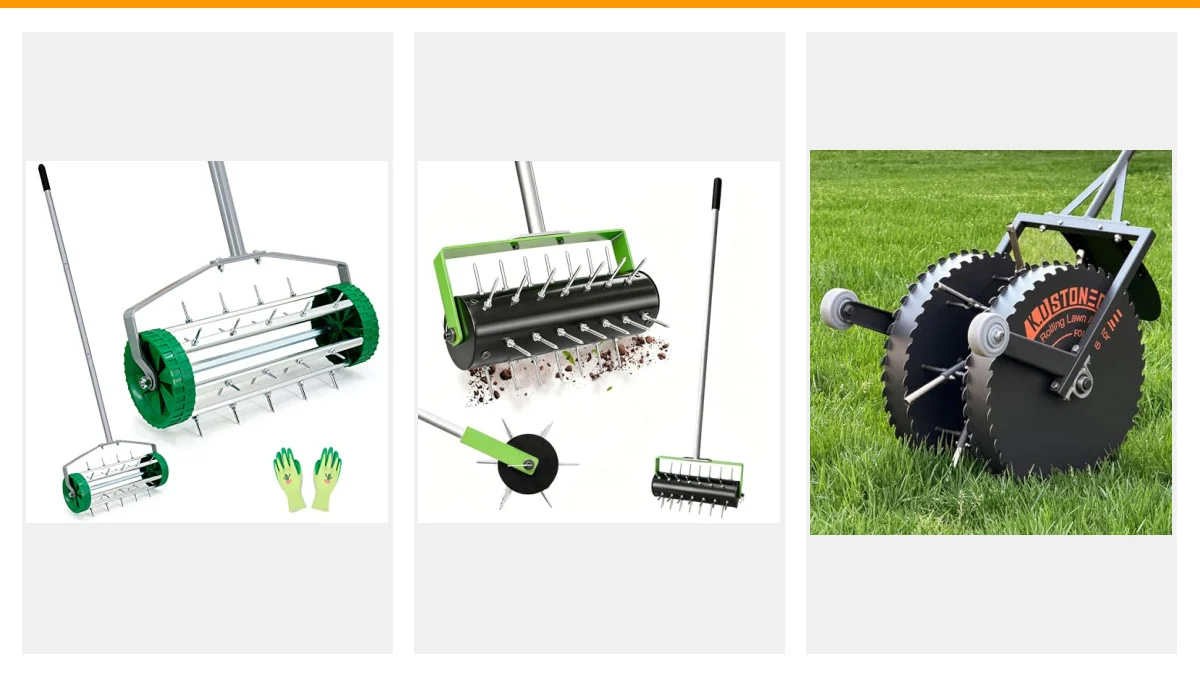
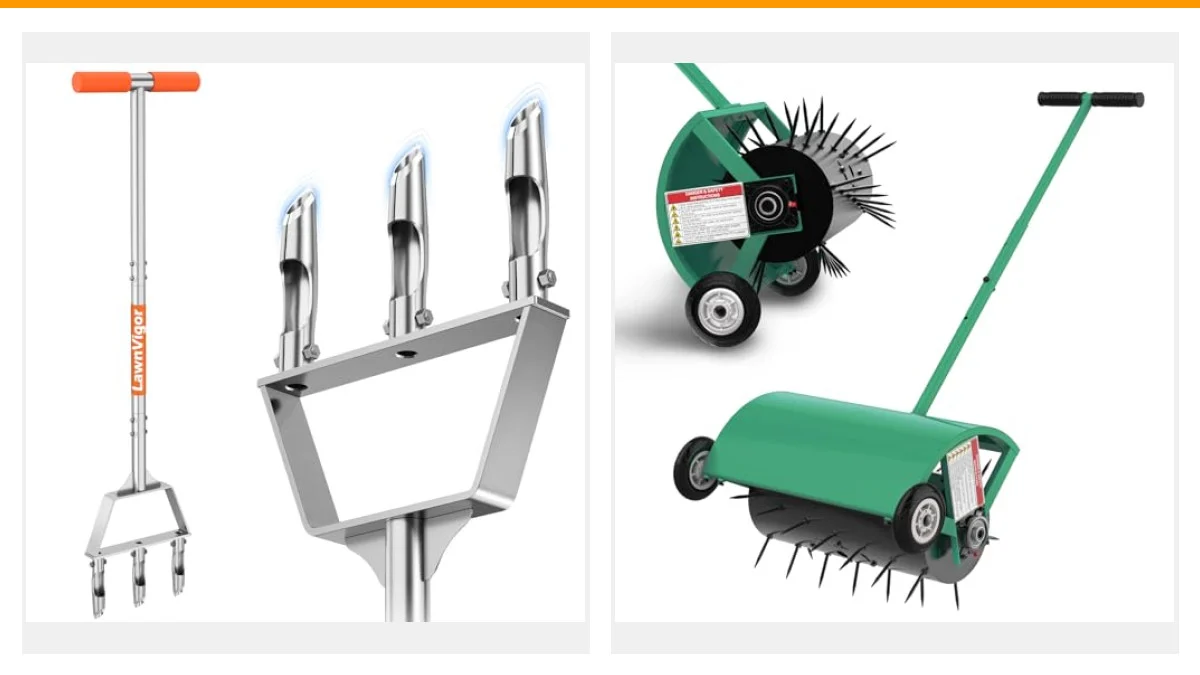
Your lawn feels like a parking lot. Water pools on the surface, fertilizer runs off, and the grass looks thin no matter how much you water. That crust on top is compaction, and the fix is punching holes through it.
A rolling aerator does that job without renting a machine. The best ones pull actual soil plugs, roll smoothly over uneven ground, and let you add weight so the tines bite into hard clay. Pair one with a bagger setup and you can collect the plugs instead of leaving them scattered across the turf.
This guide covers five rolling aerators worth your money, explains how a bagger actually fits into the process, and helps you match spike or core tines to your soil type. The K.D STONEDGE takes the top spot for small yards, with the dexirona dual-row and SENVERT filling out the shortlist for different needs.
Here is a quick look at how the five picks compare on the specs that matter most.
| Features | K.D STONEDGE Patented | dexirona Heavy-Duty | SENVERT Rolling | Failenfeivp Rolling | YihuaTop Rolling |
|---|---|---|---|---|---|
| Type | Core (plug) | Core (plug) | Spike | Spike | Spike |
| Tine Design | Rotary coring | Dual-row hollow | Spiral-spiked tread | 42 spiral pegs | 42 matrix spikes |
| Weight Options | Balanced manual design | Fillable drum (water/sand) | 32 lbs base, 55 lbs max | Fillable with sand/rocks | 32 lbs base, 70 lbs max |
| Handle | Manual push | Manual push | Manual push | 55-inch ergonomic | Height adjustable |
| Best Use | Small to medium lawns | Larger yards, fewer passes | Small to medium lawns | Hard, dense soil | Clay-heavy, compacted soil |
In this article
Patented Rolling Lawn Aer…
The K.D STONEDGE is a manual core aerator built for homeowners who want real plug pulling without renting a machine. It suits small to medium lawns where a tow-behind unit would be overkill. If your yard is under a quarter acre and you don’t mind some physical work, this is the one to start with.
What sets it apart is the patented rotary coring design. Instead of stabbing spikes into the ground, it extracts actual soil plugs. Those plugs create channels for air, water, and nutrients to reach the root zone. The weight is balanced so the tines pull plugs efficiently without you having to lean your whole body into every pass. It’s a genuine workout, but a productive one.
The trade-off is speed. Core aeration takes more passes than spike aeration because each tine pulls a plug rather than just poking a hole. On a large lawn, you’ll feel it in your shoulders. The build quality is solid and meant to last, but this isn’t a tool for someone who wants to aerate half an acre in twenty minutes.
- Rotary coring pulls actual soil plugs, not just spikes holes
- Balanced weight design reduces the effort needed per pass
- Heavy-duty construction handles regular seasonal use
- Best suited to small and medium lawns with moderate compaction
Best for: Homeowners with small to medium lawns who want true core aeration and don’t mind a manual workout.
Heavy-Duty Rolling Core L…
The dexirona is a dual-row core aerator that covers more ground per pass than most manual units. It’s aimed at homeowners with larger backyards or garden spaces who want to reduce the number of trips across the lawn. If you’ve got a half acre of compacted turf and a free afternoon, this one earns its keep.
The dual-row hollow tine design is the standout feature. Two rows of tines mean wider coverage with each roll, so you make fewer passes to finish the job. The drum is fillable with water or sand, which lets you adjust the weight to match your soil. Lighter for sandy loam, heavier for clay. That flexibility matters more than most buyers realize until they’re fighting a tine that won’t penetrate.
Assembly is straightforward with basic tools, and the unit is built for regular outdoor use. The catch is that you need to aerate when the soil is slightly moist. Dry, baked clay will stop hollow tines cold, and forcing it can bend them. Plan around a recent rain or water the lawn a day before.
- Dual-row hollow tines cover a wider area per pass
- Fillable drum adjusts weight for different soil conditions
- No rental equipment needed, aerate on your own schedule
- Requires slightly moist soil for best tine penetration
Best for: Homeowners with larger yards who want core aeration and fewer passes across the lawn.
SENVERT Rolling Lawn Aera…

SENVERT
SENVERT Rolling Lawn Aerator, Heavy Duty Push Spike Aeration Tool Up to 55 lbs, Manual Rotary Grass Aerator for Garden and Yard Use
- EFFECTIVE LAWN REVITALIZER : Achieve optimal turf health with our rolling lawn aerator. Its effective design promotes better air c…
- EFFICIENT LAWN AERATION : Compared to aerator shoes and step-style aerators, the rolling aerator offers higher efficiency, making…
- HEAVY DUTY PERFORMANCE : The aerator weighs 32 pounds, allowing the spikes to penetrate most soils effectively. You can also add e…
SENVERT makes a spike aerator with a spiral-spiked tread pattern that rolls smoother than most step-style or shoe aerators. It’s designed for small to medium lawns where you want faster coverage than a core aerator provides. The 32-pound base weight is enough for most soils, and you can add sand or stones to push it to 55 pounds.
The auxiliary wheel design is a thoughtful touch. When you’re done aerating, a pair of TPR wheels lets you roll the unit across driveways and patios without the spikes gouging the surface. That’s a small detail, but it saves you from dragging a spiked drum across your concrete. The spiral tread also makes steering easier, so you’re not fighting the tool on turns.
Here’s the honest limitation: this is a spike aerator, not a core aerator. Spikes push soil aside rather than removing it. On severely compacted clay, spike aeration can actually make compaction worse over time if you use it repeatedly. It works best on loam or sandy soil with mild compaction. The drum also should not be filled with water, only sand or stones.
- Spiral-spiked tread rolls smoothly and steers easily
- 32-pound base weight, expandable to 55 pounds with sand or stones
- Auxiliary TPR wheels protect driveways during transport
- Do not add water to the drum, use sand or stones only
Best for: Small to medium lawns with mild compaction where speed matters more than pulling plugs.
Failenfeivp Rolling Lawn…
The Failenfeivp is a spike aerator with 42 heat-treated steel pegs arranged in a spiral pattern. It’s built for homeowners dealing with hard, dense soil who need spikes that won’t warp or snap. The 55-inch handle means no bending, which matters if you’re aerating for an hour or more.
What stands out is the peg construction. Each 2-inch peg is heat-treated to increase hardness, so they hold up better against rocks and hardpan than standard spikes. The spiral arrangement forms a near-perfect circle when viewed from the side, which keeps the roll smooth and reduces the vertical bouncing you get from cheaper spike rollers. You can load the drum with sand or rocks for extra penetration on tough ground.
The galvanized steel frame resists rust, which is a real concern if you store your tools outdoors or live in a humid climate. The main drawback is the same as any spike aerator: it doesn’t remove plugs. On clay soil, you’re poking holes, not relieving compaction at depth. It’s a maintenance tool, not a cure for badly compacted ground.
- 42 heat-treated 2-inch pegs resist warping and breakage
- Spiral peg pattern rolls smoothly with minimal vertical runout
- Galvanized steel frame resists rust and corrosion
- 55-inch handle eliminates bending during use
Best for: Homeowners with hard, dense soil who want durable spikes and a comfortable handle.
YihuaTop Rolling Lawn Aer…

YihuaTop
YihuaTop Rolling Lawn Aerator Tool Heavy Duty Manual Push Aerator Lawn Tool with 42 Spikes Lawn Aerator Spike Tool Soil Penetrator Push Lawn Aeration for Garden Yard Patio (Red)
- 【Can Effectively Promote Soil Aeration】Our rolling lawn aerator can effectively solve the problem of soil compaction and promote t…
- 【42 Spikes for Uniform Aeration】This aerator lawn tool arranges 42 spikes in a matrix layout to form evenly spaced holes in the so…
- 【Adjustable Weight Design】 Lawn aerator with a self weight of 32 pounds, it can easily penetrate the most common soils. Lawn aerat…
YihuaTop’s spike aerator uses a 13.5-inch wide drum and 42 matrix-arranged spikes to cover ground quickly. It’s aimed at clay-heavy or compacted lawns where you need weight to get penetration. The base weight is 32 pounds, and the weight chamber accepts sand to reach 70 pounds total.
The wide drum is the main advantage. More width per pass means fewer trips up and down the lawn, which adds up on a larger yard. The matrix spike layout creates evenly spaced holes with smooth rolling and minimal jumping. The height-adjustable handle is a nice feature for taller users, and the rubber grips are comfortable for long sessions.
One practical note from the product data: once you add weight, it’s easier to pull the aerator backward than push it forward. That’s worth knowing before you load it up with 70 pounds of sand and try to shove it across the lawn. Also, like all spike aerators, it won’t pull plugs. It’s best for maintaining a lawn that’s already in decent shape, not rescuing one that’s badly compacted.
- 13.5-inch wide drum covers more ground per pass
- 42 matrix-arranged spikes create evenly spaced holes
- Weight chamber accepts sand up to 70 pounds total
- Height-adjustable handle with non-slip rubber grips
Best for: Homeowners with clay-heavy soil who want a wide spike aerator and adjustable handle height.
How We Chose These Products
We looked at what actually separates a useful rolling aerator from a frustrating one. Tine type came first. Core aerators pull plugs and relieve compaction at depth. Spike aerators poke holes and work faster but don’t remove soil. Both have a place, and we included both so you can match the tool to your soil.
Weight and adjustability came next. A 32-pound aerator works on soft ground. On hard clay, you need 50 pounds or more, or a fillable drum. We favored models that let you add weight without buying a separate attachment. Handle length, drum width, and build material rounded out the criteria. A 55-inch handle saves your back. A wider drum saves passes. Galvanized or heat-treated parts last longer. We also checked whether each unit could realistically pair with a bagger setup for plug collection, which most listings ignore.
Buying Guide: What Really Matters
Spike or core? That’s the first decision. Spike aerators are faster and cheaper. They work on loam and sandy soil with mild compaction. Core aerators pull plugs, which is the only way to genuinely relieve deep compaction in clay. If your lawn feels like concrete and water sits on top, you want core. If it’s just a bit tight and you want a quick seasonal tune-up, spike is fine.
Weight matters more than most buyers expect. A 30-pound aerator won’t penetrate baked clay. Look for a fillable drum so you can add sand or water. But remember: heavier means harder to push. Some units are easier to pull backward once loaded. That’s not a flaw, just physics.
Bagger integration is the piece most guides skip. A rolling aerator doesn’t come with a bagger. You pair it with a bagger-equipped mower or a tow-behind bagger. After core aeration, the plugs sit on the surface. You can let them break down naturally, which returns organic matter to the soil. Or you can run a bagger over them to collect the plugs and thatch. Collecting gives a cleaner look faster. Leaving them feeds the lawn. Both work. The bagger is a cleanup tool, not part of the aerator itself. If you’re researching bagger setups, our guide to the best lawn mower with bagger covers compatibility. For smaller yards, the best rolling aerator for small gardens breaks down compact options.
Our Top Recommendation
The K.D STONEDGE Patented Rolling Lawn Aerator takes the top spot for small to medium lawns. It pulls real soil plugs, has a balanced design that reduces effort, and uses patented rotary coring that actually relieves compaction. It’s not fast, and it’s not for large properties, but for the homeowner who wants genuine core aeration without renting a machine, it’s the best fit.
For larger yards, the dexirona Heavy-Duty Rolling Core Aerator is the runner-up. Dual-row hollow tines and a fillable drum make it more efficient across bigger areas. If you’re on a tighter budget and your soil isn’t badly compacted, the SENVERT Rolling Lawn Aerator offers spike aeration with a smooth roll and auxiliary wheels for transport. And if you’re dealing with clay so hard that spikes bend, the Failenfeivp or YihuaTop models with heat-treated pegs and heavy weight capacity are worth a look.
Frequently Asked Questions
Can I use a bagger with a rolling aerator?
Not directly. Rolling aerators don’t have a bagger attachment. You collect plugs and thatch by running a bagger-equipped mower over the lawn after aerating. Some tow-behind baggers can also be pulled behind a tractor or ATV. The aerator does the punching. The bagger does the cleanup.
Should I collect the soil plugs or leave them?
Leaving them is easier and returns organic matter to the soil as they break down. Collecting gives a cleaner appearance faster, which matters if you’re overseeding or hosting an event. If you collect, add the plugs to your compost pile. Don’t bag them for landfill.
How do I know if I need core or spike aeration?
Push a screwdriver into the soil. If it goes in easily, you have mild compaction and spike aeration will help. If you have to stomp it in, you need core aeration. Clay soil compacts hard and spike aeration can make it worse over time. Sandy or loamy soil responds well to spikes.
When is the best time to aerate?
Cool-season grasses like fescue and bluegrass do best in early fall. Warm-season grasses like Bermuda and zoysia prefer late spring or early summer. Aerate when the soil is slightly moist, not soaked. Wet soil tears, dry soil resists. A day after a good rain is usually ideal.
Maintenance, Safety, and Lawn-Damage Warnings
Rinse the tines after each use. Soil left on hollow tines hardens and blocks the next plug from ejecting. A quick spray with a hose and a wire brush keeps them clear. Check the drum for rust if you fill it with water. Sand is safer for long-term storage because it won’t corrode the inside.
Don’t aerate wet soil. Spike aerators on saturated ground push soil sideways and can smear the surface, making compaction worse. Core aerators on wet ground pull messy, uneven plugs. Wait until the soil is moist but crumbly. Also, mark your sprinkler heads and shallow lines before you start. A tine through an irrigation line is an expensive mistake.
If you have a lawn service or a homeowner’s association, check whether aeration is allowed during certain months. Some neighborhoods restrict it during drought conditions. And if your lawn is newly seeded, wait until the grass is established before aerating. Young roots don’t need the disturbance.
Final Verdict
Pick the K.D STONEDGE for small yards and real plug pulling. Choose the dexirona for larger properties and dual-row coverage. The SENVERT suits budget-minded homeowners with mild compaction. The Failenfeivp and YihuaTop handle hard, dense soil with heat-treated spikes and heavy weight capacity. Match the tool to your soil, aerate at the right time, and use a bagger for cleanup if you want a tidy finish. Your lawn will thank you with deeper roots and better water absorption.