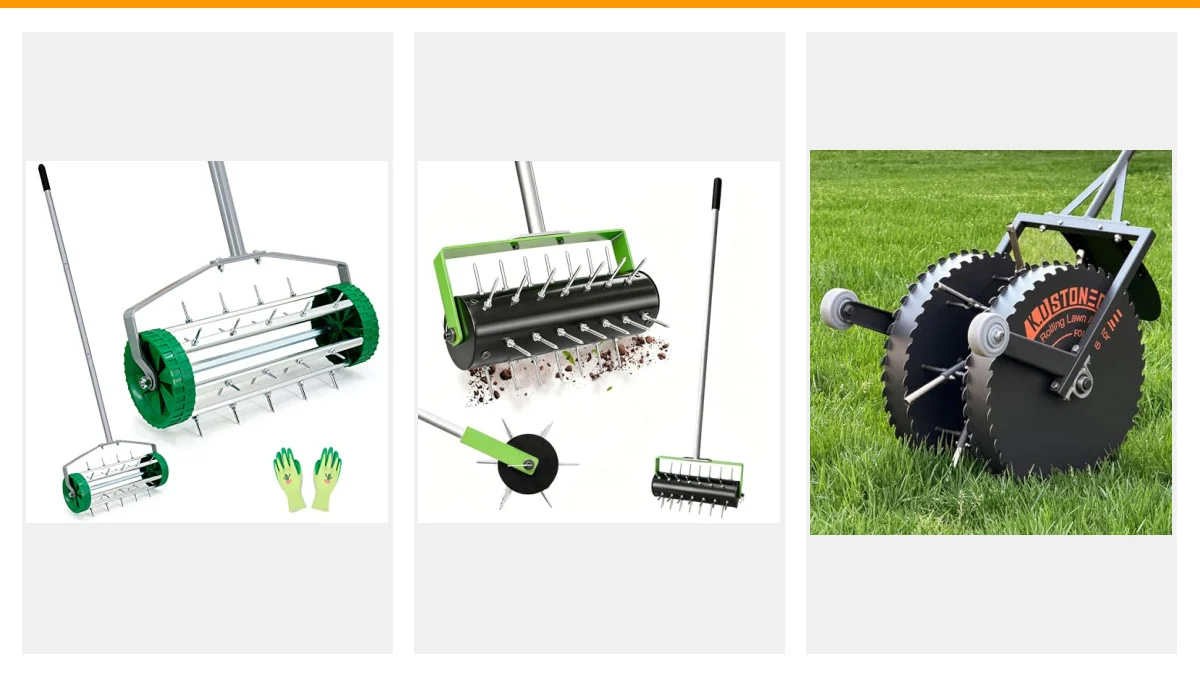
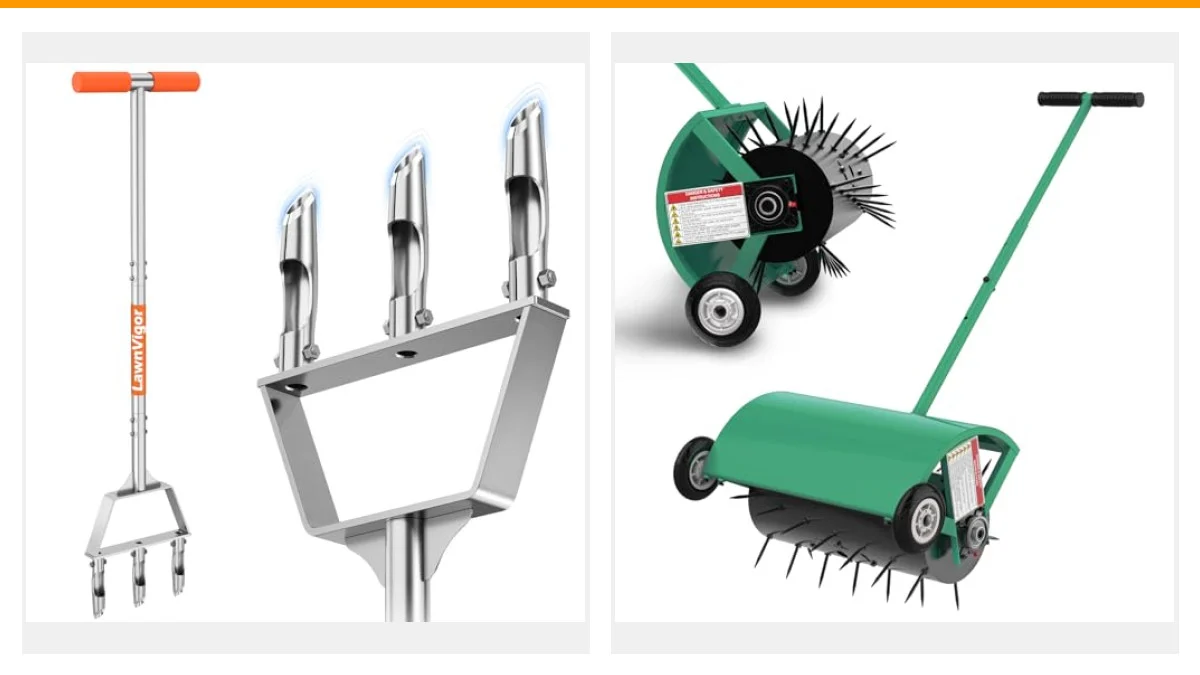
You walk outside in spring and the lawn looks tired. Water pools in the same low spot, fertilizer seems to do nothing, and the grass feels spongy underfoot. You start reading about aeration, and suddenly there are twenty tabs open: core aerators, spike aerators, tow-behind drums, rolling manuals, liquid treatments, and a rental yard two towns over.
Here’s the problem. Most roundups just list features and call it a day. Nobody tells you which machine actually pulls a plug, which one just pokes holes, or how much weight you need for clay versus sand. That’s what this comparison fixes. We looked at five real machines across four categories and broke down what each one does well, where it struggles, and who should buy it.
Short version: the SENVERT Rolling Lawn Aerator is the easiest starting point for most homeowners, the Hubiiett 24-inch is the better pick if your soil is hard, and the Suchtale tow-behind is the only real option for large properties. The two manual coring tools round out the list for small yards and precision work.
Compare the key specs side by side before you read the full reviews.
| Features | K.D STONEDGE Rolling | SENVERT Rolling | Hubiiett 24-Inch | Hubiiett 24-Inch Orange | Suchtale 40-Inch Tow |
|---|---|---|---|---|---|
| Aeration Type | Manual coring (pulls plugs) | Spike roller | Spike roller | Spike roller | Tow-behind plug coring |
| Max Weight | Fixed balanced design | Up to 55 lbs | Up to 70 lbs | Up to 70 lbs | Up to 125 lbs added |
| Spike/Plug Count | Rotary coring design | Spiral spike tread | 42 heat-treated spikes | 42 heat-treated spikes | 24 coring plugs |
| Best Lawn Size | Small to medium | Small to medium | Small to medium | Small to medium | Large yards, farm, garden |
| Best Use Case | Precision plugging | Light compaction | Harder soils | Harder soils | Tractor owners |
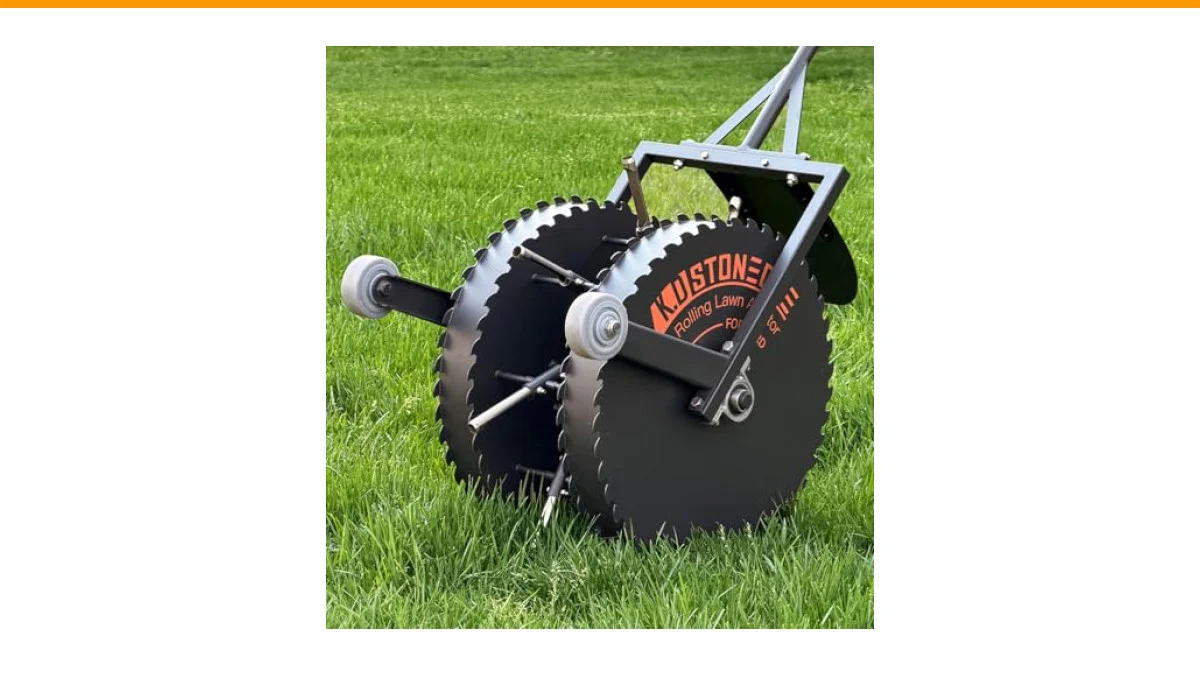
Patented Rolling Lawn Aer…

K.D STONEDGE
Patented Rolling Lawn Aerator Manual Coring Tool Compacted Soil Loosening | Transport Mobile Wheels, Reinforced Dual Push Rod, Pull Soil Plugs to Relieve Lawn Compaction, Promote Healthier Grass Growth
- Boosts Lawn Condition: Punches holes and extracts soil plugs to improve air, water, and nutrient absorption
- Promotes Root Growth: Helps loosen compacted soil, encouraging deeper and stronger root systems for healthier grass
- Manual Push Operation: Scientifically balanced weight design ensures efficient plug pulling in small to medium lawns, delivering e…
The K.D STONEDGE rolling aerator is the odd one out in this group. It’s a manual push tool, but it pulls actual soil plugs instead of just punching spike holes. That matters more than most people realize. Spike aeration compresses soil sideways; core aeration removes a small cylinder of dirt so air, water, and fertilizer can move down into the root zone. If your lawn has a genuine thatch layer or heavy clay, this is the design you want.
What stands out is the rotary coring mechanism. K.D STONEDGE patented it, and the design uses the machine’s own weight balance to pull plugs as you push. No motor, no cord, no gas. It’s also a workout. The brand even leans into that, calling it sweat-inducing. For a small city lot or a townhome yard, that’s fine. For a half-acre, you’ll feel it the next morning.
The trade-off is speed. Core pulling is slower than rolling a spike drum across the grass. You also can’t adjust the weight, so penetration on rock-hard soil depends entirely on moisture. Water the lawn a day before you use it. If you want a broader look at manual options, this manual aerator guide covers larger-area picks worth reading.
- Rotary coring design pulls real plugs, not just spike holes
- No power source needed; push operation only
- Balanced weight distribution for consistent plug pulling
- Heavy-duty build meant for repeat seasonal use
- Best on moist soil; dry ground makes plug removal harder
Best for: Homeowners with small yards who want real core aeration without renting a machine or buying a gas unit.
SENVERT Rolling Lawn Aera…

SENVERT
SENVERT Rolling Lawn Aerator, Heavy Duty Push Spike Aeration Tool Up to 55 lbs, Manual Rotary Grass Aerator for Garden and Yard Use
- EFFECTIVE LAWN REVITALIZER : Achieve optimal turf health with our rolling lawn aerator. Its effective design promotes better air c…
- EFFICIENT LAWN AERATION : Compared to aerator shoes and step-style aerators, the rolling aerator offers higher efficiency, making…
- HEAVY DUTY PERFORMANCE : The aerator weighs 32 pounds, allowing the spikes to penetrate most soils effectively. You can also add e…
SENVERT’s rolling aerator is the friendliest entry point on this list. It’s a spike roller with a spiral tread pattern, and it weighs 32 pounds out of the box. That’s enough to press into most common soils without you doing anything special. The drum has a covered opening so you can add sand or stones, pushing total weight to 55 pounds. Do not add water. The manufacturer specifically warns against it, probably because moisture rusts the drum from the inside.
The auxiliary wheels are the detail most buyers miss. They let you roll the unit across the driveway or sidewalk without the spikes gouging concrete. That’s a small thing until you’ve dragged a spike roller 40 feet over pavers and left a trail of scratches. Setup is quick too. The body ships assembled; you only bolt on the handle.
Now the honest part. Spikes don’t remove soil. They push it aside. On a lawn with mild compaction, that’s enough to open channels for water and nutrients. On dense clay, spikes can actually make compaction worse over time by pressing particles together. If your soil is genuinely hard, jump to the Hubiiett below instead.
- 32 lbs base weight, expandable to 55 lbs with sand or stones
- Spiral spike tread rolls smoother than straight-row designs
- TPR auxiliary wheels protect driveways and patios
- Minimal assembly; handle attaches in minutes
- Spike type, not core type — no plug removal
Best for: First-time aerator buyers with small to medium lawns and mildly compacted soil.
Hubiiett 24 Inch Rolling…

Hubiiett
Hubiiett 24 Inch Rolling Lawn Aerator, Heavy Duty Manual Aerator Tool, Up to 70 lbs, Push Spike Aeration Tool with 42 Spikes, Suitable for Lawns, Garden, and Yard Grass Aeration [Green]
- Efficient Lawn Aeration: Compared to step-on aerators, this 24-inch roller-style tool provides more effortless and effective aerat…
- Adjustable Weight Design: Weighing 32 lbs on its own, it penetrates most common soils with ease. The built-in weight chamber allow…
- Durable Alloy Steel Construction: The lawn aerator is made with thickened high-density alloy steel and finished with anti-rust coa…
Hubiiett’s green 24-inch roller takes the SENVERT concept and adds more muscle. It carries 42 heat-treated spikes, each 3 inches long, set in a spiral pattern across a widened drum. The 24-inch width covers more ground per pass, which cuts your total time on the lawn. Base weight is 32 pounds, but the weight chamber accepts sand up to 70 pounds total. That extra 38 pounds makes a visible difference on clay and compacted loam.
The handle design deserves attention. It uses a tripod connection with a 3-height adjustable T-grip and silicone anti-slip pads. Translation: less wobble, less back strain, and a grip that doesn’t slip when your hands get sweaty. Hubiiett also gives a practical tip in the manual — once you load the drum past a certain weight, pull the aerator backward instead of pushing it. That’s genuinely useful advice and it’s rare to see a brand admit pushing gets hard.
Limitations? It’s still a spike aerator, so no plugs come out. The 3-inch spikes are also relatively short compared to tow-behind plug tines that reach 2 inches deep with a wider core. And on very sandy soil, added weight can sink the drum instead of helping penetration. Match the weight to the ground, not to the maximum.
- 42 heat-treated 3-inch spikes resist bending
- Weight chamber expands from 32 lbs to 70 lbs with sand
- Anti-rust coated alloy steel construction
- 3-position T-grip reduces lower-back strain
- Pull rather than push once fully weighted
Best for: Homeowners with harder soil who want deeper spike penetration without stepping up to a tow-behind machine.
Hubiiett 24 Inch Rolling…

Hubiiett
Hubiiett 24 Inch Rolling Lawn Aerator, Heavy Duty Manual Aerator Tool, Up to 70 lbs, Push Spike Aeration Tool with 42 Spikes, Suitable for Lawns, Garden, and Yard Grass Aeration [Orange]
- Efficient Lawn Aeration: Compared to step-on aerators, this 24-inch roller-style tool provides more effortless and effective aerat…
- Adjustable Weight Design: Weighing 32 lbs on its own, it penetrates most common soils with ease. The built-in weight chamber allow…
- Durable Alloy Steel Construction: The lawn aerator is made with thickened high-density alloy steel and finished with anti-rust coa…
The orange Hubiiett is the same machine as the green one, down to the spike count and weight capacity. Same 24-inch drum, same 42 heat-treated spikes, same 70-pound maximum, same tripod handle. The only difference is the color of the powder coat. If you’re comparing listings and wondering whether one outperforms the other, they don’t. Pick based on which color you’d rather see in the garage.
That said, it’s worth calling out why the color option exists. Hubiiett sells these in multiple finishes so buyers can match their other garden tools or just avoid losing the aerator in tall grass. It’s a minor thing, but a bright orange drum is easier to spot when you’ve left it half-hidden behind the shed.
Every trade-off from the green version applies here. Spike aeration only, no plug removal, and the drum gets heavy fast once you add sand. The anti-slip silicone grips and stable handle connection are the same. If you found the green version appealing but want something more visible, this is your pick. Otherwise, they’re interchangeable.
- Identical specs to the green Hubiiett 24-inch model
- 42 reinforced 3-inch spikes, heat-treated for hardness
- Sand-fill chamber raises working weight to 70 lbs
- Anti-rust alloy steel body with silicone grip pads
- Water the lawn first to soften soil and extend spike life
Best for: Buyers who want the Hubiiett performance in a brighter finish that’s easy to spot in storage.
Suchtale 40-Inch Tow Behi…

Suchtale
Suchtale 40-Inch Tow Behind Plug Aerator with Universal Hitch, Tow Plug Aerator with Extra-Wide Tow Bar, Durable Lawn Aerator Soil Penetrator Tractor with 24 Coring Plugs for Lawn, Farm and Garden
- Durable Structure with 6 spools of integral aerator knives: Suchtale Tow Behind Plug Aerator with 24 Heat-Treated Plugs, each plug…
- Easy to Use and Effort Saving: The unique 2-piece steel draw bar complete with a universal hitch pin, conveniently connects to you…
- Durable Construction & Easy to Install: Designed with high-quality all-steel, and reinforced side plate and solid steel axle for e…
The Suchtale tow-behind is a different animal entirely. This is a 40-inch plug aerator with 24 heat-treated coring tines mounted on six spools. It hitches to a riding mower or ATV with a universal pin-style hitch and a two-piece steel draw bar. You aerate from the seat. No pushing, no walking, no sweat. For anyone maintaining an acre or more, that’s the only realistic option on this list.
Each plug penetrates up to 2 inches deep and pulls a real soil core. That’s genuine core aeration, the same principle the K.D STONEDGE uses but scaled up and mechanized. The weight tray accepts up to 125 pounds of extra load — cement blocks, sandbags, whatever you have — for deeper penetration in compacted ground. The transport handle lifts the tines for crossing driveways and walkways without tearing them up. Wheel bearings handle the load, and the 6mm adjust handle is thicker than the 4mm you’ll find on cheaper tow units.
The catch: you need a tow vehicle. No riding mower means no Suchtale. Availability is also listed as scarce, so stock fluctuates. Assembly takes longer than the manual rollers — the instruction manual includes a full parts breakdown, but plan on an hour. And when you’re done, storage is a real consideration. This thing is 40 inches wide and heavy.
- 24 heat-treated coring plugs pull real soil cores
- 40-inch working width covers ground fast
- Weight tray accepts up to 125 lbs of added load
- Universal hitch fits most riding mowers and ATVs
- Transport handle raises tines for driveway crossings
Best for: Property owners with a riding mower and a large lawn, farm, or garden that needs true plug aeration.
How We Chose These Products
We started with the categories that actually matter: core versus spike, manual versus tow-behind, and how much weight each machine can carry. Then we filtered out anything with vague specs or missing details. Every product here lists its spike or plug count, weight range, and materials. That’s the minimum for a fair comparison.
We also weighted real-world usability. A machine that takes two hours to assemble or requires a tow vehicle you don’t own isn’t helpful, no matter how good the specs look. Handle design, storage footprint, and setup time all factored in. So did honest limitations — every product here has at least one.
Buying Guide: What Really Matters
Core versus spike is the first decision. Core aerators pull plugs and relieve compaction at the root zone. Spike aerators push holes and work fine for mild compaction, but they can worsen hard clay over repeated use. If you’ve never aerated and your soil is soft, a spike roller is a reasonable start. If water pools and the ground feels like concrete, go core.
Weight drives penetration. A 32-pound roller barely dents hard ground. Add sand to reach 55 or 70 pounds and the same machine bites deeper. Tow-behind units take this further with weight trays that hold up to 125 pounds. Match the weight to your soil, not to the maximum the drum allows. Overweight on sandy ground just buries the spikes.
Lawn size decides the type. Under a quarter acre, manual rollers are fine and cost less. Above half an acre, you’re looking at tow-behind or a rental unit. If you’re weighing the rental math, this rental aerator breakdown walks through the numbers. And if you want to see how these compare against powered alternatives, the gas aerator options cover the next tier up.
Our Top Recommendation
The SENVERT Rolling Lawn Aerator wins for most homeowners. It’s light enough to handle, heavy enough to work on typical soil, and the auxiliary wheels solve the driveway-scratching problem that plagues spike rollers. Setup takes minutes. It’s the least fussy way to start aerating.
If your soil is harder than average, spend the extra on the Hubiiett 24-inch. The 70-pound capacity and 42 heat-treated spikes make a real difference on clay and compacted loam. The adjustable handle is also better for taller users.
For large properties with a riding mower, the Suchtale tow-behind is the only pick here that delivers true core aeration at scale. And if you want real plugs on a small yard without a tow vehicle, the K.D STONEDGE manual coring tool is the one to get.
Frequently Asked Questions
How deep should a lawn aerator actually go?
The Suchtale tow-behind reaches up to 2 inches, which is the standard target for core aeration. Spike rollers typically penetrate less, closer to 1 to 1.5 inches depending on soil moisture and added weight. Deeper isn’t always better — 2 to 3 inches is the sweet spot for most turfgrass root zones.
Do I need to water before aerating?
Yes, and this is the step most people skip. Moist soil lets tines and spikes penetrate without bending or clogging. Water thoroughly the day before, not the morning of. Saturated ground tears up worse than dry ground because the tines pull mud instead of clean plugs.
Can I aerate a lawn with sprinkler heads or buried lines?
Mark everything first. Spike rollers can crack irrigation tubing, and core tines will punch straight through shallow cable or sprinkler lines. Flag heads, valve boxes, and any known conduit before you start. On slopes, aerate across the grade, not up and down, to avoid tearing the turf.
How often should I aerate, and when?
Once a year is enough for most lawns. Cool-season grass does best in early fall, warm-season grass in late spring. If your soil is heavy clay or gets heavy foot traffic, twice a year helps. Skip aeration during drought or right after overseeding — you’ll disturb the new seed.