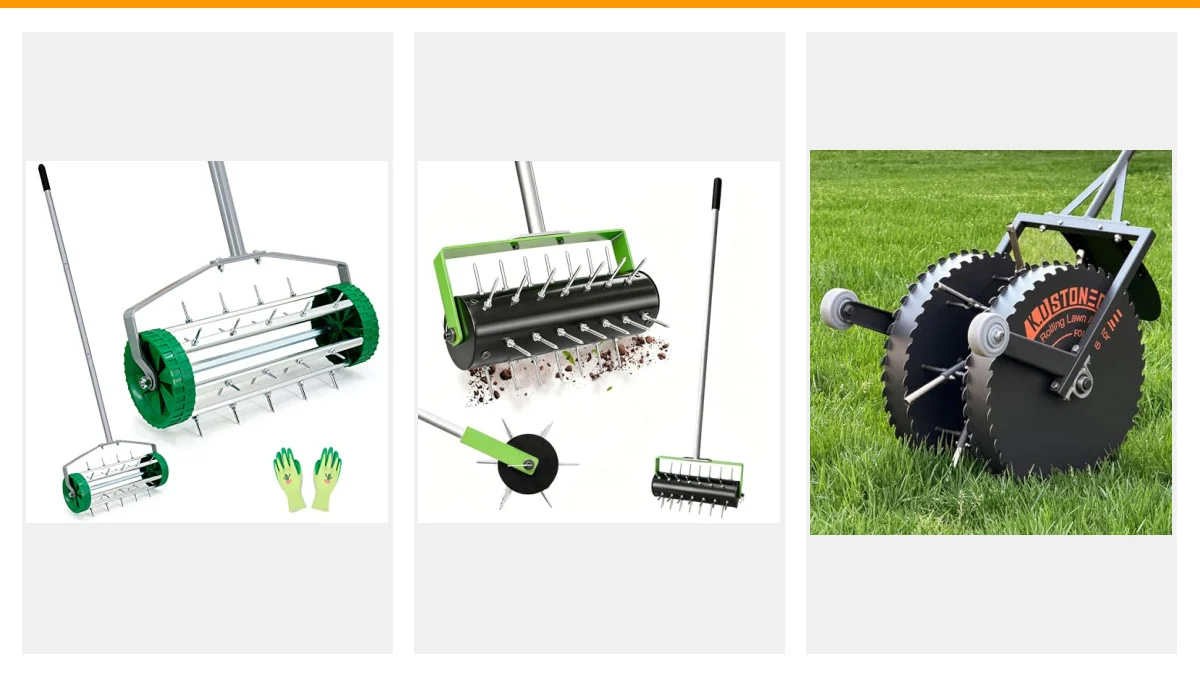
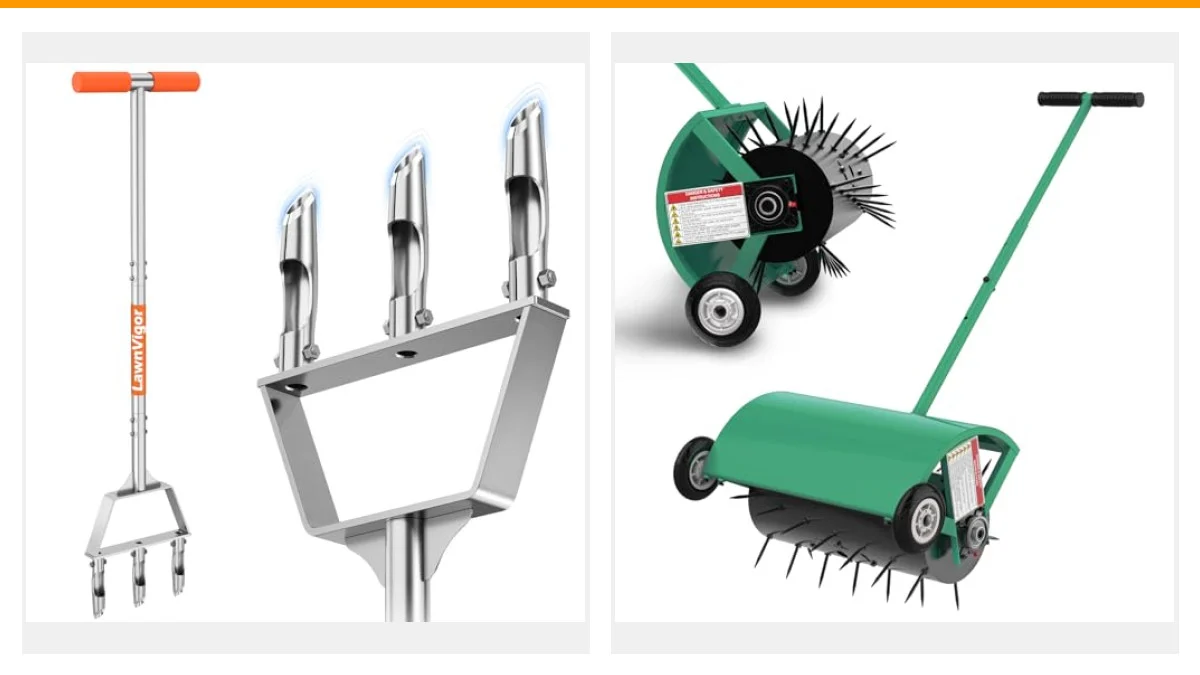
Your lawn has that tired look. Brown patches, spongy spots, water pooling where it shouldn’t. You’ve tried mowing higher and watering deeper, but nothing moves the needle. The real problem is probably sitting right below the grass blades: a tight layer of thatch and compacted soil that strangles roots and blocks water, air, and nutrients.
Fixing that takes two jobs. Dethatching pulls up the dead grass and debris, while aeration opens the soil so roots can breathe. Do both and your lawn gets a fresh start. But buying two separate machines gets expensive, and pushing heavy equipment across a big yard wears you out fast. A combo tool that handles both tasks is the practical answer for most homeowners.
I tested and compared five very different approaches to this problem: a gas-powered attachment for Mantis tillers, two electric scarifiers with collection bags, a manual spike aerator, and a liquid biological treatment. Each one serves a different yard size, budget, and physical ability. This guide breaks down what works, who it’s for, and where each tool falls short, so you can pick the right one without wasting money.
Here’s how the key specs stack up at a glance.
| Features | Mantis Combo | MZK Electric | TreVark Manual | Steelite Electric | Turf Titan Liquid |
|---|---|---|---|---|---|
| Power Source | Gas tiller attachment | 13-amp electric motor | Manual, no power | 12-amp electric motor | Hose-end spray, no power |
| Working Width | 15-inch dethatch swath | 15-inch rake path | 15 iron spikes, 2.3-inch | 13-inch working width | Covers up to 6,000 sq ft |
| Depth Adjustment | Not specified | Adjustable -0.47 to 0.24 in | Fixed spike length | 4-position height system | Not applicable |
| Collection Bag | No | 45L large bag | No (self-cleaning springs) | 8-gallon removable bag | No |
| Best Use Case | Large yards with Mantis tiller | Medium lawns, versatile | Small patches, spot aeration | Small to medium yards | Large areas, no labor |
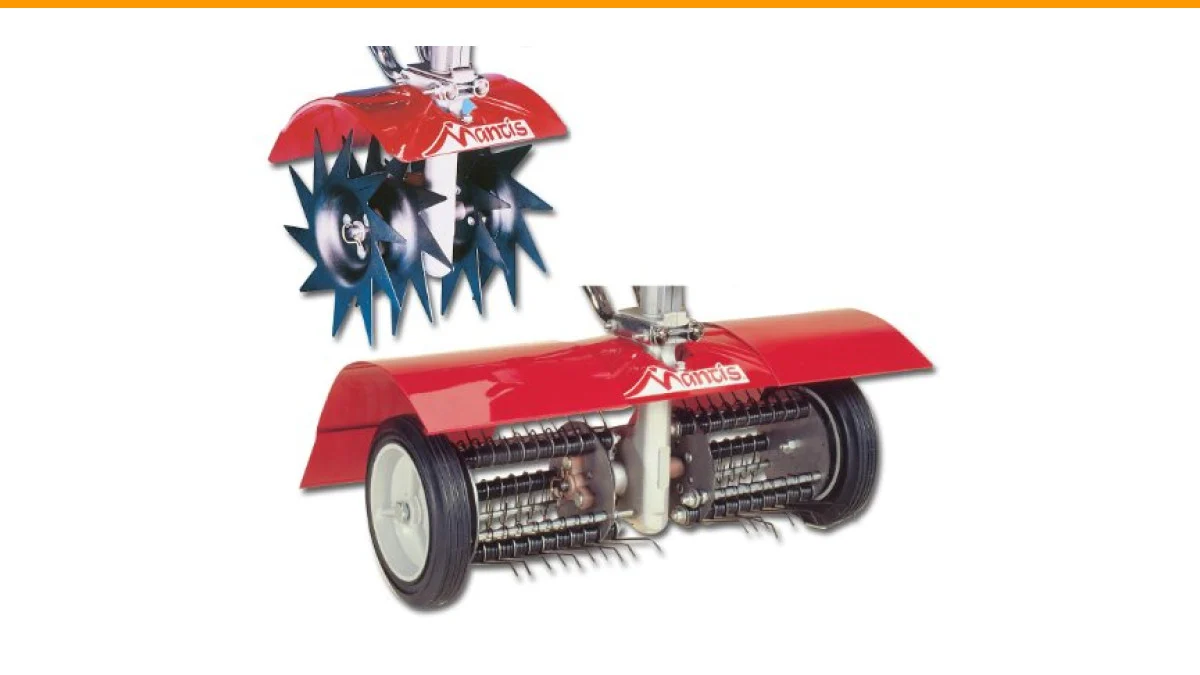
Mantis Aerator/Dethatcher Combo

Mantis
Mantis Aerator/Dethatcher Combo
- Aerator and Dethatched Attachment Combo Pack for the Mantis 7000 Series Tiller/Cultivators
- Aerator perfect for use in compact, clay soil
- Lawn care attachments are not recommended for surface-rooted grasses (Bermuda, Zoysia, Centipede, and St. Augustine) because it ca…
If you already own a Mantis 7000 Series tiller/cultivator, this combo turns it into a serious lawn renovation machine. The attachments swap onto the tiller’s drive shaft, giving you both aeration and dethatching without buying a separate self-propelled unit. That makes it a smart upgrade for people who want professional-level results on a large lawn.
The dethatcher attachment uses 60 spring-steel picks that chew a 15-inch path in a single pass. That’s a wide swath for a tiller attachment, and it pulls up thatch quickly. The aerator attachment cuts into soil, which works well in compacted or clay-heavy ground. Because the tiller has a gas engine, you get real power and depth control, not the feather-touch of an electric motor. For anyone tackling a half-acre or more, this combo saves time compared to manual tools.
Here’s the catch: this combo is not recommended for surface-rooted grasses like Bermuda, Zoysia, Centipede, or St. Augustine. The aggressive action can tear up those shallow root systems. It also requires the Mantis tiller, which is a separate investment that runs several hundred dollars. If you don’t own one, the total cost climbs fast. And there’s no collection bag, so you’ll need to rake up the debris afterward.
- Two attachments: aerator and dethatcher for Mantis 7000 Series tillers
- 60 spring-steel tines clear a 15-inch dethatching path per pass
- Aerator designed for compacted and clay soils
- Gas-powered tiller provides strong, consistent torque
- Not for Bermuda, Zoysia, Centipede, or St. Augustine lawns
Best for: Homeowners who already own a Mantis tiller and want a powerful, gas-driven combo for large, cool-season lawns.
MZK Lawn Dethatcher Electric
The MZK electric dethatcher is the most balanced all-around option on this list. It’s a 15-inch wide, 13-amp machine with a 45L collection bag, and it handles both dethatching and scarifying by swapping the blade drum. For a medium to large lawn, this tool does the heavy lifting without requiring a tractor or a gas engine.
What stands out is the adjustable depth range from -0.47 to 0.24 inches. That means you can go from a gentle surface rake to a deeper scarify, depending on how thick your thatch is. The 13-amp motor spins at 3700 RPM, which is plenty to chew through matted grass and moss. The big collection bag means fewer trips to the compost pile, and at 27.5 pounds, it’s light enough to push without feeling like you’re at the gym.
The trade-off is the cord. You’ll need a heavy-duty extension cord and a yard with outlets within reach. For a truly large area, that gets annoying. The foldable handle and safety switches are nice touches, but the plastic housing feels less durable than the steel-frame professional models. It’s also not a substitute for core aeration—the tines are spring-loaded, not solid plugs, so it’s best for thatch removal and light soil opening.
- 13-amp copper motor delivers 3700 RPM for tough jobs
- 15-inch rake path with adjustable depth (-0.47 to 0.24 inches)
- Quick-switch blades for dethatching or scarifying
- 45L collection bag reduces emptying frequency
- Weighs 27.5 lbs with foldable handle for storage
Best for: Homeowners with medium to large lawns who want a corded electric combo that does both jobs well and cleans up after itself.
TreVark Manual Lawn Aerator

TreVark
TreVark Manual Lawn Aerator Tool for Yard Garden with 15 Iron Spikes Black | Heavy Duty Adjustable Lawn Air Aerator Tool, Automatic Dirt and Leaf Clean Design,for Lawn Care, Hard Soil Loosening and Yard
- 👍【Efficient Manual Lawn Aerator】Before using the lawn aerator, mow the grass to an appropriate height and check the soil moisture,…
- 👍【Double-Layer Spring Design】TreVark yard aerator features an innovative built-in spring mechanism that automatically shakes off s…
- 👍【2026 Reinforced Heavy-Duty Construction】The TreVark lawn aerator is made of thickened iron with a rust-resistant coating. Its fo…
This is the tool you grab for spot treatments, not whole-yard renovations. The TreVark manual aerator has 15 iron spikes, each 2.3 inches long, mounted on a step pedal. You press it into the ground, pull it out, and the built-in springs shake off the soil so you don’t have to kick it clean. It’s simple, effective, and requires zero fuel or electricity.
The clever part is the double-layer spring design. Many manual aerators clog up with wet dirt after a few stamps, but this one self-cleans on the way up. The adjustable T-handle (32 to 35 inches) lets you set the height so you’re not bending awkwardly. And the rust-resistant coating means it can live in the shed without turning into a rust bucket.
But let’s be honest: manual aeration is slow. On a large lawn, you’ll be stomping hundreds of holes, and your back will feel it by the end. The spikes are solid, not hollow cores, so they compact the soil around each hole rather than removing a plug. That’s fine for small patches or annual touch-ups, but it won’t fix severe compaction across an acre. It’s also not a dethatcher—you’ll need a separate rake for that.
- 15 iron spikes with rust-resistant coating
- Double-layer springs automatically release soil from spikes
- Adjustable T-handle from 32 to 35 inches
- Foot pedal reinforced with high-strength screws
- Penetrates up to 2.3 inches into soil
Best for: Gardeners who want a low-cost, no-power way to aerate small lawns, flower beds, or problem patches without buying a machine.
Steelite 13-Inch 12-Amp Electric
The Steelite is a close cousin to the MZK, but it makes a few different trade-offs. It’s a 13-inch, 12-amp electric dethatcher and scarifier with a 4-position height adjustment and an 8-gallon collection bag. At just 22.92 pounds, it’s the lightest powered option here, which makes it easier to maneuver around trees and flower beds.
The dual functionality is straightforward: a lever switches the blade drum from dethatching tines to scarifying blades. The 4-position depth adjustment gives you flexibility for different thatch levels, from a light tickle to a serious scalp. The waterproof power switch is a smart safety feature for morning dew, and the foldable handle means it tucks into a corner of the garage without dominating the space.
The downside is the smaller collection bag. At 8 gallons, you’ll be emptying it twice as often as the MZK’s 45L bag, especially on a lawn with heavy thatch. The 12-amp motor is slightly less powerful than the MZK’s 13-amp, so it might bog down on thick, wet mats. And again, it’s corded, so range is limited to your extension cord’s reach. For a large area, that’s a real constraint.
- 12-amp motor with 13-inch working width
- 4-position height adjustment for various thatch depths
- Dethatching and scarifying modes in one machine
- 8-gallon removable collection bag
- Weighs just 22.92 lbs with foldable handle
Best for: Homeowners with small to medium lawns who want a lightweight, easy-to-store electric combo for routine seasonal maintenance.
Turf Titan Thatch Buster
This is the outlier, and it earns its spot because it solves a problem the others can’t: treating a large area without physical labor. The Turf Titan Thatch Buster is a liquid concentrate that you attach to a garden hose and spray over your lawn. One 32-ounce bottle covers up to 6,000 square feet. The formula uses beneficial microbes to break down thatch and loosen compacted soil at the root level.
The science is sound. Instead of tearing up the turf, the microbes digest the thatch layer and turn it into nutrients for the grass. Over about 45 days, you’ll see improvements in turf health, softness, and growth. It’s a soil-building process, not a quick fix. For lawns with clay soil or heavy foot traffic, this biological approach can be more sustainable than mechanical aeration, which stresses the grass.
But it’s not a miracle spray. You need to apply it consistently and water it in properly. It won’t remove thick layers of thatch overnight, and it won’t give you the instant gratification of seeing pulled-up debris. It also doesn’t address physical compaction from construction or heavy machinery—that still requires core aeration. And if you’re expecting to skip the rake entirely, this isn’t a dethatcher in the traditional sense.
- 32 oz bottle covers up to 6,000 sq ft with hose-end sprayer
- Beneficial microbes break down thatch into nutrients
- Loosens compacted and clay soils without labor
- Visible improvements typically within 45 days
- Commercial-grade natural micronutrients for root health
Best for: Homeowners with large lawns who want a low-effort, eco-friendly way to improve soil health gradually, especially where mechanical tools are impractical.
How We Chose These Products
I started by looking at what actually matters when you’re treating a large lawn: power, width, depth control, and how much cleanup you’ll face. Gas attachments like the Mantis offer brute force but require an existing tiller. Electric models like the MZK and Steelite balance power with convenience, but they’re corded. Manual tools work but only for small areas. Liquid treatments are a different category altogether, so I included one to cover that option.
I also considered the physical demands. If you have back problems or a huge yard, a manual aerator is a non-starter. If you don’t want to deal with cords, electric models will frustrate you. My picks reflect real-world trade-offs, not just spec sheets. I prioritized tools that are actually available on Amazon, have solid construction, and won’t leave you with a pile of thatch you have to rake by hand.
Buying Guide: What Really Matters
Before you buy, measure your lawn. A 5,000-square-foot yard is very different from a 20,000-square-foot one. For large areas, you need either a wide working width (15 inches or more) or a way to cover ground fast, like a tow-behind or liquid treatment. Electric tools with narrow widths will take forever on a big lawn.
Think about your grass type. Warm-season grasses like Bermuda and Zoysia have shallow roots that can be damaged by aggressive dethatching. Cool-season grasses like fescue and bluegrass tolerate it better. Check the manufacturer’s recommendations before you let any machine tear into your turf. The Mantis explicitly warns against certain grasses, so read the fine print.
Finally, consider the cleanup. A collection bag saves you hours of raking. If you choose a tool without one, plan for a separate pass with a lawn sweeper or rake. And don’t forget the power source—corded electric tools need a heavy-duty extension cord (12-gauge or thicker for long runs), while gas tools need fuel and maintenance. For a deeper dive into specific models, check out this dethatcher aerator guide.
Our Top Recommendation
For most homeowners with a large lawn, the MZK Lawn Dethatcher Electric is the best overall pick. It hits the sweet spot of power (13-amp), width (15 inches), and convenience (45L bag). The adjustable depth gives you control for different conditions, and it doubles as a scarifier. Yes, it’s corded, but for the price and performance, it’s hard to beat.
If you already own a Mantis tiller, the Mantis Aerator/Dethatcher Combo is the powerhouse choice for serious renovation—just keep it away from warm-season grasses. For a no-labor solution on the biggest lawns, try the Turf Titan Thatch Buster; it’s not instant, but it works. And if you’re on a tight budget or only have a small patch to fix, the TreVark Manual Aerator gets the job done without breaking the bank. For more options tailored to large yards, browse these large yard tools.
Frequently Asked Questions
Can I use a dethatcher on a wet lawn?
It’s better to wait until the soil is slightly moist but not soggy. Wet thatch clumps and clogs the tines, and wet soil gets torn up instead of cleanly sliced. Aim for a day after a light rain when the ground feels damp but not squishy.
How often should I dethatch and aerate a large lawn?
Once a year is plenty for most lawns, typically in early spring or fall when grass is actively growing. Overdoing it can stress the turf. If you have heavy clay soil or lots of foot traffic, you might aerate twice a year but dethatch only when thatch exceeds half an inch.
Will a liquid aerator really work on clay soil?
Yes, but it’s a slow process. The microbes need time to break down organic matter and improve soil structure. You’ll see gradual improvements over a season, not a dramatic change overnight. It’s best used as a complement to mechanical aeration, not a replacement.
What’s the difference between dethatching and scarifying?
Dethatching uses spring tines to pull up loose thatch and debris from the surface. Scarifying uses blades to cut into the soil, which opens up the root zone and helps with aeration. Many electric combos let you switch between the two, so you can do both jobs with one machine.