Three weekends in a row I stared at the same patch of lawn. Compacted clay, thinning grass, water pooling after every rain. Aeration was the fix. Finding an aerator I could trust was the problem.


Amazon listings all blur together. One says 48 inches, another says 40. Some pull plugs, some punch spikes. Weight trays range from 75 to 330 pounds, and half the reviews read like they were written by the manufacturer. So I did the digging for you.
A good tow behind aerator needs three things: tines that actually reach the soil, a weight tray heavy enough to force penetration, and a hitch that fits your tractor without a trip to the hardware store. Below are five models that pass those tests, plus a breakdown of which one suits your lawn, your soil, and your budget.
Here is a quick side-by-side of the key specs that separate these five aerators.
| Features | Agri-Fab 48-Inch Plug | Brinly Combo Aerator | Brinly Spike Aerator | Garvee 48-Inch Plug | BlumeTrec 40-Inch Spike |
|---|---|---|---|---|---|
| Aeration Type | Plug (core) | Spike tines | Spike tines | Plug (core) | Spike tines |
| Working Width | 48 inches | 40 inches | 40 inches | 48 inches | 40 inches |
| Weight Tray Capacity | 175 lbs | 75 lbs | 150 lbs | 330 lbs | 110 lbs |
| Penetration Depth | Up to 3 inches | Up to 2 inches | Up to 2 inches | Up to 3 inches | Up to 2 inches |
| Best Use Case | Large lawns, deep plugs | Aerate and overseed together | Routine maintenance | Heavy clay, big acreage | Tight yards, turning |
In this article
Agri-Fab 48 In Tow Behind
Agri-Fab
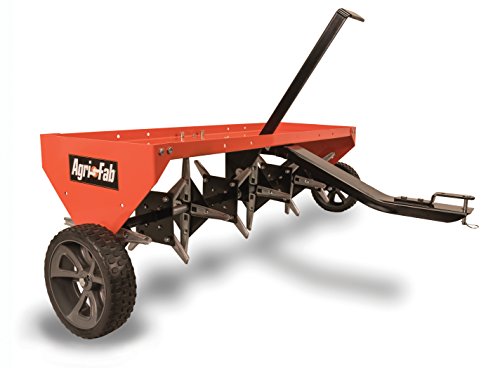
Agri-Fab 48 In Tow Behind Lawn Plug Aerator with 32 Galvanized Knives and Universal Hitch
- DEEP SOIL AERATION PERFORMANCE: Pulls plugs up to 3 in deep to improve airflow, water absorption, and nutrient penetration for str…
- IMPROVES LAWN ROOT DEVELOPMENT: Helps loosen compacted soil to encourage deeper root growth and support a thicker more professiona…
- SMOOTH EASY OPERATION: Flat free tires provide reliable transport while the cantilever transport handle allows convenient raising…
The Agri-Fab 48-inch plug aerator is the classic choice for homeowners with a half-acre or more of established turf. It pulls actual soil plugs, not just spikes, which means it relieves compaction instead of temporarily poking holes in it. If your lawn has never been aerated or feels rock-hard underfoot, this is the model to start with.
What sets it apart is the combination of 32 galvanized, self-sharpening knives and a 175-pound weight tray. That weight matters more than most buyers realize. A light aerator bounces across hard ground without pulling plugs. Load this one with sandbags or concrete blocks and the tines bite down to 3 inches. The cantilever handle lets you raise and lower the tines from the tractor seat, so you aren’t hopping off at every driveway crossing. Flat-free tires are a small detail that saves real headaches.
For optimal results, consider using straw vs hay as mulch in your vegetable garden after aerating your lawn.
The trade-off is that plug aerators leave cores on the surface. You will see little soil plugs scattered across the lawn for a week or two. Some people rake them in, some let rain dissolve them. Also, the universal hitch fits most tractors but not every model, so measure your hitch pin before ordering.
- 32 galvanized self-sharpening plug knives
- Pulls cores up to 3 inches deep
- 175-lb weight tray for hard soil
- Flat-free tires and cantilever transport handle
- Universal hitch fits most lawn and garden tractors
Best for: Homeowners with large, compacted lawns who want real core aeration without hiring a service.
Brinly Tow Behind Combina…
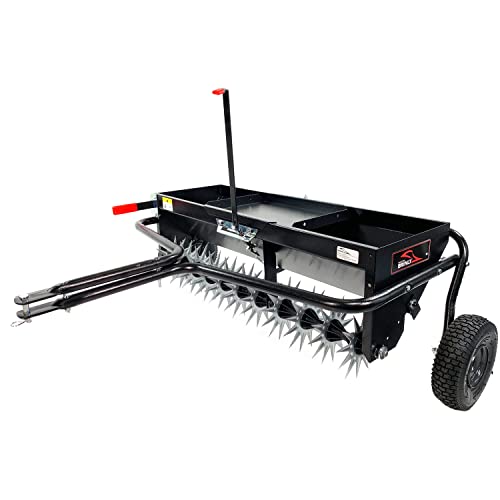
Brinly took a different angle with this one. It’s a combination aerator and spreader, which means you drop seed, fertilizer, or lime while the tines are opening up the soil. For anyone overseeding in fall, that timing matters. Seed that lands in freshly opened soil has a much better shot at germinating than seed sitting on top of a hard crust.
The 3-D tines are the standout feature here. Brinly designed them to resist bending, and that’s a genuine improvement over older flat-tine designs that fold the first time they hit a tree root. The steel hopper holds 100 pounds of material, and the weight tray adds another 75 pounds of downward pressure. With 132 tine tips across 40 inches, you get decent coverage per pass.
Here’s the honest limitation: 75 pounds of tray weight is modest compared to the Garvee or the Agri-Fab. On genuinely hard clay, you may not hit the full 2-inch depth without pre-soaking the lawn. The 2-in-1 design also means it’s a compromise on both fronts. It aerates well but not as aggressively as a dedicated plug unit, and it spreads well but not as precisely as a standalone broadcast spreader.
- Combination aerator and seed/fertilizer spreader
- Patent-pending 3-D galvanized tines resist bending
- 100-lb steel hopper plus 75-lb weight tray
- 132 tine tips penetrate up to 2 inches
- All-steel construction prevents twisting
Best for: Anyone planning to aerate and overseed in the same pass, especially in fall.
Brinly SAT2-40BH-P Tow Be…
Brinly
Brinly SAT2-40BH-P Tow Behind Spike Aerator with Transport Wheels, 40" - Hammered Black
- Aerate and relieve compacted soil: 11 tine stars with 8" Diameters each feature 12 spike tips to penetrate soil up to 2" In depth,…
- NEW 3-D Tines for 2X the Strength: Brinly's Patent-Pending 3-D tines in galvanized steel inhibit rust and resist bending, even in…
- Durable construction: Features an all-steel design with extra-strength double tow bar. A 5/8 in. solid steel axle and nylon spacer…
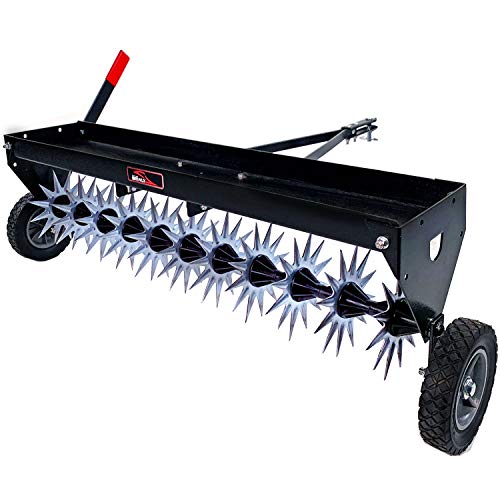
If the combo unit felt like too much going on at once, this Brinly spike aerator is the simpler alternative. It does one job: punch holes in the soil so water and nutrients can reach the roots. No hopper, no spreader, no extra parts to maintain. That simplicity is the whole point.
Eleven tine stars, each 8 inches in diameter with 12 spike tips, roll across a 40-inch path. The 150-pound weight tray gives you more downward force than the combo model, which makes a real difference on moderately compacted ground. Brinly also built in a transport mode with turf-tread wheels. A single lever lifts the tines so you can cross your driveway without scraping concrete or dulling the spikes. That’s a feature people don’t appreciate until they’ve dragged a fixed-tine aerator across asphalt.
Spike aeration has a known weakness. It pokes holes rather than removing cores, and in heavy clay the spikes can actually make compaction slightly worse over time by pushing soil sideways. For routine maintenance on soil that’s already in decent shape, it works fine. For a lawn that’s been neglected for years, a plug aerator will do more good.
- 11 tine stars with 12 spike tips each
- 150-lb weight tray for deeper penetration
- Single-lever transport mode with turf-tread wheels
- Double tow bar and solid 5/8-inch steel axle
- Galvanized 3-D tines resist rust and bending
Best for: Homeowners who aerate once or twice a year on soil that isn’t severely compacted.
Garvee 48-Inch Tow Behind
The Garvee is the heaviest hitter in this group, literally. Its weight tray holds up to 330 pounds, which is nearly double the Agri-Fab and more than four times the Brinly combo. On dense, clay-rich soil where other aerators skim the surface, this one keeps driving tines into the ground.
Thirty-two galvanized plug tines are arranged in a geometric pattern to reduce skipped spots. The 48-inch width matches the Agri-Fab, so you cover the same ground per pass. Pneumatic 12-inch tires with bearing systems roll smoothly even when the tray is fully loaded, which is not something you can say about every aerator in this class. The universal hitch works with lawn tractors, ATVs, and UTVs.
Two things to keep in mind. First, 330 pounds of added weight is a lot to haul and load. You’ll need a stack of concrete blocks or sandbags, and you’ll feel the drag on a smaller tractor. Second, pneumatic tires can go flat. That’s the price you pay for a smoother ride, and it’s worth checking tire pressure before each use.
- 48-inch working width with 32 plug tines
- 330-lb weight tray for the hardest soil
- 12-inch pneumatic tires with bearing systems
- Penetrates up to 3 inches deep
- Universal hitch fits tractors, ATVs, and UTVs
Best for: Large properties with stubborn clay soil and a tractor or ATV strong enough to pull serious weight.
BlumeTrec 40-Inch Tow Beh…
BlumeTrec’s 40-inch spike aerator is the maneuverable one. Ten galvanized 3D tines rotate independently, which sounds like a small detail until you try turning at the end of a row. Fixed-tine aerators skip and gouge during turns. Independent rotation keeps each tine engaged with the soil through the curve.
The build quality punches above the price point. Reinforced side plates, a thick channel-shaped tow bar, and a solid steel axle give it a sturdier feel than some budget aerators. Metal spacers between each star tine cut down on friction, which extends the life of the moving parts. The 110-pound weight tray sits between the Brinly spike and the Agri-Fab in terms of downward force. A side-control lever flips between transport and working mode, and the pin-style hitch attaches to most mowers and ATVs without tools.
It’s not the widest option at 40 inches, so big lawns will take more passes. And the 2-inch penetration depth is typical for spike aerators. On dry, hard ground, you’ll want to water the lawn a day before to help the tines bite.
- 10 independently rotating 3D tines with 11 tips each
- 110-lb weight tray for moderate compaction
- Pin-style hitch fits mowers, ATVs, and tractors
- Side-control lever for transport and working modes
- Powder-coated finish resists rust
Best for: Smaller yards and irregular lawns where turning maneuverability matters more than raw width.
How We Chose These Products
Every model here had to earn its spot. The first filter was function: does it actually aerate, or is it a glorified lawn roller with spikes? Plug aerators and spike aerators both have legitimate uses, but they solve different problems, so we kept both types in the mix and explained when each makes sense.
Next came build quality and weight capacity. A weight tray is only useful if the frame can handle the load, so we looked at steel thickness, axle design, and tine material. Galvanized tines resist rust and hold an edge longer. Pneumatic tires roll smoother under load but need air. Flat-free tires eliminate that chore. Every trade-off got weighed against real-world use, not spec-sheet bragging.
Buying Guide: What Really Matters
Plug versus spike is the first decision. Plug aerators remove cores of soil, which directly relieves compaction and is the gold standard for lawns that have gone years without attention. Spike aerators push soil aside to create channels, which is faster and less messy but less effective on hard ground. If your lawn is soft and you aerate regularly, spikes work fine. If it’s hard and neglected, go with plugs.
Weight capacity drives penetration more than anything else. A 75-pound tray on clay soil won’t reach 2 inches. A 175-pound tray will. A 330-pound tray will go deeper still. Match the tray capacity to your soil type and your willingness to load it. Also check the working width against your lawn size. A 48-inch path covers ground faster, but a 40-inch unit turns tighter around flower beds and trees.
Finally, verify the hitch. Most of these use a universal pin-style hitch, but pin diameters and tractor heights vary. Measure your hitch before ordering, and check whether the aerator has a transport mode. Lifting tines for driveway crossings saves wear on both the tines and your concrete.
Our Top Recommendation
The Agri-Fab 48-inch plug aerator is the best all-around pick for most homeowners. It pulls real plugs, reaches 3 inches deep, and the 175-pound tray is enough for typical compacted soil without requiring a forklift to load. The cantilever handle and flat-free tires make it genuinely easy to live with.
If your soil is brutal clay and you own an ATV or a strong tractor, the Garvee’s 330-pound tray will out-dig everything else here. Budget-conscious buyers with smaller lawns should look at the BlumeTrec, which offers solid construction and independent tines at a lower entry point. And if you’re overseeding this fall, the Brinly combo saves you a full pass by spreading seed while it aerates.
Frequently Asked Questions
How often should I aerate my lawn?
Once a year for most cool-season grasses, ideally in early fall when grass is actively growing. Lawns with heavy foot traffic or clay soil may need it twice a year. Warm-season grasses do better with aeration in late spring.
Do I need to water before aerating?
Yes, and this step gets skipped constantly. Water the lawn thoroughly a day or two before aerating. Moist soil lets tines penetrate to full depth. Dry, hard ground causes tines to bounce or bend, especially on spike models.
What should I use to weigh down the tray?
Concrete pavers, sandbags, and bagged topsoil all work. Concrete blocks are the cheapest option and stack neatly. Just keep the load balanced side to side so the aerator tracks straight.
Can I tow an aerator with a riding mower?
Most riding mowers handle a 40 to 48-inch aerator without trouble, provided the hitch matches. Check your mower’s towing capacity in the manual. Smaller tractors may struggle with a fully loaded 330-pound tray, so start with less weight and add more if the tines aren’t penetrating.