You spot yellowing leaves on your tomatoes and assume it’s a nitrogen problem. You buy a nitrogen fertilizer, apply it, and wait. Two weeks later, the plant looks worse. The real issue was poor drainage causing root stress, not a nutrient shortage. Without accurate soil data, you’re guessing, and guessing costs money and kills plants.

A great soil tester with nutrient deficiency alerts removes the guesswork. It measures key parameters like NPK levels, pH, and moisture, then flags potential problems before symptoms appear. The best options combine reliable sensors, clear readouts, and practical guidance tailored to specific crops or soil types.
We reviewed five top contenders, from budget-friendly digital meters to professional lab kits. Each has a distinct strength, and one stands out for most home gardeners. Here’s what you need to know before spending a dime.
Compare the key specs of our top picks side by side.
| Features | Buladeke 7-in-1 | MySoil Lab Kit | HSLGOVE 7-in-1 | YAMRON 4-in-1 | Dewilde 140 Tests |
|---|---|---|---|---|---|
| Measurement Type | Digital probe | Mail-in lab | Digital probe | Digital probe | Liquid chemical |
| Nutrient Alert Method | EC/TDS fertility reading | Lab report flags | Fertility dial reading | No nutrient alert | Color chart comparison |
| Key Parameters | Moisture, pH, temp, light, EC, TDS | 13 nutrients, pH | Moisture, pH, fertility, temp, light | Moisture, pH, temp, light | pH, N, P, K, ammonia |
| Results Time | 10 seconds | 6-8 days | 3-5 minutes | 10 seconds | Minutes per test |
| Best Use Case | Quick home monitoring | Professional accuracy | Beginner-friendly gardening | Budget-conscious growers | Routine seasonal testing |
Buladeke Moisture Meter for Plants
Buladeke
Buladeke Moisture Meter for Plants,7-in-1 Digital Soil Tester Kit | Soil pH Tester with LCD - Measures pH, EC, TDS, Fertility, Temp, Moisture & Sunlight, Garden Tools for Indoor & Outdoor
- 【7-in-1 Features】This is a 7-in-1 multi-function soil tester. Our soil tester quickly measures soil moisture, pH, temperature and…
- 【Large Screen & LCD Backlight】The Soil Moisture Meter has a large LCD display with white backlight that clearly shows the numerica…
- 【Fast and accurate measurement】With the latest 2025 probe technology, it can quickly and accurately measure soil pH, moisture, tem…
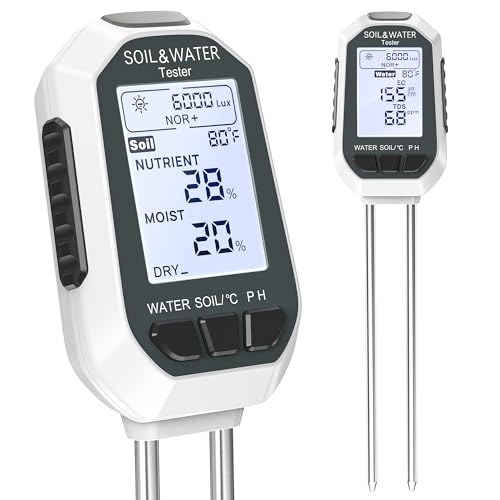
The Buladeke 7-in-1 digital soil tester targets home gardeners who want fast, actionable data without sending samples to a lab. It measures moisture, pH, temperature, light intensity, EC, and TDS. That last pair matters for nutrient deficiency alerts. Electrical conductivity and total dissolved solids indicate how much dissolved salt and nutrient content sits in your soil solution. When EC drops too low, your plants are likely hungry. When it spikes, you may have salt buildup from over-fertilizing.
What sets this unit apart is the large backlit LCD screen. You can read it at dusk or in a dim garage. The 2026 probe technology responds quickly, giving stable readings in about 10 seconds. The fertility function translates EC and TDS into a simple good/bad indicator, which helps beginners understand when to feed. If you grow tomatoes in raised beds or maintain a mix of houseplants, this tester gives you a solid daily driver. For a deeper look at how EC and TDS relate to fertilizer schedules, see this guide on fertilizer compatibility.
The trade-off? The probe must not be forced into dry, hard soil. You need to moisten the area and wait 10 minutes before testing. That’s a minor inconvenience, but skipping it can damage the device. Also, the fertility reading is a general indicator, not a precise NPK breakdown. It won’t tell you exactly how much nitrogen vs. phosphorus your soil lacks. And the unit runs on 4 AAA batteries, which aren’t included. Overall, it’s a reliable tool for quick checks, but not a lab replacement.
- Measures 7 parameters including EC and TDS for nutrient estimation
- Large backlit LCD readable in low light
- 10-second response time with 2026 probe technology
- Requires moist soil and careful insertion to avoid damage
- Battery powered (4 AAA, not included)
Best for: Home gardeners who want fast, multi-parameter readings and a simple fertility alert without lab fees.
MySoil Soil Test Kit, Unlock Your Lawn & Garden Potential

My Soil
MySoil Soil Test Kit, Unlock Your Lawn & Garden Potential, Complete & Accurate Nutrient and pH Analysis with Recommendations Tailored to Your Soil and Plant Needs
- KNOW BEFORE YOU GROW | Grow the healthiest, sustainable lawn and garden with the most accurate and easy to use professional soil t…
- FAST & ACCURATE | Unlike at-home pH meters and test strips, our mail-in professional lab analysis accurately measures 13 plant-ava…
- FOR ANY GROWING SCENARIO | Tests any soil type and growing condition - lawn & turf, vegetable gardening, flowers, compost, trees,…
The MySoil kit takes a completely different approach. You collect a soil sample, mail it to a professional lab, and receive a detailed report in 6-8 days. That report measures 13 plant-available nutrient levels, including nitrogen, phosphorus, potassium, and pH. The lab also provides custom fertilizer recommendations for organic and non-organic programs. If you manage a lawn, vegetable garden, or orchard and want precise data, this is the gold standard for home use.
What makes MySoil stand out is the accuracy. At-home meters and test strips often drift or give vague ranges. Lab analysis uses calibrated instruments and reports actual parts-per-million values. You’ll know exactly how much lime to add for pH correction or how many pounds of nitrogen per 1,000 square feet your lawn needs. The recommendations are tailored to your specific soil type and crop. That level of detail prevents over-fertilizing, which wastes money and harms the environment. For those who prefer lab-quality results without the wait, there are also lab-quality soil testers that offer similar precision in a handheld format.
The obvious downside is the wait. You won’t get instant feedback. If you suspect a deficiency today, you’ll wait over a week for answers. The kit also costs more per test than a reusable meter, though it’s still cheaper than a private lab. And you can’t reuse the kit indefinitely; you’ll need to buy refills for each test. For serious growers who test 2-4 times per year, the cost per test is reasonable. For someone who wants to check moisture every few days, this isn’t the right tool.
- Professional lab analysis of 13 nutrients plus pH
- Custom organic and non-organic fertilizer recommendations
- Results in 6-8 days via mail-in sample
- Works for any soil type and growing scenario
- Requires purchasing refill kits for repeat tests
Best for: Lawn and garden enthusiasts who need precise, lab-verified nutrient data and tailored amendment plans.
HSLGOVE Soil Test Kit, 7-in-One

HSLGOVE
HSLGOVE Soil Test Kit, 7-in-One Soil Moisture Meter/Soil PH Meter/Fertility, Dual Screen Soil Tester w/Digital Soil Temp/Air Temp&Humidity for Plants Gardening,Lawn,Farm Indoor&Outdoor-Lvory White
- ✅ 1Dial & 1 LCD Screen - Replace/install all 3 batteries each time. Put button to %RH/°F to - Turn On, and put to LIGHT to - Turn…
- 7Meter-in1 Comprehensive Maintenace: Specially designed for beginners, the built-in 1.6" chips board, can meet all your needs for…
- Design Patented US & Utility Patented US: Origin Dual-Dial Design -combined with both soil meter and LCD-display soil/air temperat…
HSLGOVE designed this 7-in-1 meter with beginners in mind. It combines a traditional dial for soil moisture, pH, and fertility with an LCD screen for soil temperature, air temperature, and humidity. That dual-display approach is unique. You get the instant analog feedback of a dial plus digital readouts for environmental conditions. The single metal probe is less invasive to roots than multi-probe designs, which matters for potted plants and seedlings.
The fertility dial gives you a rough idea of nutrient availability. It’s not as precise as EC/TDS readings, but it flags poor, average, or good fertility. For a new gardener, that’s often enough to decide whether to fertilize. The 1.6-inch chip board processes data quickly, and you’ll see results in 3-5 minutes for the digital parameters. The probe reaches about 6.8 inches, so it works for medium to large pots. If you’re mostly growing in containers on a patio, this is a practical choice. The single-probe design also means less soil disturbance, which reduces stress on delicate roots.
Here’s the catch: the instructions are a bit clunky. You need to switch modes with a button and interpret the dial separately from the LCD. It’s not as intuitive as a single-screen display. Also, the fertility dial is less actionable than a numeric EC reading. You won’t know exactly how deficient your soil is, just that it’s on the low end. And the unit requires 3 batteries, which you’ll replace more often if you use the backlight frequently. It’s a solid starter tool, but not for someone who wants precise nutrient numbers.
- Dual display: analog dial plus LCD for temp and humidity
- Single metal probe reduces root damage
- Measures soil moisture, pH, fertility, light, and air conditions
- Results in 3-5 minutes for digital readings
- Fertility dial gives general ranges, not precise values
Best for: Beginners and container gardeners who want a gentle, multi-function meter with basic fertility alerts.
YAMRON 4-in-1 Soil Moisture Meter

YAMRON
4-in-1 Soil Moisture Meter Digital Plant Temperature/Soil Moisture/PH Meter/Sunlight Intensity Backlight LCD Display Soil Test Meter for Gardening, Farming and Outdoor Plants
- 【4 in 1 function】This is a 4-in-1 multifunctional soil tester.Our soil tester fastly to measure soil moisture, pH, temperature and…
- 【Large Screen & Backlight LCD Display】The Soil Tester uses a large LCD screen and white backlight to conveniently display and read…
- 【Quick Accurate measurement】The latest probe detection technology in 2026 can quickly and accurately measure the pH, moisture and…
YAMRON’s 4-in-1 tester covers the essentials: moisture, pH, temperature, and sunlight. It doesn’t measure EC, TDS, or fertility. So if you need nutrient deficiency alerts, this isn’t the tool for that specific job. But it excels at helping you manage watering and light, which are the two most common reasons plants struggle. Overwatering and underwatering cause symptoms that mimic nutrient deficiencies, so getting moisture right is step one. The large LCD screen and white backlight make it easy to read in any light. The 45-degree rotating head lets you view the screen without bending over, which is a small but thoughtful design touch.
The probe reaches about 4 inches into the soil. That’s shallower than some competitors, but adequate for most houseplants and shallow-rooted vegetables. Readings stabilize in about 10 seconds. The unit averages data from at least five locations, which reduces the chance of a false reading from a single dry pocket. For the price, it’s a reliable entry-level tool. If you’re just starting out and want to stop killing plants with improper watering, this is a sensible first purchase. You can always upgrade to a nutrient-aware model later.
The lack of nutrient alerts is the main limitation. You won’t know if your soil is low in nitrogen or potassium. You’ll only know if it’s too wet, too dry, or the pH is off. That’s still useful, but it doesn’t fulfill the promise of deficiency alerts. Also, the probe can be damaged if inserted into hard, dry soil. You need to water the area first and wait. And the 4 AAA batteries aren’t included. It’s a budget tool with budget limitations, but it does its core job well.
- Measures moisture, pH, temperature, and light only
- 45-degree rotating head for easy viewing
- 4-inch probe depth suitable for pots and shallow beds
- Averages readings from 5 locations for accuracy
- No EC, TDS, or fertility functions
Best for: Budget-conscious growers who mainly need help with watering and light, not nutrient analysis.
Soil Test Kit 140 Tests by Dewilde Trading Co
This liquid soil test kit from Dewilde Trading Co provides a middle ground between cheap meters and mail-in labs. You get 140 tests total: roughly 40 each for pH, phosphorus, potassium, and ammonia, plus about 20 for nitrogen. The kit uses chemical reagents that change color based on nutrient levels. You compare the color to a chart to estimate concentrations. It’s more accurate than most analog meters for NPK, though less precise than a lab report.
The big advantage is cost per test. At 140 tests, you can monitor your garden weekly through the growing season without breaking the bank. You’ll see trends over time, which helps you adjust fertilizer applications before deficiencies become severe. The kit covers all three macronutrients plus ammonia, giving you a fuller picture than a meter that only reads EC. For vegetable gardeners who want to stay on top of fertility, this is a practical, hands-on option.
The trade-off is the manual work. Each test requires collecting a soil sample, mixing it with water and reagent, and comparing colors. It’s not as simple as inserting a probe. The color matching is subjective; two people might read the same result differently. And the reagents have a shelf life, so you can’t stockpile the kit for years. Also, you don’t get instant digital alerts. You have to interpret the results yourself. It’s a good value for dedicated gardeners, but not for someone who wants push-button simplicity.
- 140 total tests across pH, N, P, K, and ammonia
- Colorimetric analysis more accurate than analog meters
- Low cost per test for frequent monitoring
- Requires manual sample prep and color matching
- Reagents have limited shelf life
Best for: Vegetable and lawn gardeners who test frequently and want affordable, reasonably accurate NPK data.
How We Chose These Products
We started by identifying what actually matters for nutrient deficiency alerts. A tester needs to measure something related to nutrient availability, whether that’s EC, TDS, or direct NPK levels. Products that only measure moisture and pH were still included if they offered exceptional value for other reasons, but we ranked them lower for this specific use case. We also weighed accuracy, ease of use, and the clarity of the alert mechanism. A reading that requires a PhD to interpret isn’t helpful.
We looked at real-world usability, not just spec sheets. How long does it take to get a reading? Does the probe damage roots? Are the batteries included? Can you use it in dry soil without breaking it? These details separate a tool you’ll actually use from one that sits in a drawer. We also considered cost per test over time. A cheap meter that gives vague readings is a false economy if it leads to wrong fertilizer decisions. The best tool is the one that gives you actionable data at a price you can justify.
Buying Guide: What Really Matters
Nutrient deficiency alerts come in three main forms: sensor-based, app-based, and lab-report flags. Sensor-based alerts use EC or TDS readings to estimate nutrient concentration. They’re instant but indirect. A high EC reading could mean plenty of nutrients or a salt buildup from over-fertilizing. You need context to interpret it. App-based alerts connect your tester to a smartphone and use algorithms to flag deficiencies. These can be more user-friendly but depend on the app’s database and your willingness to sync data. Lab-report alerts are the most accurate. The lab measures actual nutrient levels and flags which ones are low, optimal, or high. The trade-off is the wait and the cost per test.
Accuracy limits matter. No consumer-grade sensor measures nitrogen, phosphorus, and potassium directly. They infer from electrical conductivity. That’s why a $20 meter can’t tell you exactly how much nitrogen your soil lacks. It can only say “low” or “high” fertility. For precise NPK numbers, you need a lab or a chemical test kit. False positives happen too. A dry soil reading can spike EC, making it look like you have plenty of nutrients when you actually need water. Always test moist soil and average multiple readings.
Calibration is another factor. Digital meters can drift over time. Some have a calibration function; others don’t. If you’re serious about accuracy, look for a meter you can recalibrate or a lab kit that uses fresh reagents. For seasonal testing, plan to test in early spring before planting and again mid-season if plants show symptoms. Sandy soils leach nutrients faster than clay, so you may need to test more often. If you garden on sandy soil, a tester with frequent monitoring capability is especially valuable.
Our Top Recommendation
The Buladeke 7-in-1 is our top pick for most home gardeners. It balances speed, features, and price. You get EC and TDS readings that serve as nutrient alerts, plus moisture, pH, temperature, and light. The large backlit screen is genuinely easy to read, and the 10-second response time means you’ll actually test regularly. It’s not a lab, but it’s the best all-rounder for everyday use.
If you need professional-grade accuracy for a lawn or large garden, the MySoil lab kit is worth the wait and cost. It gives you precise NPK numbers and custom fertilizer plans. For budget-minded growers who mainly need watering help, the YAMRON 4-in-1 is a solid starter tool. And if you prefer hands-on chemical testing with low cost per test, the Dewilde 140-test kit is a smart choice for frequent monitors.
Frequently Asked Questions
How do nutrient deficiency alerts actually work on a digital soil tester?
Most digital testers measure electrical conductivity (EC) or total dissolved solids (TDS). These values indicate the total concentration of dissolved salts, which includes nutrients. When EC drops below a certain threshold, the tester flags low fertility. It’s an indirect estimate, not a direct measurement of nitrogen or phosphorus. Lab kits measure actual nutrient ions, which is why they’re more precise.
Can a soil tester tell me exactly which nutrient my plant is missing?
No consumer-grade meter can pinpoint a specific nutrient deficiency. They can indicate overall fertility or pH imbalances. To know if you’re low on nitrogen versus potassium, you need a lab report or a chemical test kit that measures individual nutrients. Symptoms like yellowing lower leaves suggest nitrogen, while purple leaves suggest phosphorus, but confirming with a test is always better.
How often should I test my soil for nutrient deficiencies?
Test at least twice per year: once in early spring before planting and once mid-growing season. If you use heavy fertilizers or grow in sandy soil, test monthly during the growing season. After amending soil with compost or fertilizer, wait two weeks and test again to see how levels changed.
Do I need to calibrate my soil tester?
Some digital meters have a calibration mode, but many budget models don’t. If yours doesn’t, you can still get consistent readings by testing moist soil, avoiding rocks, and averaging multiple spots. Lab kits and chemical test kits don’t require calibration, but you must follow the instructions precisely and use fresh reagents. Over time, digital probes can drift, so replace them if readings seem erratic.