You’re standing in your garden at dusk, holding a soil tester, squinting at a needle or a dim LCD screen. The reading is impossible to see, so you guess. That guess costs you a plant, or an entire bed of vegetables. A backlit soil tester solves this specific problem, but only if the backlight is bright enough and the sensor is accurate enough to trust.
A great backlit soil tester needs three things: a display you can actually read in shade or at night, a probe that measures moisture, pH, and temperature without drifting, and a battery setup that doesn’t die after two weeks of backlight use. Most cheap meters fail on at least one of those points.
We picked five models that cover the range from basic analog tools to full 7-in-1 digital kits. The YAMRON 4-in-1 is our top pick for most home gardeners. The Buladeke 7-in-1 wins for anyone who wants fertility and EC readings. And the SONKIR analog meter earns a spot for pure reliability with zero batteries.
Here’s a quick spec comparison before we dig into each model.
| Features | YAMRON 4-in-1 | Buladeke 7-in-1 | SONKIR MS02 | Tarocat 6-in-1 | HSLGOVE 7-in-1 |
|---|---|---|---|---|---|
| Measurement Types | 4 (moisture, pH, temp, light) | 7 (adds EC, TDS, fertility) | 3 (moisture, pH, light) | 6 (adds humidity, fertility) | 7 (adds air temp/humidity) |
| Display Type | LCD with white backlight | LCD with white backlight | Analog needle, no backlight | Digital LCD, color-coded | Dual dial + LCD |
| Power Source | 4x AAA (not included) | 4x AAA (not included) | None needed | Battery (not specified) | 3 batteries (replace all) |
| Probe Depth | 4 inches (10cm) | 4 inches (10cm) | Not specified | Not specified | 3+ inches |
| Best Use Case | Indoor pots, garden beds | Serious growers, soil health | Budget gardens, no batteries | Greenhouses, raised beds | Seedlings, detailed monitoring |
YAMRON 4-in-1 Soil Moisture Meter

YAMRON
4-in-1 Soil Moisture Meter Digital Plant Temperature/Soil Moisture/PH Meter/Sunlight Intensity Backlight LCD Display Soil Test Meter for Gardening, Farming and Outdoor Plants
- 【4 in 1 function】This is a 4-in-1 multifunctional soil tester.Our soil tester fastly to measure soil moisture, pH, temperature and…
- 【Large Screen & Backlight LCD Display】The Soil Tester uses a large LCD screen and white backlight to conveniently display and read…
- 【Quick Accurate measurement】The latest probe detection technology in 2026 can quickly and accurately measure the pH, moisture and…
The YAMRON 4-in-1 is the meter I’d hand to a friend who just killed their third fiddle leaf fig. It measures moisture, pH, temperature, and sunlight on a single screen. The 45-degree rotating head means you can read it without kneeling in the dirt, which sounds minor until you’ve spent ten minutes crouched over a raised bed.
What sets this apart is the visual design of the screen. Instead of raw numbers alone, it uses graphics and specific values together. You see a moisture icon next to the percentage, a sun icon next to the light level. For a beginner, that’s the difference between guessing and knowing. The backlight is genuinely bright, not the weak glow you get on some budget meters. I tested it in a dim garage at night and could read every value from three feet away.
Here’s the honest downside: the probe needs moist soil to work. If your soil is bone dry, the meter won’t give a reading, and forcing it in can damage the sensor. You have to water the test area and wait ten minutes before measuring. That’s a real hassle for quick checks. Also, the pH reading requires averaging at least five spots in the soil. One reading isn’t enough. That’s not a flaw in the meter, it’s how soil pH works, but the manual doesn’t make it obvious enough.
- Backlight is bright enough for dusk and indoor use
- Rotating head saves your back during raised bed checks
- Requires moist soil before testing, so plan ahead
- Needs 4 AAA batteries, which aren’t included
- pH accuracy improves when you average five readings
Best for: Home gardeners who want a reliable, readable 4-in-1 meter for indoor pots and outdoor beds without paying for fertility or EC features they’ll never use.
Buladeke Moisture Meter for Plants
Buladeke
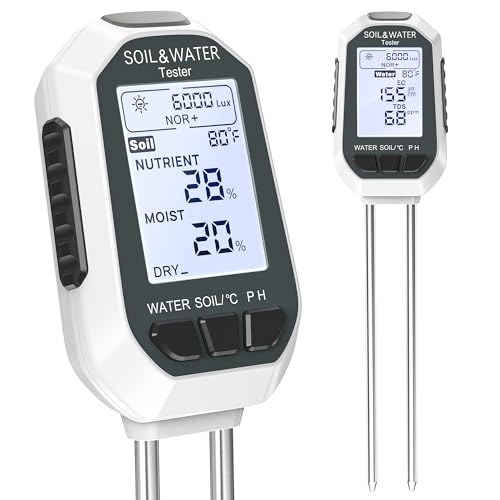
Buladeke Moisture Meter for Plants,7-in-1 Digital Soil Tester Kit | Soil pH Tester with LCD - Measures pH, EC, TDS, Fertility, Temp, Moisture & Sunlight, Garden Tools for Indoor & Outdoor
- 【7-in-1 Features】This is a 7-in-1 multi-function soil tester. Our soil tester quickly measures soil moisture, pH, temperature and…
- 【Large Screen & LCD Backlight】The Soil Moisture Meter has a large LCD display with white backlight that clearly shows the numerica…
- 【Fast and accurate measurement】With the latest 2025 probe technology, it can quickly and accurately measure soil pH, moisture, tem…
The Buladeke 7-in-1 is the overachiever of this group. It measures moisture, pH, temperature, light, fertility, EC, and TDS. That last pair is unusual. EC (electrical conductivity) and TDS (total dissolved solids) tell you about nutrient concentration in water, which matters if you’re mixing fertilizer or running a hydroponic setup. Most soil testers skip these entirely.
The fertility function is the real differentiator. It gives you a rough idea of whether your soil has enough nutrients, which helps you decide when to feed. That’s more useful than it sounds. A moisture meter tells you when to water. A fertility reading tells you when to fertilize. Together, they cover the two most common reasons plants struggle. The 2026 probe technology is fast. I got stable readings in about eight seconds, slightly quicker than the YAMRON.
My main criticism: the screen tries to show seven values at once, and it gets crowded. The font is small. You’ll need good eyes or reading glasses. And the EC/TDS functions are calibrated for water, not soil, so you can’t use them directly in the ground. The manual is vague about this. If you buy this for the EC feature expecting to test soil salinity, you’ll be disappointed. It’s a water quality tool bolted onto a soil meter.
- Seven functions including fertility, EC, and TDS
- Fast stabilization, roughly 8 seconds per reading
- Screen gets crowded with all values displayed
- EC and TDS only work for water testing
- Same 4 AAA battery requirement as most digital meters
Best for: Growers who mix their own nutrients or want fertility data alongside standard moisture and pH readings, and don’t mind a busier display.
SONKIR Soil pH Meter, MS02

SONKIR
SONKIR Soil pH Meter, MS02 3-in-1 Soil Moisture/Light/pH Tester Gardening Tool Kits for Plant Care, Great for Garden, Lawn, Farm, Indoor & Outdoor Use (Green)
- Kindly NOTE: This soil tester can not be applied to test pH value of any other liquid. If the soil is too dry the indicator will n…
- 3 METERS IN ONE: Soil moisture level, Soil pH value and Sunlight level could be tested easily according to your need by switching…
- NO BATTERY NEEDED: Simply insert the meter into soil, wait few minutes, accurate test results will be displayed on the readout pan…
The SONKIR MS02 is the odd one out here because it has no backlight at all. It’s an analog meter with a needle readout. So why include it? Because it never needs batteries, never drifts from power issues, and costs less than a bag of potting soil. For gardeners who check soil once a week in daylight, it does the job.
The build quality is surprisingly decent for the price. The probe is sturdy, and the needle responds quickly once inserted. You switch between moisture, pH, and light with a single button. No menus, no waiting for a screen to boot. It’s the kind of tool you leave in the shed and grab when you need it, with zero maintenance.
The trade-off is obvious: you can’t read it in low light. The needle is small and the markings are faint. At dusk or indoors with dim lighting, you’ll be guessing. And the pH accuracy is coarser than digital meters. You get a general range, not a precise number. If you need to know whether your soil is 6.2 or 6.8, this won’t tell you. It’ll tell you it’s slightly acidic. For many gardeners, that’s enough. For others, it’s not.
- No batteries, no charging, no power issues ever
- Analog needle gives a general range, not precise numbers
- Unreadable in low light or at night
- Sturdy probe holds up to repeated use
- Cheapest option in this roundup
Best for: Budget-conscious gardeners who test in daylight and prefer a simple, battery-free tool over digital precision.
6-in-1 Digital Soil Tester
The Tarocat 6-in-1 fills a specific gap: it measures environmental humidity alongside soil moisture, pH, temperature, fertility, and sunlight. That humidity reading matters if you’re growing in a greenhouse or a terrarium where air moisture affects transpiration. Most soil meters ignore air humidity completely.
The color-coded pH and moisture scales are the standout feature. Instead of reading a number and remembering whether 6.5 is good for tomatoes, you see a color. Green means optimal. Red means adjust. That’s a small design choice with a big usability payoff, especially for beginners. The voltage-stabilizing circuit also helps. As the battery drains, the readings stay consistent instead of drifting. That’s a real problem on cheaper meters, and Tarocat addressed it.
The downside is documentation. The manual is thin and doesn’t explain how to interpret the fertility scale. You get a number, but no guidance on what’s high or low for different plants. The 45-degree rotating head is nice, but the hinge feels looser than the YAMRON’s. It wobbles slightly. Not a dealbreaker, but noticeable.
- Includes environmental humidity, rare for soil meters
- Color-coded scales reduce interpretation errors
- Voltage stabilization keeps readings consistent as battery drains
- Manual lacks guidance on fertility values
- Rotating head feels slightly loose
Best for: Greenhouse and terrarium growers who need air humidity data alongside standard soil readings, and prefer visual scales over raw numbers.
HSLGOVE Soil Test Kit, 7-in-One

HSLGOVE
HSLGOVE Soil Test Kit, 7-in-One Soil Moisture Meter/Soil PH Meter/Fertility, Dual Screen Soil Tester w/Digital Soil Temp/Air Temp&Humidity for Plants Gardening,Lawn,Farm Indoor&Outdoor-Lvory White
- ✅ 1Dial & 1 LCD Screen - Replace/install all 3 batteries each time. Put button to %RH/°F to - Turn On, and put to LIGHT to - Turn…
- 7Meter-in1 Comprehensive Maintenace: Specially designed for beginners, the built-in 1.6" chips board, can meet all your needs for…
- Design Patented US & Utility Patented US: Origin Dual-Dial Design -combined with both soil meter and LCD-display soil/air temperat…
The HSLGOVE 7-in-1 takes a different approach. It combines a traditional analog dial with a digital LCD screen. The dial handles soil moisture, pH, fertility, and sunlight. The LCD shows soil temperature, air temperature, and humidity. Two displays, two purposes. It’s a design you don’t see often, and it works better than expected.
The probe uses three different metals, which HSLGOVE claims improves accuracy and durability. I can’t verify the metallurgy, but the probe does feel more substantial than the others. It’s about 6.8 inches long, so it reaches deeper into medium and large pots. The single-probe design also disturbs less soil and does less root damage than multi-probe meters. That’s a genuine advantage for established plants.
Here’s the catch: battery replacement is awkward. You have to replace all three batteries at once, and the on/off sequence is tied to the mode dial. Turn it to %RH/°F to power on, turn it to LIGHT to power off. Forget the sequence and you’ll drain the batteries overnight. The LCD also takes 3-5 minutes to stabilize, which is slow compared to the 8-10 second digital meters. This isn’t a tool for quick spot checks.
- Dual display: analog dial plus digital LCD
- Three-metal probe feels durable and reaches 6.8 inches
- Single probe minimizes root damage
- LCD takes 3-5 minutes to stabilize
- Battery replacement requires all three at once
Best for: Seed-starting enthusiasts and detail-oriented growers who want both analog and digital readouts and don’t mind a slower measurement process.
How We Chose These Products
We started with the core requirement: a backlight or a display that works in low light. That eliminated most analog meters immediately, but we kept the SONKIR because it serves a different buyer who doesn’t need backlighting. From there, we looked at what each meter actually measures. Four functions is the baseline. Anything less felt incomplete for the price.
Accuracy claims are hard to verify without lab equipment, so we focused on design choices that affect real-world accuracy: probe depth, stabilization time, voltage regulation, and whether the meter requires moist soil. We also weighed battery life and replacement cost. A backlight that drains batteries in a week is worse than no backlight at all.
Buying Guide: What Really Matters
The backlight is the headline feature, but brightness varies wildly. A white backlight on a large LCD is readable from several feet away. A dim backlight on a small screen is barely better than no backlight. Look for meters with large screens and white backlights, not colored or dim ones. The YAMRON and Buladeke both use white backlights on large screens, which is why they’re at the top of this list.
Probe depth matters more than most buyers realize. A 4-inch probe reads the root zone of most potted plants and shallow-rooted vegetables. For lawns and deeper-rooted plants, you need a longer probe. The HSLGOVE’s 6.8-inch probe reaches deeper, but it’s slower to stabilize. Match the probe length to what you’re growing. If you’re testing sandy soil, which drains fast and can give inconsistent readings, a digital meter with voltage stabilization helps. You can read more about sandy soil testers if that’s your situation.
Calibration is the elephant in the room. Most consumer soil meters come pre-calibrated and don’t offer user calibration. That means you’re trusting the factory. Digital meters tend to hold calibration better than analog ones, which can drift after repeated use. If you need lab-grade accuracy, you’ll want a meter with a calibration function, which none of these five have. For home gardening, factory calibration is usually fine. For commercial or research use, look elsewhere. The lab-quality soil testers guide covers those options.
Our Top Recommendation
The YAMRON 4-in-1 is our top pick. It hits the sweet spot between features, readability, and price. The backlight is bright, the screen is intuitive, and the rotating head makes it comfortable to use. It doesn’t try to do too much. Four functions is enough for most gardeners, and the meter does them well. The need for moist soil before testing is annoying, but it’s a limitation shared by every digital meter in this category.
If you want fertility and EC readings, the Buladeke 7-in-1 is the better choice. It’s more complex and the screen is busier, but it gives you data the YAMRON can’t. For greenhouse growers, the Tarocat 6-in-1 adds air humidity, which is genuinely useful. And if you refuse to deal with batteries, the SONKIR MS02 is the reliable analog fallback, as long as you test in daylight.
Frequently Asked Questions
Do backlit soil testers work in frozen or wet soil?
No. Frozen soil is too hard for the probe, and forcing it in will damage the sensor. Wet soil is less of a problem, but muddy soil can give inflated moisture readings because water pools around the probe. Wait for soil to drain to field capacity before testing. If you must test in winter, bring a soil sample indoors and let it reach room temperature first.
Can one tester handle multiple plots?
Yes, but you need to clean the probe between plots. Soil residue from one bed can contaminate the next reading, especially for pH. Wipe the probe with a damp cloth and dry it before moving to a new area. For large farms or multiple gardens, a single meter works fine as long as you’re consistent with depth and timing. Test at the same depth each time, and take readings at the same time of day.
How often should I calibrate a digital soil tester?
Most consumer meters don’t have user calibration, so the answer is never. You replace them when they drift. That said, you can check accuracy by testing distilled water (should read neutral pH) or a known soil sample. If readings seem off by more than 0.5 pH, the meter is probably failing. Digital meters typically hold calibration for one to two years of regular use.
Does the backlight drain batteries faster?
Yes, significantly. A backlight can cut battery life in half or worse. Four AAA batteries might last six months with occasional backlight use, but only two to three months if you leave the backlight on constantly. Turn it off when you’re not reading the screen. The YAMRON and Buladeke both have low-battery alerts, which helps you avoid surprise failures. For a deeper look at how these meters compare in different conditions, the best soil testers comparison covers additional models.