Your hydrangeas are turning yellow between the veins. The azalea you planted last spring hasn’t put on new growth. You’ve watered, fertilized, and moved them around the yard, but nothing changes. The problem is probably hiding underground, and it’s almost certainly a pH issue.
Acid-loving plants like azaleas, rhododendrons, blueberries, and camellias need soil in the 4.5 to 6.0 pH range. Push that number up even half a point and the roots stop absorbing iron, magnesium, and other nutrients. A good soil tester tells you what’s actually happening down there before you waste money on the wrong fix. The trick is finding one that reads pH accurately in damp soil, doesn’t need a chemistry degree to operate, and holds up after a season of use.
We looked at five testers that cover very different needs: analog meters for quick checks, digital kits with temperature and fertility readings, and even a bundle that includes pre-acidified planting soil. The HSLGOVE 7-in-1 takes our top spot for its dual-screen design and metal probe, but the SONKIR MS02 is the one to grab if you want zero batteries and zero fuss.
Here’s a quick look at how the five compare on the specs that matter most.
| Features | HSLGOVE 7-in-1 | Coast of Maine Kit | SONKIR MS02 | Buladeke 7-in-1 | YAMRON 4-in-1 |
|---|---|---|---|---|---|
| Measurement Type | 7-in-1 analog + LCD | Test strips + soil | 3-in-1 analog | 7-in-1 digital LCD | 4-in-1 digital LCD |
| Power Source | 3 batteries | None needed | No battery | 4 AAA batteries | 4 AAA batteries |
| Probe Design | Single 3-metal probe | Dip strips | Dual metal probe | Single digital probe | Single digital probe |
| Read Time | 3-5 minutes | Instant strips | Few minutes | 10 seconds | 10 seconds |
| Best Use Case | Full garden monitoring | Planting acid lovers | Budget quick checks | Data-heavy growers | Ergonomic readability |
HSLGOVE Soil Test Kit, 7-in-1

HSLGOVE
HSLGOVE Soil Test Kit, 7-in-One Soil Moisture Meter/Soil PH Meter/Fertility, Dual Screen Soil Tester w/Digital Soil Temp/Air Temp&Humidity for Plants Gardening,Lawn,Farm Indoor&Outdoor-Lvory White
- ✅ 1Dial & 1 LCD Screen - Replace/install all 3 batteries each time. Put button to %RH/°F to - Turn On, and put to LIGHT to - Turn…
- 7Meter-in1 Comprehensive Maintenace: Specially designed for beginners, the built-in 1.6" chips board, can meet all your needs for…
- Design Patented US & Utility Patented US: Origin Dual-Dial Design -combined with both soil meter and LCD-display soil/air temperat…
The HSLGOVE is the closest thing to a full diagnostic station in this lineup. It combines a traditional analog dial with an LCD screen, so you get soil moisture, pH, and fertility on the dial while the digital side handles soil temperature, air temperature, and humidity. That dual-display approach is unusual, and it’s genuinely useful for anyone growing acid-loving plants in containers or raised beds where air conditions matter as much as soil chemistry.
What sets this one apart is the probe. It uses three different metals fused into a single 6.8-inch shaft. That length reaches deep enough for medium and large potted plants, and the single-probe design means less root disturbance when you push it in. The company holds both a US design patent and a utility patent on the dual-dial layout, which explains why you won’t see this exact configuration from other brands. Setup takes a few minutes the first time since you need to install three batteries, but after that it’s a single button press to cycle through modes.
Here’s the honest part: this is not a fast tester. The manufacturer states 3 to 5 minutes for a stable LCD reading, and in practice you’ll want to leave it in the soil that long for pH accuracy. The analog dial moves faster, but the digital side needs patience. Also, it’s not a liquid tester, so don’t try to check your water pH with it. And the battery compartment requires all three cells to be replaced together, which is mildly annoying.
- Dual display: analog dial for moisture/pH/fertility, LCD for temp and humidity
- Single 6.8-inch probe made from three metal alloys
- Reads soil temp, air temp, and humidity alongside standard soil metrics
- Requires three batteries, all replaced at once
- Not designed for testing liquids or very dry soil
Best for: Gardeners who want one device that tracks soil chemistry and ambient conditions for acid-loving plants in pots, raised beds, or greenhouses.
Coast of Maine AL3500 Acid-Loving Kit
My Garden Pool
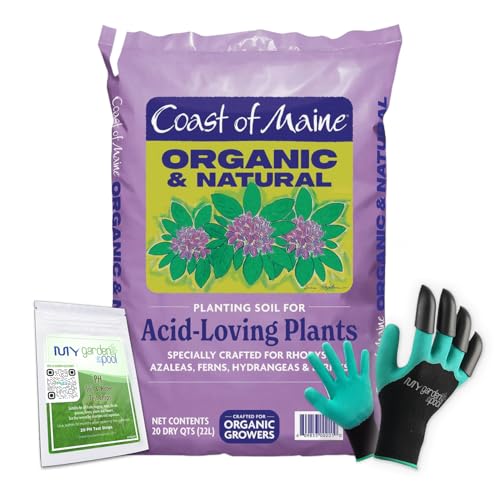
Coast of Maine AL3500 Acid-Loving Planting Soil 20 qt with My Garden Pool 7-in-1 Soil Test Strips, 20 ct. and Claw Gardening Gloves
- 🌸 Formulated for azaleas, hydrangeas, and rhododendrons
- 🌿 Maintains the ideal acidic pH for vibrant growth
- 🌱 Enriched with compost and organic material for strong roots
This pick is different from the others because it’s not just a tester. It’s a complete starter bundle: a 20-quart bag of Coast of Maine acid-loving planting soil, a 20-count pack of My Garden Pool 7-in-1 test strips, and a pair of claw gardening gloves. The soil is formulated specifically for azaleas, hydrangeas, and rhododendrons, which means it arrives at the right pH instead of you having to adjust it.
The test strips are the actual testing component here, and they work differently from probe meters. You dip them in a soil slurry and compare the color change to a chart. That sounds low-tech, and it is, but strips have one advantage: they don’t drift out of calibration the way cheap analog probes do. The soil itself is enriched with compost and organic material, which improves water retention and texture. For someone planting a new acid-loving bed from scratch, this bundle removes two steps at once.
The catch is obvious. Strips give you a range, not a precise number. You’ll know your soil is somewhere around 5.0 or 5.5, but not exactly. And once the 20 strips run out, you’re buying more. The gloves are a nice extra but they’re basic. If you already have established beds and just need to monitor pH, this isn’t the right tool. If you’re starting fresh, it saves a trip to the nursery.
- Includes 20 quarts of pre-acidified planting soil
- 20 test strips read pH, moisture, and nutrient levels
- Soil is enriched with compost for root development
- Strips give range readings, not precise values
- Claw gloves included for planting and weeding
Best for: New gardeners planting azaleas, hydrangeas, or rhododendrons who want soil and testing supplies in one purchase.
SONKIR Soil pH Meter, MS02

SONKIR
SONKIR Soil pH Meter, MS02 3-in-1 Soil Moisture/Light/pH Tester Gardening Tool Kits for Plant Care, Great for Garden, Lawn, Farm, Indoor & Outdoor Use (Green)
- Kindly NOTE: This soil tester can not be applied to test pH value of any other liquid. If the soil is too dry the indicator will n…
- 3 METERS IN ONE: Soil moisture level, Soil pH value and Sunlight level could be tested easily according to your need by switching…
- NO BATTERY NEEDED: Simply insert the meter into soil, wait few minutes, accurate test results will be displayed on the readout pan…
The SONKIR MS02 has been around for years, and it’s still one of the most straightforward soil testers you can buy. It reads moisture, pH, and light through a single analog dial with a switch on the side. No batteries, no screens, no menus. You push it into the soil, wait a few minutes, and read the needle. For anyone who just wants a quick pH check on their blueberry bushes without fiddling with electronics, this is the simplest option here.
Build quality is better than the price suggests. The probe is sturdy and the housing feels solid in hand. It’s also compact enough to leave in a shed or tuck into a gardening bag. The light sensor is a bonus feature you won’t use often, but it helps when you’re deciding whether a spot gets enough sun for acid-loving plants. For the money, it’s hard to beat as a first tester or a backup.
Two limitations matter. First, dry soil breaks the reading. The needle won’t move if the soil is too dry, so you have to water and wait before testing. Second, analog probes like this one tend to lose accuracy over time, especially if you leave them in soil or don’t wipe them clean. Expect to replace it every couple of seasons if you use it heavily. It’s also not a liquid tester, same as the others.
- Three functions: moisture, pH, and light
- No batteries required, ever
- Analog dial with function switch
- Needs moist soil to give a reading
- Probe accuracy can drift over time
Best for: Budget-conscious gardeners who want a no-frills pH check and don’t mind replacing the meter every few seasons.
Buladeke Moisture Meter, 7-in-1
Buladeke
Buladeke Moisture Meter for Plants,7-in-1 Digital Soil Tester Kit | Soil pH Tester with LCD - Measures pH, EC, TDS, Fertility, Temp, Moisture & Sunlight, Garden Tools for Indoor & Outdoor
- 【7-in-1 Features】This is a 7-in-1 multi-function soil tester. Our soil tester quickly measures soil moisture, pH, temperature and…
- 【Large Screen & LCD Backlight】The Soil Moisture Meter has a large LCD display with white backlight that clearly shows the numerica…
- 【Fast and accurate measurement】With the latest 2025 probe technology, it can quickly and accurately measure soil pH, moisture, tem…
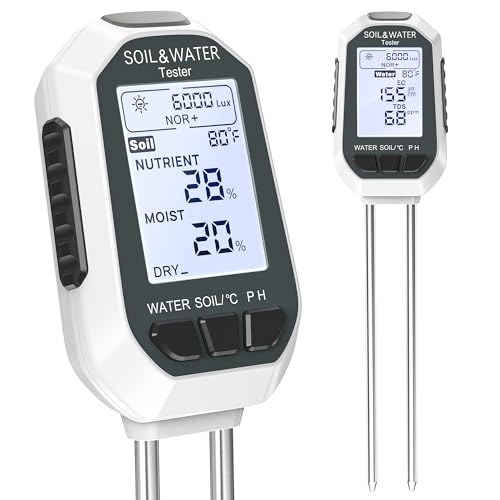
Buladeke’s 7-in-1 tester is the most data-hungry device in this group. It reads soil moisture, pH, temperature, light intensity, fertility, EC, and TDS. The EC and TDS functions are unusual for a soil tester at this level, and they’re genuinely useful if you’re mixing your own nutrient solutions for acid-loving plants in containers. The large backlit LCD shows everything clearly, even in low light.
Speed is the standout feature. The manufacturer claims readings in about 10 seconds, and the 2026 probe technology does deliver faster response than the analog options here. The screen uses intuitive icons alongside numbers, so you don’t need to memorize what each value means. Battery life is reasonable with four AAA cells, and the low-battery warning saves you from a dead meter mid-season. For someone who wants to track multiple variables across a vegetable garden or a collection of potted acid lovers, this covers more ground than anything else in the lineup.
The trade-off is complexity. Seven functions mean more to learn, and the EC/TDS readings are only useful if you understand what to do with them. The probe also needs moist soil, and forcing it into dry ground can damage it. Plus, it doesn’t include batteries, so factor that into your first use. It’s a lot of meter for the money, but it’s overkill if all you want is a pH number.
- Reads soil moisture, pH, temp, light, fertility, EC, and TDS
- Large backlit LCD with intuitive icons
- Fast readings in roughly 10 seconds
- Powered by four AAA batteries, not included
- Requires moist soil and careful probe insertion
Best for: Detail-oriented growers who want to monitor nutrient levels and pH together in containers or raised beds.
YAMRON 4-in-1 Soil Moisture Meter

YAMRON
4-in-1 Soil Moisture Meter Digital Plant Temperature/Soil Moisture/PH Meter/Sunlight Intensity Backlight LCD Display Soil Test Meter for Gardening, Farming and Outdoor Plants
- 【4 in 1 function】This is a 4-in-1 multifunctional soil tester.Our soil tester fastly to measure soil moisture, pH, temperature and…
- 【Large Screen & Backlight LCD Display】The Soil Tester uses a large LCD screen and white backlight to conveniently display and read…
- 【Quick Accurate measurement】The latest probe detection technology in 2026 can quickly and accurately measure the pH, moisture and…
YAMRON’s 4-in-1 tester keeps things simpler than the Buladeke while still offering a digital screen. It measures moisture, pH, temperature, and sunlight. The head rotates up to 45 degrees, which sounds like a small thing until you’ve spent five minutes crouching over a garden bed trying to read a screen at ground level. That ergonomic touch is the main reason this one made the list.
The display uses visual icons and clear numbers, so beginners can interpret readings without a manual. Setup is quick, and the probe reaches about 4 inches into the soil. For acid-loving plants in pots or small beds, that depth is usually enough. The manufacturer recommends averaging readings from at least five spots in the soil for pH and moisture, which is good advice for any tester but especially important with a single-probe design.
The main drawback is the 4-inch probe depth. For deep-rooted acid lovers like established rhododendrons or blueberry bushes, you’ll only be sampling the top layer of soil. That’s often where pH matters most, but it’s not the whole picture. The 10-second read time is fast, though you’ll want to wait a bit longer for stable pH numbers. And like every other digital model here, it can’t handle dry, hard soil without pre-watering.
- Four functions: moisture, pH, temperature, and sunlight
- 45-degree rotating head for easier reading
- Large backlit LCD with visual icons
- Probe reaches roughly 4 inches deep
- Needs four AAA batteries, not included
Best for: Container gardeners and raised-bed growers who want digital accuracy without bending over to read a screen.
How We Chose These Products
We started with a simple question: which testers actually help someone grow acid-loving plants better? That ruled out anything that only reads moisture or light. Every product here measures pH, and most go further with temperature, fertility, or nutrient data. We prioritized accuracy in the 4.5 to 6.0 pH range, since that’s where azaleas, hydrangeas, and blueberries live.
Build quality mattered too. Analog probes that bend or corrode after a few months aren’t worth the savings. We looked for metal probes, clear displays, and designs that don’t require a chemistry background to interpret. We also weighed practical factors like battery requirements, read time, and whether the tester works in both indoor pots and outdoor beds. The five picks here represent different trade-offs, not just different price points.
Buying Guide: What Really Matters
Probe depth is the spec most people overlook. A 4-inch probe reads the top layer of soil, which is fine for seedlings and small pots. A 6.8-inch probe like the HSLGOVE’s reaches deeper root zones, where acid-loving shrubs actually feed. If you’re testing established plants, go deeper.
Read time matters more than you’d think. Analog meters respond in seconds but can drift. Digital meters take 10 seconds to a few minutes for stable pH readings. Neither is wrong, but if you’re testing multiple spots across a garden, the faster option saves real time. Just don’t trust a pH number that appears instantly on a digital screen; give it the full read cycle.
Battery versus no battery is a lifestyle choice. The SONKIR never needs power, which makes it ideal for a shed or a backup tool. Digital models need AAA cells, and some require all batteries replaced at once. None of these testers work well in bone-dry soil, so water your test area first regardless of which one you buy. For a deeper look at matching testers to specific soil types, see this guide to the best soil tester for acidic soil.
Our Top Recommendation
The HSLGOVE 7-in-1 earns the top spot because it covers the widest range of conditions without sacrificing probe quality. The dual-screen design gives you fast analog feedback plus precise digital temperature and humidity data. The three-metal single probe reaches deep enough for established acid-loving plants, and the patent-protected layout isn’t something you’ll find elsewhere. If you want one tester that handles pH, moisture, fertility, temperature, and light in a single unit, this is it.
For a tighter budget, the SONKIR MS02 remains the best no-battery option. It’s simple, durable enough for a few seasons, and costs very little. If you’re planting a new acid-loving bed and want soil included, the Coast of Maine bundle saves a step. And if you’re monitoring nutrient solutions alongside pH, the Buladeke’s EC and TDS functions justify the extra complexity. For potted acid lovers specifically, this soil tester for potted plants comparison is worth a look.
Frequently Asked Questions
Can I use a soil tester to check the pH of my tap water?
No. Every tester in this roundup is designed for soil only. Dipping a probe into liquid can damage the sensor or give false readings. If you need to test water pH, use a dedicated liquid pH meter or test strips.
Why does my pH reading change between spots in the same bed?
Soil pH varies more than most people expect, especially in beds amended with compost or fertilizer. The YAMRON manual recommends averaging readings from at least five locations. That’s good practice for any tester. Sample multiple spots and use the average, not a single reading.
Do I need to water the soil before testing?
Yes, if the soil is dry. Analog meters won’t move their needle in dry soil, and digital probes can be damaged by forcing them into hard ground. Water the test area, wait about 10 minutes, then take your reading. Moist soil also gives more accurate pH results.
How often should I replace an analog soil tester?
Budget analog probes typically last one to three seasons with regular use. Clean the probe after each use and store it dry. If readings start contradicting each other or the needle sticks, it’s time for a replacement. Digital models tend to hold calibration longer. For more on soil health monitoring, see this plant health monitoring guide.