Best Soil Tester for Drought Prevention: 5 Testers That Save Your Garden
Contents
Your tomatoes are wilting, the lawn is crunchy, and the hose is right there. But is the soil actually dry three inches down? A $12 moisture meter answers that question in seconds. Without one, you water too much or too little, and drought stress does the rest.
A good soil tester for drought prevention measures moisture at root depth, tracks pH and nutrients, and tells you what your soil needs before plants show stress. The right tool depends on whether you want a quick moisture reading, a full lab analysis, or a single device that covers pH, light, and fertility.
We picked five testers for different buyer types: the gardener who wants instant moisture data, the lawn owner who wants a professional lab report, and the beginner who wants one affordable kit for everything. Here’s how they compare.
Compare the key specs side by side before you decide.
| Features | Rapitest Soil Kit | MySoil Lab Kit | XLUX Moisture Meter | LAWNFUL pH Meter | Luster Leaf 1818 |
|---|---|---|---|---|---|
| Testing Method | Capsule color comparator | Mail-in lab analysis | Single-probe analog | Digital pH pen | 4-in-1 analog probes |
| What It Measures | pH, N, P, K | 13 nutrients plus pH | Moisture only | pH only | pH, moisture, fertility, light |
| Results Speed | Minutes at home | 6-8 days by mail | Instant | Instant | Instant |
| Power Source | None | None | Battery-free | 3 AA batteries | None |
| Best Use Case | Quick garden checks | Lawn and garden tuning | Deep pot watering | pH troubleshooting | All-in-one spot checks |
Rapitest Soil Test Kit
1st Pick

Luster Leaf
Rapitest Soil Test Kit for Gardens, Vegetables, Flowers and Lawns. USA designed and assembled soil tester completely, quickly and accurately measures/analyzes soil pH acidity and garden nutrients.
- Quick, at home results for Soil pH, Nitrogen, Phosphorous and Potash Innovative and inexpensive soil test kit features an easy-to-…
- Contains all components needed for 20 tests. 5 for each of pH, N, P and K
- Contains all components needed to test all variables in several spots in the yard or garden
This is for the gardener who wants to know what’s happening below the surface without spending much. You get 20 tests total, five each for pH, nitrogen, phosphorus, and potash. The capsule system works like a tiny chemistry set: mix soil with water, add a capsule, shake, and match the color against the comparator.
The real value is the pH preference list covering over 450 plants. That list alone tells you whether your soil suits roses, blueberries, or tomatoes. In a drought year, nutrient lockup gets worse when soil dries out, so knowing your pH and N-P-K levels helps you correct problems before plants stall.
The trade-off is manual work. You’re mixing, shaking, and eyeballing colors, and results are approximate. It’s not a lab. But for a few dollars per test, it’s hard to beat for spot-checking several garden beds. If you’re dealing with sandy soil that drains fast and dries out quickly, this kit pairs well with a dedicated sandy soil tester guide.
- 20 tests total, five per nutrient and pH
- Patented color comparator for easy reading
- Includes pH preference list for 450+ plants
- No batteries or calibration needed
- Works for gardens, lawns, vegetables, and flowers
Best for: Budget-minded gardeners who want a full nutrient snapshot across multiple beds without buying a digital meter.
MySoil Soil Test Kit
2nd Pick

My Soil
MySoil Soil Test Kit, Unlock Your Lawn & Garden Potential, Complete & Accurate Nutrient and pH Analysis with Recommendations Tailored to Your Soil and Plant Needs
- KNOW BEFORE YOU GROW | Grow the healthiest, sustainable lawn and garden with the most accurate and easy to use professional soil t…
- FAST & ACCURATE | Unlike at-home pH meters and test strips, our mail-in professional lab analysis accurately measures 13 plant-ava…
- FOR ANY GROWING SCENARIO | Tests any soil type and growing condition - lawn & turf, vegetable gardening, flowers, compost, trees,…
Lawn owners and serious gardeners who want real numbers should look here. You collect a soil sample, mail it in, and get a professional lab report in 6-8 days. The report covers 13 plant-available nutrients plus pH, which is far more detail than any at-home kit provides.
What sets MySoil apart is the custom recommendation. You don’t just get data; you get a plan telling you what to apply, how much, and when. That matters during drought because dry soil changes how nutrients become available. Over-fertilizing stressed grass wastes money and can burn roots. The report includes both organic and non-organic options, so you can pick your approach.
The obvious limitation is the wait. You won’t get instant feedback, and you need to plan ahead. It also costs more per test than a capsule kit. But if you’re managing a large lawn or a vegetable garden where guessing gets expensive, the accuracy and tailored advice justify the price. Check the current price on Amazon before ordering.
- Lab analysis of 13 nutrients plus pH
- Results in 6-8 days by mail
- Custom fertilizer recommendations, organic and conventional
- Works for lawns, gardens, compost, trees, and hydroponics
- Tests any soil type or growing condition
Best for: Homeowners with large lawns or high-value gardens who want precise, actionable soil data and don’t mind waiting a week.
XLUX 2 Pack Long Probe
3rd Pick

XLUX
XLUX 2 Pack Long Probe Plant Soil Moisture Meter, Battery-Free | longer stem for deeper use, instant read, anti-rust 304 SST probe, Easy-to-Read Display, Single-Probe, less hurts to roots
- Accurate Soil Moisture Detection: The XLUX Soil Moisture Meter can tell you if the soil deep inside your pot or garden is dry, moi…
- Easy-to-Read Large Dial: The large dial is easy to read and includes three zones with ten scales, making it very straightforward t…
- Immediate Moisture Reading: Insert the probe into the soil, and without waiting, the dial will immediately display the moisture le…
This is the tool for anyone who kills houseplants or container gardens by watering on a schedule. The XLUX moisture meter has a 5.5-inch probe that reaches deep into pots and garden beds, past the dry surface layer your finger can’t get through. You insert it, read the dial, and pull it out. No batteries, no setup.
The two-pack is genuinely useful. Keep one in the kitchen for indoor plants and one near the back door for outdoor containers. The single-probe design causes less root damage than double-probe meters, and it slides out cleanly without dragging up half the potting mix. For drought prevention, this is the fastest way to check whether your soil is dry at root level or just crusty on top.
Here’s the honest catch: you can’t leave it in the soil. The metal tip corrodes if left for more than five minutes. It also won’t work in very hard, compacted soil. And it only measures moisture, not pH or nutrients. For a complete picture, you’ll want a second tool. But for the price of two meters, it’s a practical starting point. If you’re testing raised beds or community plots, a community garden soil tester might offer more features.
- 5.5-inch probe reaches deep pot moisture
- Battery-free operation with instant dial reading
- Two-pack covers indoor and outdoor use
- Single probe minimizes root damage
- Requires cleaning after each use to prevent corrosion
Best for: Container gardeners and houseplant owners who need a fast, no-fuss moisture check at root depth.
LAWNFUL Digital Soil pH Meter
Gardeners troubleshooting yellowing leaves, stunted growth, or nutrient lockout will appreciate this digital pH pen. It’s industrial grade, which means it’s built for repeated use in home gardens and even lab settings. The double-needle stainless steel probes are sensitive and corrosion-resistant, and the LCD display gives you a clear pH reading without squinting at color charts.
Calibration-free operation is the standout feature. You turn it on, stick it in the soil, and read the number. No buffer solutions, no adjustment screws. The three AA batteries are included and should last about five years with normal use. At 160 grams, it’s light enough to carry around the yard while you test different spots.
The limitation is scope: it measures pH only. That’s fine if pH is your main concern, but drought-stressed plants often have multiple issues. You’ll still need a moisture meter or nutrient test. Also, the probes need cleaning after use to keep readings accurate. It’s not a toy, but it’s not a full soil lab either. For acidic soil issues, a dedicated acidic soil tester may be more targeted.
- Industrial-grade digital pH meter with LCD
- Calibration-free, ready to use out of the box
- Double-needle stainless steel probes
- Includes 3 AA batteries rated for 5 years
- Weighs 160 grams for portable use
Best for: Gardeners who need quick, accurate pH readings without the hassle of calibration or color matching.
Luster Leaf 1818 Rapitest
5th Pick
Luster Leaf
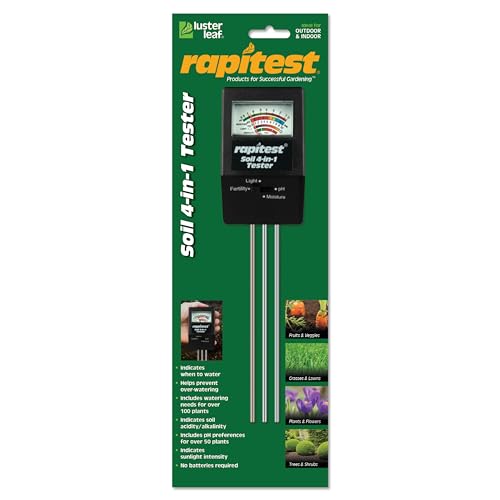
Luster Leaf 1818 Rapitest 4-in1 Soil pH/Moisture/Fertility/Light Tester, Fertility
- Helps provide a healthy growing environment
- Measures sunlight, soil fertility, soil moisture, and soil pH
- Three stainless steel probes
This is the Swiss Army knife for gardeners who want one tool that covers four measurements. The Luster Leaf 1818 checks soil pH, moisture, fertility, and sunlight using three stainless steel probes. No batteries, no capsules, no waiting. You push it in, flip the switch, and read the dial.
For drought prevention, the moisture reading is the most useful function. You can quickly check whether your soil is dry at root level before dragging out the hose. The fertility reading gives you a rough idea of nutrient availability, and the light meter helps you place plants where they’ll get enough sun without drying out too fast.
The trade-off is precision. Analog meters like this give you a range, not an exact number. Fertility readings are especially rough and shouldn’t replace a proper nutrient test. The probes can also bend if you force them into hard, dry soil. But for a quick, all-in-one check, it’s convenient and affordable. It works best as a first-line tool, not a final answer.
- 4-in-1: pH, moisture, fertility, and light
- Three stainless steel probes for stability
- No batteries required
- Designed for soil use only
- Analog dial gives range readings, not exact values
Best for: Beginners and casual gardeners who want a single, affordable tool for quick spot checks across multiple variables.
How We Chose These Products
We started with the core problem: drought stress kills plants when soil moisture drops below root level, and most gardeners can’t tell by looking. So we prioritized testers that measure moisture directly, plus tools that reveal the soil conditions drought makes worse, like pH swings and nutrient lockup.
We evaluated each product on accuracy, ease of use, durability, and whether it solves a specific buyer’s problem. We avoided tools with vague claims or proprietary features that don’t translate to real garden use. We also considered cost per test, battery life, and whether the product requires calibration or maintenance. No single tester covers everything, so we picked a range that lets you build a complete soil monitoring setup.
Buying Guide: What Really Matters
Moisture is the first thing to measure. A soil tester for drought prevention must read moisture at root depth, not just the surface. Probes shorter than four inches won’t reach the root zone in large pots or garden beds. Look for a probe length that matches your containers or bed depth.
pH and nutrients come second. Drought changes soil chemistry. Dry soil can become more acidic or alkaline, and nutrients become less available even if they’re present. A pH meter or a full nutrient test helps you correct these issues before plants show deficiency symptoms. If you’re only buying one tool, a 4-in-1 meter gives you the widest coverage.
Build quality matters more than features. Cheap probes bend or corrode. Digital meters need clean probes for accurate readings. Analog meters need no batteries but offer less precision. Decide whether you want speed, accuracy, or convenience, and pick the tool that matches. For most gardeners, a moisture meter plus a pH pen covers the essentials without overspending.
Our Top Recommendation
The XLUX 2 Pack Long Probe wins for drought prevention because it directly answers the most urgent question: is the soil dry where roots live? It’s fast, battery-free, and the two-pack covers both indoor and outdoor plants. The 5.5-inch probe reaches deep enough for most containers and garden beds. It’s not a full soil lab, but it stops you from overwatering or underwatering, which is the core of drought stress.
For a more complete picture, pair it with the MySoil Lab Kit if you want professional nutrient data, or the LAWNFUL Digital pH Meter if pH is your main concern. The Rapitest Soil Test Kit is the budget pick for nutrient testing, and the Luster Leaf 1818 is the best all-in-one for beginners. No single tool does everything, but a combination of moisture and pH testing covers most drought-related soil problems.
Frequently Asked Questions
Can a soil tester really prevent drought damage?
It prevents the biggest cause of drought damage: watering at the wrong time. A moisture meter tells you when soil is dry at root level, so you water before plants stress. It also stops you from overwatering, which can drown roots and waste water during a dry spell.
Do I need a lab test or is a home meter enough?
For drought prevention, a home moisture meter is enough. Lab tests are better for long-term soil health and nutrient planning. If you’re just trying to keep plants alive through a dry summer, start with a moisture meter and add a pH pen if you see deficiency symptoms.
How often should I test soil moisture during a drought?
Check every two to three days for containers and every four to five days for garden beds. Sandy soil dries faster than clay, so adjust based on your soil type. After a heavy watering, wait a day and test again to see how long moisture lasts.
Why does my moisture meter give different readings in the same pot?
Soil moisture isn’t uniform. The top inch dries first, and the bottom can stay wet. Insert the probe at different depths and spots to get a full picture. Also, clean the probe between readings. Dirty or corroded probes give false readings.