You kneel in the field, push a probe into the ground, and get a number back. Then you wonder if the number is real. Soil testing in the field has always had this problem: the tool is only as good as the sample you give it. Push the probe into a dry clod and you’ll get a reading that means nothing. Test the same spot twice and get two different answers.
A good field soil tester solves most of this. It needs a probe that reaches root depth, a display you can read in full sun, and enough stability that the reading doesn’t drift between rows. Battery life matters more than most buyers expect, since a dead meter halfway through a 40-acre grid wastes a whole afternoon.
This shortlist covers five meters that handle field work differently. Two are compaction testers built for engineering and agronomy, three are digital multi-parameter meters aimed at growers and gardeners. I’ll also cover sampling protocol, calibration, and crop-specific target ranges, since those matter as much as the meter itself.
Here’s a quick look at how the five stack up on the specs that drive field performance.
| Features | HOJILA FM-204DJ Penetrometer | Buladeke 7-in-1 Tester | YAMRON 4-in-1 Meter | SONKIR MS02 Meter | AgraTronix 8180 Tester |
|---|---|---|---|---|---|
| Measurement Type | Soil resistance / compaction | Moisture, pH, temp, light, EC, TDS | Moisture, pH, temp, light | Moisture, pH, light | Soil compaction (PSI) |
| Probe Depth | Up to 30 cm | About 10 cm | About 10 cm | Not specified | 24 inches |
| Power Source | Auto / manual shutoff | 4 x AAA batteries | 4 x AAA batteries | No battery needed | Mechanical dial |
| Display | Digital readout | LCD with backlight | LCD with backlight | Analog needle | Liquid-filled stainless dial |
| Best Use Case | Compaction, construction, fill | Multi-parameter garden and field | Everyday plant and soil checks | Budget quick checks | Deep agronomic compaction |
HOJILA FM-204DJ Digital S…

HOJILA
HOJILA FM-204DJ Digital Soil Penetrometer, 1000N Soil Compaction Tester | 0-1000N range, 0-30cm test depth, ≤0.25% accuracy for backfill, clay, sand and mixed soil field testing
- Precision Soil Resistance Measurement: Measures soil resistance from 0-100 kg (0-1000 N) with a test depth up to 30 cm and ≤0.25%…
- Supports Compaction & Bearing Evaluation: Designed to measure soil resistance and assist in evaluating fill resistance, relative d…
- Suitable for Multiple Soil Types: Works with backfill soil, clay, sand, and mixed soil after rolling, making it a practical testin…
The one you buy when soil strength matters more than soil chemistry. The HOJILA FM-204DJ is a digital penetrometer, not a pH or moisture meter. It measures how much resistance the soil puts up when you push a probe in, which tells you about compaction, relative density, and bearing capacity.
Field crews working on roadbeds, embankments, pipeline backfill, and dam sites will get the most from it. The 0-1000 N range covers soft clay through compacted fill, and the 30 cm test depth reaches below the topsoil layer where real compaction hides. A single test run takes 15 to 20 minutes, which is fast enough to knock out several grid points before lunch.
It’s not a plant-care tool, and that’s the honest limitation. You won’t get pH, moisture, or NPK from it. The auto and manual shutoff is handy, but the unit still needs a steady hand and a level push to avoid skewed readings on uneven ground.
- Measures 0-1000 N (roughly 0-100 kg) of soil resistance
- Test depth up to 30 cm, which reaches below the tillage layer
- Stated accuracy of ≤0.25% on resistance readings
- Works with backfill, clay, sand, and mixed soil after rolling
- Handheld build with auto and manual shutoff for field sessions
Best for: Geotechnical crews, civil engineers, and farm managers who need compaction data, not chemistry.
Buladeke Moisture Meter f…

Buladeke
Buladeke Moisture Meter for Plants,7-in-1 Digital Soil Tester Kit | Soil pH Tester with LCD - Measures pH, EC, TDS, Fertility, Temp, Moisture & Sunlight, Garden Tools for Indoor & Outdoor
- 【7-in-1 Features】This is a 7-in-1 multi-function soil tester. Our soil tester quickly measures soil moisture, pH, temperature and…
- 【Large Screen & LCD Backlight】The Soil Moisture Meter has a large LCD display with white backlight that clearly shows the numerica…
- 【Fast and accurate measurement】With the latest 2025 probe technology, it can quickly and accurately measure soil pH, moisture, tem…
The multi-tool of the group. The Buladeke 7-in-1 tester reads soil moisture, pH, temperature, light intensity, EC, and TDS, plus a fertility function. For growers who want one meter to cover most of the field checklist, this is the closest thing to a full kit in a single handheld.
The large backlit LCD is a real advantage in the field. Bright sun washes out cheap displays, and this one stays readable. Ten seconds after insertion, you have numbers. The 2026 probe technology is the marketing line, but the practical benefit is quick stabilization, which matters when you’re sampling dozens of spots across a grid.
Two things to know before you buy. It needs 4 AAA batteries, so pack spares for long days. And the probe shouldn’t go into bone-dry, hard soil without pre-moistening the test area first. Force it and you’ll damage the tip.
- Seven parameters including EC and TDS for water quality checks
- Backlit LCD readable in daylight and after dark
- Low-battery warning prevents mid-field surprises
- About 10 cm probe depth, ideal for root-zone sampling
- Ten-second read time after insertion
Best for: Growers who want pH, moisture, temperature, light, and EC from one device without carrying a full lab kit.
YAMRON 4-in-1 Soil Moistu…

YAMRON
4-in-1 Soil Moisture Meter Digital Plant Temperature/Soil Moisture/PH Meter/Sunlight Intensity Backlight LCD Display Soil Test Meter for Gardening, Farming and Outdoor Plants
- 【4 in 1 function】This is a 4-in-1 multifunctional soil tester.Our soil tester fastly to measure soil moisture, pH, temperature and…
- 【Large Screen & Backlight LCD Display】The Soil Tester uses a large LCD screen and white backlight to conveniently display and read…
- 【Quick Accurate measurement】The latest probe detection technology in 2026 can quickly and accurately measure the pH, moisture and…
The ergonomic pick. The YAMRON 4-in-1 covers moisture, pH, temperature, and sunlight, and its 45° rotating head is the standout design choice. You can tilt the display toward you instead of bending over every time you take a reading, which sounds minor until you’ve sampled 30 points in a row.
Screen readability is solid. The large LCD with white backlight handles both bright afternoons and dim evenings. The probe reaches about 4 inches (10 cm), which suits most vegetable, turf, and row-crop root zones. Readings arrive in roughly 10 seconds, and the visual icons make it easy for someone new to soil testing to interpret the numbers.
Accuracy depends on technique. YAMRON recommends reading pH and moisture from at least five spots and averaging the results. That’s a real workflow adjustment, not a marketing footnote. Skip it and you’ll chase phantom pH swings caused by a single clay pocket.
- Four core parameters: moisture, pH, temperature, sunlight
- Rotating head adjusts 0° to 45° for easier viewing
- Backlit LCD with intuitive icons for beginners
- 10-second stabilization after probe insertion
- Requires 4 AAA batteries (not included)
Best for: Gardeners and small-scale growers who want accurate readings with less bending and a simpler learning curve. If you’re just getting started, the soil tester for beginners guide is worth a look too.
SONKIR Soil pH Meter, MS0…

SONKIR
SONKIR Soil pH Meter, MS02 3-in-1 Soil Moisture/Light/pH Tester Gardening Tool Kits for Plant Care, Great for Garden, Lawn, Farm, Indoor & Outdoor Use (Green)
- Kindly NOTE: This soil tester can not be applied to test pH value of any other liquid. If the soil is too dry the indicator will n…
- 3 METERS IN ONE: Soil moisture level, Soil pH value and Sunlight level could be tested easily according to your need by switching…
- NO BATTERY NEEDED: Simply insert the meter into soil, wait few minutes, accurate test results will be displayed on the readout pan…
The no-battery analog option. The SONKIR MS02 runs on soil chemistry and physics alone. No batteries, no charging, no low-power warnings. You push it in, wait a few minutes, and read the needle. For quick field checks where you don’t want to think about power, this is the simplest tool on the list.
Three functions cover moisture, pH, and sunlight, switched with a single button. The build feels sturdy and the analog gauge is easy to glance at. It’s also the lightest and most portable of the group, which makes it a good glovebox or shed meter for spot checks.
The catch is precision. Analog needles don’t give you decimal readings, and dry soil won’t move the needle at all. You have to water the test area first if the ground is parched. And it can’t test liquids, so don’t try to use it on irrigation water.
- Three functions: moisture, pH, and sunlight
- No batteries required, ever
- Analog needle display, readable at a glance
- Compact and lightweight for pocket or glovebox carry
- Requires moist soil to register readings
Best for: Budget-conscious gardeners and hobby farmers who want a battery-free meter for quick moisture and pH spot checks.
AgraTronix 8180 Soil Comp…
AgraTronix
AgraTronix 8180 Soil Compaction Tester - 24 in. Probe, 300 PSI, Rubber Grip Handles, Water Filled Stainless Dial | Agricultural Supplies
- Soil Testing Equipment: Designed to accurately test soil compaction, this soil tester lets you determine the ideal state of soil f…
- Portable Device: The electronic tester features double molded rubber handles, hanger hole with nails and a lightweight body. Its e…
- Durable Construction: Made from high-grade stainless steel, the 24-inch probe of the portable soil tester with adjustable shock co…
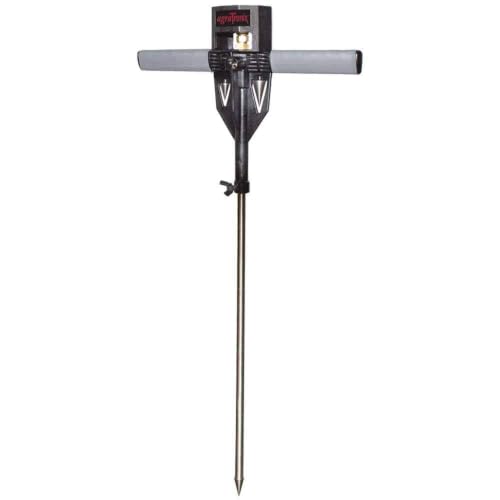
The professional-grade compaction tool. The AgraTronix 8180 is built for serious agronomy work. A 24-inch stainless probe reaches deep into the soil profile, and the liquid-filled dial reads compaction in PSI with a color-coded 3-way rating system. Green means good growing conditions, red means trouble.
Two interchangeable tips (1/2-inch and 3/4-inch) let you adapt the tester to different soil conditions. The double-molded rubber handles and lightweight body make it easier to push through dense layers than the spec sheet suggests. The hanger hole is a small but genuinely useful detail for keeping the tool off the ground between readings.
It’s a single-purpose instrument. You get compaction data and nothing else. The liquid-filled dial resists shock damage during transport, but this is still a precision tool that deserves a case. For farm operations tracking tillage effectiveness season over season, the depth and repeatability justify the cost.
- 24-inch stainless steel probe for deep profile testing
- 300 PSI range with color-coded green/yellow/red dial
- Two tips included: 1/2-inch and 3/4-inch diameter
- Liquid-filled dial reduces shock damage in transport
- Double-molded rubber handles for grip during insertion
Best for: Agronomists and farm managers who need deep-profile compaction data to guide tillage and cover-crop decisions.
How We Chose These Products
Every pick on this list had to solve a real field problem, not just look good on a spec sheet. I looked at probe depth and build quality first, because a meter that can’t reach the root zone or bends on first use is useless. Display readability in daylight, battery life, and stabilization time were next.
I also weighed how each tool handles the messy reality of field testing: uneven ground, dry patches, temperature swings, and long sampling days. Meters that require careful technique or specific soil conditions earned a spot, but only when the trade-off was worth it. No product made the cut on brand name alone.
Buying Guide: What Really Matters
Probe depth is the first thing to check. Shallow probes (around 10 cm) work for turf, vegetables, and seedlings. Deep probes (24 inches and up) are essential for compaction work and row crops with deep root systems. Match the depth to your crop, or you’ll be testing the wrong layer.
Next, decide whether you need chemistry or physics. pH, moisture, EC, and NPK meters tell you about soil fertility and plant growing conditions. Penetrometers and compaction testers tell you about soil structure. They answer different questions, and no single handheld does both well.
Battery life and display quality separate field-ready meters from bench tools. A backlit LCD saves you from squinting in full sun, and a low-battery warning prevents a dead meter mid-grid. Analog meters skip batteries entirely but trade away precision. For crop-specific guidance, see the best soil tester for farm use breakdown.
Our Top Recommendation
The Buladeke 7-in-1 takes the top spot for most field testers. Seven parameters, a bright backlit display, fast 10-second readings, and a price that fits a working grower’s budget. It covers the chemistry side of field testing better than anything else on this list.
If compaction is your actual concern, the HOJILA FM-204DJ is the better pick. It measures what a pH meter can’t: soil resistance, density, and bearing capacity. For deep-profile agronomic work, the AgraTronix 8180 delivers the depth and durability that shallower tools can’t match.
Budget buyers should look at the SONKIR MS02. It’s battery-free, rugged, and good enough for quick moisture and pH checks. The YAMRON 4-in-1 sits between the Buladeke and SONKIR as a middle-ground option with better ergonomics.
Frequently Asked Questions
How deep should I push a field soil tester?
Match the probe depth to your crop’s active root zone. Turf and vegetables need about 10 cm. Row crops and orchard trees need 15-30 cm or more. Compaction testing usually goes deeper, often 24 inches, to find plow pans and hardpans.
Why do I get different pH readings from the same field?
Soil is not uniform. Clay pockets, organic matter clumps, and moisture differences all shift pH. Take at least five readings per sampling area and average them. Clean the probe between spots to prevent cross-contamination.
How often should I calibrate a digital soil tester?
Check calibration at the start of each season and after any drop or hard impact. Use reference solutions where the meter supports them. Analog meters rarely need calibration but should be stored clean and dry.
Does soil temperature affect pH and NPK readings?
Yes. Cold soil slows the electrochemical response in pH and nutrient probes, which can shift readings by a meaningful margin. Test when soil is above roughly 50°F (10°C) for the most reliable numbers. For alkaline-specific guidance, see the best soil tester for alkaline soil article.