I spent three weekends scrolling through soil tester listings and came away more confused than when I started. Half the meters claimed lab-grade accuracy, a quarter of them buried the connection type in paragraph nine, and almost none told me whether the data could actually leave the device. If you grow anything at scale, that last point matters more than the sensor itself.
A good USB soil tester does three jobs: it reads moisture, pH, EC, temperature and nutrients with reasonable consistency, it survives contact with wet soil, and it hands you a file you can open in Excel or a farm platform. Bluetooth meters are fine for casual gardeners. USB wins when you need to plug into a laptop, log a season of readings, and compare plots without retyping numbers.
Below are five picks that cover the realistic spread of what’s out there, from a full 7-in-1 probe to a compaction dial that has nothing to do with USB but earns its place for a different reason. I’ve flagged which ones export data, which ones don’t, and where each falls short.
Here’s the quick spec comparison before the full reviews.
| Features | Cloudpower 7-in-1 | DROK USB Tester | AgraTronix 8180 | LAWNFUL pH Pen | ArecaIoT 8-in-1 |
|---|---|---|---|---|---|
| Connection Type | USB to Android | USB-A and USB-C | None, analog dial | None, LCD screen | USB Type-C to Android |
| Parameters Measured | 7 soil metrics | Voltage, current, power | Compaction in PSI | pH only | 8 soil metrics |
| Probe Depth | Standard insertion | Not applicable | 24-inch probe | Double needle, shallow | Standard insertion |
| Data Export | App save and export | On-screen only | Manual reading | Manual reading | App logging and export |
| Best Use Case | Garden and field crops | Power source testing | Compaction surveys | Quick pH checks | Logged research plots |
USB Soil Sensor 7-in-1 Tester

Cloudpower
USB Soil Sensor 7-in-1 Tester For Moisture, Soil Analysis Tool, Temperature, PH & NPK Nutrients - IP68 Digital Meter For Agriculture, Gardening & Research Farming, Floriculture
- Comprehensive Soil Analysis: This 7-in-1 USB soil sensor delivers complete plant health monitoring with accurate measurements of f…
- Multi-Parameter Measurement: Advanced sensing technology provides precise readings for ACROSS 7 critical soil parameters - for moi…
- Real-Time Data for ACCESS: Connect directly to for Android device via USB to instantly view, save, and export comprehensive soil d…
Cloudpower’s 7-in-1 meter is the closest thing on this list to a full soil lab in your pocket. It reads moisture, conductivity, temperature, pH and all three NPK nutrients from a single probe, then pushes everything to an Android phone over USB. Vegetable growers, greenhouse operators, and anyone running side-by-side plot trials will get the most use out of it.
The IP68 housing is the standout detail. Flame-retardant epoxy seals the electronics, and the metal alloy probe is built for repeated insertion without corroding. Moisture reads across 0-100%, EC tops out at 20000 μS/cm, and NPK covers 0-1999 mg/kg, which is enough range for most agricultural soils. There’s no battery to charge, so it works the moment you plug in.
Two honest caveats. First, it’s Android-only, so iPhone and Mac users are out of luck unless they keep a cheap Android tablet around. Second, the USB connection means you can’t leave the probe in the ground and walk away with live readings on your phone. You plug in, sample, unplug. If you want wireless monitoring, look at a Bluetooth option instead.
- Seven parameters from one probe: moisture, EC, temp, pH, N, P, K
- IP68 sealed body with flame-retardant epoxy resin
- No battery required, powered by the USB connection
- Android app handles saving and exporting readings
- Suited to agriculture, floriculture, potted plants and research
Best for: Android-based growers who want broad soil chemistry data in one pass without paying lab fees.
DROK USB Tester, USB-A USB-C

DROK
DROK USB Tester, USB-A USB-C 2.0 Multimeter Dual USB Ports PD QC 3.0 with Color LED Display Battery Charger Monitor, 7 Modes Capacity Voltage Current Power for Laptop Power Bank Solar Panel
- 【7 Modes Display Monitor】 DROK USB Tester is equipped with digital color LED display screen, which can be switched between 7 displ…
- 【Dual USB Output】 This item is equipped with USB-A USB-C input and dual USB 2.0 output. The output ports support PD QC 3.0 fast ch…
- 【Multifunction】 DROK USB detector can be used for capacity checking, capacity clear, over voltage, under voltage, over current and…
I’ll be blunt: the DROK USB Tester is not a soil tester. It measures voltage, current, power and capacity on USB power sources. I’m including it because anyone building a solar-powered soil monitoring setup needs to verify their panel and battery are actually delivering what the label claims, and this little meter does that job for a fraction of a dedicated analyzer.
The color LED screen cycles through seven display modes, and you can lock it to a fixed view if the rotation annoys you. Dual output ports support PD and QC 3.0 fast charge protocols, so it auto-detects what your device is asking for. Over-voltage, under-voltage, over-current and short-circuit alarms are built in, which is more useful than it sounds when you’re troubleshooting a field rig at dusk.
The limitation is obvious: it tells you nothing about soil. Zero moisture data, zero pH, zero nutrients. It’s a supporting tool, not a replacement. Also, output port two only charges, no data transfer, which trips people up the first time.
- Seven switchable display modes for voltage, current, power, capacity
- Dual USB 2.0 output with PD and QC 3.0 support
- Handles devices between 3.2-30V and 0-5A
- Built-in alarms for over-voltage, under-voltage and short circuits
- Works with solar panels, power banks and battery chargers
Best for: Growers running solar or battery-powered sensor arrays who need to confirm their power supply is honest.
AgraTronix 8180 Soil Compaction Tester
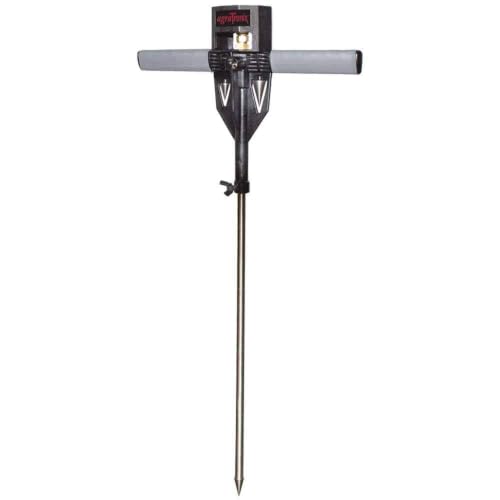
Compaction is the soil problem most home testers ignore. AgraTronix built the 8180 specifically to measure it, and the 24-inch stainless probe reaches deep enough to catch a hardpan layer that a 6-inch moisture meter will never touch. Orchard managers, no-till farmers, and anyone dealing with poor root penetration should start here before buying a chemistry meter.
The liquid-filled dial reads up to 300 PSI and uses a color-coded 3-way rating: green for good growing condition, red for poor. Two interchangeable tips, 1/2 inch and 3/4 inch, let you match the probe to soil type. Double-molded rubber handles and a lightweight frame make repeated sampling less of a forearm workout than it sounds.
No USB, no app, no data logging. You read the dial and write the number down. That’s the trade-off. For growers who want a spreadsheet of compaction readings across twenty grid points, this means manual entry. But the physical measurement itself is more reliable than any electronic probe at this depth.
- 24-inch stainless steel probe for deep compaction testing
- Liquid-filled dial rated to 300 PSI
- Two tips included: 1/2 inch and 3/4 inch diameter
- Color-coded green, yellow, red rating system
- Adjustable shock collar and hanger hole for field carry
Best for: Farmers and orchard growers diagnosing hardpan and root-zone density issues at depth.
LAWNFUL Digital Soil pH Meter
Sometimes you just want a pH number without opening an app. LAWNFUL’s pen-style meter does exactly that. Two stainless steel needles push into moist soil, the LCD shows pH, and you move on. It weighs 160 grams and runs on three AA batteries that the company says last around five years.
The calibration-free design is the real selling point. No buffer solutions, no two-point calibration routine, no fiddling. For lawn care, potted plants, and quick spot checks across a garden bed, that simplicity is worth more than extra parameters you’ll never use. The double-needle probe is described as anticorrosive, which helps if you’re sampling frequently.
Don’t expect lab precision. A pen-style pH meter reads the soil solution around the needles, not a proper slurry sample, so numbers drift a bit depending on moisture. It also gives you nothing on nutrients, EC or temperature. And the one-year warranty is welcome but tells you the company knows these don’t last forever.
- Calibration-free operation, no buffer solutions needed
- Double stainless steel needles, anticorrosive coating
- LCD display, 160-gram handheld body
- Three AA batteries included, roughly five-year life
- One-year replacement warranty from LAWNFUL
Best for: Lawn and garden owners who want fast pH readings without apps, cables or calibration steps.
Temperature Moisture EC PH NPK Tester
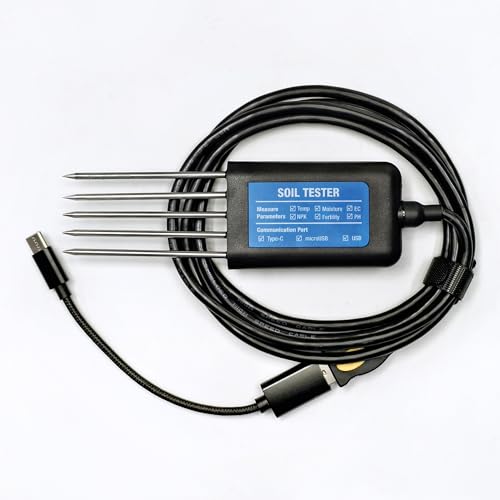
ArecaIoT
Temperature Moisture EC PH NPK Soil Tester Portable USB Type-C 8 in 1 Soil Sensor with Free Android App
- 1. Connect smart phone by type C
- 2. Measuring soil temp, moisture, EC, PH, NPK
- 3. Free Andriod APP
ArecaIoT’s 8-in-1 sensor is the closest competitor to the Cloudpower unit, and it takes a different angle on data. Instead of just showing readings, it logs them. The free Android app stores timestamped entries and exports them as files, which is the feature that makes this worth considering for anyone running replicated trials or tracking a season of soil changes.
Type-C connection is a small but real improvement over older micro-USB designs. Cables are easier to find and the connector survives more plug cycles. The sensor measures temperature, moisture, EC, pH and NPK, matching the 7-in-1’s parameter list with one extra metric.
Availability is the weak point. This model frequently shows a lead time rather than immediate stock, so if you need a meter this week, check the listing carefully before ordering. Android-only again, same as the Cloudpower. No iOS support, no desktop software mentioned.
- Type-C connection to Android phones
- Measures temperature, moisture, EC, pH and NPK
- Free Android app with in-app logging
- Export logging files for spreadsheet analysis
- Eight parameters total from a single probe
Best for: Researchers and serious growers who need timestamped soil data they can export and chart over a full season.
How We Chose These Products
I started by filtering out anything that couldn’t produce a file. A soil tester with USB output has to actually move data somewhere useful, whether that’s an Android app, a CSV export, or a readable screen you can transcribe. Meters that only blink a number and forget it got cut early.
From there I weighed probe construction, parameter coverage, and whether the claimed ranges matched real-world soil conditions. IP68 sealing, stainless probes, and battery-free operation all counted in favor. So did honest limitations, like Android-only apps and manual-logging designs. A tool that tells you what it can’t do is more trustworthy than one that promises everything.
Buying Guide: What Really Matters
USB versus Bluetooth is the first decision. USB meters are cheaper, never need charging, and plug straight into a laptop or Android device for immediate export. Bluetooth meters let you leave the probe in place and read wirelessly, but they add a battery, a pairing step, and often a companion app with its own quirks. If your workflow ends in a spreadsheet, USB is simpler. If you’re monitoring a fixed point over weeks, Bluetooth earns its keep. There’s a solid breakdown of app-connected soil testers if you want to compare the two approaches side by side.
Export format matters more than most buyers realize. Some apps generate a CSV you can open in Excel or Google Sheets. Others only show readings on screen and offer a screenshot. Ask before you buy. If you plan to feed data into a farm management platform, confirm the export is a real file, not an image.
Sampling depth and technique will affect your numbers more than the sensor brand. Push the probe into moist soil, not dry crust. Wipe it between samples. Take three readings per plot and average them. A 7-in-1 meter in careless hands produces worse data than a cheap pH pen used properly. If you’re working in unusual ground, our guide to sandy soil testing covers how drainage changes the readings you’ll see.
Total cost of ownership is the last piece. Budget for a spare USB cable, a replacement probe if the model supports one, and any app subscription the manufacturer sneaks in later. Some free apps stay free. Others gate export behind a paid tier. Read the fine print before you commit to a platform.
USB vs Lab Testing: Accuracy and Cost
A soil lab sends you a report with error margins printed on it. A consumer USB meter gives you a number and hopes you trust it. In practice, the gap is smaller than the price difference suggests, as long as you sample consistently and understand the limits.
Lab tests run per sample, and costs add up fast across multiple plots and multiple dates. A USB meter costs once and reads unlimited times. For tracking trends, that’s a better deal. For a one-time legal or certification requirement, pay the lab. Handheld devices have improved enough that comparing in-field handheld options against lab results is now a reasonable exercise rather than a joke.
Calibration frequency depends on the meter. Pen-style pH units like the LAWNFUL claim calibration-free operation, but any electronic sensor drifts over time. Store probes clean and dry, avoid extreme temperatures, and check against a known reference once a season. Firmware updates, when offered, usually come through the app and are worth installing.
Frequently Asked Questions
Can I export USB soil tester data to Excel?
Only if the app supports file export. The ArecaIoT 8-in-1 and Cloudpower 7-in-1 both save readings in their Android apps, and ArecaIoT specifically mentions exportable logging files. Always confirm export format before buying, since some apps only display data on screen.
Do these meters work on iPhone or Mac?
The two USB soil sensors here are Android-only. The DROK tester works with any USB power source regardless of host OS, but it measures electricity, not soil. If you need iOS compatibility, look at Bluetooth soil meters instead.
How deep should I push the probe?
Most electronic soil probes are designed for the top 4-6 inches, where most feeder roots live. The AgraTronix 8180 is the exception with its 24-inch probe, but that measures compaction, not chemistry. Pushing a standard probe deeper than its design allows can damage the sensor.
Why do my readings change between samples in the same bed?
Soil is not uniform. Moisture, organic matter and nutrient levels vary across a few feet. Take three readings per spot, average them, and clean the probe between insertions. If numbers swing wildly, the soil is likely too dry or the probe needs wiping.
Our Top Recommendation
The Cloudpower USB Soil Sensor 7-in-1 takes the top spot for most buyers. It covers the widest parameter range, survives real field conditions with its IP68 body, and needs no battery. The Android app handles saving and export, and the price sits well below what a lab would charge for a single multi-parameter test. If you’re on Android and want one tool that does the bulk of soil chemistry work, this is it.
For growers who specifically need logged, timestamped data for analysis, the ArecaIoT 8-in-1 is the better fit despite its lead time. Its export function is the feature that matters when you’re building a season-long record. And if your problem is compaction rather than chemistry, skip the electronics entirely and get the AgraTronix 8180. No USB meter on this list will tell you what a 24-inch probe and a pressure dial can.