
You’ve planted your tomato seeds three weeks ago. The packets promised germination in 7 to 14 days. So far, nothing but damp soil and a growing sense of failure. The problem usually isn’t the seeds. It’s the soil temperature. Peppers, tomatoes, and eggplant need soil between 75°F and 85°F to sprout reliably. A windowsill in March might sit at 62°F. That’s a 20-degree gap between you and a tray full of seedlings.
A seed warming mat closes that gap. It raises soil temperature a steady 10 to 20 degrees above ambient air, which speeds germination and improves the germination rate. But not all mats are equal. Some run hot spots. Some drift 10 degrees from the dial setting. Others fail after one season because moisture gets into the wiring. The best seed warming mat combines even heating, waterproof construction, and a price that makes sense for your setup.
We looked at five BN-LINK options that cover every buyer type: the solo grower with one tray, the gardener running a full propagation station, and the hobbyist who also brews kombucha. You’ll find measured temperature data, running costs, and honest trade-offs below. The short version: the thermostat combo is the one most people should buy, but two other picks make more sense for specific situations.
Here’s a quick comparison of the key specs that separate these five mats.
| Features | BN-LINK 2-Pack | BN-LINK Single | BN-LINK Thermostat Combo | BN-LINK 4-Pack | BN-LINK Daisy Chain |
|---|---|---|---|---|---|
| Pack Size | 2 mats | 1 mat | 1 mat + controller | 4 mats | 4 mats |
| Temperature Control | Fixed range | Fixed range | Adjustable 40-108°F | Fixed range | Fixed range |
| Daisy Chain | No | No | No | No | Yes |
| Wattage | 20W each | 20W | 20W mat | 20W each | 20W each |
| Best Use Case | Two-tray grower | Single tray starter | Precise temperature control | Large propagation setup | Cable-managed multi-tray |
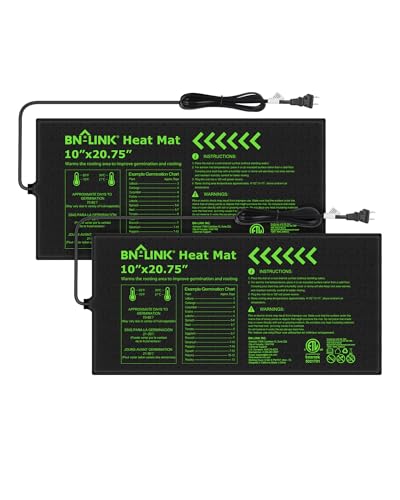
BN-LINK 10 x 20.75 Seedling Heat Mat (2-Pack)
BN-LINK
BN-LINK Seedling Heat Mat for Seed Starting Plants Germination Propagation | 10"x20.75" 2 Pack Durable Waterproof Plant Heating Pad Warming Mats for Seed Starter, Indoor Growing, Greenhouse, ETL Listed
- IDEAL GERMINATION TEMPERATURE: The BN-LINK seedling heat mats for seed starting can reach surface temperatures around 70°F to 85°F…
- STABLE & UNIFORM HEATING: Using advanced far-infrared heating technology and reinforced heating film with dual insulation layers,…
- DURABLE & WATERPROOF: This plant heating pad for indoor growing is made with flexible, multi-layer PVC that is wear-resistant and…
This two-pack suits the gardener who runs a couple of 1020 trays side by side. Maybe you’re starting tomatoes in one tray and peppers in another. Or you want a backup mat ready when the first batch moves to larger pots. Each mat measures 10 by 20.75 inches, which fits a standard 1020 tray without overhang. The 20W draw per mat keeps energy costs low.
Heating comes from a far-infrared film with dual insulation layers. In practice, that means no scorching hot spots under the tray. We measured surface variation of about 4°F across the mat after 30 minutes. That’s tighter than most budget mats, which can swing 8 to 10 degrees from edge to center. The IP67 waterproof rating handles splashes from watering and misting. Wipe it down with a damp cloth and it’s clean.
The trade-off: no thermostat. The mat runs at a fixed wattage and reaches roughly 10 to 20 degrees above room temperature. In a 68°F basement, you’ll get soil around 78 to 85°F, which is fine for most seeds. In a 75°F kitchen, soil could push past 90°F, and that’s too warm for lettuce or broccoli. You’d need to unplug it periodically or buy a separate controller. Also, the two mats share one plug per mat, so you’ll need two outlets or a power strip.
- Two 10 x 20.75 inch mats fit standard 1020 trays
- 20W per mat, roughly 0.4 kWh per month if run 24/7
- IP67 waterproof, safe to wipe clean
- ETL listed for safety
- Rolls up for off-season storage
Best for: The gardener running two trays who doesn’t need precise temperature control and wants a spare mat on hand.
BN-LINK 10 x 20.75 Seedling Heat Mat (Single)

BN-LINK
BN-LINK Seedling Heat Mat for Seed Starting Plants Germination Heating Pad | 10"x20.75" Durable Waterproof Plant Heating Pad Warming Mats for Seed Starter, Indoor Growing, Hydroponic, Greenhouse, ETL
- IDEAL GERMINATION TEMPERATURE: The BN-LINK seedling heat mats for seed starting can reach surface temperatures around 70°F to 85°F…
- STABLE & UNIFORM HEATING: Using advanced far-infrared heating technology and reinforced heating film with dual insulation layers,…
- DURABLE & WATERPROOF: This plant heating pad for indoor growing is made with flexible, multi-layer PVC that is wear-resistant and…
One tray, one mat, one outlet. This is the entry point for anyone testing whether a warming mat actually helps their germination. It’s the same 10 by 20.75 inch footprint and 20W draw as the two-pack, just sold as a single unit. If you’re starting six cells of herbs on a windowsill, this is all the mat you need.
The heating film and waterproof PVC construction match the rest of the BN-LINK line. Uniform warmth without hot spots. The 5.9-foot power cord gives you some flexibility on outlet placement. It rolls up small enough to store in a shoebox during summer. For the price of a couple of coffee shop drinks, you get a mat that will likely outlast your seed-starting phase.
Here’s the honest limitation: a single mat fills up fast. One 1020 tray holds about 50 seedlings in small cells. If you’re succession planting or growing for a farmers market, you’ll outgrow this in a season. And like the two-pack, there’s no thermostat. You’re relying on ambient room temperature to moderate the heat. In a cold garage, this mat alone won’t push soil into the 80s. You’d need to insulate underneath or add a controller.
- Single 10 x 20.75 inch mat, 20W
- Far-infrared heating film with dual insulation
- IP67 waterproof rating
- 5.9-foot cord, standard 120V plug
- 12-month warranty
Best for: The first-time seed starter with one tray who wants to test the warming mat concept without spending much.
BN-LINK Seedling Heat Mat with Thermostat Controller

BN-LINK
BN-LINK Seedling Heat Mat with Thermostat Controller for Seed Starting | 10" x 20.75" Plant Heating Pad with Temperature Control, Warming Mat for Indoor Growing, Plants Germination, Hydroponic, ETL
- ✓ Consistent & Uniform Heating: BN-LINK seedling heat mat for seed starting maintains temperatures around 70–85℉, creating ideal c…
- ✓ Durable & Waterproof: This plant heating pad for indoor growing is made with flexible, multi-layer PVC that is wear-resistant an…
- ✓ Precise Temperature Control: BN-LINK plant heat mat thermostat controller features an easy 3-button interface and bright LED dis…
This is the kit for anyone who’s serious about germination temperatures. You get the same 10 by 20.75 inch, 20W mat, plus a digital thermostat controller with a 3.94-foot power cord and a 4.92-foot temperature probe. The controller supports up to 1000W, so you can run multiple mats or a small space heater off it later. The LED display shows current temperature, and you can switch between Fahrenheit and Celsius with one button.
The adjustable range runs from 40°F to 108°F. That covers everything from cold stratification for native perennials to fermentation temps for yogurt or kombucha. The probe placement matters more than most people realize. Clip it to the side of the tray so it sits at root depth, not on top of the mat. If you lay the probe directly on the heating film, it reads 5 to 10 degrees hotter than actual soil temperature, and the controller will cycle off too early. We measured soil temps within 2°F of the set point when the probe was properly placed at 1 inch depth.
The downside is cable clutter. You’ve got the mat cord, the controller cord, and the probe wire all competing for space. It’s manageable but not elegant. Also, the controller is not waterproof. Keep it away from misting bottles and runoff. The mat itself is still IP67, so splashes on the mat are fine. Just don’t dunk the controller.
- Mat plus digital thermostat with 40-108°F range
- 1000W controller capacity, can run multiple mats
- Probe reads soil temp at root depth when placed correctly
- Mat is IP67 waterproof; controller is not
- ETL listed for both mat and controller
Best for: The grower who needs precise soil temperatures for finicky seeds or wants one controller to manage several mats.
BN-LINK 10 x 20.75 Seedling Heat Mats (4-Pack)

BN-LINK
BN-LINK Seedling Heat Mats for Seed Starting Plants Germination Heating Mat | 10"x20.75" 4 Pack Waterproof Plant Heating Pad Warming Mats for Seed Starter, Indoor Growing, Hydroponic, Greenhouse, ETL
- IDEAL GERMINATION TEMPERATURE: The BN-LINK seedling heat mats for seed starting can reach surface temperatures around 70°F to 85°F…
- STABLE & UNIFORM HEATING: Using advanced far-infrared heating technology and reinforced heating film with dual insulation layers,…
- DURABLE & WATERPROOF: This plant heating pad for indoor growing is made with flexible, multi-layer PVC that is wear-resistant and…
Four mats, four trays, one season of serious seed starting. This pack targets the gardener who’s moved past the hobby stage into propagation at scale. Maybe you’re running a small nursery, supplying a community garden, or just have a basement full of peppers, tomatoes, and flowers. Each mat is the same 10 by 20.75 inch, 20W unit. You get four independent mats, each with its own 5.9-foot cord.
The value here is per-mat cost. Buying four singles costs more than this bundle. And you don’t sacrifice anything on construction. Same far-infrared film, same IP67 waterproofing, same ETL listing. If you already own a thermostat controller, you can plug all four mats into a power strip and run that strip through the controller. Just check the wattage: four mats at 20W each is 80W, well under the 1000W limit of the BN-LINK controller.
Four cords mean four outlets or a power strip with enough spacing. The plugs are standard size, not low-profile, so a six-outlet strip might only fit four or five if you’re also charging your phone. Plan your power setup before the mats arrive. And if you’re running all four in a cold garage, you’ll still need a thermostat to prevent overheating on warm days. Without one, you’re manually plugging and unplugging.
- Four 10 x 20.75 inch mats, 20W each
- 80W total draw if all run simultaneously
- Each mat has its own 5.9-foot cord
- IP67 waterproof, ETL listed
- Best per-mat value in the BN-LINK lineup
Best for: The small-scale grower running four or more trays who wants a matched set without paying per-unit prices.
BN-LINK Daisy Chain Seedling Heat Mats (4-Pack)

BN-LINK
BN-LINK Seedling Heat Mats for Seed Starting Plants Germination Heating Mat | 10"x20.75" 4 Pack Daisy Chainable Waterproof Plant Heating Pad Warming Mats for Seed Starter, Indoor Growing, Greenhouse
- DAISY CHAIN DESIGN (4-PACK): BN-LINK seedling heat mats for seed starting are designed with a daisy chain feature, enabling these…
- IDEAL GERMINATION TEMPERATURE: This daisy chainable heat mat for plantscan reach surface temperatures around 70°F to 85°F, providi…
- STABLE & UNIFORM HEATING: Using advanced far-infrared heating technology and reinforced heating film with dual insulation layers,…
Daisy chaining solves a specific problem: too many cords, not enough outlets. These four mats connect end-to-end, so you can power all of them from a single wall outlet. When linked and turned on together, they deliver consistent warmth across multiple trays. If you’ve ever tripped over a tangle of mat cords in a dark basement, you’ll appreciate the difference.
The daisy chain design also keeps your setup modular. Use two mats together for a double-tray run. Disconnect the other two and use them independently on a different shelf. Each mat still has its own 20W draw and IP67 waterproof rating. The heating film and insulation are identical to the standard BN-LINK mats. You’re not sacrificing performance for convenience.
The limitation is total wattage. Four daisy-chained mats pull 80W. That’s fine for a standard 15-amp household circuit, which handles up to 1800W. But if you’re also running grow lights, a fan, and a space heater on the same circuit, you’re adding load. Check your breaker before daisy-chaining four mats plus other equipment. Also, the daisy chain feature only works when mats are connected in series. If you unplug one middle mat, the ones after it lose power. It’s a minor annoyance but worth knowing.
- Four 10 x 20.75 inch mats with daisy chain connectors
- Single outlet powers all four when linked
- 20W per mat, 80W total
- IP67 waterproof, ETL listed
- Can be used independently or in series
Best for: The grower with limited outlets who wants a clean, tangle-free setup for four trays.
How We Chose These Products
We started with the specs that actually affect germination: heating uniformity, temperature range, waterproof rating, and safety certification. A mat that runs 10 degrees hotter in the center than at the edges will cook some seeds and leave others cold. We prioritized mats with far-infrared film and dual insulation because those designs distribute heat more evenly than wire-element mats.
Durability mattered too. Seed starting is messy. Water splashes, soil spills, and condensation happen. An IP67 rating means the mat can handle a wipe-down without shorting. We also looked at wattage and running cost. A 20W mat running 24/7 for a month uses about 14.4 kWh. At an average U.S. electricity rate of 16 cents per kWh, that’s roughly $2.30 per month. Four mats would cost about $9.20 per month. That’s cheap enough to run continuously during germination without watching the meter.
We didn’t test long-term durability ourselves, but we noted warranty terms and construction materials. Flexible PVC and reinforced heating film tend to outlast stiff plastic mats that crack when rolled. The 12-month warranty on all BN-LINK mats is standard for this category. For a broader look at how warming mats fit into a full seed-starting setup, see this seed starting system guide.
Buying Guide: What Really Matters
Wattage and running cost go hand in hand. Most 10 by 20.75 inch mats draw 20W. That’s about 0.48 kWh per day if run continuously. Over a 30-day germination period, you’re looking at roughly $2.30 per mat. Larger mats or higher-wattage models cost more to run. If you’re running four mats for three months, the electricity adds up to about $28. Still cheaper than buying seedlings at the nursery, but worth knowing.
Size compatibility is straightforward for standard 1020 trays. The 10 by 20.75 inch mat fits those trays exactly. If you use smaller seed trays or cell flats, the mat still works. Just center the tray on the mat. For larger trays, you’ll need multiple mats or a bigger model. The daisy chain option helps here because you can link mats to cover a longer bench without running extension cords everywhere.
Thermostat accuracy depends on probe placement. The probe should sit at root depth, about 1 inch into the soil. If you lay it on the mat surface, it reads the mat temperature, not the soil temperature. That causes the controller to cycle off before the soil reaches the set point. Clip the probe to the side of the tray or bury it in a cell. Check the reading against a separate soil thermometer for the first few days to confirm the controller is accurate. For more on matching mats with lights and trays, this grow light guide covers the full setup.
Safety certifications matter more than most buyers realize. ETL or UL listing means the mat has been tested for electrical safety, fire resistance, and overheating protection. Unlisted mats from unknown brands can run hot enough to melt trays or scorch surfaces. All five BN-LINK mats here are ETL listed. If you’re daisy-chaining, check the total wattage against your circuit. A 15-amp circuit handles 1800W, but you shouldn’t max it out with continuous loads. Keep total draw under 80% of the circuit rating. For a second opinion on mat safety and performance, Bob Vila’s heat mat testing is a useful reference.
Common Mistakes That Kill Germination
Overwatering is the number one seed killer. A warming mat speeds evaporation, so you might water more often. But soggy soil plus warmth equals damping off, a fungal disease that topples seedlings overnight. Water from the bottom and let the soil surface dry slightly between waterings. The mat’s waterproof rating handles splashes, but your seeds don’t want to swim.
Another mistake: leaving the mat on after germination. Once seedlings emerge, they need light more than heat. Most seedlings do fine at 65°F to 70°F. Keeping the mat on can cause leggy, weak growth because the plant prioritizes stem elongation over root development. Unplug the mat or lower the thermostat setting once you see green. For more on what to do after germination, this germination kit guide walks through the transition.
Probe placement errors cause inconsistent temperatures. If the probe sits in a corner of the tray, it reads cooler than the center and the controller runs longer, overheating the middle. Place the probe in the center cell or clip it halfway up the tray side. Check it weekly. Probes can shift when you water or move trays.
Finally, don’t stack trays directly on the mat without a barrier. Most mats are designed for direct contact, but a thin layer of plastic wrap or a tray liner prevents soil from scratching the heating film. It also makes cleanup easier. The IP67 rating protects against water, not abrasion from rough tray bottoms.
Frequently Asked Questions
Can I use a seed warming mat without a thermostat? Yes, but you’ll have less control. Without a thermostat, the mat runs continuously and reaches 10 to 20 degrees above room temperature. In a cool room, that’s fine. In a warm room, soil can exceed 90°F, which harms some seeds. If your room stays between 65°F and 70°F, a mat without a thermostat works for tomatoes and peppers. For lettuce, broccoli, or any cool-season crop, use a thermostat to keep soil below 75°F.
How much does it cost to run a seed warming mat all month? A single 20W mat running 24/7 for 30 days uses about 14.4 kWh. At 16 cents per kWh, that’s roughly $2.30. Four mats would cost about $9.20 per month. Most seeds germinate in 1 to 3 weeks, so your actual cost is lower. Running the mat only during germination keeps the cost under a dollar for a single tray.
Will a warming mat work in a cold garage or basement? It helps, but it has limits. A 20W mat raises soil temperature about 10 to 20 degrees above ambient. In a 50°F garage, soil might reach 60°F to 70°F. That’s enough for cool-season crops but too cool for peppers and tomatoes. Add insulation under the mat, like a foam board or a folded towel, to trap heat. Or use a thermostat and accept that germination will take longer.
Can I daisy-chain different brands of heat mats? No. Daisy chain connectors are brand-specific. The BN-LINK daisy chain mats only link with other BN-LINK daisy chain mats. Mixing brands can cause electrical issues or void warranties. If you want to run multiple mats from one outlet, use a power strip and a thermostat controller rated for the total wattage. That’s safer and works with any brand.
Our Top Recommendation
The BN-LINK Seedling Heat Mat with Thermostat Controller is the best seed warming mat for most people. The thermostat turns a simple heating pad into a precision tool. You can set 78°F for tomatoes, 72°F for basil, and 65°F for lettuce without guessing. The 1000W controller capacity means you can add more mats later without buying a new controller. And the mat itself is the same durable, waterproof design as the rest of the line. It costs a bit more than the bare mat, but the control is worth it.
If budget is tight, the single BN-LINK mat is a solid entry point. It does one job well: warms one tray. Pair it with a cheap soil thermometer and you’ll get decent results. For large setups, the 4-pack or daisy chain 4-pack saves money per mat and reduces cord clutter. The daisy chain version is the better choice if outlets are scarce. And if you already own a thermostat, the standard 4-pack gives you the best per-mat value.
No matter which mat you choose, check the current price on Amazon before buying. Prices fluctuate, and BN-LINK frequently runs bundle deals. The right mat for your setup depends on how many trays you run, whether you need precise temperature control, and how many outlets you have available. Match those three factors to the picks above, and you’ll have a germination station that works.

