Your windowsill is a lie. It looks bright enough to you, but to a tomato seedling stretching toward a cloudy February sky, it’s a starvation diet. That pale, spindly stem isn’t a sign of growth; it’s a distress signal. Leggy seedlings are the number one reason home gardeners fail before the season even begins.



A good grow light fixes this, but the market is crowded with blurple bulbs and misleading wattage claims. You need a light that delivers the right intensity for your specific crops, fits your space, and doesn’t spike your electric bill. This guide cuts through the hype.
We’ve matched five proven lights to the specific buyer types who will get the most from them, from the windowsill hobbyist to the garage-scale grower. Below, you’ll find the specs that actually matter, a week-by-week schedule, and the math on what it costs to run each one.
| Features | GooingTop 6000K | FOXGARDEN Stand | LEOTER 80 LED | Barrina T5 1FT | Barrina T8 4FT |
|---|---|---|---|---|---|
| Best Use Case | Small houseplants, herbs | Desktop seed starting | Flexible multi-plant setups | Shelf seed starting | Large grow tents, garages |
| Key Spec | 10W, 6000K white | 108 LEDs, adjustable height | 80 LEDs, 10 dimmable levels | 20W, 96 LEDs | 252W, 1152 LEDs |
| Coverage | Single small pot | Small tray or shelf | Up to 4 small pots | 1-2 foot shelf section | Full 4-foot shelf or tent |
| Timer & Dimming | 3 timers, no dimming | 3 timers, 6 dimming levels | 3 timers, 10 dimming levels | No timer, no dimming | No timer, no dimming |
| Installation | Clamp & gooseneck | Stand & base | Clamp & gooseneck | Double-sided tape & clips | Clips, ties, linkable |
GooingTop Grow Light,6000…
This is the light for the person who kills every basil plant they bring home from the grocery store. It’s a single-head clip-on unit with a flexible gooseneck, designed for a small collection of pots on a desk or kitchen counter. If you’re starting two tomato plants on a windowsill, this is your entry point.
The 6000K white light is the standout feature. It looks like natural daylight, not the purple glow that makes your living room look like a rave. With a color rendering index of 95, you can actually read a book under it. The 10-watt draw is tiny, costing roughly two dollars a month if you run it 12 hours a day. The built-in timer cycles automatically, so you don’t have to remember to turn it on.
The trade-off is coverage. This light is for one plant, maybe two small ones. It doesn’t have dimming, so you can’t dial back the intensity for delicate new sprouts. And the clamp needs a sturdy edge to grip; a flimsy plastic shelf won’t hold it.
- 10W draw, equivalent to a 50W halogen bulb
- 6000K white full spectrum with 10 red and 74 white LEDs
- 3 timer settings: 4, 8, or 12 hours
- USB or AC powered with a sturdy clamp
- 365-day warranty
Best for: The windowsill gardener who needs a compact, good-looking light for a few herbs or houseplants.
FOXGARDEN Grow Light Stan…
Picture a dedicated seed-starting station on a side table. The FOXGARDEN is a self-contained unit with a metal stand and a light board that hangs above your tray. It’s for the gardener who wants a tidy, adjustable setup without clamping lights to furniture or drilling into shelves.
The height adjustment is the real selling point. You can raise the light from about 11 inches to nearly 22 inches as your seedlings grow. That’s crucial for preventing light burn on new sprouts and keeping the light close enough to stop stretching. With 108 LEDs and six dimming levels, you have fine control over intensity. The reflector design helps push more light down onto the plants instead of scattering it around the room.
It’s not perfect. The coverage area is small, so it’s best for a single standard seed tray. The unit is also on preorder, meaning you might wait a bit for delivery. And while the stand is stable, it’s not meant for heavy pots or large plants.
- 108 LEDs: 60 cold white, 32 warm white, 16 red
- Height adjustable from 11.02 to 21.65 inches
- 3 timer settings and 6 brightness levels
- Stable metal base with a protective sponge pad
- 12-month warranty and 90-day return window
Best for: The organized gardener who wants a dedicated, adjustable seed-starting station on a desk or counter.
LEOTER Grow Light for Ind…
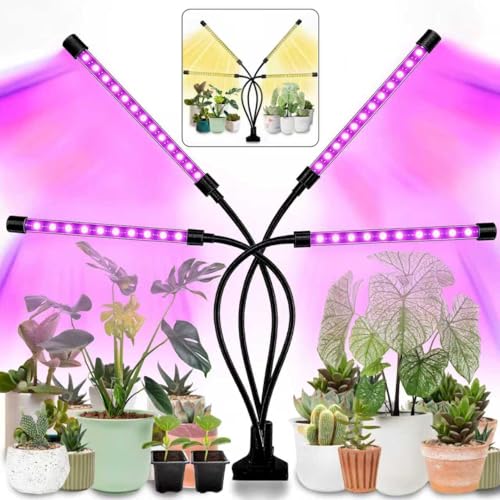
Some gardeners don’t have a shelf or a table to spare. The LEOTER is a four-head clip-on light with long goosenecks. It’s for the person who needs to weave light around a crowded collection of pots on a bookshelf, a windowsill, or a plant stand.
Flexibility is the main event here. Each of the four heads can be bent independently, so you can aim light at a tall pepper plant and a short basil seedling at the same time. The 80 LEDs cover a full spectrum, and you can switch between three spectral modes: full spectrum, red and blue for blooming, or a mix. Ten dimming levels let you match intensity to the plant’s stage. The heat sink is aviation-grade aluminum, which keeps the heads cool to the touch.
The limitation is that four heads on one clamp can feel fiddly. You’ll spend a minute or two adjusting them every time you move a pot. The timer requires a reset if the power goes out, which is a minor annoyance. And while the clamp is strong, it needs a solid surface to grip.
- 80 LEDs: 32 red, 12 blue, 20 yellow, 16 white
- 3 spectral modes and 10 dimming levels
- 4 flexible gooseneck heads with a 360-degree range
- 3/9/12-hour timer with memory function
- Aviation-grade heat sink for efficient cooling
Best for: The collector with plants of different heights who needs flexible, multi-directional light from a single clamp.
Barrina T5 Grow Lights fo…

Barrina
Barrina T5 Grow Lights for Indoor Plants, 5000K Full Spectrum, 1FT, 4 Packs | 1FT LED Growing Lamp, Plant Light Strip for Seed Starting, Vegetables and Greens, Plug and Play, Linkable
- 5000K White Full Spectrum Light: Barrina T5 grow lights 1ft provide indoor plants with full-spectrum sunlight replacement. We prov…
- Super Bright and High PPFD: Consuming only 20W with 96 LEDs totally, replace 120W general plant lights. Over 95% light energy can…
- Separately Controllable: Each t5 grow lights fixtures have on off switch on the surface of housing, controlling the lights separat…
This is the light for the gardener who has converted a bookshelf or a wire rack into a seed-starting nursery. The Barrina T5 is a one-foot bar light that mounts under a shelf. It’s for the grower who wants even, overhead light across a whole tray of seedlings, not a spotlight on one pot.
Barrina packs a lot of power into a small bar. At 20 watts, it replaces a 120-watt general plant light, and over 95 percent of the light energy is usable by plants. The 5000K white spectrum is bright and clean, easy on the eyes. Each fixture has its own on/off switch, so you can control them individually or link them together. Installation is simple with the included tape and clips, and you can daisy-chain up to 16 lights.
The catch is that these lights have no timer and no dimming. You’ll need a separate outlet timer, which costs a few dollars. The double-sided tape also won’t stick to dusty or rough surfaces, so clean the shelf first. And at one foot long, they’re best for narrow shelves.
- 20W draw with 96 LEDs, replacing 120W
- 5000K full spectrum white light
- Link up to 16 lights in a series
- Individual on/off switch on each fixture
- Includes tapes, clips, and cable ties for installation
Best for: The shelf gardener who wants even, high-efficiency light across a standard seed tray.
Barrina Plant Grow Lights…
Now we’re in garage territory. The Barrina T8 is a four-foot bar light, sold in a six-pack. This is for the serious grower with a large shelving unit, a grow tent, or a dedicated seed-starting room. It’s for someone starting dozens of tomatoes, peppers, and brassicas, not a few herbs.
The scale here is different. With 1152 LEDs and a 252-watt draw, this system replaces a 1400-watt general grow light. The V-shaped reflector boosts efficiency by 17 to 20 percent, pushing more light down to the canopy. The 5000K white light is comfortable to work under. The aluminum shell provides excellent heat dissipation, which extends the life of the LEDs. You can link up to six strips in a series.
This is a commitment. It’s not a plug-and-play clip-on; you need to plan your installation. There’s no timer or dimming, so you’ll need a controller or outlet timer. And the six-pack is overkill for a small setup. But for a large operation, the cost per watt and the coverage are hard to beat.
- 252W draw with 1152 LEDs, replacing 1400W
- 5000K full spectrum white light
- V-shaped reflector for 17-20% more efficiency
- Link up to 6 strips in a series
- 100% aluminum shell for heat dissipation
Best for: The large-scale grower with a multi-shelf setup or grow tent who needs maximum coverage and efficiency.
How We Chose These Products
We started with the physics. A grow light is only as good as the light it delivers to the leaf surface, so we looked for products with published PPFD data or clear wattage and LED counts that let us estimate it. We ignored marketing terms like ‘blurple’ and focused on color temperature, spectrum, and actual power draw.
Then we matched the lights to real-world scenarios. A light that’s perfect for a garage tent is a waste of money on a windowsill. We prioritized adjustability, timer functions, and heat management, because those are the features that separate a frustrating experience from a successful one. We also considered the small stuff: clamp strength, cord length, and whether the light looks decent in a living space.
Buying Guide: What Really Matters
Ignore the ‘equivalent wattage’ claims. Look at the actual power draw in watts and the PPFD (Photosynthetic Photon Flux Density) at a given height. For seedlings, you want a PPFD of 200-400 at 6-12 inches from the canopy. Lettuce and herbs are fine with 150-250. Tomatoes and peppers want 300-400. If a light doesn’t publish PPFD, look for a wattage of at least 20-30 watts per square foot of coverage.
Color temperature matters for your eyes, not just your plants. A 5000K or 6000K white light is pleasant to work under. A 3000K warm white light is better for flowering. For seed starting, a full-spectrum white light in the 5000K range is the sweet spot. It gives your plants the blue light they need for compact growth and the red light they need for root development.
Don’t overlook dimming and height adjustment. A dimmable light lets you start seeds at a lower intensity and ramp up as they grow. Adjustable height does the same thing mechanically. If you’re starting delicate herbs like basil, a light that’s too intense will burn them. If you’re starting tomatoes, a light that’s too weak will give you leggy, weak stems. The ability to adjust is more important than raw power.
Finally, think about your space. A clip-on light is great for a countertop but useless for a shelf. A bar light is perfect for a shelf but overkill for a single pot. Match the form factor to your setup before you buy.
Our Top Recommendation
For most home gardeners, the Barrina T5 1FT is the best balance of price, performance, and flexibility. It delivers strong, even light across a standard seed tray, it’s easy to install under a shelf, and you can link multiple bars as your needs grow. It doesn’t have a timer or dimming, but a cheap outlet timer solves that. It’s the light we’d buy for our own seed-starting shelf.
If you’re on a tight budget or just starting a few pots, the GooingTop is a solid, low-cost entry point. It’s not powerful enough for a full tray of tomatoes, but it will keep your basil and houseplants happy. For a dedicated, adjustable desktop setup, the FOXGARDEN is worth the wait. And if you’re scaling up to a garage or grow tent, the Barrina T8 4FT is the workhorse you want.
Frequently Asked Questions
How high should I hang my grow light above seedlings? Start with the light 4-6 inches above the top of the seedlings for a T5 or similar bar light. For a more powerful LED, start at 12-18 inches and adjust based on plant response. If seedlings stretch, lower the light. If leaves curl or turn brown, raise it.
How many hours of light do seedlings need? Most seedlings need 14-16 hours of light per day. A timer is essential. Running lights 24/7 can actually stress plants and prevent them from developing properly. Give them 8 hours of darkness to rest.
Do I need a full spectrum light or just red and blue? Full spectrum white light is better for seed starting. It gives you a clear view of your plants, so you can spot pests or disease early. Red and blue (blurple) lights work, but they’re hard on the eyes and make it difficult to assess plant health.
How much does it cost to run a grow light? A 20-watt light running 16 hours a day uses 0.32 kWh per day. At a rate of 15 cents per kWh, that’s about 5 cents a day, or $1.50 a month. A 250-watt light would cost about $18 a month. LEDs are very cheap to run.
Can I use a regular shop light for seed starting? A standard shop light with a 5000K or 6500K LED bulb can work for seed starting. The key is the color temperature and the intensity. A shop light is often cheaper and more powerful than a dedicated grow light, but it may not have the same spectrum or heat management. It’s a viable budget option.