
Top 4 Best Rotary Sprinkler Heads: Expert Review & Buying Guide
Contents
You’ve probably stood on a dry patch of lawn, hose in hand, wondering why half your sprinkler zone looks like a swamp while the other half cracks. Rotary sprinkler heads fix that — if you pick the right ones. The wrong head wastes water, misses corners, and clogs every season. The right one runs quietly for years and keeps your grass even.
A good rotary head does three things well: it throws water far enough for your yard, it adjusts to the exact arc you need, and it survives real-world pressure swings. Gear-driven rotors beat old impact heads on noise and reliability. Pop-up height matters too — 4 inches clears most mower decks, shorter risers get scalped.
I’ve sorted through the noise and picked four heads worth your money. The Hunter PGP-ADJ is the overall winner for most lawns. Rain Bird’s 5000 is the value champ, the 42SA+ suits medium zones, and K-Rain’s K1 wins for small yards and tight spaces. Below you’ll find a spec table, honest trade-offs, and a zone-planning guide most competitors skip.
Here’s a quick side-by-side of the key specs that actually affect your buying decision.
| Features | Hunter PGP-ADJ | Rain Bird 5000 | Rain Bird 42SA+ | K Rain K1 |
|---|---|---|---|---|
| Inlet Size | 3/4 inch NPT | 3/4 inch NPT | 3/4 inch NPT | 1/2 inch NPT |
| Spray Distance | 22-52 ft | Up to 40 ft | 26-38 ft | 15-30 ft |
| Arc Adjustment | 40-360 degrees | 40-360 degrees | 40-360 degrees | 40-360 degrees |
| Pop-Up Height | 4 inches | 4 inches | 4 inches | 4 inches |
| Best Use Case | Large lawns, full coverage | Value replacement, mid-size yards | Medium zones, wind resistance | Small yards, tight spaces |
Hunter PGP-ADJ 3/4″ Rotor
1st Pick

Hunter
Hunter PGP-ADJ 3/4" Rotor Lawn Sprinkler Head, 22-52 ft, 4" Pop Up, 2 Pack
- ADJUSTABLE ARC & SPRAY DISTANCE: Includes a preinstalled 3.0 GPM nozzle with an arc that adjusts from 40° to 360°, ideal for both…
- HUNTER’S ORIGINAL ROTOR: The PGP-ADJ delivers proven performance and precision, trusted by professionals and homeowners for its du…
- GEAR-DRIVEN PERFORMANCE FOR QUIET, SMOOTH ROTATION: Equipped with a water-lubricated gear drive, this 4-inch pop-up sprinkler deli…
The one you buy when you want pro-grade reliability without pro-grade pricing.
The Hunter PGP-ADJ is the head I’d put in my own yard if I had a half-acre of grass and a standard 3/4-inch system. It’s a gear-driven rotor that throws water 22 to 52 feet, which covers most residential zones in one pass. The preinstalled 3.0 GPM nozzle handles the heavy lifting, and you can swap in optional nozzles later if your pressure runs low or high.
What sets this apart is the water-lubricated gear drive. No clacking, no ratcheting noise at 6 AM. It rotates smooth and even, and the arc adjusts from 40 to 360 degrees with the included wrench. The fast-forward feature lets you check your stop points without waiting through a full cycle. That’s a small thing until you’ve spent twenty minutes watching a rotor crawl around a zone.
Trade-offs exist. The 4-inch pop-up clears most mower decks, but if you’ve got tall fescue and a deck that sits low, you might want a 6-inch version. The 3.0 GPM nozzle drinks a lot of water — check your flow rate before installing a full zone of these. And the 2-pack is convenient, but if you need eight heads, you’re buying four packs. Check the current price on Amazon before committing.
- Preinstalled 3.0 GPM nozzle, swappable for other flow rates
- 40 to 360 degree arc, adjustable with included wrench
- Water-lubricated gear drive for quiet operation
- 3/4-inch female NPT inlet fits standard systems
- Retracted body height of 7.75 inches, exposed diameter 1.75 inches
Best for: Homeowners with large lawns and standard 3/4-inch systems who want a quiet, durable rotor without paying commercial prices.
Rain Bird 5000 Heavy Duty
2nd Pick

Rain Bird
Rain Bird 5000 Heavy Duty Simple Adjust Gear Driven Rotor Sprinkler Head
- Adjustable From 40-360 Degrees
- Heavier-Duty Retract Spring Assures Positive Pop-Down
- Top-Adjust Arc Adjustment Requiring Only A Flat-Blade Screwdriver
The value pick that punches above its price tag.
Rain Bird’s 5000 is the head you see in a lot of contractor installs for a reason. It’s a gear-driven rotor with a 40 to 360 degree arc and a spray radius up to 40 feet. The heavier-duty retract spring is the standout detail — it pulls the head down positively every cycle, which matters if you’ve got sandy soil or a mower that runs low.
Top-adjust arc control needs only a flat-blade screwdriver. No disassembly, no pulling the head. The Rain Curtain nozzle produces larger droplets that resist wind better than fine mist, so you get even distribution across the full radius. For medium to large yards on a budget, this is a smart pick. If you’re comparing options for a bigger property, the best sprinkler heads for lawns guide covers more ground on matching heads to yard size.
It’s not perfect. The 5000 doesn’t include a nozzle adjustment tool, so you’ll need a flathead screwdriver handy. The arc adjustment range is wide, but fine-tuning the exact stop points takes a few tries. And while the retract spring is heavy-duty, the body itself is plastic — it holds up fine, but don’t expect metal construction at this price point.
- 40 to 360 degree adjustable arc with top-adjust screwdriver access
- Heavier-duty retract spring for positive pop-down
- Rain Curtain nozzle for wind-resistant droplet size
- Up to 40-foot spray radius
- Nozzle preinstalled, ready to drop into a 3/4-inch system
Best for: Budget-conscious buyers replacing old rotors in mid-size yards who want reliable pop-down and even coverage.
Rain Bird 42SA+ Simple Ad
3rd Pick
Rain Bird
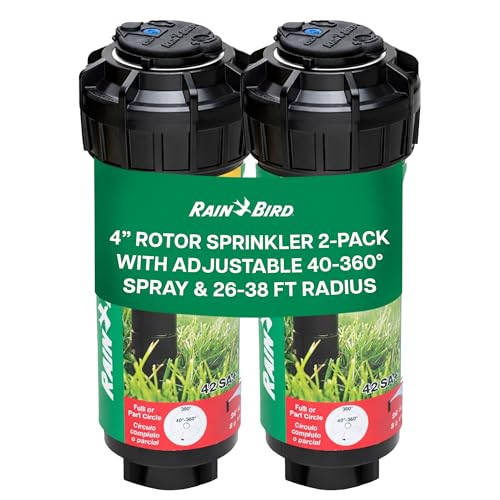
Rain Bird 42SA+ Simple Adjust Gear Driven Rotor Sprinkler Head, 2 Pack
- Professional Gear-Driven Rotor Sprinkler Head - The Rain Bird 42SA+ (W42003HC) heavy duty simple adjust gear-driven rotor sprinkle…
- Rain Curtain Nozzles for Even Watering - Patented Rain Curtain nozzle technology produces larger, wind-resistant droplets that fal…
- Easy Top Adjustments, No Disassembly - Adjust arc and spray distance right from the top using a flat-blade screwdriver. Factory pr…
The medium-zone specialist with wind-resistant spray.
The 42SA+ sits in a sweet spot for medium lawns — 26 to 38 feet of throw, which fits most suburban front yards and side strips. It’s a gear-driven rotor with a 3/4-inch NPT inlet, so it drops into standard systems without adapters. The closed-case design keeps sand and debris out, which is a real advantage if you’ve got gritty soil or creeping grass.
Rain Curtain nozzles are the headline here. They produce larger droplets that fall uniformly instead of drifting into your neighbor’s driveway. Micro ramps add gentle close-in coverage, so you don’t get a dry ring right around the head. Arc and distance adjust from the top with a flat-blade screwdriver — factory preset at 180 degrees, so you can fine-tune without pulling anything apart.
The limitation is range. If your zone needs 45-foot throws, this head won’t get there. It’s built for medium zones, and pushing it beyond 38 feet means weak coverage at the edges. The stainless steel retract spring and reinforced seals suggest long-term durability, but the plastic body won’t survive a direct hit from a shovel. It operates best at 45 to 55 PSI — check your system pressure before buying a full set.
- 26 to 38 foot spray distance, ideal for medium zones
- Rain Curtain nozzle for wind-resistant, even coverage
- Top-adjust arc and distance with flat-blade screwdriver
- Closed-case design resists sand and debris
- 3/4-inch NPT female inlet, 45-55 PSI operating range
Best for: Homeowners with medium-sized lawns and moderate pressure who want even coverage without overspray onto sidewalks.
K Rain K1 1/2″ Smart Set
4th Pick
K-Rain
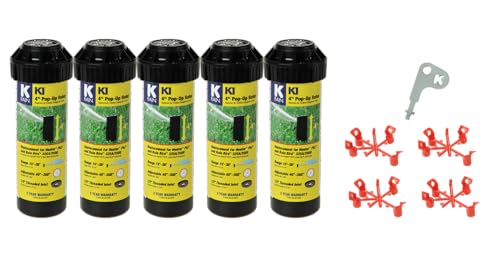
K Rain K1 1/2" Smart Set Rotor 4" Pop-Up| 15' - 30' Spray Distance, 40° - 360° Arc Spray Pattern | Includes Install Kit (5 Pack)
- The revolutionary patented top arc set simplifies arc adjustment for wet or dry conditions in seconds, replacing all standard mini…
- K Rain offers a range of sprinkler heads designed for efficient and effective watering of lawns and landscapes
- The design of K Rain sprinklers focuses on water efficiency, helping users conserve water while ensuring proper coverage
The small-yard solution with the easiest arc adjustment in the group.
K-Rain’s K1 is a different animal. It uses a 1/2-inch inlet instead of 3/4-inch, so it fits smaller systems and tighter spaces. The spray distance runs 15 to 30 feet, which suits small yards, garden beds, and narrow side strips where bigger rotors would overshoot. The 5-pack includes an install kit, so you get everything for a basic swap.
The patented top arc set is the standout feature. You adjust the arc by hand — wet or dry — in seconds. No screwdriver, no wrench. Patented degree markings show your current pattern, so you’re not guessing. The reversing mechanism has a 35-year track record, and the rubber cover seals out dirt, which extends the life of the head in dusty or sandy conditions.
Here’s the honest part: 1/2-inch inlets move less water than 3/4-inch, so you can’t push these as far or run as many per zone. The 30-foot max throw limits them to small yards. And the 5-pack might leave you short if you’re replacing a whole zone — check your head count before ordering. For small lawns, though, the adjustment convenience is hard to beat. If you’re working with a compact space, the best pop-up sprinkler heads for small lawns guide has more options worth comparing.
- 1/2-inch inlet for smaller systems and tight spaces
- 15 to 30 foot spray distance
- Patented top arc set adjusts by hand, wet or dry
- Degree markings show current watering pattern
- Rubber cover seals out dirt for longer life
Best for: Small-yard owners and gardeners who want fast arc adjustments without tools and a head that fits 1/2-inch systems.
How We Chose These Products
I started with the specs that matter: inlet size, spray distance, arc range, and pop-up height. Heads that didn’t cover a useful range of yard sizes got cut. Then I looked at build quality signals — gear drive vs impact, retract spring type, seal design, and body construction. A rotor that clogs or sticks after one season isn’t worth the savings.
Real-world usability separated the finalists. Top-adjust arc control, included tools, and nozzle options earned points. So did noise level — gear-driven rotors run quieter than impact heads, which matters for early morning watering. I also considered availability and whether replacement parts or nozzles are easy to find. All four picks are in stock and come from brands with long track records in irrigation.
Buying Guide: What Really Matters
Inlet size drives everything. A 3/4-inch inlet moves more water and supports longer throws. A 1/2-inch inlet fits smaller systems but limits your radius and the number of heads per zone. Check your existing system before buying — swapping inlet sizes means new fittings or a different manifold.
Spray distance must match your zone. Measure from the head to the farthest point you need to cover. Add a foot for overlap. A head rated for 40 feet won’t perform well at 45, and a 30-foot head wastes pressure in a 20-foot space. Arc adjustment range matters too — 40 to 360 degrees covers everything from a corner strip to full circle.
Matched precipitation rate is the hidden factor. If you mix head types in one zone — say, a 3.0 GPM rotor with a 1.5 GPM spray head — you’ll get dry and wet spots. Water applies at different rates. Stick with one head model per zone, or use nozzles designed to match precipitation rates across different arcs. This one detail solves most coverage complaints.
How Many Heads Per Zone
Count your flow rate first. A typical residential system delivers 8 to 12 GPM. If each rotor uses 3.0 GPM, you can run three or four per zone. Add up the GPM of all heads on a zone and keep it under 80% of your total flow. That leaves margin for pressure drops and future additions.
Pressure matters too. Rotors need 45 to 55 PSI for proper pop-up and throw. If your pressure runs lower, use smaller nozzles or fewer heads per zone. For larger properties where zone planning gets complex, a dedicated garden sprinkler for large areas setup can simplify coverage. Sketch your yard, mark head positions, and group them by similar watering needs — sun vs shade, grass vs beds.
Installation, Maintenance, and Winterization
Installation is straightforward if you’re replacing like-for-like. Dig around the old head, unscrew it from the fitting, and thread the new one on. Use Teflon tape on the threads. Flush the line before installing — dirt in the pipe clogs nozzles fast. Hand-tighten plus a quarter turn with a wrench is enough.
Maintenance takes ten minutes a season. Pull the riser up, check the wiper seal for grit, and clean the nozzle screen. If the head doesn’t pop down fully, the retract spring may be weak or debris is blocking the case. Replace the nozzle if the spray pattern looks uneven.
Winterization is non-negotiable in freezing climates. Shut off the water supply, drain the lines, and blow them out with compressed air if you have a compressor. Water left in a pop-up head expands when it freezes and cracks the body. Even if you live in a mild climate, draining the system prevents algae and sediment buildup over winter.
Frequently Asked Questions
Can I mix rotary heads with spray heads on the same zone?
Only if they have matched precipitation rates. A standard rotor applies water slower than a fixed spray head, so mixing them creates dry and wet spots. Stick with one type per zone, or use nozzles specifically designed to match rates across different head types.
How do I know if my system pressure is high enough for a rotor?
Most rotors need 45 to 55 PSI at the head. You can check with a pressure gauge on a hose bib, but that reads static pressure. For accurate readings, use a pitot tube or a gauge on a sprinkler head while the zone runs. If pressure is below 40 PSI, consider smaller nozzles or fewer heads per zone.
What’s the difference between a gear-driven rotor and an impact rotor?
Gear-driven rotors use a water-lubricated gear mechanism to rotate smoothly and quietly. Impact heads use a spring-loaded arm that slaps the water stream, creating a distinctive clicking sound. Gear drives are more reliable, quieter, and less prone to wear. Impact heads handle dirty water better and are cheaper, but they’re louder and less precise.
How many rotary heads can I run on one zone?
Divide your system’s flow rate by the GPM of one head. If your system delivers 10 GPM and each rotor uses 3.0 GPM, you can run three heads per zone. Keep the total under 80% of your flow to account for pressure drops. Always check your specific system’s flow rate before planning zones.
Our Top Recommendation
The Hunter PGP-ADJ wins for most homeowners. It throws water 22 to 52 feet, adjusts from 40 to 360 degrees, and runs on a quiet gear drive that holds up over years. The included adjustment wrench and fast-forward feature make setup easy. For large lawns with standard 3/4-inch systems, it’s the head to beat.
If budget matters more, the Rain Bird 5000 delivers solid performance for less. The heavy-duty retract spring and Rain Curtain nozzle give you reliable pop-down and even coverage at a lower price point. For medium zones with wind exposure, the 42SA+ is the better fit. And if you’re working with a small yard or a 1/2-inch system, the K-Rain K1’s hand-adjust arc and compact throw make it the practical choice.
Whichever you pick, match the head to your zone’s flow rate, pressure, and coverage needs. That’s the difference between a lawn that thrives and one that fights you every season.