
Best Sprinkler Heads for Lawns: A No-Nonsense Guide to Even Coverage
Contents
I spent three weekends last summer watching my neighbor’s lawn turn into a patchwork of green and brown. He’d bought a cheap oscillating sprinkler from a big-box store, set it in the middle of the yard, and hoped for the best. The problem wasn’t his water pressure or his soil. It was the sprinkler head. Water pooled near the driveway, the far corner stayed dusty, and the whole thing tipped over every time the hose kinked. That experience sent me down a rabbit hole of rotor heads, spray nozzles, GPM ratings, and arc adjustments. The deeper I went, the more I realized most product pages skip the details that actually matter.
A great sprinkler head does three things well. It puts water where you need it, it doesn’t waste water where you don’t, and it survives more than one season. Sounds simple, right? The tricky part is matching the head to your specific yard. A 4,000-square-foot lawn with sandy soil needs something completely different from a 1,200-square-foot clay patch with a single hose bib. Water pressure, grass type, and even your local climate all play a role in the decision.
This guide covers five sprinkler heads that solve different problems. Some are portable units you drag around the yard. Others are pop-up rotors designed for permanent irrigation systems. I’ll explain who each one suits, where it falls short, and how to think about zone coverage and head spacing so you don’t repeat my neighbor’s mistake. The Hunter PGP-ADJ is the standout for anyone with an existing system, but the Eden oscillating model surprised me for portable use.
Here’s a quick look at how these five compare on the specs that matter most.
| Features | Eden 96213 Oscillating | Hunter PGP-ADJ Rotor | Melnor MiniMax Turbo | Orbit H2O-Six Spike | Melnor MiniMax Spike |
|---|---|---|---|---|---|
| Coverage Area | Up to 3,600 sq. ft. | 22-52 ft radius | Up to 4,000 sq. ft. | Large-area coverage | Up to 4,000 sq. ft. |
| Adjustability | Range sliding tabs | Arc 40° to 360° | 4-way width, range, flow | Six spray patterns | 4-way width, range, flow |
| Build Type | Weighted base | Pop-up rotor | Compact oscillating | Metal T-spike | Step spike base |
| Drive System | Sealed turbo motor | Water-lubricated gear | Dirt-resistant drive | Gear-drive head | Dirt-resistant drive |
| Best Use Case | Portable lawn watering | In-ground systems | Large yards, linking | Quick spike setup | Garden beds, slopes |
Eden 96213 Weighted Oscillating
1st Pick
Eden
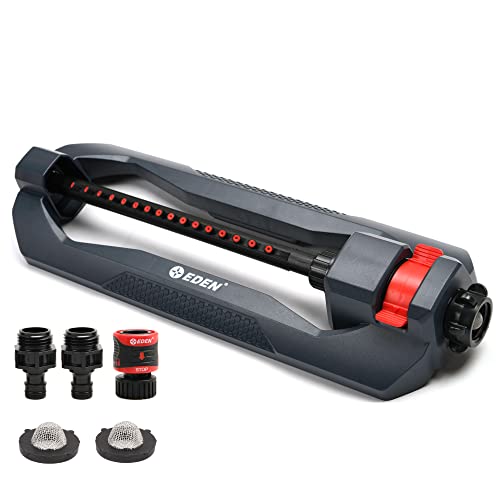
Eden 96213 Weighted Essential Oscillating Sprinkler | Covers Up to 3,600 sq. ft., 16 Precision Nozzles, Adjustable Range, Turbo Drive Motor, Quick Connect Bundle, Stainless Steel Filters, Black
- 16 PRECISION NOZZLES- Provides even, consistent watering coverage for lawns and gardens up to 3,600 sq. ft..
- ADJUSTABLE WATERING RANGE- Range sliding tabs allow easy customization of the watering area for precise coverage.
- SEALED TURBO DRIVE MOTOR- Patented turbo drive design delivers smooth operation, quiet performance, and extended gear life.
The Eden 96213 suits homeowners who want a portable sprinkler that won’t wander across the lawn. Its weighted base keeps it planted, which matters if you’ve ever watched a lightweight unit creep toward your flower beds. The 16 nozzles deliver even coverage across up to 3,600 square feet, and the range sliding tabs let you narrow the spray pattern without swapping parts. For a typical suburban front yard, this covers the whole thing in one position.
What sets this model apart is the sealed turbo drive motor. Most oscillating sprinklers use plastic gears that wear out after a season or two. Eden’s design runs quieter and lasts longer, especially if you’re pulling from well water or a hose bib with minor debris. The included quick-connect starter set is a nice touch. You get the twist-and-lock system with a water-halt feature, so you can swap tools without running back to shut off the spigot.
Here’s the honest trade-off: oscillating sprinklers lose efficiency in wind. If you live in an exposed area, the spray pattern drifts and you’ll see dry stripes. The Eden also needs decent pressure to hit its full 3,600-square-foot rating. Homes with low PSI will see reduced coverage. And while the weighted base helps, it’s not a permanent solution. You’ll still move it manually if you want to cover a larger area.
- 16 precision nozzles for even distribution
- Weighted base resists tipping and creeping
- Turbo drive motor runs quieter than gear-driven rivals
- Quick-connect bundle includes water-halt feature
- Stainless steel filters protect internal components
Best for: Homeowners with medium-sized lawns who want a durable, portable sprinkler that won’t tip over or wear out mid-season.
Hunter PGP-ADJ 3/4″ Rotor
2nd Pick

Hunter
Hunter PGP-ADJ 3/4" Rotor Lawn Sprinkler Head, 22-52 ft, 4" Pop Up, 2 Pack
- ADJUSTABLE ARC & SPRAY DISTANCE: Includes a preinstalled 3.0 GPM nozzle with an arc that adjusts from 40° to 360°, ideal for both…
- HUNTER’S ORIGINAL ROTOR: The PGP-ADJ delivers proven performance and precision, trusted by professionals and homeowners for its du…
- GEAR-DRIVEN PERFORMANCE FOR QUIET, SMOOTH ROTATION: Equipped with a water-lubricated gear drive, this 4-inch pop-up sprinkler deli…
The Hunter PGP-ADJ is the choice for anyone with an existing in-ground irrigation system. This is a 4-inch pop-up rotor head, sold as a two-pack, and it replaces standard 3/4-inch inlet rotors without modification. The adjustable arc runs from 40 to 360 degrees, so you can water a narrow strip along a driveway or a full circle in an open yard. The preinstalled 3.0 GPM nozzle throws water 22 to 52 feet, which covers most residential spacing requirements.
Hunter’s original rotor design has been the industry standard for decades. The water-lubricated gear drive runs smooth and quiet, and it resists wear better than sealed-bearing alternatives. The adjustment tool included in the box lets you set arc and radius quickly. A fast-forward feature lets you verify stopping points without cycling the whole zone. For anyone retrofitting an old system, this is about as close to plug-and-play as it gets.
Two limitations worth knowing. First, this is a head only. You need an existing system with matching 3/4-inch female NPT inlets. Second, the 3.0 GPM nozzle is a starting point. If your zone has low pressure, you may need to swap to a smaller nozzle to maintain coverage. That’s an extra purchase. And while the PGP-ADJ is reliable, it’s not the cheapest option per head. You’re paying for longevity and consistent performance.
- Adjustable arc from 40° to 360°
- Spray distance of 22 to 52 feet
- Water-lubricated gear drive for quiet operation
- Compatible with standard 3/4-inch NPT inlets
- Includes Hunter adjustment wrench
Best for: Homeowners with existing irrigation systems who need reliable replacement rotors for medium to large lawns.
Melnor MiniMax Turbo Sprinkler
3rd Pick

Melnor
Melnor MiniMax Turbo Sprinkler, 4000 Sq Ft: 360°, Flow, Width, Range Adjust
- FULL-SIZE COVERAGE IN A COMPACT DESIGN: Get the power of a full-sized oscillating sprinkler in a space-saving form—covering up to…
- PRECISION 4-WAY ADJUSTMENT: Customize your watering with independent width, range, and flow controls—plus a 360° rotating head—to…
- DIRT-RESISTANT DRIVE: Engineered for reliability, the Dirt-Resistant Drive ensures smooth, long-lasting operation even with well w…
Melnor’s MiniMax Turbo packs full-sized coverage into a compact body. It handles up to 4,000 square feet, which is more than most oscillating sprinklers twice its size. The 360-degree rotating head and four-way adjustment give you independent control over width, range, and flow. That means you can water a narrow side yard or open up the pattern for a wide backyard without changing positions. For anyone with irregular lot shapes, this flexibility saves time and water.
The dirt-resistant drive is a real advantage if you pull from a well or a older plumbing system. Debris in the water supply kills most sprinklers prematurely. Melnor’s design keeps running even when the water isn’t perfectly clean. The Flo-Thru base lets you link multiple units together, so you can expand coverage across a large yard without running separate hoses. And the limited lifetime warranty backs up the build quality.
One caveat: the MiniMax Turbo is still a portable sprinkler. It doesn’t pop up from the ground, and it won’t survive being left outside through winter. You’ll need to drain and store it before the first freeze. The compact size also means it sits lower to the ground, which can be a problem if your lawn has tall grass or uneven terrain. And while the 4,000-square-foot rating is impressive, it assumes ideal pressure. Real-world coverage will be lower on a standard hose bib.
- Covers up to 4,000 square feet
- 360° rotating head with four-way adjustment
- Dirt-resistant drive handles well water
- Flo-Thru base links multiple sprinklers
- Limited lifetime warranty
Best for: Homeowners with large or irregular lawns who want a portable sprinkler that handles well water and links with other units.
Orbit H2O-Six Gear-Drive
4th Pick

Orbit
Orbit H2O-Six Gear-Drive Sprinkler on Metal T-Spike - Customizable Lawn Watering Coverage - Multi-Pattern Rotating Head with Adjustable Spray Range - Durable Outdoor Yard Irrigation Sprinkler - 58573
- Lush Lawn Coverage: The Orbit H2O-Six Gear Drive Sprinkler delivers efficient watering for lawns and gardens with six spray patter…
- Effortless Spray Adjustments: Customize watering angles and spray distance with rotating head controls and adjustable collar tabs,…
- Precise Water Distribution: Built with a four-position spray control system that helps fine-tune watering flow for consistent cove…
The Orbit H2O-Six is a spike-mounted gear-drive sprinkler for quick setup. You push the metal T-spike into the soil, connect your hose, and you’re watering. Six spray patterns let you choose between a gentle mist for seedlings and a heavier spray for established turf. The rotating head and adjustable collar tabs give you 360-degree control over spray direction and distance. It’s a practical choice for garden beds, slopes, and areas where a portable base won’t sit level.
Gear-drive performance separates this from cheap impact sprinklers. The rotation is smooth and consistent, and the four-position spray control lets you fine-tune flow without adjusting the hose bib. The metal spike holds firm in most soils, though it can struggle in loose sand or freshly tilled ground. For a temporary setup or a supplemental watering station, the H2O-Six gets the job done without fuss.
The trade-offs are straightforward. This is not a precision tool. The spray patterns are broad, and you won’t get the even coverage of a well-tuned oscillating sprinkler. The spike can also work loose over time, especially if you bump it with a mower or step on it. And like all spike sprinklers, it’s best for spot watering rather than covering an entire lawn in one position. You’ll move it around to hit different zones.
- Six spray patterns for different plant needs
- Gear-drive rotation for smooth operation
- Metal T-spike holds in most soils
- Adjustable collar tabs control spray distance
- Four-position spray control
Best for: Gardeners who need a quick-setup sprinkler for beds, slopes, or supplemental watering in specific spots.
Melnor MiniMax Spike Sprinkler
5th Pick

Melnor
Melnor MiniMax Spike Sprinkler, 4000 Sq Ft: 360°, Flow, Width, Range Adjust
- FULL-SIZE COVERAGE– Get the power of a full-sized oscillating sprinkler in a space-compact form—covering up to 4,000 sq. ft. to ea…
- PRECISION 4 WAY ADJUSTMENT – Easily control width, range, and flow to direct water exactly where it is needed.
- DIRT RESISTANT PERFORMANCE – Designed for consistent operation, even when debris is present in the water supply.
The Melnor MiniMax Spike takes the same core design as the Turbo model and mounts it on a step spike. The metal spike inserts easily into soil and keeps the sprinkler stable during operation. Coverage matches the Turbo at 4,000 square feet, and you get the same four-way adjustment for width, range, and flow. The dirt-resistant drive handles debris just as well. If you want the MiniMax performance but need something that stays put on a slope or in a garden bed, this is the version to get.
The step spike base is the key difference. Instead of a weighted base that sits on top of the grass, the spike pushes into the soil. That keeps the sprinkler lower to the ground and reduces the chance of it tipping over in wind. The Flo-Thru base still lets you link multiple units, so you can run a chain of these across a large area. For anyone with a sloped yard or a mix of lawn and garden beds, the spike design solves a real problem.
Limitations mirror the Turbo model. It’s portable, not permanent. You’ll drain and store it for winter. The spike can be difficult to insert in hard, dry clay, and it may not hold well in very sandy soil. The compact size also means it sits low, which can be a problem if your grass is tall. And while the 4,000-square-foot rating is impressive, it assumes decent water pressure. Low-PSI homes will see reduced coverage.
- Covers up to 4,000 square feet
- Step spike base for stable placement
- Four-way adjustment for width, range, flow
- Dirt-resistant drive for well water
- Flo-Thru base links multiple sprinklers
Best for: Homeowners with sloped yards or garden beds who want the MiniMax performance in a spike-mounted design.
How We Chose These Products
I started with a list of 20 sprinkler heads across every major category: oscillating, rotor, impact, and spike-mounted. The first cut removed anything with a reputation for leaking, cracking, or failing within a single season. That eliminated most of the bargain-bin options. The second cut focused on adjustability. A sprinkler head that can’t be tuned to your yard shape wastes water and leaves dry spots. Every product on this list offers meaningful control over spray pattern, distance, or flow.
The final five earned their spots by solving different problems. The Eden handles portable watering with a stable base. The Hunter PGP-ADJ is the go-to for in-ground systems. The Melnor MiniMax models offer the best coverage-to-size ratio for portable units. The Orbit H2O-Six fills the spike-sprinkler niche for gardens and slopes. I also weighed warranty coverage, replacement part availability, and how each product handles real-world conditions like well water and low pressure. No product is perfect, but each one earns its place for a specific use case.
Buying Guide: What Really Matters
Zone coverage is the first thing to calculate. Measure your lawn’s square footage, then match it to the sprinkler’s rated coverage. But don’t stop there. Check your water pressure with a cheap gauge from a hardware store. Most homes run between 40 and 60 PSI. If you’re below 40, expect reduced coverage from any sprinkler. You may need to run fewer heads per zone or choose a model with lower GPM requirements. The best type of sprinkler for low-pressure yards is usually a rotor with adjustable nozzles.
Head-to-head spacing matters for in-ground systems. Rotor heads like the Hunter PGP-ADJ are typically spaced 30 to 50 feet apart, depending on nozzle size and pressure. Spray heads go closer, usually 10 to 15 feet. If you mix rotor and spray heads on the same zone, the spray heads will get too much water and the rotors will get too little. Keep them on separate zones. For portable sprinklers, spacing is less critical, but you still want to avoid overlapping too much. That wastes water and can cause runoff.
Soil type changes how you water. Clay soil absorbs slowly, so you need lower flow rates and longer run times. Sandy soil drains fast, so you need shorter, more frequent cycles. Loam is the easiest to work with. The Orbit H2O-Six and Melnor spike models work well for garden beds and slopes because you can position them precisely. For large lawns, the Eden oscillating sprinkler or Melnor MiniMax Turbo cover more ground per position. If you’re dealing with a very large area, check out the best sprinkler for large areas to compare higher-capacity options.
Smart controller compatibility is worth checking if you have an in-ground system. The Hunter PGP-ADJ works with standard 24-volt controllers and rain sensors. You’ll need to wire the solenoid correctly, but it’s a straightforward job. Portable sprinklers don’t integrate with smart controllers, so you’ll need a timer attachment if you want automation. Winterization is another consideration. Pop-up rotors need to be blown out with compressed air before the first freeze. Portable sprinklers should be drained and stored indoors. Spike sprinklers are the easiest to winterize since you just pull them up and bring them inside.
Our Top Recommendation
The Hunter PGP-ADJ is the best sprinkler head for most homeowners with an existing irrigation system. It’s reliable, adjustable, and built to last. The 40-to-360-degree arc covers everything from narrow strips to full circles. The 22-to-52-foot spray distance handles standard residential spacing. And the water-lubricated gear drive runs quietly for years. If you’re replacing old rotors or building a new zone, this is the head to buy.
For portable watering, the Eden 96213 is the winner. The weighted base stays put, the turbo drive motor outlasts cheap gear-driven rivals, and the 3,600-square-foot coverage handles most front yards. The quick-connect bundle is a nice bonus. If you need more coverage or have well water, the Melnor MiniMax Turbo is the better choice. It covers 4,000 square feet, handles debris, and links with other units. And if you need a spike-mounted sprinkler for gardens or slopes, the Melnor MiniMax Spike or Orbit H2O-Six both get the job done. The Orbit offers more spray patterns; the Melnor offers better coverage and a longer warranty.
Frequently Asked Questions
How do I calculate GPM per zone? Add up the GPM ratings of every head on the zone. A standard 3.0 GPM rotor like the Hunter PGP-ADJ uses 3 gallons per minute. If you have six heads on one zone, that’s 18 GPM. Check your water source’s flow rate. Most residential hose bibs deliver 10 to 15 GPM. If your zone exceeds that, you’ll need to split it into two zones or use smaller nozzles.
Can I mix rotor and spray heads on the same zone? No. Rotors and spray heads have different precipitation rates. Rotors put out less water per square foot over a longer period. Spray heads put out more water in less time. Mixing them means one type gets too much water and the other gets too little. Keep them on separate zones for even coverage.
How do I winterize a pop-up sprinkler head? Shut off the water supply, then use an air compressor to blow out the lines. Start with the zone closest to the compressor and work outward. Keep the pressure below 50 PSI to avoid damaging the heads. For portable sprinklers, drain the water and store them indoors. Spike sprinklers are the easiest: pull them up, drain them, and bring them inside.
What’s the best sprinkler head for clay soil? Clay soil absorbs water slowly, so you want a head with a lower precipitation rate. Rotor heads like the Hunter PGP-ADJ work well because they apply water gradually. Oscillating sprinklers can also work if you run them in shorter cycles. Avoid impact sprinklers on clay. They apply water too fast and cause runoff. For more tips on matching sprinklers to soil and lawn conditions, see this sprinkler buying guide.