You planted tomatoes, peppers, and squash in April. By July, half the leaves are yellow, the soil is bone dry two inches down, and you’re standing in the garden with a hose every evening like it’s a second job. Hand-watering a vegetable garden wastes time and water, and it rarely reaches the root zone where it counts.

A good drip system fixes that. It delivers water directly to the soil at a slow, steady rate. But not every kit suits every garden. A raised bed with dense plantings needs different hardware than a row of containers on a patio. Water pressure, emitter spacing, and expandability all matter more than the box photo suggests.
We tested four popular systems across real vegetable gardens and ranked them on setup, coverage, durability, and honest limitations. The Garden Grid 2×4 takes the top spot for raised beds. The PUUKU 240FT kit wins for large, custom layouts. The Carpathen kit suits beginners on a budget, and the Raindrip R567DT is the no-fuss starter option. Here’s how they compare.
Quick comparison of the four systems we recommend for vegetable gardens.
| Features | Garden Grid 2×4 | PUUKU 240FT Kit | Carpathen 100ft Kit | Raindrip R567DT |
|---|---|---|---|---|
| Best Use Case | Raised beds 2×4 ft | Large custom layouts | Up to 3 raised beds | Single vegetable row |
| Setup Time | About 1 minute | 15 minutes, no tools | 30-45 minutes | 3 easy steps |
| Emitter Type | 16 streams per square | 3 adjustable emitter types | Vortex and spray emitters | 1/2 GPH spaced 12 in. |
| Tubing Included | Pre-built grid | 240 ft total | 100 ft total | 50 ft dripline |
| Pressure Needs | Standard hose pressure | Standard hose pressure | 20-45 PSI | Standard hose pressure |
In this article
Garden Grid 2×4 | Garden…

Garden In Minutes
Garden Grid 2x4 | Garden Drip Irrigation System For Raised Beds | Pre-built | 1-Min Setup Garden Irrigation Kit; Full-Cover, No Dry Spots; US-Made; Lasts Years Longer Than Drip Kits; 22.5x44"
- WATER EVERY PLANT, NOT JUST EMITTER SPOTS: Each of the 8 squares delivers 16 streams for even, soil-level irrigation around plants…
- PRE-ASSEMBLED 1-MINUTE SETUP: Place the 2x4 Garden Grid on the soil, connect it to a garden hose, & start watering. This raised ga…
- LOW MAINTENANCE & BUILT TO LAST: No clog-prone emitters to inspect, replace, or reposition. UV-resistant LLDPE tubing, industry-be…
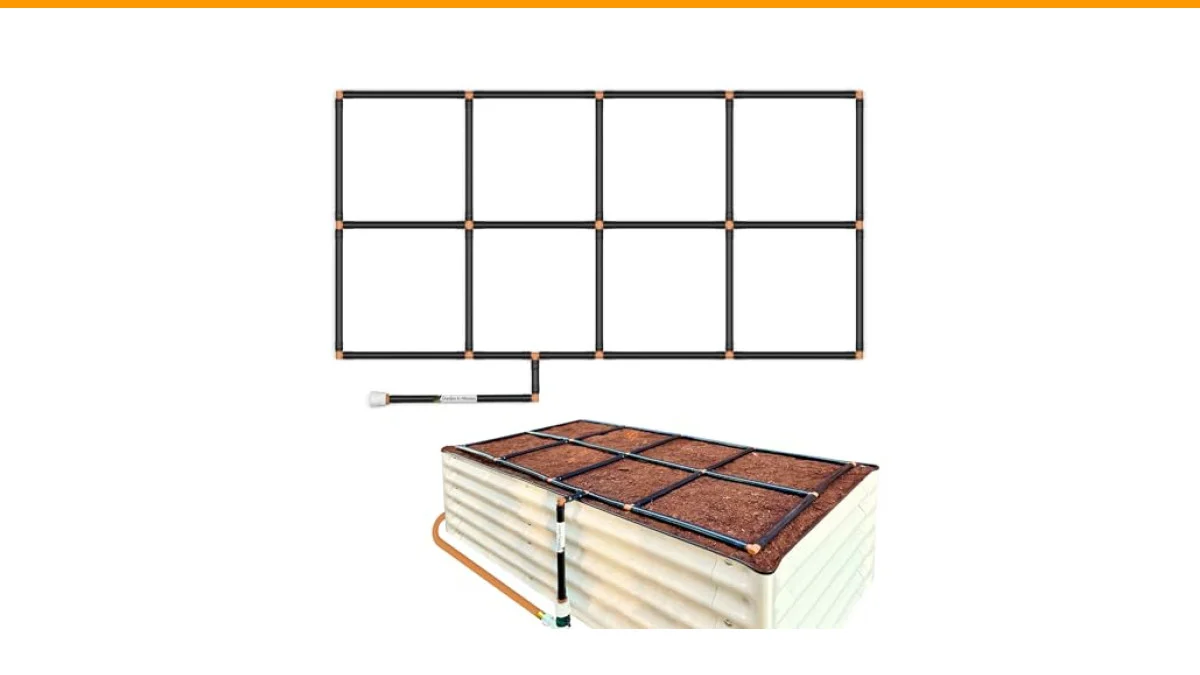
The Garden Grid is a pre-built square grid that drops into a standard 2×4 raised bed. It measures 22.5 by 44 inches, so it fits most wooden and metal beds without cutting or trimming. This is the system for someone who wants even watering without building anything.
Each of the eight squares pushes 16 streams of water into the soil. That’s 128 streams total, spaced evenly across the bed. Water lands at soil level, not on the leaves, which cuts down on fungal problems. The grid doubles as a square-foot spacing guide, so you can plant in neat squares and water the whole bed with one hose connection. No pressure reducer needed. No emitters to punch or position. Setup takes about a minute.
Here’s the catch: it only fits a 2×4 bed. If your raised bed is 4×4 or 4×8, you’ll need two or more grids. The fixed square layout also limits you if you want to grow sprawling crops like pumpkins or corn in wide rows. And the water output is uniform across the whole grid, so you can’t give more water to thirsty tomatoes and less to herbs. It’s a trade-off for the simplicity.
- Pre-assembled grid fits 2×4 raised beds
- 128 streams across eight squares for even coverage
- UV-resistant LLDPE tubing and POM fittings
- Built-in filter and no pressure reducer required
- Works with a hose timer for automatic watering
Best for: Raised-bed gardeners who want even watering with zero assembly and no emitter maintenance.
240FT Drip Irrigation Sys…

PUUKU
240FT Drip Irrigation System for Garden, 2026 Upgraded Quick-Connect Automatic Garden Watering System with 1/2" & 1/4" Tubing and Adjustable Nozzle Emitters for Greenhouse, Yard, Lawn, Raised Bed
- Efficient Drip Irrigation System:Our garden watering system delivers water directly to plant roots, minimizing evaporation and was…
- Quick-Connect Design: No tools or expertise needed! The 6-way connector and drip emitter connect directly to 1/4" irrigation tubin…
- 240FT Complete Drip Irrigation Kit: Includes 1/2" heavy-duty main tubing (supports high water pressure) and 1/4" distribution line…
The PUUKU 240FT kit is a full custom drip system in a box. It includes 1/2-inch main tubing for high pressure and 1/4-inch distribution lines for branching to individual plants. Two hundred forty feet is enough for a large raised bed setup, a greenhouse, or a long row of containers. If you want to design your own layout, this is the kit to start with.
What sets it apart is the quick-connect design. The 6-way connector and emitters push together by hand. No heating, no tools, no guessing. You can build a custom system in under 15 minutes. The kit includes three emitter types: ten stream emitters, ten vortex emitters, and eighteen misting nozzles. That variety lets you water tomatoes with a steady drip and leafy greens with a finer spray. The 1/2-inch main line handles higher pressure than thin soaker hose, so you can run longer distances without losing flow at the end.
One honest drawback: the kit doesn’t include a pressure regulator or a timer. You’ll need to buy those separately if your household water pressure runs above 45 PSI. The push-to-connect fittings also aren’t as permanent as barbed fittings. They can pop loose if you yank the tubing hard. Treat them gently during installation and they’ll hold fine.
- 240 feet of 1/2-inch and 1/4-inch tubing
- Quick-connect fittings need no tools
- Includes stream, vortex, and misting emitters
- UV-resistant and corrosion-proof materials
- Expandable as your garden grows
Best for: Gardeners with large or irregular layouts who want a flexible, expandable DIY drip system.
CARPATHEN Drip Irrigation…

CARPATHEN
CARPATHEN Drip Irrigation System Kit for Garden Watering, Sprinkler, 100 ft | For Garden, Yard, Raised Beds, Plants, Lawn, with Barbed 5/16 Mainline + 1/4 Tubing + 30 Emitters, 20-45 PSI and up to 40 GPH
- Be a Gardening Master with the help of our superior and complete Drip Irrigation Kit: 50ft flexible & durable PVC 5/16" Irrigation…
- Make your own garden irrigation system kit easier than ever: run a 3/4 connection from your water source to the watering area. Use…
- Enjoy taking care of your garden with high quality adjustable spray emitters and forget about broken irrigation sprayer stakes and…
The Carpathen 100ft kit sits in the middle ground. It includes 50 feet of 5/16-inch mainline tubing and 50 feet of 1/4-inch distribution tubing. That’s enough to cover up to three raised beds or a decent-sized in-ground vegetable patch. The kit comes with a printed instruction guide and two digital grow-your-own guides, which helps beginners avoid common mistakes.
What stands out is the emitter quality. You get ten vortex emitters and twenty spray emitters, all adjustable by rotating the cap. The drip stakes are 7.5 inches long with sharp bottoms, so they push into loose soil and stay put. The emitter heads detach for cleaning, which matters if you have hard water. The system runs best between 20 and 45 PSI. Each emitter can put out up to 60 gallons per hour, but you’ll likely run them much lower for vegetables. The couplers let you branch in four ways, two ways, or one way, so you can shape the layout to your beds.
The main limitation is the 5/16-inch mainline. It’s thinner than the 1/2-inch line on the PUUKU kit, so you can’t run as many emitters on a single zone. Carpathen recommends a maximum of 30 emitters per run. Go beyond that and the last plants in line get weak flow. The kit also doesn’t include a filter or pressure regulator, which you’ll want if your water source is gritty or high-pressure.
- 100 feet of combined 5/16-inch and 1/4-inch tubing
- Adjustable vortex and spray emitters
- Detachable emitter heads for easy cleaning
- Works with 20-45 PSI water pressure
- Includes printed and digital growing guides
Best for: Beginners with two or three raised beds who want adjustable emitters and clear instructions.
Raindrip R567DT Drip Irri…
The Raindrip R567DT is the simplest kit on this list. It’s a 50-foot roll of 1/4-inch dripline with emitters built in every 12 inches. You connect the swivel adapter to your hose, lay the line along your vegetable row, and stake it down. That’s it. Three steps, no cutting, no punching, no figuring out emitter spacing. For a single row of tomatoes or peppers, this is hard to beat.
The emitters are non-pressure-compensating and rated at 1/2 gallon per hour. They use a turbulent flow design that flushes sediment, which reduces clogging compared to cheap drippers. The kit includes ten galvanized steel hold-down stakes and one end plug. It works with standard hose pressure and doesn’t need a regulator for most setups. If you’re new to drip irrigation and want to test it on one bed before committing to a bigger system, this is the lowest-risk way to start.
But don’t expect this kit to water a whole garden. Fifty feet covers one row or a small bed. The emitters are fixed at 12-inch spacing, so you can’t adjust them for wider plant spacing or container pots. And the 1/4-inch line is the main line here, not a branch line. That means you can’t extend it indefinitely. Raindrip sells expansion parts, but the kit itself is a starter, not a full system. For a bigger garden, you’ll outgrow it fast.
- 50 feet of 1/4-inch dripline with built-in emitters
- 1/2 GPH emitters spaced every 12 inches
- Turbulent flow design resists clogging
- Includes 10 galvanized steel stakes and end plug
- Connects directly to a standard garden hose
Best for: Gardeners who want to water a single vegetable row with minimal setup and no extra parts.
How We Chose These Products
We started with the sizing math. A vegetable garden needs roughly 1 to 2 gallons per plant per week, depending on climate and soil. That means a 4×8 bed with 32 plants needs about 32 to 64 gallons weekly. We checked whether each kit could deliver that volume without pressure dropping at the end of the run. Kits with thin mainline tubing and too many emitters got marked down.
Next, we looked at real-world setup. Some kits claim 15-minute installation, but that’s only true if you don’t need to cut tubing or hunt for a missing connector. We noted which kits needed extra parts like timers, regulators, or filters. We also weighed durability. UV-resistant tubing and brass or POM fittings last longer than cheap plastic. Finally, we considered expandability. A kit that can’t grow with your garden becomes a one-season purchase.
Buying Guide: What Really Matters
Flow rate is the number most gardeners ignore. Emitters are rated in gallons per hour (GPH). A 1/2 GPH emitter puts out half a gallon every hour. For tomatoes in summer, you might run four 1/2 GPH emitters per plant for 30 minutes a day. That’s 1 gallon per plant. For lettuce, one 1/2 GPH emitter for 15 minutes is plenty. Match your emitter count and run time to the crop, not to the kit’s marketing.
Pressure matters too. Most drip systems run best between 20 and 30 PSI. Household water pressure often sits at 50 to 80 PSI. Without a pressure regulator, emitters can pop off or spray unevenly. If your kit doesn’t include one, buy a 25 PSI regulator. A filter is equally important if your water source is a well or pond. Sediment clogs emitters fast. And a timer saves you from remembering to water. Even a basic hose timer pays for itself in one season.
Emitter spacing depends on your crop. Dense plantings like carrots or radishes want emitters every 6 to 12 inches. Tomatoes and peppers do fine with emitters every 12 to 18 inches, placed near the root zone. For row crops, drip tape with 8-inch spacing works well. For containers, use micro drippers or adjustable emitters so you can tune each pot. Don’t mix drip tape and soaker hose on the same zone unless you have a pressure-compensating system. They have different flow characteristics and one will starve.
If you’re working with a tighter budget, our guide to the best drip irrigation kits under $100 covers more affordable options. For beginners who want extra hand-holding, the best drip irrigation kits for beginners breaks down installation step by step.
Our Top Recommendation
The Garden Grid 2×4 wins for most raised-bed vegetable gardeners. It eliminates the two biggest headaches: emitter spacing and clogging. You drop it in, connect a hose, and every square gets even water. Add a hose timer and you’re done for the season. It’s not cheap, and it only fits one bed size, but the time and water savings add up fast.
If you have a larger or irregular garden, the PUUKU 240FT kit is the better pick. It gives you the tubing and fittings to build a custom layout, and the quick-connect system makes changes easy. For a budget start, the Carpathen kit covers two or three beds with adjustable emitters. And for a single row, the Raindrip R567DT is the simplest, cheapest way to test drip irrigation. Pair any of these with a timer and a 25 PSI regulator for best results.
Frequently Asked Questions
How many emitters can I run on one zone? It depends on your mainline size and water pressure. A 1/2-inch mainline at 30 PSI can handle about 200 feet of 1/2 GPH emitter tubing. A 1/4-inch line maxes out around 30 emitters. If flow drops at the end of the run, split the zone in two or switch to a larger mainline.
Can I mix drip tape, soaker hose, and micro drippers on one timer? You can, but only if you use a pressure-compensating system and separate zones. Drip tape runs at low pressure, soaker hose at medium, and micro drippers at higher pressure. Putting them on the same zone means one type gets too much water and another gets too little. Use a multi-zone timer and separate valves.
How do I winterize my drip system? Drain the lines before the first freeze. Disconnect the system from the water source and open all end caps. If you have a compressor, blow air through the lines at low pressure for a minute. If not, lift the tubing and let gravity drain it. Store the filter and timer indoors. Leaving water in the lines over winter cracks emitters and fittings.
How often should I flush the system? Flush once a month during the growing season. Remove the end caps and let water run for a minute. This pushes out sediment and mineral buildup before it clogs emitters. If you have hard water, flush every two weeks and use a filter. For a deeper look at system options and maintenance, see this complete buyer’s guide to drip irrigation.
Final Verdict
Drip irrigation pays for itself in one season. You’ll use less water, spend less time holding a hose, and grow healthier vegetables because the roots get steady moisture. The Garden Grid 2×4 is our top pick for raised beds. The PUUKU 240FT kit is the best choice for custom layouts. The Carpathen kit is the budget-friendly starter, and the Raindrip R567DT is the simplest way to try drip on a single row. Whichever you choose, add a timer and a pressure regulator. Your tomatoes will thank you.