Watering a big lawn with a cheap oscillating sprinkler is a special kind of frustration. You drag the hose out, turn the tap on, and watch half the water drift into the wind while the far corner of the yard stays bone dry. Two hours later the grass looks the same as it did before you started.


A sprinkler built for large areas fixes this. The good ones throw water 30 to 40 feet, hold their position under full pressure, and let you dial the spray pattern to match the shape of your yard. The wrong one wastes hundreds of gallons a week and still leaves dry strips.
Below you’ll find five sprinklers that actually move serious water, sorted by the type of buyer they suit. There’s a rotating unit for irregular yards, two impact sprinklers for big open lawns, a tripod model for reaching over tall grass, and a compact spot sprinkler for targeted work. We also cover pressure thresholds, zone planning math, and what it costs to run each type.
Here’s a quick side-by-side of the specs that matter most before you read the full reviews.
| Features | Joeys Rotating Sprinkler | Meekamar Impact Sprinkler | Nexlogi Impact Sprinkler | Biswing Tripod Sprinkler | SYOOY Spot Sprinkler |
|---|---|---|---|---|---|
| Build Material | ABS plastic, weighted base | Zinc alloy, brass nozzle | All-metal, brass nozzle | Alloy metal tripod, metal head | Polished heavy-duty metal |
| Coverage Area | Wide rotating circle | Up to 4,500 sq ft | Up to 4,500 sq ft | 20-35 ft radius | 0-8 meter diameter |
| Spray Pattern | 360° rotating arms | 20° to 360° adjustable | 20° to 360° adjustable | Near 360° adjustable | Fixed 360° circular |
| Pressure Range | Standard household | Standard household | 20-80 PSI | 20-60 PSI | Up to 5 kg pressure |
| Best Use Case | Irregular and round yards | Large open lawns | Big lawns, low pressure | Tall grass, uneven ground | Small beds, spot watering |
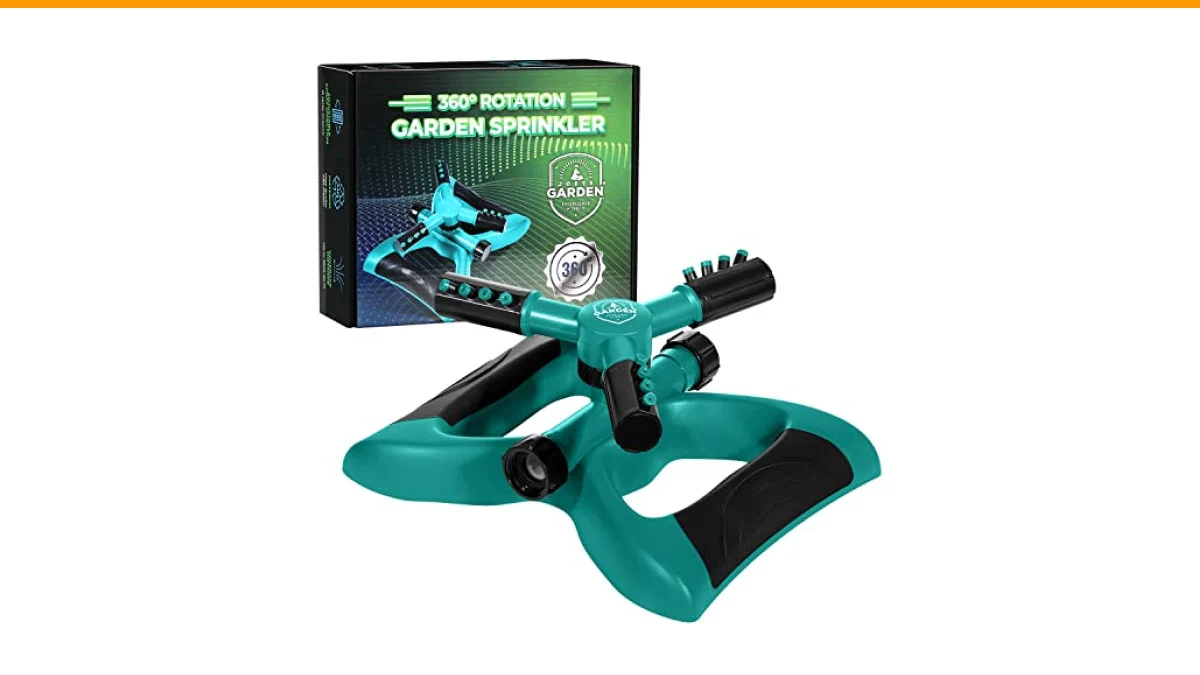
Joeys Rotating Sprinkler
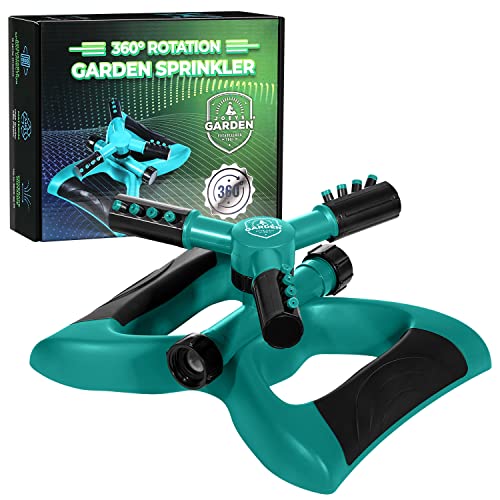
Joeys Garden
Sprinklers for Yard - 360° Rotating Lawn Sprinkler, Heavy Duty Weighted | Stays in Place with Weighted Base, 3 Adjustable Arms, Expandable Connection for Large Area, Garden Hose Compatible, Green
- MADE FOR FAMILIES & LAWNS: From a kids' backyard water day to evenly watering large lawns and gardens, this rotating sprinkler cov…
- TRUE 360° ROTATION, NOT OSCILLATING: 3 adjustable arms spin in a full circle for even coverage, unlike back-and-forth oscillating…
- BUILT TO STAY PUT, ANY YARD SIZE: Durable ABS plastic body with a weighted base holds steady on grass, patio, or gravel even at hi…
Picture a backyard with a curved garden bed on one side and a trampoline eating up the middle. A back-and-forth oscillating sprinkler can’t handle that layout. The Joeys unit spins in a true 360-degree circle, which makes it the natural pick for round yards, corner lots, and any lawn where the shape isn’t a neat rectangle.
The weighted base is the real selling point here. It’s an ABS plastic body with enough mass to stay planted on grass, gravel, or patio stone even when you crank the tap wide open. Three adjustable arms let you tweak the spray so you’re not soaking the fence or the side of the house. If you have a really big property, you can daisy-chain several of these together on one hose run and cover multiple zones in a single session.
Now the honest part. Plastic doesn’t last as long as metal if you leave it outside through winter. The arms can also get knocked out of alignment if a kid or a dog tramples it. It’s not a buy-it-once-and-forget-it item, but for the price it does its job well. You’ll be fine with this unless you want a sprinkler you can leave in the yard year-round in harsh weather.
- True 360-degree rotation, not oscillating back-and-forth
- Weighted base holds position on grass, patio, and gravel
- Screw-on hose connection works with any standard garden hose
- Multiple units can be daisy-chained for bigger coverage
- Adjustable spray arms let you avoid fences and walkways
Best for: Homeowners with irregular or round yards who want even coverage without dry strips.
Meekamar Heavy Duty Pulsating Impact Sprinkler

Meekamar
Meekamar Heavy Duty Pulsating Impact Lawn Sprinkler 360° Adjustable Rotating Automatic Water Sprinkler for Yard with Metal Base, Large Area Irrigation Sprinkle for Garden, Covers Up to 4,500 Sq. Ft
- New color, upgrade brass nozzle, 8.86 x 7.87 x 5.12 inches.
- Heavy-duty Anti-tip Metal Base: Crafted from high-grade zinc alloy, both the impact head and heavy-duty base deliver superior stre…
- Easy To Use: Simply attach your garden hose to the lawn sprinkler hose connector supplied and turn on the faucet. As the water pre…
If you’ve got half an acre of open lawn and a standard household tap, this is the kind of sprinkler you want. Impact sprinklers work differently from rotating or oscillating models. A single pulsating arm smacks the water stream and throws it in a long, even arc. That design handles wind better and throws farther than most gear-drive units at the same pressure.
Meekamar built this one with a zinc alloy base and head plus an upgraded brass nozzle. The metal construction matters for two reasons. First, it won’t crack after a season of UV exposure like plastic. Second, the weighted base resists tipping even when you’re running high pressure. The adjustable radius lets you go from a narrow 20-degree arc for a garden bed to a full 360-degree sweep for the whole lawn. Coverage tops out around 4,500 square feet, which is roughly a 38-foot radius.
The trade-off with impact sprinklers is noise. That pulsating arm makes a rhythmic thwack-thwack sound that some people find soothing and others find annoying at 6 AM. The other thing to know is that impact sprinklers need decent pressure to throw their full distance. If your tap runs below 30 PSI, you’ll get a smaller circle than the spec sheet suggests.
- Zinc alloy base and head resist rust and weather damage
- Upgraded brass nozzle for a tighter, farther spray
- Adjustable arc from 20 to 360 degrees
- Fits standard 3/4-inch thread garden hoses
- Rubber gasket filter washer prevents leaks and clogs
Best for: Large open lawns with decent household water pressure and a need for long throw distance.
Nexlogi Heavy Duty Pulsating Impact Sprinkler
Here’s the pick for the person who’s tired of replacing plastic sprinklers every spring. Nexlogi went all-metal on this one, from the brass nozzle to the zinc alloy base and head. That combination resists rust, corrosion, and the kind of cracking that kills cheap sprinklers after one hard freeze.
The performance numbers are where this unit separates itself. It’s rated for 20 to 80 PSI, which is a wider window than most competitors. That means it still throws a usable pattern on low-pressure systems where other sprinklers just dribble. At the top end, it covers up to 4,500 square feet. You can dial the arc anywhere from a 20-degree partial section to a full 360-degree rotation, so it adapts to whatever shape your yard happens to be.
One thing to keep in mind: all-metal construction makes this heavier than plastic alternatives. That’s good for stability but annoying if you’re moving it between zones every day. The brass nozzle also needs occasional cleaning if your water supply has high mineral content. It’s not a dealbreaker, just part of owning a metal sprinkler.
- All-metal build with brass nozzle and zinc alloy base
- Works across a 20-80 PSI pressure range
- Adjustable spray from gentle mist to powerful jet
- Maximum coverage of 4,500 square feet
- Universal 3/4-inch hose connection with filter washer
Best for: Buyers who want a metal sprinkler that performs well even on lower-pressure water systems.
Biswing Impact Sprinkler on Tripod
Tall grass, uneven ground, and sloped lawns create a problem for ground-level sprinklers. The spray hits the grass blades right in front of the unit and never reaches the back of the yard. The Biswing tripod solves this by lifting the sprinkler head 16 to 37 inches off the ground. Water arcs over the tall stuff and lands where you actually need it.
The quick-release leg clips let you adjust the height without tools, and the flip locks hold everything steady once you’ve set it. A gooseneck hose connector makes hooking up the hose easier than wrestling with a straight connector at ground level. There’s also a rubber filter O-ring in the connector that catches sand and gravel before it reaches the nozzle, which cuts down on clogging. The impact head rotates nearly 360 degrees, and you can adjust both the spray range and the arc.
The tripod design has one drawback: stability on windy days. A tall tripod catches more wind than a ground-level sprinkler, and a strong gust can knock the whole thing over. You’ll want to stake the legs or position it in a sheltered spot if your yard is exposed. Also, the 2-pack means you’re buying two units whether you need them or not.
- Adjustable tripod height from 16 to 37 inches
- Quick-release leg clips and flip locks for tool-free setup
- Gooseneck hose connector with sand and gravel filter
- Impact head rotates nearly 360 degrees
- Works on 20-60 PSI with a 20-35 foot radius
Best for: Lawns with tall grass, slopes, or uneven ground where a ground-level sprinkler can’t reach.
SYOOY 360 Degree Metal Spot Sprinkler

SYOOY
360 Degree Metal Spot Sprinkler,Small Sprinkler Garden for Small Areas | Lawn Sprinklers for Yard Circle Pattern with Gentle Water Flow Garden Watering (1, Yellow)
- 360 Degree Metal Spot Sprinkler: Small sprinkler is made of heavy-duty metal with bright colors, the surface of the garden sprinkl…
- 30FT Coverage Watering: Sprinklers for yard the distance of water jet is related to the size of water pressure. Small water pressu…
- Easy to Use: The lawn sprinkler circular pattern design enables 360-degree spray without leaks. Even spray, water-saving design, e…
Not every watering job needs 4,500 square feet of coverage. Sometimes you just want to soak a flower bed, a newly seeded patch, or a row of shrubs without drowning the rest of the yard. The SYOOY spot sprinkler is a small metal unit that sprays in a fixed 360-degree circle with a diameter of up to 8 meters, depending on your water pressure.
The polished heavy-duty metal body feels more substantial than the plastic spot sprinklers you see at big-box stores. It handles up to 5 kg of pressure, which is plenty for a standard garden hose. The circular spray pattern is even and water-saving, so you’re not wasting gallons on the sidewalk. It also works for roof cooling and pool misting, which is a nice bonus if you live somewhere with brutal summers.
Let’s be clear about what this isn’t. It won’t cover a large lawn. The 8-meter diameter is the maximum, and that’s at full pressure. On a weak tap, you’ll get a much smaller circle. For a big yard, this is a supplemental tool, not a primary sprinkler. For small beds and targeted watering, it’s hard to beat.
- Heavy-duty polished metal body with bright finish
- Fixed 360-degree circular spray pattern
- Coverage diameter of 0 to 8 meters depending on pressure
- Withstands up to 5 kg of water pressure
- Fits standard garden hose threads
Best for: Gardeners who need a durable spot sprinkler for beds, seedlings, and small targeted areas.
How We Chose These Products
We started with the specs that actually affect performance on a large lawn: throw distance, coverage area, pressure range, and build material. A sprinkler that claims 4,500 square feet but needs 60 PSI to get there isn’t useful for someone on a standard household tap. We prioritized units that perform across a realistic pressure range.
Durability was the second filter. Plastic sprinklers can work fine for a season or two, but metal units with brass nozzles and weighted bases last longer and hold their position better under pressure. We also looked at whether each sprinkler could be adjusted to avoid overspray onto fences, driveways, and sidewalks. That’s a feature that saves water and prevents a muddy mess.
Finally, we considered how each sprinkler fits into a real watering routine. Can you daisy-chain multiple units? Does the tripod height help on uneven ground? Is the spot sprinkler useful for targeted work? Each pick here solves a different problem, so you can match the tool to your yard instead of guessing.
Buying Guide: What Really Matters
Water pressure is the number one factor. Most household taps deliver between 40 and 60 PSI, but that drops when you run a long hose or split the line. Impact sprinklers need at least 30 PSI to throw their rated distance. Rotating and oscillating models can work at lower pressure but cover less ground. If your pressure is below 30 PSI, look for a sprinkler rated for low-pressure operation, like the Nexlogi unit that works down to 20 PSI.
Coverage area claims are usually measured at ideal pressure and zero wind. Real-world coverage is smaller. A sprinkler rated for 4,500 square feet might cover 3,000 square feet on a breezy day. Plan for overlap between passes to avoid dry spots. Wind drift is the silent killer of even watering. If you live in a windy area, impact sprinklers handle it better than oscillating models because they throw a heavier droplet stream.
Material matters more than most buyers realize. Plastic sprinklers are lighter and cheaper, but they crack in freezing temperatures and degrade under UV light. Metal sprinklers with brass nozzles cost more upfront but last several seasons longer. If you leave your sprinkler outside year-round, metal is the smarter investment. If you bring it in after every use, plastic can work fine.
Don’t overlook the connection type. Most sprinklers fit standard 3/4-inch garden hose threads, but some use quick-connect fittings. Check what your hose uses before you buy. A rubber gasket filter washer is a small feature that makes a big difference. It catches sand and grit before it reaches the nozzle, which prevents clogs and keeps the spray pattern even.
For more on building a complete watering system, see our guide to the best drip irrigation system for large gardens. And if you’re managing leaves and debris alongside watering, a mulching blade for large yards can help keep your lawn healthy between waterings.
Zone Planning: How Many Sprinklers for Your Yard
A single sprinkler rarely covers a large lawn evenly. The math is straightforward. If your yard is 5,000 square feet and your sprinkler covers 4,500 square feet at ideal pressure, you still need overlap to avoid dry edges. In practice, one sprinkler handles about 2,500 to 3,000 square feet of real coverage. For a 5,000 square foot lawn, plan on two sprinklers running in sequence or daisy-chained.
For 10,000 square feet or more, you’re looking at three to four sprinklers, or a zone system with a timer. Running multiple sprinklers at once drops the pressure at each head, which reduces throw distance. The better approach is to run them in sequence: water one zone, move the sprinkler, water the next. It takes longer but delivers more even coverage.
If you want to automate the process, a smart controller or timer can handle the scheduling. Pair it with a lawn sprinkler for large areas that has a stable base and adjustable arc, and you can set it to run before sunrise when evaporation is lowest. That alone can cut your water usage by 20 to 30 percent.
Cost to Run and Water Usage
A standard impact sprinkler uses about 3 to 5 gallons per minute. Running one for an hour uses 180 to 300 gallons. At an average U.S. water cost of $0.004 per gallon, that’s roughly $0.72 to $1.20 per hour. For a 5,000 square foot lawn that needs about an inch of water per week, you’re looking at two to three hours of runtime, or about $2 to $3.50 per week.
Oscillating sprinklers often use more water because they spray a finer mist that evaporates before it hits the ground. Impact sprinklers throw heavier droplets that resist wind drift and evaporation. That’s one reason they’re the better choice for large areas. The upfront cost is similar, but the long-term water savings add up.
If you’re on a well, the cost calculation changes. You’re paying for electricity to run the pump, not for the water itself. In that case, the priority shifts to even coverage and runtime. A sprinkler that covers more ground per pass saves you pump hours and electricity.
Setup, Maintenance, and Winterizing
Setup is simple for all five sprinklers. Screw the hose onto the connector, turn the tap on, and adjust the spray pattern. No tools required. The tripod model takes an extra minute to extend the legs and lock them in place. The rotating and impact sprinklers sit on the ground and stay put thanks to their weighted bases.
Maintenance is mostly about keeping the nozzle clean. Minerals in hard water build up on brass nozzles and reduce spray distance. Soak the nozzle in white vinegar for an hour or two every few months to dissolve the deposits. The rubber filter washers on the Meekamar and Nexlogi models catch most debris before it reaches the nozzle, which cuts down on how often you need to clean.
Winterizing is critical for metal sprinklers. Water left inside the body can freeze and crack the housing. Drain the sprinkler completely after the last fall watering, and store it indoors if possible. Plastic sprinklers are more forgiving but still benefit from indoor storage. If you leave any sprinkler outside through a hard freeze, expect a shorter lifespan.
For more tips on maintaining a large property, check out our recommendations for the best garden dump cart for hauling tools and debris.
Frequently Asked Questions
What PSI do I need for an impact sprinkler to cover 4,500 square feet?
Most impact sprinklers need at least 40 PSI to reach their maximum coverage area. At 30 PSI, you’ll get about 70 percent of the rated distance. The Nexlogi model works down to 20 PSI, but expect a smaller circle at that pressure. Check your tap pressure with an inexpensive gauge before you buy if you’re unsure.
Can I run two sprinklers at the same time on one hose?
You can, but both will lose pressure. The water splits between them, so each sprinkler throws a shorter distance. For large lawns, it’s better to run them in sequence. Water one zone, then move the sprinkler to the next zone. It takes longer but delivers more even coverage and wastes less water.
How do I stop a sprinkler from leaving dry spots in my lawn?
Overlap is the answer. Set your sprinkler so the edge of its spray pattern reaches the center of the previous pass. For impact sprinklers, adjust the arc so it covers a full 360 degrees and let it run through a complete rotation before moving it. Wind is the other factor. Water early in the morning when wind is calmest.
Is a metal sprinkler worth the extra cost over plastic?
Yes, if you plan to leave it outside or use it for multiple seasons. Metal sprinklers with brass nozzles resist rust, UV damage, and freezing better than plastic. They also hold their position under high pressure. Plastic sprinklers are lighter and cheaper, but they crack after a hard freeze and degrade in sunlight. For a large lawn, metal is the better long-term investment.
Our Top Recommendation
The Nexlogi Heavy Duty Pulsating Impact Sprinkler takes the top spot for large lawns. Its all-metal build, 20-80 PSI operating range, and 4,500 square foot coverage make it the most versatile pick here. It handles low-pressure systems better than most competitors and holds up to harsh weather without cracking or rusting. The adjustable arc lets you match the spray to your yard shape, and the brass nozzle delivers a consistent pattern that resists wind drift.
If you’re on a tighter budget, the Joeys Rotating Sprinkler is a solid alternative for irregular or round yards. The weighted base and true 360-degree rotation make it easy to set up and forget. Just bring it inside before winter.
For lawns with tall grass or uneven ground, the Biswing Tripod Sprinkler is the practical choice. The adjustable height lifts the spray above the grass so water reaches the back of the yard. And if you just need to water a flower bed or a newly seeded patch, the SYOOY Spot Sprinkler is a durable, no-fuss option that won’t waste water on the rest of the lawn.