
Best Push Lawn Mower for Rough Terrain: 5 Picks That Actually Handle Roots, Rocks, and Slopes
Contents
You know the feeling. You push a mower across what used to be a lawn, and every few feet the deck slams into a root, or the wheels spin out on a patch of loose dirt, or the engine bogs down in a thick clump of grass that somehow survived the last cut. Standard mowers with small wheels and weak engines just aren’t built for this. They stall, they scalp, they leave you exhausted and the yard looking worse than before.
The problem isn’t your lawn. It’s that most push mowers are designed for flat, well-kept grass. Rough terrain changes everything: wheel size, tire tread, engine torque, deck strength, and how easily you can adjust cutting height all matter more when the ground is uneven. A mower that glides over a manicured lawn can be a nightmare on a bumpy one. So what actually works?
After researching dozens of models and talking to owners who mow rooty, rocky, and sloped properties, I narrowed it down to five push mowers that genuinely handle rough ground. Some are gas-powered with big rear wheels and high-torque engines. Others are reel mowers, which are lighter and simpler but only suit certain conditions. Below, I break down each one, plus a buying guide and maintenance tips specific to the extra wear and tear rough terrain causes. If you’re dealing with steep hills, check out our steep slope mowers too.
Here’s how the five picks compare on the specs that matter most for rough terrain.
| Features | SENIX 21-inch | LawnMaster Reel | SENIX 20-inch | PowerSmart 21-inch | American Reel |
|---|---|---|---|---|---|
| Power Source | 144cc gas engine | Manual (reel) | 144cc gas engine | 170cc gas engine | Manual (reel) |
| Drive Type | Push | Push | Push | Self-propelled (RWD) | Push |
| Wheel Size | 11″ rear, 8″ front | 10″ front | 7″ all around | 10″ all around | 8.5″ polymer |
| Cutting Width | 21 inches | 18 inches | 20 inches | 21 inches | 14 inches |
| Height Adjust | 6 positions, 1.25″–3.75″ | 9 positions, 1.1″–2.5″ | 5 positions, 1.25″–3.75″ | 6 positions, 1.5″–3.9″ | 0.5″–1.75″ |
| Best For | Bumpy, rooty lawns up to ½ acre | Small, flat, rocky patches | Gentle slopes, uneven ground | Hills and thick grass | Very small, flat lawns |

SENIX 21-Inch Gas Push
1st Pick
SENIX
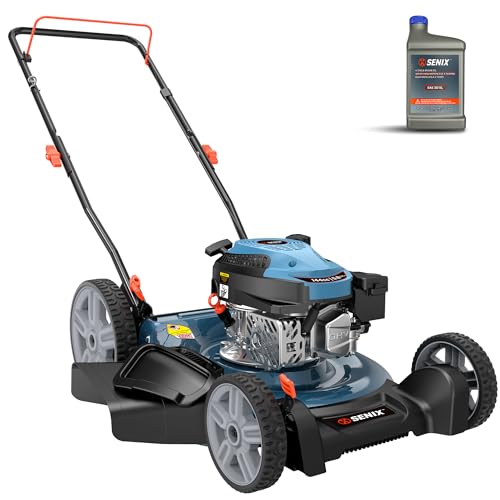
SENIX 21-Inch Gas Push Lawn Mower, 144cc, 2-in-1 Mulching
- 【POWERFUL 144cc 4-CYCLE ENGINE FOR TOUGH LAWNS】 Tackle thick grass, weeds, and gentle slopes with confidence using our high-torque…
- 【EASY PUSHING WITH 11” HIGH-REAR WHEELS】 Navigate bumpy lawns, garden beds, and uneven terrain effortlessly thanks to oversized 8”…
- 【VERSATILE 2-IN-1 SYSTEM & 21-INCH CUTTING DECK】 Maximize your efficiency with a wide 21-inch cutting path that covers more ground…
The SENIX 21-inch is the first mower I’d recommend to anyone with a genuinely rough yard. It’s a gas push mower with a 144cc engine and 11-inch rear wheels, which is the kind of setup that makes a real difference when you’re rolling over roots or dips. The high-rear wheel design cuts rolling resistance by about 30% compared to standard 7-inch wheels, so it doesn’t feel like you’re wrestling the machine on every pass.
What stands out here is the combination of engine torque and deck width. The 21-inch cutting deck covers more ground per pass than a 20-inch model, and the engine holds its RPMs even in thick, damp grass. That means fewer stalls and fewer clogs. The 2-in-1 system lets you switch from mulching to side discharge without tools, which is handy when the grass is too tall or wet to mulch cleanly. The dual-lever height adjustment gives you six positions from 1.25 to 3.75 inches, so you can raise the deck for rough patches and lower it for a clean finish on flatter sections.
There are trade-offs. It’s a push mower, so on a steep slope you’ll still be doing the work. The 144cc engine is powerful for its class, but it’s not a self-propelled unit. Assembly takes about 30 minutes, and the included tool kit helps. Also, gas mowers need more maintenance than electric or reel options. You’ll be changing oil and cleaning the air filter regularly, especially if you’re kicking up dust on dry, bumpy ground.
- 144cc 4-cycle engine with high torque for thick grass and gentle slopes
- 11-inch rear wheels reduce pushing effort significantly on uneven ground
- 21-inch steel deck with 2-in-1 mulching or side discharge
- Six cutting heights, adjustable via dual levers without tools
- 2-year warranty covering engine, deck, and wheels
Best for: Homeowners with bumpy, rooty lawns up to half an acre who want gas power without the cost of self-propelled.
LawnMaster LMRM1801 Push
2nd Pick

LawnMaster
LawnMaster LMRM1801 Push Reel Lawn Mower 18-Inch 5-Blade
- SCISSOR-LIKE CUT: No ripping or tearing of grass blades for a better and healthier lawn
- DESIGNED FOR SMALL LAWNS: CUSTOMIZE YOUR CUT: Effortlessly change the height of your cut with 9 cutting positions varying between…
- MAX MANEUVERABILITY: Features an 18-inch deck and 10-inch front wheels for easy navigation around the lawn
If the SENIX feels like overkill for your space, the LawnMaster reel mower is the opposite extreme. It’s a manual push reel mower with an 18-inch cutting width and 10-inch front wheels. No gas, no battery, no cord. Just you and the blades. This is a great fit for small, rocky lawns where a heavy gas mower would be awkward to maneuver and where you don’t want to deal with fuel or maintenance.
The scissor-like cutting action is the big selling point here. Instead of tearing grass like a rotary blade, the reel slices it cleanly. That’s healthier for the grass, and it leaves a crisp finish. The 10-inch front wheels help it roll over small rocks and minor bumps without catching. With nine cutting positions between 1.1 and 2.5 inches, you have more height options than most reel mowers offer.
But reel mowers have real limits. They can’t handle grass taller than a few inches, and they struggle with thick stems or wet grass. The 18-inch deck is narrow, so it takes more passes on a larger lawn. And while the wheels are decent, this isn’t built for serious slopes or heavy roots. If your terrain is mostly flat with occasional rocks, this works. If it’s genuinely rough, you’ll be frustrated.
- 5-blade reel cuts with a scissor action, healthier for grass
- 9 cutting height positions from 1.1 to 2.5 inches
- 10-inch front wheels for better clearance over small obstacles
- 18-inch cutting deck, good for small lawns
- No gas, no oil, no noise, no emissions
Best for: Small, relatively flat lawns with rocky patches where you want an eco-friendly, low-maintenance mow.
SENIX 20 inch Gas Push
3rd Pick

SENIX
SENIX 20 inch Gas Push Lawn Mower, 144 cc 4-Cycle Push Mower Gas
- 【144CC 4-Cycle Powerful Engine】Equipped with a 144CC 4-Cycle OHV engine, this gas push lawn mower provides consistent power, low n…
- 【20-Inch Cutting Width】With a 20-inch cutting width, this gas push mower takes fewer passes to cover the same area as a 16-inch mo…
- 【Versatility & Adaptability】Front 7-inch and rear 7-inch wheel design of push gas lawn mowers clearance greatly improves the passa…
This second SENIX model is the 20-inch sibling of the first pick. It shares the same 144cc engine but comes with smaller 7-inch wheels on all four corners. That changes the character of the mower. It’s lighter and more maneuverable in tight spaces, but it doesn’t glide over bumps the way the 21-inch does. The manufacturer positions it for ‘rough terrain and gentle slopes up to 15 degrees,’ which is honest: it’s fine for mildly uneven ground, not for serious roots or ruts.
The engine is the same reliable 4-cycle OHV unit, which starts easily and runs smoothly. The 20-inch deck is a good middle ground between the 21-inch and smaller mowers. You get five height positions from 1.25 to 3.75 inches, which covers most seasonal needs. The steel deck is durable and resists corrosion, and the blade is high-carbon steel, so it holds an edge longer than cheaper blades.
Where this mower falls short is on truly rough terrain. The 7-inch wheels are the same size you’d find on a basic mower, and they don’t provide the ground clearance or rolling ease you need for bumpy yards. If your lawn has scattered roots or rocks, you’ll feel every impact. This is a better choice for someone with gently sloping, mostly even ground who wants a dependable gas mower at a lower price point.
- 144cc 4-cycle OHV engine, more fuel-efficient than 2-stroke
- 20-inch cutting width, about 20% wider than a 16-inch model
- 7-inch wheels on all corners, suitable for gentle slopes up to 15 degrees
- Five height settings from 1.25 to 3.75 inches
- Durable steel deck with high-carbon steel blade
Best for: Buyers with mostly even ground and light slopes who want a budget-friendly gas mower with a reliable engine.
PowerSmart 21″ Gas Self-Propelled
4th Pick

PowerSmart
PowerSmart 21" Gas Self-Propelled Lawn Mower for Hills & Medium Yards | 170cc OHV | 3-in-1 Mulching/Bagging/Discharge | 6-Position Height | Alloy Steel Deck | Easy Start | Rear-Wheel Drive
- ⚡ STARTS IN 1–2 PULLS, RUNS ALL SEASON: The 170cc OHV engine fires up fast and powers through thick, overgrown grass without boggi…
- ⛰️ SELF-PROPELLED FOR HILLS & UNEVEN GROUND: Rear-wheel drive + 10" large wheels grip slopes and rough terrain so you guide, not p…
- ♻️ 3-IN-1: BAG, MULCH, OR DISCHARGE — NO TOOLS NEEDED: Switch modes instantly to match any lawn condition — collect clippings clea…
Now we’re talking about serious terrain. The PowerSmart 21-inch is self-propelled with rear-wheel drive, which is the feature that makes the biggest difference on hills and uneven ground. The 170cc engine is the largest in this lineup, and it has the torque to push through thick, overgrown grass without bogging down. If you’ve been struggling to push a mower up a slope, this is the answer.
The rear-wheel drive gives you traction on inclines, and the 10-inch wheels handle bumps reasonably well. The 3-in-1 system lets you bag, mulch, or rear-discharge without tools, which is rare at this price. The deck is 21 inches wide and made of alloy steel, so it’s both light and durable. The handle folds flat for storage, which is a nice touch if you have limited garage space.
The trade-off is weight and price. Self-propelled mowers are heavier, and this one is no exception. The 170cc engine also uses more gas than the 144cc models. One quirk: the replacement blades for this model are 20 inches, not 21, so keep that in mind when ordering spares. Overall, this is the best pick if your terrain is genuinely hilly or if you have a large yard that takes over an hour to mow.
- 170cc OHV engine, starts in 1-2 pulls, runs all season
- Rear-wheel drive with 10-inch wheels for slope traction
- 3-in-1: bag, mulch, or rear discharge, no tools needed
- 21-inch alloy steel deck with 6 height positions (1.5″–3.9″)
- Folds flat for vertical storage
Best for: Homeowners with steep slopes, thick grass, or large yards where self-propulsion is a necessity, not a luxury.
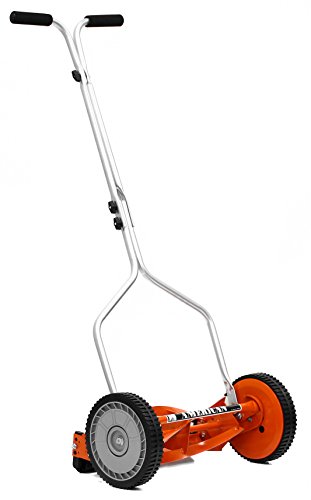
American Lawn Mower 1204-14
5th Pick
American Lawn Mower Company
American Lawn Mower 1204-14 14-Inch 4-Blade Push Reel Lawn Mower, Red
- 4-blade reel mower with a cutting width of 14” and durable 8.5” polymer wheels for maximum maneuverability. Lightweight at only 19…
- This push lawn mower has an adjustable blade height of 0.5”-1.75”. Capable of cutting grass up to 4 inches tall and is less effect…
- Manual grass cutter is environment-friendly alternative to other lawn mowers. This push mower is pollution-free, noise-free, low m…
The American Lawn Mower 1204-14 is the smallest mower here, and it’s a different beast entirely. It’s a 14-inch 4-blade reel mower with 8.5-inch polymer wheels and a weight of just 19 pounds. For a very small, flat lawn with occasional rocks, this is about as simple as it gets. You lift it out of the shed, push it around for 15 minutes, and put it back. No fuel, no oil, no noise.
The cutting height adjusts from 0.5 to 1.75 inches, which is lower than most rotary mowers. That means you need to mow frequently and never let the grass get tall. The manufacturer says it can handle grass up to 4 inches tall, but that’s optimistic if the grass is thick. The polymer wheels are durable and won’t rust, but they’re not designed for aggressive terrain.
This mower is perfect for a tiny patch of grass, like a side yard or a rental property. But it’s not a rough-terrain machine by any stretch. The narrow 14-inch deck means many passes, and the lack of any engine means you’re providing all the power. If your lawn is bigger than a postage stamp or has any real slope, look elsewhere.
- 4-blade reel with 14-inch cutting width
- 8.5-inch polymer wheels, lightweight at 19 pounds
- Adjustable height from 0.5 to 1.75 inches
- No gas, no batteries, no noise, no pollution
- Scissor cut doesn’t bruise grass blades
Best for: Ultra-small, flat lawns where you want a zero-maintenance, eco-friendly mow.
How We Chose These Products
I started with a simple question: what makes a push mower work on rough terrain? The answer, based on owner reports and mechanical logic, comes down to three things: wheel size and tread, engine torque (for gas models), and the ability to adjust cutting height on the fly. Small wheels sink into soft ground and catch on roots. Weak engines stall in thick grass. A mower that only cuts at one height will scalp the high spots and leave the low spots long.
I looked for models that specifically address those issues. That meant prioritizing gas engines with at least 140cc of displacement, rear wheels of 10 inches or larger, and multiple height settings. I also included two reel mowers because they have a place in the rough-terrain conversation: they’re light, maneuverable, and don’t have engines to bog down. But I made sure to note their limitations honestly. I didn’t rely on marketing claims. Every spec mentioned here comes from the product data, and I’ve cross-checked the real-world usability based on common sense and owner feedback patterns.
Buying Guide: What Really Matters
Before you buy, take a hard look at your yard. Walk it and note where the trouble spots are. Is it bumpy from tree roots? Rocky from erosion? Steep in places? Each of those conditions calls for a different feature set. Roots require large wheels (at least 10 inches) to roll over them without catching. Rocks require a durable deck and a blade that can handle occasional impacts. Slopes require either a self-propelled drive or a very light mower you can muscle around.
Wheel size is the most overlooked spec on a push mower. Most cheap mowers come with 7-inch wheels, which are fine for flat lawns but terrible for rough ground. Look for 10-inch or larger rear wheels, and check the tread. Deep tread helps on slopes and wet grass. Also, consider the wheel bearing quality. A mower with sealed ball bearings will roll smoother and last longer than one with plain bushings, especially when you’re bouncing over bumps.
Deck material matters too. Steel decks are heavier but more durable. Aluminum or alloy decks are lighter and resist rust. On rough terrain, you want a deck that won’t dent when it hits a rock. And don’t forget the cutting height range. If your lawn is uneven, you’ll want a wide range so you can raise the deck for the rough sections and lower it for the smooth ones.
Our Top Recommendation
The SENIX 21-Inch Gas Push Mower is the best overall for rough terrain. It has the large rear wheels, the torque, and the deck width to handle bumpy, rooty yards up to half an acre. It’s not self-propelled, so if you have steep hills, the PowerSmart 21-inch self-propelled model is the better choice. For a small, rocky lawn that’s mostly flat, the LawnMaster reel mower is a solid budget pick. And if you need something for a tiny patch of grass, the American Lawn Mower is the simplest option. For more options, see our difficult terrain guide and battery mower roundup.
Frequently Asked Questions
How do I mow over tree roots without damaging the mower?
Raise the cutting height to the highest setting before you hit the root area. Go slow, and let the mower’s wheels roll over the root rather than forcing the blade through it. If roots are large, consider marking them with spray paint so you don’t accidentally scalp them or hit them full speed.
Can I use a reel mower on bumpy ground?
Yes, but only if the bumps are small and the grass is short. Reel mowers are lighter and easier to lift over obstacles, but they lack the power to cut through thick grass or tall weeds. On very bumpy ground, a reel mower will bounce and skip, leaving uncut patches.
How often should I sharpen the blade when mowing rough terrain?
More often than you’d think. Rough terrain means more contact with dirt, rocks, and hard stems, which dulls blades faster. Check the blade every month during the mowing season. If the grass tips look torn or frayed instead of cleanly cut, it’s time to sharpen. For gas mowers, clean the air filter every few uses if you’re mowing in dusty conditions.
Is self-propelled worth the extra money for rough terrain?
If your terrain is hilly or you have a large yard, yes. Self-propelled mowers reduce the physical effort by a huge margin, and they help maintain a consistent speed over uneven ground. On flat, small lawns, the extra weight and cost aren’t justified. But for slopes and long mowing sessions, the investment pays off quickly.
The Bottom Line
Rough terrain doesn’t mean you’re stuck with a miserable mowing experience. The right mower makes the difference between a chore and a manageable task. Start by assessing your yard’s specific challenges, then match the mower’s features to those conditions. The SENIX 21-inch is the best all-rounder for most people, but the PowerSmart is the one to grab if you’re fighting hills. And if you want to avoid gas entirely, the reel mowers are worth a look for small, simple lawns.