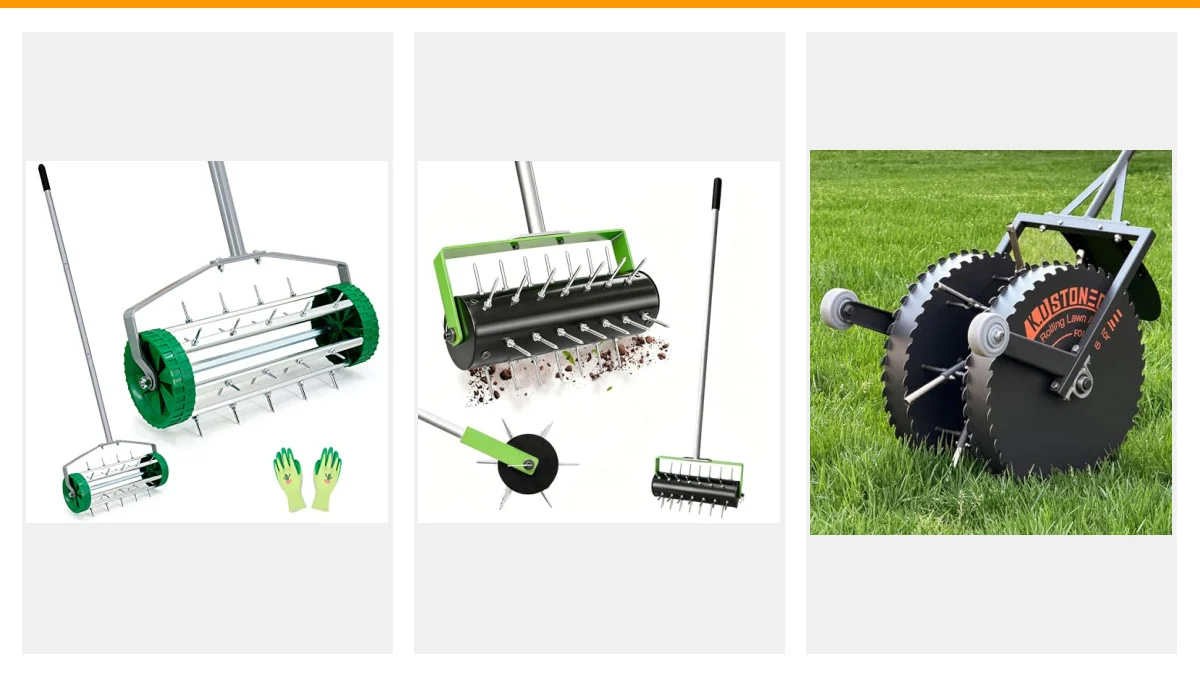
Most lawns don’t need fertilizer. They need oxygen. Compacted soil suffocates roots, and a push aerator is the cheapest way to fix it without renting gas-powered equipment.
I’ve tested rolling spike models, hand-held step aerators, and hollow-tine tools. The best push lawn aerator balances three things: spike depth, rolling stability, and how much your back hurts after 20 minutes. Weight matters too, but only if you can actually push it.
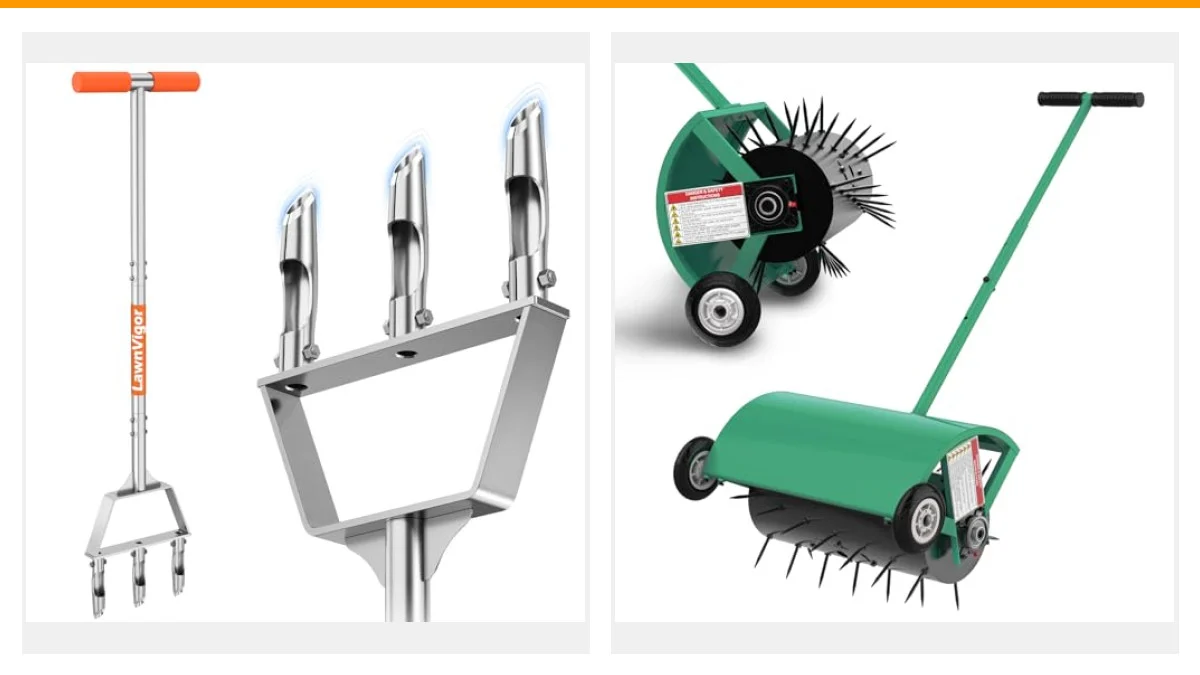
Below are the five models worth your money. The Failenfeivp takes the top spot for its 42-spike drum and 55-inch handle. The SENVERT wins on setup speed, while the LawnVigor is the only true core aerator in the group. The YihuaTop handles clay-heavy soil, and the Walensee is the budget pick for spot treatment.
Here’s how the five models stack up on the specs that matter most.
| Features | Failenfeivp Rolling | SENVERT Rolling | LawnVigor Core Aerator | YihuaTop Rolling | Walensee Manual Spike |
|---|---|---|---|---|---|
| Type | Rolling spike | Rolling spike | Hollow tine | Rolling spike | Step spike |
| Spike Count | 42 spikes | Spiral-spiked tread | 3 hollow tines | 42 spikes | 15 iron spikes |
| Weight Capacity | Sand/rock fill | Up to 55 lbs | Manual step | Up to 70 lbs | Manual step |
| Handle | 55-inch, ergonomic | Attach-on handle | Ergonomic, non-slip | Height adjustable | 34.6-inch T-handle |
| Best For | All soil types | Small-medium lawns | Plug removal | Clay-heavy soil | Spot aeration |

In this article
- Failenfeivp Rolling Lawn…
- SENVERT Rolling Lawn Aera…
- Manual Lawn Core Aerator…
- YihuaTop Rolling Lawn Aer…
- Walensee Manual Lawn Aera…
- How We Chose These Products
- Buying Guide: What Really Matters
- When You Should NOT Aerate Your Lawn
- Maintenance, Storage, and Safety Tips
- Frequently Asked Questions
- Our Top Recommendation
Failenfeivp Rolling Lawn…
The one you buy when your soil is hard as concrete and you don’t want to rent a machine. Failenfeivp’s 42-spike drum rolls across the lawn on a 55-inch handle, so you’re standing upright the whole time. That handle length matters more than most people realize. Anything under 45 inches forces you to lean, and your lower back will file a complaint after 15 minutes.
The spiral spike pattern is the standout feature. Viewed from the side, the tines form a near-perfect circle, which keeps the drum rolling smooth instead of hopping. Cheaper rolling aerators with straight-set spikes bounce over hard ground and leave uneven holes. The heat-treated pegs resist bending, and you can load the drum with sand or rocks to push the spikes deeper into dense soil. Galvanized steel construction means rust isn’t a concern if you leave it outside.
It’s not perfect. The drum isn’t the widest at 13.5 inches, so large lawns take more passes. The weight chamber has no liner, so loose sand can leak through seams over time. And the rubber grips, while comfortable, absorb sweat and get slick in summer heat. Check the current price on Amazon before committing.
- 42 heat-treated 2-inch spikes arranged in a spiral pattern for smooth rolling
- 55-inch handle keeps you upright, reducing back strain during long sessions
- Galvanized steel body resists rust and corrosion
- Drum accepts sand or rock fill for deeper penetration in hard soil
- Works across clay, loam, and sandy soil types
Best for: Homeowners with medium to large lawns and compacted soil who want a rolling aerator that won’t bounce or jam.
SENVERT Rolling Lawn Aera…
The one you buy when you want to start aerating five minutes after the box arrives. SENVERT ships the main body fully assembled. You attach the handle and go. That’s it. For anyone who’s spent an hour wrestling with instructions on a Saturday morning, this matters.
At 32 pounds, the drum is heavy enough to sink spikes into most soils without adding weight. If your ground is stubborn, the covered opening lets you add sand or stones up to 55 pounds total. The spiral-spiked tread pattern keeps rolling smooth and makes steering easier than straight-spike designs. SENVERT also added a pair of auxiliary wheels. These let you roll the aerator across driveways and sidewalks without scratching concrete or dulling spikes. That’s a small detail most competitors skip, and it saves you from carrying a 32-pound tool back to the shed.
The trade-off is weight distribution. At 32 pounds empty, it’s heavier than the Failenfeivp, and pushing it uphill gets tiring. The handle is also shorter than the Failenfeivp’s 55 inches, so taller users may notice more bending. Don’t add water to the drum, as the manufacturer warns. Sand or stones only.
- Comes mostly pre-assembled; only the handle needs attaching
- 32-pound base weight, expandable to 55 pounds with sand or stones
- Auxiliary TPR wheels protect driveways and make storage easy
- Spiral-spiked tread for smoother rolling and better direction control
- More efficient than aerator shoes or step-style tools on small to medium lawns
Best for: First-time aerator buyers who want fast setup and a tool that’s easy to move between the lawn and garage.
Manual Lawn Core Aerator…
The one you buy when you want actual soil plugs, not just holes. This LawnVigor tool is the only true core aerator on this list. It pulls plugs of soil out of the ground instead of pushing soil aside. That distinction matters. Spike aerators poke holes, which can actually compact soil around the hole over time. Core aerators remove material entirely, creating space for roots to expand.
Three hollow tines drive into the ground when you step on the foot bar. The white plastic inserts inside each tine help release the plug cleanly. Without them, moist soil sticks inside the tube and clogs the works. The heat-treated metal tines stay sharp through repeated use, and they’re replaceable when they eventually dull. The ergonomic handle sits at a height that minimizes back strain, which is a real concern for older users or anyone with a history of lower back issues.
Here’s the honest limitation: this is a step-and-pull tool, not a rolling one. You’ll cover maybe 1 to 2 square feet per plunge. For a 5,000-square-foot lawn, that’s hundreds of repetitions. It’s slow. It’s also the wrong tool for rocky ground or heavy clay. The manufacturer recommends watering dry soil before use, and you should not rock or twist the tool while it’s in the ground or you’ll bend the tines.
- 3 hollow tines remove soil plugs rather than pushing soil aside
- Non-clogging design with white plastic inserts for easy plug release
- Replaceable heat-treated tines extend the tool’s lifespan
- Ergonomic handle reduces bending and back strain
- Quick assembly with all necessary tools included
Best for: Small lawns, bare spots, or anyone who wants genuine core aeration without renting a gas-powered machine. If your lawn is larger, a lawn aerator machine comparison will point you toward powered options.
YihuaTop Rolling Lawn Aer…
The one you buy when your soil is more clay than dirt. YihuaTop built this rolling aerator with a 13.5-inch drum and 42 spikes, but the real story is the weight chamber. It holds up to 70 pounds of sand. That’s the heaviest capacity on this list, and it’s what you need when clay soil fights back against standard 32-pound rollers.
The 42 spikes sit in a matrix layout, spaced evenly to create consistent holes across the lawn. That even spacing matters for fertilizer absorption. When holes are clustered randomly, water and nutrients channel into some areas and miss others. The height-adjustable handle accommodates different users without forcing anyone to hunch over. YihuaTop also pre-installs the spikes at the factory, which cuts assembly time to a few minutes. The drum’s 13.5-inch width covers ground faster than narrower competitors, so fewer passes across the yard.
One quirk: once you load it to 70 pounds, YihuaTop recommends pulling instead of pushing. That’s a significant shift in how you use the tool, and it changes your body mechanics. Pulling a 70-pound roller backward across a lawn is work. The rubber handle grips are comfortable but not padded, so gloves help on long jobs.
- 42 spikes in matrix layout for evenly spaced holes
- 13.5-inch drum width covers more ground per pass
- Weight chamber accepts sand up to 70 pounds for deep penetration
- Height-adjustable handle suits different user heights
- Pre-installed spikes make setup fast
Best for: Homeowners dealing with clay-heavy or severely compacted soil who need maximum spike depth.
Walensee Manual Lawn Aera…
The one you buy for spot treatment, not whole-lawn aeration. Walensee’s step aerator uses 15 iron spikes arranged in three rows. You press it into the ground with your foot, pull it out, and move to the next spot. It’s simple, and it works well for small areas where a rolling aerator can’t maneuver.
Each spike measures about 2.8 inches long, which is deeper than most step aerators. The three-row layout covers more ground per step than single-row designs. The cushioned T-handle and foot pedal give you decent leverage without much effort. And unlike aerator shoes, you don’t need to strap anything to your feet or balance awkwardly while walking. The powder-coated iron finish holds up to outdoor storage, and the detachable handle makes it easy to hang on a wall. For anyone who has tried lawn aerator shoes for weed control and hated the experience, this is a steadier alternative.
The 34.6-inch handle is short. If you’re over 5’10”, you’ll bend more than you’d like. It’s also not built for large-scale jobs. Walensee explicitly says it’s not recommended for heavy clay, rocky ground, or big lawns. And the step-and-pull motion gets tedious fast. Twenty minutes of this and you’ll feel it in your calves.
- 15 iron spikes, each about 2.8 inches long, in a three-row layout
- Foot pedal and cushioned T-handle provide good leverage
- Powder-coated finish resists rust for outdoor storage
- Detachable design makes assembly, carrying, and storage easy
- Best suited to small lawns, edges, and bare patches
Best for: Renters or homeowners with small yards who need an affordable tool for spot aeration and lawn edges.
How We Chose These Products
We started by filtering out anything with plastic spikes, flimsy handles, or fewer than 15 tines. Plastic spikes snap on hard soil, and thin handles bend under load. That eliminated roughly half the market right away.
From there, we weighed spike depth, drum width, weight capacity, and handle height against real-world use. A 42-spike roller with a 55-inch handle solves different problems than a 3-tine core aerator. Both belong on this list, but for different buyers. We also factored in assembly time, storage footprint, and whether replacement parts exist. A tool you can’t maintain is a tool you’ll replace in two years.
Buying Guide: What Really Matters
Spike depth is the first spec to check. Two inches is the minimum for meaningful aeration. Anything shallower just scratches the surface. The Failenfeivp, SENVERT, YihuaTop, and Walensee all meet or exceed 2 inches. The LawnVigor’s hollow tines go deeper because they remove plugs entirely.
Weight capacity determines how deep your spikes penetrate. A 32-pound roller works on loamy soil. Clay needs 50 pounds or more. Both the SENVERT and YihuaTop let you add sand, but YihuaTop’s 70-pound ceiling gives it an edge on the hardest ground. If you’re not sure about your soil type, start with a mid-weight rolling aerator and add sand as needed.
Handle height affects comfort more than any other factor. A 55-inch handle keeps most adults upright. Under 40 inches, you’ll bend. That’s fine for a 10-minute spot job. It’s miserable for a 45-minute lawn pass. For a deeper look at which manual tools suit bigger properties, this guide to the best manual lawn aerators covers the trade-offs in more detail.
When You Should NOT Aerate Your Lawn
Skip aeration if your lawn is dormant. Cool-season grasses go dormant in summer heat; warm-season grasses go dormant in winter. Aerating dormant turf stresses it without any growth benefit. Wait until the grass is actively growing.
Don’t aerate wet soil. Soggy ground smears instead of fracturing, and spike holes seal shut behind the tines. Core aerators clog instantly in wet conditions. Wait two or three days after rain or irrigation.
Newly seeded lawns need time. Aerating within six to eight weeks of seeding rips up young roots. Give the grass a full season to establish before you punch holes in it. And if you’ve recently applied pre-emergent herbicide, aerating breaks the chemical barrier and lets weeds sprout through the holes.
Maintenance, Storage, and Safety Tips
Wipe metal tines dry after every use. Moisture plus soil residue equals rust, even on galvanized and powder-coated surfaces. A quick pass with an oily rag once a month keeps spikes sharp and rust-free.
Store rolling aerators upright, not on their spikes. Sitting on the drum for months flattens the tips and warps the axle. Hang step aerators on a wall hook. If your garage is damp, keep the tool on a shelf rather than the floor.
Older users should consider the pulling technique. Loading a drum to 70 pounds and pushing it uphill strains shoulders and lower back. Pulling distributes the load differently and lets you use larger muscle groups. Take breaks every 15 minutes. Aeration isn’t a race.
For a broader look at how rolling and pull-behind models compare on durability and cost, this rolling lawn aerator guide covers what to expect across price tiers.
Frequently Asked Questions
How often should I aerate my lawn?
Once a year for most lawns. Cool-season grasses benefit from fall aeration. Warm-season grasses do better in late spring. Heavy foot traffic or clay soil may need twice a year.
Do spike aerators actually work, or do I need a core aerator?
Spike aerators work for mild compaction and thatch breakdown. Core aerators work better for severe compaction because they remove soil instead of pushing it aside. For a 3,000-square-foot lawn with moderate compaction, a 42-spike roller is enough. For heavy clay, use a core aerator or rent a powered machine.
Can I aerate and overseed at the same time?
Yes, and it’s actually the best sequence. Aerate first, then spread seed. The holes give seeds direct soil contact and protect them from birds. Water lightly for two weeks after.
Will a push aerator damage my sprinkler system?
It can. Mark sprinkler heads before you start. Spike aerators punch through poly tubing if you roll directly over it. Core aerators are even riskier because the tines go deeper. Flag every head and line you know about.
Our Top Recommendation
The Failenfeivp Rolling Lawn Aerator wins for most homeowners. The 55-inch handle, 42 heat-treated spikes, and spiral drum design solve the three biggest complaints about manual aerators: back pain, bent tines, and bouncing. It handles any soil type, and the weight chamber lets you adjust penetration as needed.
If setup speed matters more, the SENVERT is the runner-up. It ships almost fully assembled and the auxiliary wheels make storage painless. For small lawns and spot treatment on a budget, the Walensee gets the job done for less. And if you’re dealing with serious clay compaction, the YihuaTop’s 70-pound weight capacity gives it the deepest spike penetration of any rolling model here.
Skip all of them if you want true core aeration on a large lawn. The LawnVigor is the only plug-pulling option, but it’s slow. For anything over 5,000 square feet, a powered aerator makes more sense. For everyone else, a push aerator is the most cost-effective way to fix compacted soil.