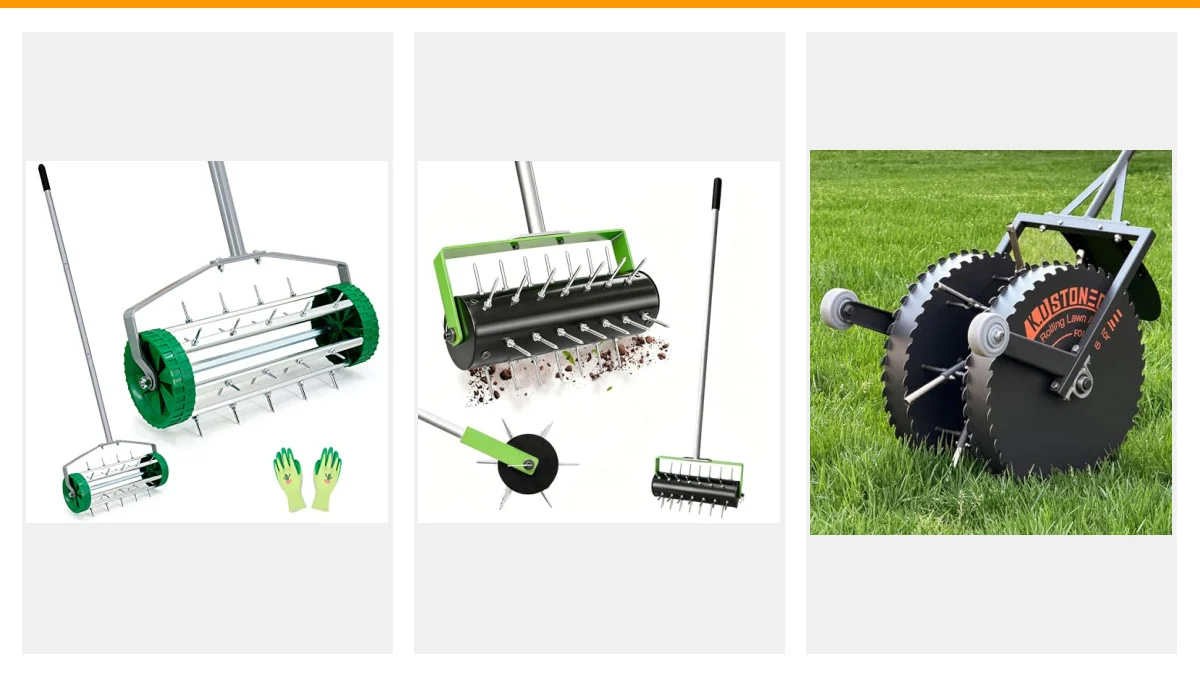
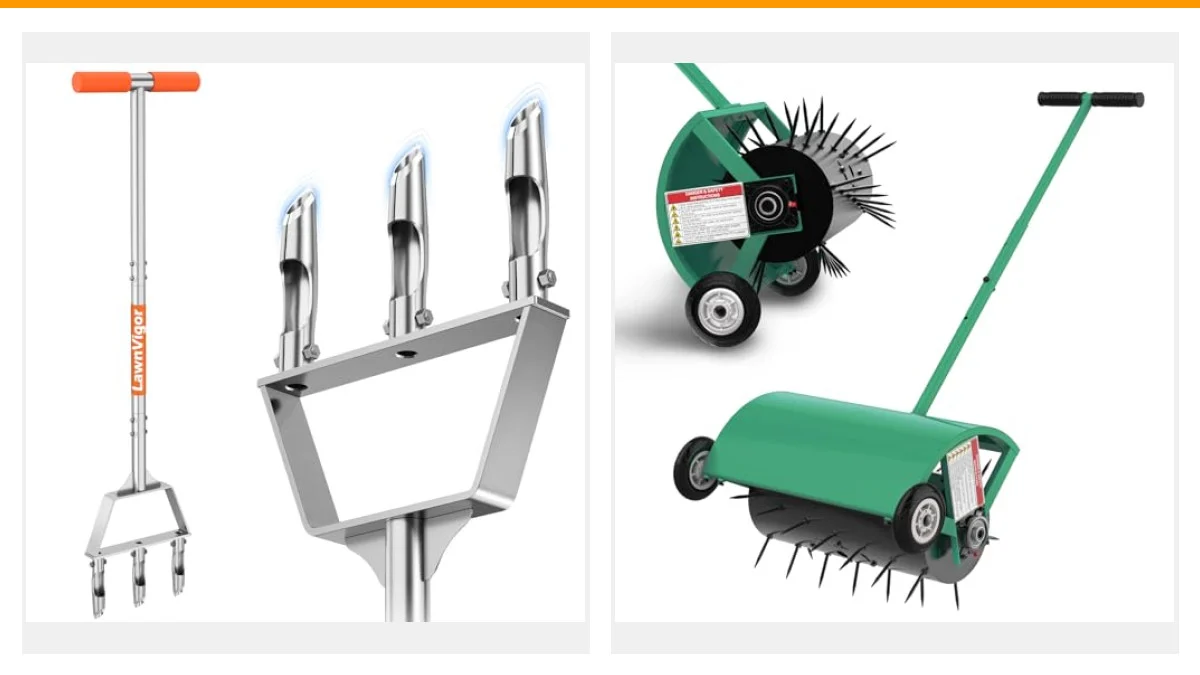
A lawn that puddles after rain, feels hard underfoot, or refuses to green up despite regular feeding usually has the same problem: compacted soil. Grass roots can’t push through it, water runs off instead of soaking in, and fertilizer sits on the surface doing nothing useful.


Core aeration fixes that. The right manual aerator pulls small plugs of soil out of the ground, opening channels that let air, water, and nutrients reach the root zone. The wrong one just pokes holes and makes a mess. Here’s how the leading home models actually compare.
| Features | LawnVigor Core Aerator | Hugeneroy Steel Aerator | Bigwish Stainless Aerator | Walensee Spike Aerator | Saker Spike Aerator |
|---|---|---|---|---|---|
| Material & Build | Sturdy metal, heat-treated tines | Industrial-strength steel, tempered tines | Full stainless steel construction | Heavy-duty iron, powder-coated finish | Thickened iron, rust-resistant coating |
| Key Specification | 3 hollow tines, replaceable | 3 hollow tines, replaceable | 3 hollow tines, adjustable height | 15 iron spikes, 2.8-inch length | 15 iron spikes, 2.3-inch length |
| Main Feature | Non-clogging plug removal | Precision-engineered tine geometry | Step bar for extra leverage | Three-row spike layout | Double-layer spring ejector |
| Performance | Creates deep, larger holes | Consistent plug removal all soils | Efficient core extraction | Fast coverage on small areas | Self-cleaning spike action |
| Best Use Case | General home lawn care | Clay and heavy compacted soil | Clay-heavy yards, seasonal restoration | Small lawns, edges, bare spots | Quick spot aeration, loose soil |

Manual Lawn Core Aerator
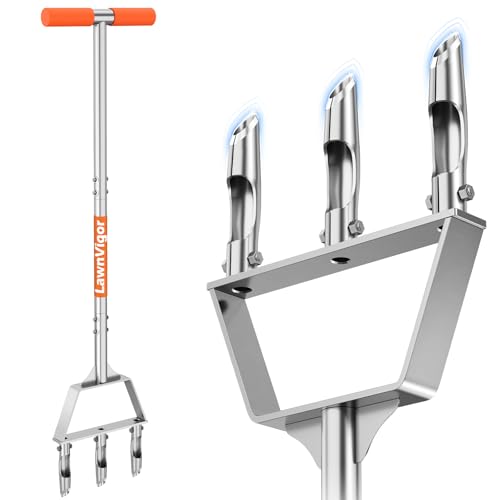
LawnVigor
Manual Lawn Core Aerator for Compacted Soil with Non-Clogging Hollow Tines | Pulls Soil Plugs Easily, Bend-Resistant Steel Frame, Wide Foot Pedal, Replaceable Tines, Ideal for Clay Soil - Orange
- LAWN AERATOR FOR HEALTHIER LAWN GROWTH: Our manual lawn aerators promotes lush, green lawns by delivering essential air, water and…
- BUILT-TO-LAST HOLLOW TINE AERATOR: Made of sturdy metal and heat-treated hollow tines, our plug aerator lawn tool is built to with…
- NON-CLOGGING YARD AERATOR: Designed with 3 hollow tines, this lawn core aerator efficiently removes soil plugs while preventing cl…
LawnVigor’s manual core aerator is a three-tine plug puller aimed at homeowners who want real core aeration without renting gas-powered equipment. It suits small to mid-size lawns where a tow-behind unit would be overkill.
The heat-treated hollow tines are the standout feature. They slice through compacted ground and pull actual soil plugs, which is the whole point of core aeration. White plastic inserts inside the tines help release those plugs instead of letting them jam. The ergonomic handle sits at a height that keeps you from hunching over, and assembly takes minutes with the included tools.
Here’s the honest part: this tool demands correct technique. Rock it side to side or pry while the tines are underground and you’ll bend them. Dry soil makes penetration nearly impossible, so water the area first. It’s also slower than a spike aerator because each plunge only covers three holes.
- Three replaceable hollow tines pull real soil cores
- Non-clogging design with plastic insert ejectors
- Heat-treated metal construction for repeated use
- Ergonomic handle reduces back strain
- Quick assembly with included tools
Best for: Homeowners with small-to-medium lawns who want genuine core aeration and will follow proper technique.
Heavy Duty Steel Hollow Tine
The Hugeneroy core aerator targets a specific problem: clay soil that laughs at lightweight tools. Its industrial-strength steel frame and tempered hollow tines are built for yards where standard aerators bend or stall.
What separates this from the LawnVigor is the reinforced tine geometry. The spikes are engineered to slice through compacted earth with less effort while holding their shape during repeated soil extraction. For clay-heavy yards, that matters. Cheaper tines warp after a few sessions. This one is designed to keep pulling consistent plugs across all soil types. The comfort-grip handle also helps during longer aeration sessions.
The trade-off is availability. This model frequently sells out because it’s a niche product for tough soil conditions. It’s also heavier than basic manual aerators, which adds fatigue over a large area. And like every hollow tine tool, it requires moist ground and vertical push-pull motion only.
- Industrial-strength steel with tempered hollow tines
- Reinforced tine geometry resists bending and warping
- Three deep-drilling tines for clay and compacted earth
- Replaceable tines extend tool lifespan
- Easy-grip handle reduces hand fatigue
Best for: Gardeners dealing with stubborn clay soil who need a core aerator that won’t fold under pressure.
Lawn Aerator Tool, Stainless

Bigwish
Lawn Aerator Tool, Stainless Steel Manual Core Aerator with 3 Hollow Tines | Heavy Duty Aeration Tool, Adjustable Height, Yard Aerator & Soil Aerator Tool for Soil Plug Removal, Lawn Garden Care
- 【TRUE CORE AERATION FOR HEALTHIER LAWNS】This manual lawn aerator removes soil plugs to relieve compaction at the root level. By cr…
- 【FULL STAINLESS STEEL CONSTRUCTION】Crafted from rust-resistant stainless steel, this plug aerator is built for durability and long…
- 【ADJUSTABLE HEIGHT FOR BETTER LEVERAGE】The adjustable handle design allows you to customize working height for improved posture an…
Bigwish takes a different angle with full stainless steel construction. Where most manual aerators use coated or heat-treated carbon steel, this one is rust-resistant throughout, which matters if you store tools in a shed or garage with humidity swings.
The adjustable handle height is the feature that sets it apart. You can set the working height to match your posture, which reduces back strain during longer sessions. A sturdy step bar lets you drive the tines into compacted ground using your body weight instead of arm strength alone. For clay-heavy yards and seasonal lawn restoration, that combination works well. The reinforced hollow tines and solid frame hold up to repeated seasonal use.
Stainless steel is heavier than carbon steel, so this tool weighs more than you might expect. The adjustable handle also adds a step to assembly that fixed-handle models skip. And while stainless resists corrosion, it’s not indestructible. Prying sideways will still damage the tines.
- Full stainless steel frame and tines resist rust
- Adjustable handle height for better posture
- Step bar drives tines with body weight, not arm strength
- Three hollow tines extract consistent soil plugs
- Suited to clay-heavy and compacted soil
Best for: Buyers who want a rust-proof core aerator with adjustable ergonomics for clay soil and seasonal restoration work.
Walensee Manual Lawn Aerator

Walensee
Walensee Lawn Aerator Tool, 15-Spike Manual Aerator Lawn Tool for Yard | Alternative to aerator shoes, patented grass aeration creates holes for lawn. Water the lawn before use or aerator after rain
- 【EFFECTIVE MANUAL LAWN AERATOR TOOL】: Walensee spike lawn aerator helps loosen soil and create small channels so air, water, and n…
- 【15 SHARP IRON SPIKES FOR BETTER COVERAGE】: Designed with 15 sturdy iron spikes, each about 2.8 inches long, this manual lawn aera…
- 【NO MORE SPIKED SHOE HASSLES】: Unlike plastic or metal lawn aerator shoes that may require strap adjustments, shoe-size matching,…
Walensee’s spike aerator takes a completely different approach. Instead of pulling plugs, it drives 15 iron spikes into the ground to create small channels. That makes it faster and simpler than core aeration, but the results differ.
The three-row spike layout covers more ground per step than single-row tools, which speeds up work on small lawns, edges, and bare patches. The 34.6-inch handle and cushioned T-grip with foot pedal give you decent leverage without bending over. It’s also a clear upgrade over spiked shoes, which never fit right and feel unstable on uneven ground.
Spike aeration doesn’t remove soil cores, so it won’t relieve deep compaction the way a hollow tine tool does. Walensee is upfront about this: the tool isn’t recommended for heavy sticky clay, rocky ground, or large-scale jobs. Think of it as a maintenance tool for lightly compacted areas, not a renovation tool.
- 15 iron spikes, each about 2.8 inches long
- Three-row layout covers ground faster than single-row tools
- 34.6-inch handle with cushioned T-grip and foot pedal
- Detachable design for easy storage
- Powder-coated finish for outdoor durability
Best for: Homeowners with small lawns or specific bare spots who want quick, low-effort soil loosening before seeding or fertilizing.
Saker Manual Lawn Aerator
Saker’s spike aerator shares the 15-spike format but adds a mechanical twist: a double-layer spring system that automatically ejects soil and debris as you work. That’s a genuine convenience feature most spike tools skip.
The reinforced construction is the other selling point. Saker upgraded the foot pedal with high-strength screw connections instead of welds, which improves load capacity and reduces the chance of breakage at the weakest point. The 2.3-inch spikes are slightly shorter than Walensee’s, so penetration depth is a bit less. For loose or moderately compacted soil, that’s fine. The rust-resistant coating on the thickened iron body should hold up through regular seasonal use.
Shorter spikes mean less depth, so this isn’t the tool for seriously compacted ground. It also works best on soft soil, which means watering before use is basically mandatory. The spring mechanism adds moving parts that could eventually wear, though the design is simple enough to last with basic care.
- 15 sharp 2.3-inch iron spikes
- Double-layer spring auto-ejects soil and debris
- Screw-connected foot pedal for higher load capacity
- Rust-resistant coating on thickened iron body
- Lightweight enough for quick spot work
Best for: Gardeners who want a self-cleaning spike aerator for quick maintenance on soft or moderately compacted soil.
How We Chose These Products
We focused on tools that solve real problems for homeowners, not commercial crews. Each pick had to either pull genuine soil cores or offer a clear advantage over basic spike shoes. Build material, tine or spike count, replaceable parts, and ergonomic design all factored into the ranking.
We also weighed honest limitations. A hollow tine aerator that bends under sideways pressure is still a good tool if the buyer knows to push straight down. A spike aerator that can’t handle clay is still useful for small lawns. Matching the tool to the job mattered more than picking an overall winner.
Buying Guide: What Really Matters
Core vs. spike is the first decision. Hollow tine aerators pull plugs of soil out of the ground, which relieves compaction at the root level. Spike aerators push soil aside and create channels, which helps water and air penetrate but doesn’t remove the compacted layer. For seriously hard ground, core aeration wins. For light maintenance, spikes are faster.
Soil type drives the second decision. Clay soil needs a heavy-duty core aerator with reinforced tines. Sandy or loamy soil works fine with a spike tool. If your soil is dry and rock-hard, water it 12 to 24 hours before aeration regardless of which type you choose.
Build quality matters more than most buyers expect. Heat-treated or stainless steel tines last for years. Cheap stamped metal bends after a few sessions. Replaceable tines are worth paying extra for because they extend the tool’s life instead of forcing a full replacement. Handle height and grip design also affect whether you’ll actually use the tool or leave it in the garage.
Our Top Recommendation
The LawnVigor Manual Lawn Core Aerator is the best starting point for most homeowners. It pulls real soil plugs, has replaceable heat-treated tines, and costs far less than a tow-behind unit. For clay soil, step up to the Hugeneroy Heavy Duty Steel Hollow Tine for its reinforced geometry. If you want rust resistance and adjustable ergonomics, the Bigwish stainless model is the pick.
For small lawns and quick touch-ups, the Walensee and Saker spike aerators are cheaper, faster, and easier to handle. They won’t fix deep compaction, but they’re fine for maintaining soil that’s already in decent shape.
Frequently Asked Questions
How do I know if my lawn actually needs aeration?
Push a screwdriver into the soil. If it goes in easily, your lawn is fine. If it takes real effort, the soil is compacted. Other signs include puddling after rain, thin or patchy grass, and a spongy layer of thatch that blocks water.
Can I aerate in summer or winter?
Cool-season grasses do best with aeration in early fall or spring. Warm-season grasses prefer late spring to early summer. Avoid aeration during drought stress or when the ground is frozen. Recovery is slower in extreme heat or cold.
Do I need to water before using a manual aerator?
Yes, for hollow tine tools. Dry soil makes penetration nearly impossible and can damage the tines. Water the area 12 to 24 hours before aeration so the ground is moist but not soggy. Spike aerators also work better on soft soil.
What do I do with the soil plugs left on the lawn?
Leave them. The plugs break down over one to two weeks and return organic matter to the surface. You can rake them lightly if you want a tidier look, but there’s no need to bag them.