
You notice it on the third pass across the yard. The grass isn’t cut—it’s torn. The tips look frayed and white, and you’re making two laps where one used to do the job. That’s not a mower problem. That’s a blade problem.

A dull blade rips grass instead of slicing it, leaving your lawn stressed and vulnerable to disease. Sharpening your blade twice a season takes about twenty minutes and costs nothing if you own the right tool. The hard part is picking one, because the market splits into manual files, angle grinder jigs, drill attachments, and full bench grinders, each with a different trade-off between price, effort, and result.
I tested five of the most popular sharpeners on the market to find out which ones actually deliver a clean edge without a steep learning curve. Below you’ll find honest reviews, a comparison table, and a complete workflow from unplugging the mower to reinstalling the blade. For a deeper look at specific setups, check our sharpening system guide.
Here’s a quick look at how the five finalists stack up on the specs that matter most.
| Features | SporGain Brushless | SporGain Jig | Jinlida JLD10-9 | SHARPAL 103N | Holdwell S |
|---|---|---|---|---|---|
| Power Source | Brushless motor | Angle grinder | 1HP 750W plug-in | Manual | 1HP 750W plug-in |
| Key Feature | Lifetime motor warranty | 15°–45° adjustable frame | 9-inch ceramic wheel | 5 sharpening parts | Dual angle brackets |
| Blade Compatibility | High/low lift, gator | 1.65″–3.60″ wide | Most standard blades | Knives, tools, blades | High/low lift, gator |
| Accessories Included | 70 sanding discs | 4 adapter screws | 5 discs, balancer | None needed | Balancer, adapters |
| Best Use Case | Homeowners, pros | Grinder owners | Heavy-duty sharpening | Quick touch-ups | Serious DIY users |
Why Blade Sharpness Matters More Than You Think

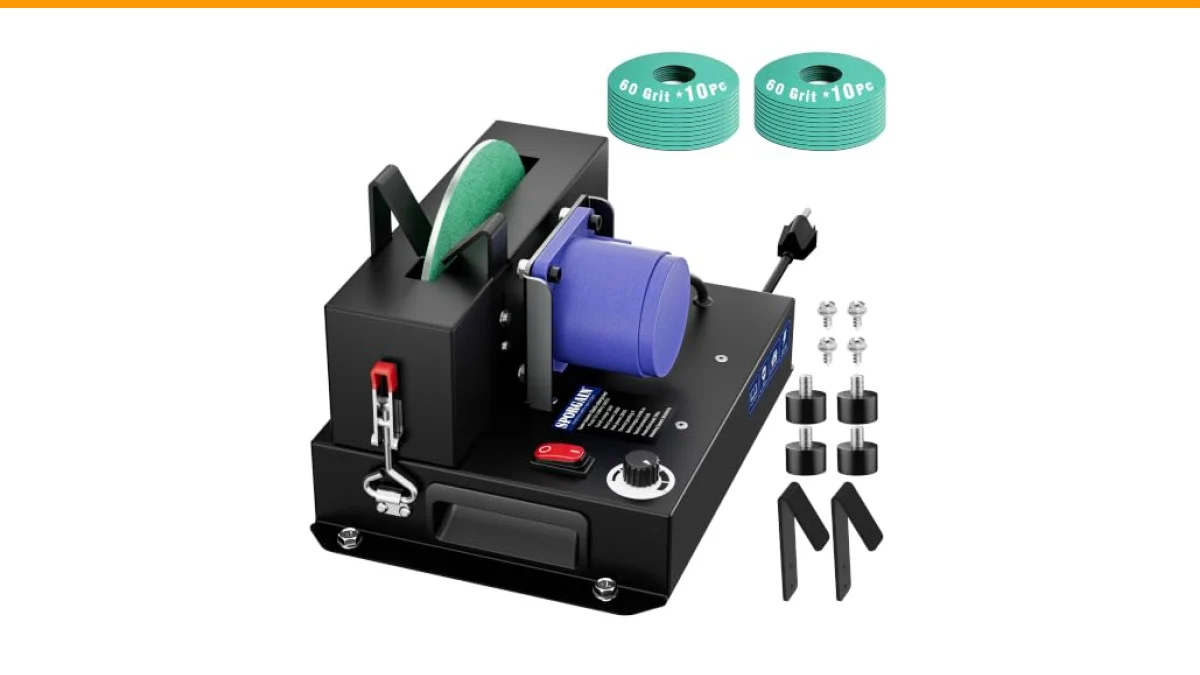
SporGain
SporGain Lawn Mower Blade Sharpener,Brushless Motor,Lifetime Motor Warranty | 3000RPM Lawnmower Blade Sharpener Tool, Blades Grinder 7" Grinding Wheel 20 Sanding Discs for High/Low Lift, Gator&Flat Blade
- Brushless Motor for Powerful Performance: SporGain mower blade sharpener tool is equipped with a high-performance brushless motor,…
- Lifetime Motor Warranty: This durable lawnmower blade sharpener comes with a lifetime motor warranty, ensuring long-term reliabili…
- Adjustable Speed up to 3000RPM: The lawn blade sharpener features adjustable speed control up to 3000RPM, allowing you to choose t…
Most homeowners ignore their blade until the mower starts vibrating or the grass looks ragged. By then, the damage is done. A dull blade doesn’t just look bad—it pulls on the grass, ripping it from the soil in places. That opens the door to fungus and pests.
Sharp blades also save fuel. A clean cut means the engine doesn’t work as hard to push a blunt piece of steel through thick turf. You’ll notice the difference in how the mower sounds and how long a tank lasts.
There’s also the financial angle. A professional sharpening service charges $10 to $20 per blade. Do that twice a season for five years and you’ve spent $200 on something you could have done at home for the price of a $30 tool. A decent manual file costs even less.
How to Tell If Your Mower Blade Is Actually Dull
SporGain
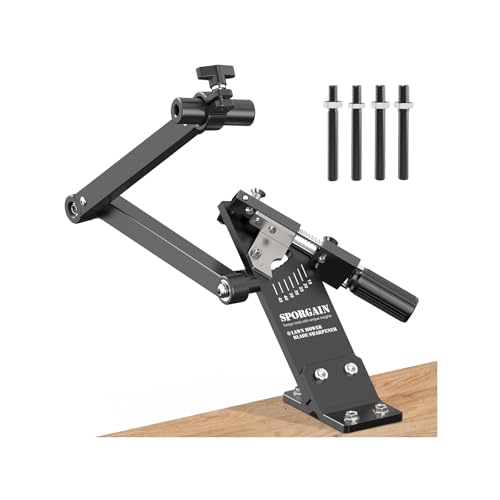
SporGain [Updated] Lawn Mower Blade Sharpener 15°-45° Adjustable Frame | Lawnmower Blade Sharpener Tool with Ball Bearing Manufacture Handle for Right/Left Hand Blades, Use with Angle Grinder, Black
- [ Updated ] Lawn Mower Blade Sharpener: SporGain mower blades sharpener suitable for Blades standard straight, mulching and high-l…
- Fits 1.65"–3.60" Mower Blades: lawn mower blade sharpener jig is designed to accommodate mower blades from 1.65" to 3.60" wide, ma…
- High-Quality Construction: This lawnmower blade sharpener jig firmly and securely holds the blades in place.
Before you buy anything, check whether you actually need it. Look at the grass tips after mowing. If they’re shredded or brown within a day, your blade is dull. Freshly cut grass should have a clean, angled tip.
Another test: put on heavy gloves and run a finger along the cutting edge. You should feel a slight burr—a rough, hooked edge. If the edge feels smooth and rounded, it’s time to sharpen. Also inspect for nicks. Hitting a rock or a tree root can roll the edge over completely.
One more clue is the mower itself. If the deck vibrates more than usual, the blade might be unbalanced, which often happens after one side hits something hard. That’s a separate issue from dullness, but it means you need to remove the blade anyway, so you might as well sharpen it while it’s off.
The 4 Main Types of Lawn Mower Blade Sharpeners
Jinlida
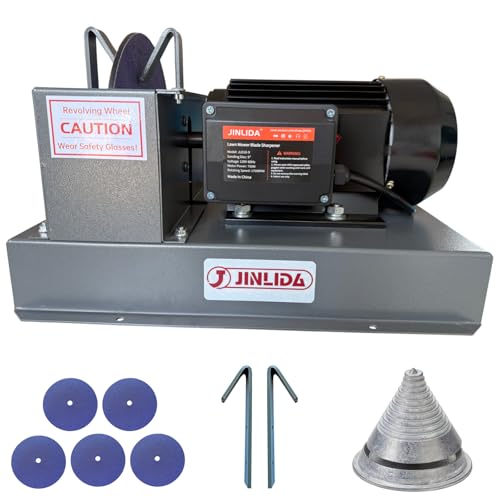
Jinlida JLD20-9 Lawn Mower Blade Sharpener, 1HP 750W Lawn Lawnmower Blade Grinder with 9-inch Ceramic Grinding Wheel and Balancer and 5 Sanding Discs
- Powerful motor: The JLD20-9 series lawn mower blade sharpener adopts a high-performance 750W motor that can output 1HP horsepower…
- Improve sharpening efficiency: Say goodbye to dull blades! Our 9-inch 60 grit ceramic grinding wheel effortlessly solves the probl…
- Complets set: includes 5 replaceable 60 grit purple ceramic grinding discs, 2 40 ° knife holders, and 1 metal balancer for compreh…
Understanding the categories helps you skip past tools that don’t fit your situation. Here’s the breakdown.
Manual Files and Hand Sharpeners

SHARPAL
SHARPAL 103N All-in-1 Knife Garden Tool Lawn Mower Blade Sharpener | Axe, Hatchet, Machete, Pruner, Hedge Shears, Scissors, Gardening Sharpening Tool Gifts for Men
- VERSATILE – The most versatile sharpener in the market to sharpen and hone both single and double beveled blades including knife,…
- SUPERIOR SHARPENING PERFORMANCE – As blades vary from different angles, shape, single or double bevel, etc., to fulfill the best s…
- DURABLE – All sharpening abrasive materials pass 10,000 times field use test. NEVER WEARS OUT
The classic approach. A bastard file or a handheld sharpening stone removes a small amount of metal with each pass. It’s slow but precise, and it costs under $25. You’ll need to clamp the blade in a vise to do it properly, which adds to the setup. Hand sharpeners like the SHARPAL 103N work on the same principle but add guides to keep the angle consistent.
Drill Attachments and Angle Grinder Discs
These spin a grinding stone or sanding disc at high speed to remove metal quickly. Drill attachments are cheap and easy to store, but they’re hard to control—the angle drifts if you’re not steady. Angle grinder jigs like the SporGain frame solve that problem by locking the blade in place while you move the grinder along a guided track.
Bench Grinders and Belt Sanders
The professional’s choice. A bench grinder with a 9-inch wheel removes nicks fast and produces a consistent edge. Units like the Jinlida and Holdwell models include angle brackets so you don’t have to hold the blade by hand. They’re heavier and more expensive, but they handle mulching blades and thick steel that wear down hand tools quickly.
All-in-One Sharpening Systems
These combine a motor, a guide, and a balancer in one package. The SporGain Brushless model fits here—it uses sanding discs instead of a rigid wheel, which means less heat buildup and less risk of ruining the blade’s temper. All-in-one systems are the easiest for beginners because they remove most of the guesswork.
Best Overall: SporGain Brushless Sharpener
The SporGain Brushless model is the one I reach for most often. It’s a complete kit that includes the motor unit, 70 sanding discs, and two angle guides (30° and 45°). You assemble it once, clamp your blade in place, and run the disc across the edge until you see a consistent shine.
What sets it apart is the brushless motor. Traditional motors use carbon brushes that wear out and lose power over time. Brushless motors don’t have that problem, which is why SporGain backs this one with a lifetime warranty on the motor. The adjustable speed goes up to 3000 RPM, so you can slow down for fine work or speed up for heavy material removal.
It’s not perfect. The sanding discs wear out faster than a rigid grinding wheel, especially if you’re sharpening badly nicked blades. You’ll go through the included 60-grit discs quickly if you’re restoring an old blade. But for regular maintenance—sharpening every 25 hours of use—the kit lasts a long time.
- Brushless motor with lifetime warranty
- Adjustable speed up to 3000 RPM
- Includes 10 coarse and 60 fine sanding discs
- 30° and 45° guides for different blade types
- Works with high-lift, low-lift, gator, and flat blades
Best for: Homeowners who want a complete, low-maintenance kit without buying extra parts.
Best Angle Grinder Jig: SporGain Adjustable Frame
If you already own an angle grinder, this updated SporGain jig turns it into a precision sharpening station. The frame holds your blade securely while a sliding carriage guides the grinder along the edge at a consistent angle. You set the angle anywhere from 15° to 45° using thumb screws—no tools required.
The design accommodates blades from 1.65 inches to 3.60 inches wide, which covers most standard walk-behind mower blades. The ball-bearing carriage moves smoothly, and the enlarged 25mm handle gives you a comfortable grip. Four adapter screws let you mount most popular angle grinders to the carriage.
The limitation is obvious: you need a grinder, and you need to know how to use one. If you’ve never operated an angle grinder, there’s a learning curve. The spinning disc can catch and kick if you apply too much pressure. Start with light passes and let the tool do the work.
- Adjustable 15°–45° sharpening angle
- Fits blades 1.65″–3.60″ wide
- Ball-bearing carriage for smooth motion
- 4 adapter screws for grinder compatibility
- Thumb-screw adjustments with no tools needed
Best for: DIYers who own an angle grinder and want consistent results without buying a dedicated machine.
Best Bench Grinder: Jinlida JLD10-9
The Jinlida JLD10-9 is a serious piece of equipment. It runs a 750W motor (1 HP) that spins a 9-inch ceramic grinding wheel at 1700 RPM. That’s enough power to eat through nicks and rolled edges that would take forever with a hand file.
The ceramic wheel is the standout feature. Ceramic stays cooler than aluminum oxide, so you’re less likely to overheat the blade and ruin its hardness. The 60-grit surface removes metal quickly while leaving a smooth finish. Included accessories cover the full workflow: five replacement discs, two 40° tool holders, and a metal balancer to check your work.
Here’s the honest trade-off: this is a bench tool, not a portable one. It takes up permanent space in your garage or workshop. Assembly is straightforward, but the integrated steel base is heavy—you won’t want to move it around. Also, the 40° angle holder is fixed, so you can’t fine-tune the angle for specialty blades.
- 750W motor with 1700 RPM output
- 9-inch 60-grit ceramic grinding wheel
- Includes 5 replacement discs and balancer
- Two 40° tool holders included
- Sturdy integrated steel base
Best for: Landscapers and serious DIYers who sharpen multiple blades and want professional speed.
Best Manual Option: SHARPAL 103N
The SHARPAL 103N takes a completely different approach. It’s a manual sharpener with five built-in abrasive surfaces, including three preset angle slots, a tungsten carbide bar, and a ceramic bar. You pull the tool along the blade edge a few times, and it restores a working edge without any power tools.
This is the most versatile sharpener in this roundup. It handles mower blades, but it also works on knives, pruners, hedge shears, axes, machetes, and scissors. The oversized handle fits gloved hands, and the rubber over-mold keeps it from slipping. A large hand guard protects your fingers from the blade.
You need to manage expectations. The 103N is for maintenance, not major repairs. If your blade has deep nicks or a badly rolled edge, this tool will take a very long time to fix it. It’s best used every few mowings to keep an edge fresh, not to restore a neglected blade.
- Five sharpening surfaces in one tool
- Preset angles for consistent results
- Works on single and double bevel edges
- Rubber over-molded handle and base
- Safe for use with gloves
Best for: Quick touch-ups between full sharpenings, and households that also need to sharpen garden tools and knives.
Best Heavy-Duty Kit: Holdwell S Bench Grinder
The Holdwell S rounds out the list with another 1HP bench grinder, but it adds features that the Jinlida lacks. The 9-inch ceramic wheel comes with extra replacement sandpapers, and you get both a 30° and a 40° angle bracket pre-installed. That dual-angle setup covers standard blades and mulching blades without swapping parts.
The package includes six blade hole adapters, which is a thoughtful addition. Different mower brands use different center hole sizes, and those adapters ensure the blade sits flat and doesn’t slip during sharpening. A blade balancer is also included, so you can verify your work before reinstalling.
Assembly takes about three steps, and the included screwdriver means you don’t need to hunt for tools. The aluminum-housed motor dissipates heat well during long sessions. The trade-off is noise—this is a loud machine, and you’ll want hearing protection. It also vibrates more than the brushless SporGain, though the steel base keeps it manageable.
- 1HP 750W aluminum-housed motor
- 9-inch 60-grit ceramic wheel
- 30° and 40° angle brackets included
- 6 blade hole adapters for fitment
- Includes balancer and screwdriver
Best for: Users who sharpen a variety of blade types and want adapters to match different mower brands out of the box.
How We Chose These Products
I evaluated each sharpener on four criteria: ease of use, edge quality, blade compatibility, and included accessories. Ease of use matters because most buyers are homeowners, not machinists. If a tool requires a steady hand or prior experience, I noted that clearly. Edge quality is about consistency—does the tool produce the same angle across the entire blade length?
Blade compatibility covers the range of mower types, from standard flat blades to thick mulching blades. And accessories matter because hidden costs add up. A sharpener that includes discs, guides, and a balancer offers better value than one that requires separate purchases. For a deeper comparison of specific models, our small yard sharpening tool guide covers lighter-duty options.
Buying Guide: What Really Matters
Start with the blade itself. Standard blades have a 30° edge angle. Mulching blades often use 40° to 45° because the cutting edge is thicker. High-lift blades need a sharp edge but also a clean finish on the curved portion. Match the sharpener to the blades you own, not the ones you might buy someday.
Consider your physical setup. Do you have a workbench and a vise? If not, a bench grinder might be more than you want to accommodate. A drill attachment or an angle grinder jig stores in a drawer and clamps to any table. Manual tools need no power at all, which makes them ideal for small yards where you sharpen once a season.
Think about the learning curve. Bench grinders are forgiving because the angle bracket does the work. Angle grinder jigs are also guided, but they require handling a spinning disc. Manual sharpeners are safest but slowest. If you’re new to this, the SporGain Brushless kit is the most beginner-friendly because it combines a motor with clear guides and a simple workflow. For more on technique, see our thick grass blade sharpening guide.
Our Top Recommendation
The SporGain Brushless sharpener takes the top spot. It delivers professional results with a fraction of the effort, and the lifetime motor warranty removes the biggest risk of buying a power tool. The included disc assortment and angle guides mean you don’t need to buy anything else. It’s the best balance of performance, convenience, and long-term value.
If you’re on a tight budget, the SHARPAL 103N is the smart pick. It costs a fraction of the powered options and handles all your garden tools, not just mower blades. If you already own an angle grinder, the SporGain jig is the cheapest way to get guided precision. And if you sharpen blades professionally or own multiple mowers, the Jinlida or Holdwell bench grinders will save you time every season.
Frequently Asked Questions
How often should I sharpen my mower blade?
Every 25 hours of use is a good rule of thumb. For most homeowners, that means twice a season—once in spring and once in mid-summer. If you mow over sandy soil or hit debris often, check the edge monthly.
Can I sharpen a blade without removing it from the mower?
You can, but you shouldn’t. Sharpening in place risks throwing sparks toward the fuel tank and leaves metal filings inside the deck. Removing the blade takes five minutes with a socket wrench and lets you check for cracks and balance issues.
What’s the correct sharpening angle?
Most standard blades use 30°. Mulching blades often need 40° to 45° because the steel is thicker. Check the blade’s original bevel with a protractor or angle guide. Matching the factory angle is more important than hitting an exact number.
How do I know if my blade is balanced?
Hang the blade on a nail or use a magnetic balancer. The heavy side will drop. Grind a little more metal off that side and recheck. An unbalanced blade causes vibration, which damages the mower’s spindle over time.
Final Verdict: Which Sharpener Should You Buy?
Sharpening your mower blade is one of the highest-impact maintenance tasks you can do. It improves cut quality, reduces fuel consumption, and extends the life of your mower. The right tool makes the job quick and repeatable.
For most people, the SporGain Brushless sharpener is the best investment. It’s complete, easy to use, and backed by a warranty that covers the most expensive part. If you want to spend less, the SHARPAL 103N keeps your blade acceptable with two minutes of work. Either way, your grass will thank you.



