
Best Cordless Electric Lawn Mowers for Hills in 2026
Contents
Hillside mowing is a different beast. Pushing a heavy gas mower up a slope leaves you winded, and wrestling it back down feels dangerous. Cordless electric models have changed that equation, but only if you pick the right one.
The ideal hill mower balances weight, wheel drive, and battery stamina. Too heavy and you’ll fight the machine. Too light with no self-propulsion and you’ll still be pushing. The good news is that today’s brushless motors and dual-battery systems deliver enough torque to chew through grass on an incline without the pull-cord frustration.
We tested and compared five cordless mowers that handle slopes differently. Some use raw power, some use featherweight frames, and one uses a drive system that does the legwork. Here’s what we found after spending time on real hills.
Here is a quick look at how the key specs stack up:
| Features | Casince 17-inch | Greenworks 40V | Casince 13-inch | RB Mini 9-inch | Worx WG760 |
|---|---|---|---|---|---|
| Deck Width | 17 inches | 16 inches | 13 inches | 9 inches | 21 inches |
| Drive Type | Push (lightweight) | Push (lightweight) | Push (compact) | Push (one-hand) | Self-propelled |
| Battery Setup | Two 20V 4.0Ah | One 40V 4.0Ah | Two 20V 4.0Ah | One 40V 2.0Ah | Two 20V 5.0Ah |
| Best For | Medium slopes | Gentle grades | Narrow, steep spots | Tiny steep patches | Long, steep drives |
| Weight | 14 kg (30.8 lbs) | Ultra-lightweight | 10 kg (22 lbs) | 5.2 kg (11.5 lbs) | Heavier (self-propelled) |

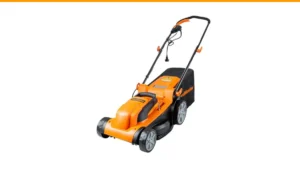
Casince 17-Inch Mower
1st Pick

Casince
Cordless Lawn Mower, 17 in Walk Behind Lawn Mower for Yard & Garden
- WIDER MORE EVEN CUTTING: The 17-inch cutting deck and 6 height settings from 1 to 3 inches (25–75 mm) help this cordless lawn mowe…
- DUAL BATTERY EXTENDED RUNTIME: Powered by two 20V 4.0Ah batteries, this walk behind lawn mower runs for up to 40 minutes and cover…
- LARGE CAPACITY GRASS COLLECTION: The 50L collection bag holds more clippings between emptying cycles, while regular cleaning aroun…
This Casince model is the balanced all-rounder for sloped yards up to a quarter acre. If your lawn has a steady grade rather than a cliff, the 17-inch deck covers ground efficiently while the dual-battery setup keeps cutting without a mid-lawn recharge.
The standout feature here is the power-to-weight ratio. A 3000 RPM brushless motor pushing up to 1200W through a 14 kg frame means it has enough grunt to maintain blade speed when you hit a thicker patch on the incline. The 50L collection bag is genuinely large, so you won’t be stopping at the top of the hill to empty it constantly. Six height settings give you fine control, which matters when you need to raise the deck for tougher slope grass.
Honest criticism: at 14 kg, this is not the lightest push mower. On a very steep slope, you will feel the weight when you pivot it. Also, the 40-minute runtime is tested on flat, regular grass; expect less if you’re pushing through damp or tall growth on a hill. The one-button start and pull-bar activation are simple, but the design feels utilitarian rather than premium.
- 17-inch deck with six height positions from 1 to 3 inches
- Dual 20V 4.0Ah batteries for up to 40 minutes of run time
- 50L rear bag reduces emptying stops on long slopes
- Brushless motor maintains 3000 RPM under load
- 14 kg weight balances stability with portability
Best for: Homeowners with medium-sized, moderately sloped lawns who want one machine that does the whole job without a second battery swap.
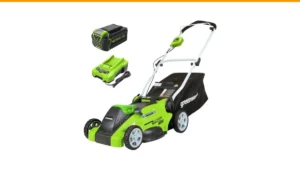
Greenworks 40V 16-Inch
2nd Pick

Greenworks
Greenworks 40V 16in Push Lawn Mower, 4.0 Ah Battery and Charger
- [16" LAWN MOWER] - This 40V lawn mower cuts up to 1/3 acre with fully charged 4.0Ah battery (varies based on grass condition and o…
- [ULTRA LIGHTWEIGHT] - 35% lighter than steel deck mowers
- [SINGLE LEVER HEIGHT ADJUST] - 5 position height adjustment
Greenworks built this one for the person who dreads dragging a heavy steel deck up a grade. The 40V platform is mature and reliable, and the 16-inch deck is wide enough for practical cutting while keeping the overall weight down. It suits yards up to a third of an acre with gentle to moderate slopes.
What stands out is the single-lever height adjustment. You can change the cut height in one motion, which is handy when you transition from a flat front yard to a hillier back section. The 2-in-1 system lets you switch between mulching and rear bagging without needing extra parts. It’s also part of the Greenworks 40V family, so the battery fits over 75 other tools like trimmers and blowers. That ecosystem is a real plus if you’re already invested or plan to be.
The limitation is the drive. This is a push mower, and it’s 35% lighter than steel decks, but on a steep, wet hill, you are still the motor. The 4.0Ah battery is decent, but heavy or tall grass on an incline will drain it faster than the listed specs suggest. The plastic deck feels sturdy enough, but it’s not as rigid as aluminum or steel on rough terrain.
- 16-inch deck with 5-position single-lever height adjust
- Weighs 35% less than traditional steel deck mowers
- Mulch and rear bagging options included
- Runs on the shared 40V Greenworks battery platform
- Backed by a 3-year limited warranty on tool and battery
Best for: Budget-conscious buyers with gentle slopes who want a light, dependable mower and plan to use the same batteries for other yard tools.
Casince 13-Inch Mower
3rd Pick

Casince
Cordless Lawn Mower, 13-Inch Walk Behind Lawn Mower for Yard Care
- COMPACT CUTTING FOR SMALL LAWNS: The 13-inch cutting deck and 5 height settings from 1 to 2.6 inches (25–65 mm) help this cordless…
- BRUSHLESS POWER FOR CONSISTENCY: The 3000 RPM brushless motor delivers up to 1200W max output, helping this electric battery power…
- DUAL BATTERY LONGER RUNTIME: Powered by two 20V 4.0Ah batteries, this walk behind lawn mower runs for up to 40 minutes and covers…
This smaller Casince is the specialist for awkward hills. If your property has narrow terraces, a steep bank beside the driveway, or tight corners that larger decks can’t reach, the 13-inch width lets you maneuver where bigger mowers stall. It is also the best choice for anyone who struggles with heavy equipment.
At just 10 kg, this is a genuinely easy mower to lift, carry, and tilt on a slope. The compact deck means you can cut closer to edges and around garden beds without as much trimmer work. The dual 20V 4.0Ah batteries still provide up to 40 minutes of runtime, which is surprising for such a small machine. The 30L bag is proportionate to the deck size, so you won’t be emptying it every two passes on a small lawn.
Here’s the trade-off: a 13-inch deck means more passes. On a large, open hill, this mower will take noticeably longer than the 17-inch or 21-inch models. The cutting height range tops out at 2.6 inches, which is fine for regular mowing but limits you if you let the grass get shaggy on a slope. It’s a tool for precision and ease, not for speed over wide areas.
- 13-inch deck with five height settings from 1 to 2.6 inches
- Ultra-light 10 kg body for easy handling on slopes
- Dual 20V batteries deliver up to 40 minutes of run time
- Brushless motor keeps 3000 RPM for consistent cuts
- One-button start simplifies operation on uneven ground
Best for: Older homeowners or those with smaller, intricately shaped hillside yards who value lightweight handling over cutting width.
RB 40V Mini Mower
4th Pick
RB
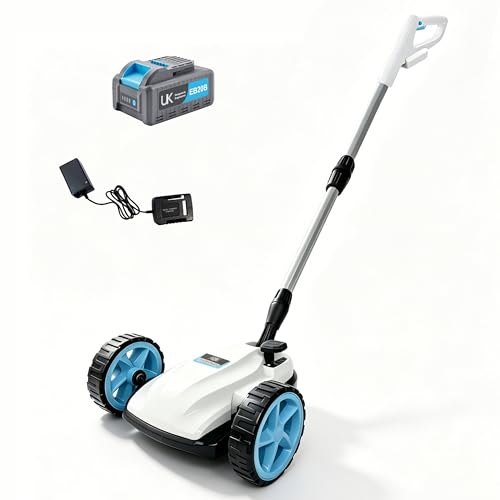
RB 40V 9" Mini Cordless Lawn Mower with Battery & Charger for Small Yards
- [Powerful & Efficient] This small battery mower features a high-speed 6000RPM brushless motor for fine mulching with zero maintena…
- [Ultra-Light & Compact] Weighing only 5.2kg (11.5lbs without battery), this mini cordless lawn mower is highly maneuverable with p…
- [Adjustable Cutting Height] Customize your lawn with 3 cutting heights from 1.2" to 2". Keep your grass healthy and well-groomed a…
The RB mini mower solves a specific problem: the tiny, steep patch of grass that a full-size mower can’t safely handle. It weighs just 5.2 kg without the battery, and the pivoting front wheels allow one-hand steering. For a steep bank or a narrow strip between the sidewalk and a retaining wall, this is a safer tool than dragging a heavy machine sideways.
The 6000 RPM brushless motor is high-speed, which helps it mulch fine clippings even on short grass. The automatic tilt shut-off is a thoughtful safety feature for slopes—it stops the blade if the mower is tilted beyond 20 to 70 degrees, which is a real consideration when you’re working on an incline. The detachable handle and upright storage design means it tucks into a corner of the garage without taking up floor space.
But let’s be clear about its limits. The 9-inch deck and 2.0Ah battery restrict it to areas around 540 square feet. This is not a primary mower for a typical yard. It’s a finishing tool. The three cutting heights (1.2 to 2 inches) are quite low, so it’s best for frequent touch-ups rather than tackling overgrown grass. You will also need to be careful on steep slopes, as the lightweight frame can bounce over rough ground.
- 9-inch deck with high-speed 6000 RPM brushless motor
- Weighs only 5.2 kg for effortless one-hand use
- Safety tilt sensor stops the blade automatically on inclines
- Folds down for upright, space-saving storage
- Ideal for lawns up to 540 square feet
Best for: Homeowners who need a dedicated solution for a small, steep bank or a tiny city yard where a standard mower is overkill.
Worx 40V 21-Inch WG760
5th Pick

WORX
Worx Cordless Lawn Mower, 40V 21" 3-in-1 Grass Mower for 1/2 Acre, WG760
- AERODECK TECHNOLOGY: Vented design boosts air volume in the cutting deck to prevent clogs and clumping, enhance cut quality, and o…
- MADE STRONGER, LASTS LONGER: Brushless motor 2.0 delivers 40% more power and 10% longer runtime than first-gen brushless motors. I…
- SELF-PROPELLED WITH VARIABLE SPEED: This walk-behind self-propelled mower does the hard work for you. Simply set your preferred sp…
The Worx WG760 is the serious tool for serious hills. This is a self-propelled mower, which is the real answer for slopes that leave you exhausted with a push model. It handles up to half an acre, and the variable speed drive lets you set a pace that matches the terrain and your walking speed.
The combination of Intellicut technology and a brushless motor is what makes it stand out. The mower senses the density of the grass and adjusts the blade speed automatically. On a thick patch at the bottom of a hill, it dials up the power. On thinner grass near the top, it conserves battery. The AeroDeck design increases airflow to prevent clumping, which is a common issue when cutting damp grass on a slope. The included two 5.0Ah PowerShare Pro batteries give it the stamina to handle bigger jobs.
There are two things to know before buying. First, self-propelled mowers are heavier than push models, and this one is no exception. You’ll feel the weight when you lift it into a shed or turn it around at the top of a steep grade. Second, the price reflects the advanced features; this is the premium option on this list. Also, stock can be scarce, so if you see it available, it’s worth acting quickly.
- 21-inch deck with AeroDeck technology to prevent clogging
- Self-propelled drive with variable speed up to 3.7 MPH
- Intellicut sensors adjust power based on grass density
- Powered by two 20V 5.0Ah PowerShare Pro batteries
- Compatible with over 140 tools in the Worx PowerShare platform
Best for: Homeowners with large, steep lawns who want the mower to do the pushing and have the budget for a premium, feature-rich machine.
How We Chose These Products
We focused on one question: how does this mower perform when the ground tilts? That means we looked at weight, because a heavy mower is a hazard on a slope. We looked at drive systems, because self-propulsion is a game-changer on long grades. And we looked at battery capacity, because hills drain power faster than flat ground.
We also considered the practical side of hillside mowing. Deck size matters for stability and coverage. Collection bags need to be large enough to avoid frequent trips up and down the hill. Safety features, like tilt sensors, are critical on steep terrain. We balanced these factors against the specific use case for each mower, from tiny banks to half-acre estates.
Buying Guide: What Really Matters
Weight distribution is more important than total weight. A mower that is heavy at the rear is harder to push uphill, while a mower with a low center of gravity feels more stable when you’re cutting across a slope. Look for models with rear wheels that are larger than the front, as this helps with traction on inclines.
Battery runtime is always optimistic on the box. Test conditions usually involve short, dry grass on flat ground. On a hill, you’re using more power to maintain blade speed and, if self-propelled, to drive the wheels. A good rule of thumb is to expect 60-70% of the advertised runtime on a sloped lawn. If you have a large area, consider a model that uses two batteries or buy a spare.
For very steep hills, self-propelled is not a luxury, it’s a safety feature. Pushing a mower uphill strains your back and heart. Pulling it back down is where accidents happen. A variable-speed drive lets you walk at a natural pace and keeps the mower from running away from you on the descent. For more insights, check out our guide on cordless mowers for hills.
Our Top Recommendation
The Worx WG760 is our top pick for hills. The self-propelled drive eliminates the physical strain of pushing up a grade, and the Intellicut system manages power intelligently to maximize runtime. It is the only mower on this list that truly makes mowing a steep hill feel manageable, rather than a workout. The 21-inch deck also means you finish faster.
For a more budget-friendly option, the Casince 17-inch mower is the best value. It lacks self-propulsion, but its light weight and powerful brushless motor make it a capable performer on moderate slopes. If you have a tiny, steep bank or a very small yard, the RB Mini is the safest and easiest tool for the job, even if it can’t cover a full lawn. If you need to compare more options, take a look at our top picks for electric mowers for hills.
Frequently Asked Questions
How steep of a hill can a cordless mower handle?
Most cordless mowers will manage a 15-20 degree slope without issue. Beyond that, you risk the mower tipping or the wheels losing traction. For steeper terrain, a self-propelled model like the Worx WG760 is safer, but even then, you should mow across the slope rather than up and down when possible. If you have a very steep bank, a hover mower is often a better answer; read our hover mower guide for details.
Why does my battery drain faster on a hill?
Mowing uphill requires more torque from the motor to keep the blade spinning at the right speed. That extra draw pulls more current from the battery. Also, if you are pushing a heavy mower, you may be moving slower, which means the mower is running for a longer time per square foot of grass. This is normal, not a sign of a faulty battery.
Is a self-propelled mower worth the extra money for a small hill?
It depends on the length of the slope. For a short, steep bank of 20-30 feet, a lightweight push mower is often easier to manage because you can lift and pivot it. For a long, sustained grade of 50 feet or more, a self-propelled mower will save you significant energy and reduce the risk of fatigue-related accidents.
Should I cut grass on a hill differently with an electric mower?
Yes. Always mow across the slope (side-to-side) rather than up and down to reduce the risk of tipping. Keep the battery charged, as a low battery reduces blade speed right when you need extra power on the incline. Finally, raise the cutting height slightly on hills to avoid scalping the high spots and to reduce the load on the motor.