

Best Compost Bin for Small Restaurant Kitchens (2026)
Contents
Your line cook just scraped a plate of lemon-garlic pasta into a home-grade compost pail, and now the whole prep station smells like a dumpster on a July afternoon. The lid hinge broke on day three, fruit flies have claimed the corner near the sink, and the bin is too wide to fit under your stainless prep table. This is the reality of composting in a commercial kitchen: the workflow is faster, the volume is heavier, and the health department has opinions.
Small restaurant kitchens need a bin that survives 20-plus emptyings a day, seals odors without relying on a filter that saturates in a week, and fits into a footprint that doesn’t steal prep space. The right choice balances capacity against the physical dimensions of your station, prioritizes materials that handle cleaning chemicals, and offers a lid design that doesn’t slow down a dinner rush scrape.
We tested and evaluated five bins that range from a heavy-duty 23-gallon commercial can to a compact 0.7-gallon countertop caddy. Below is a detailed breakdown of each, a comparison table to help you sort through the specs, and a buying guide focused on the realities of a licensed kitchen. For a broader look at managing food waste in a foodservice environment, check our compost bin guide.
Here are the key specs side-by-side to help you narrow down your choice quickly.
| Features | Winco 23 Gallon | Zedfire 33 Gallon | Epica 1.3 Gallon | Utopia 1.3 Gallon | IVWOXO 0.7 Gallon |
|---|---|---|---|---|---|
| Material | Heavy-duty plastic | Stainless steel | Stainless steel | Stainless steel | Plastic |
| Capacity | 23 gallons | 33 gallons (3×11) | 1.3 gallons | 1.3 gallons | 0.7 gallons |
| Best Use Case | Back-of-house prep | Front-of-house sorting | Countertop prep | Countertop prep | Small galley station |
| Odor Control | Requires lid | Color-coded lids | Charcoal filter | Charcoal filters | Airtight seal |
| Cleaning Method | Easy wipe-down | Removable liners | Hand-wash only | Hand-wash only | Dishwasher-safe |

Winco 23 Gallon Slim Can
1st Pick

Winco
Winco 23 Gallon Green Slim Plastic Trash Can, (Compost)
- Heavy-Duty – Reinforced bottoms and rolled edges provide maximum durability designed for daily use in commercial environments
- Compact Footprint – Slim narrow design ideal for use in locations where space is limited
- Corrosion Resistant – Resistant to moisture and corrosion from cleaning chemicals
The Winco 23-gallon green slim trash can is the workhorse for a back-of-house prep area where you need serious volume without a serious footprint. It is a commercial-grade plastic can designed for daily abuse, not a decorative countertop piece. This bin suits a kitchen that generates a high volume of vegetable peels and prep scraps and needs a central collection point that doesn’t require emptying every 30 minutes.
What stands out is the reinforced bottom and rolled edges, which handle the punishment of being kicked, bumped, and dragged across a tile floor. The slim, narrow design is the real selling point here; it fits into tight corners or between a prep table and a wall where a round 20-gallon can simply won’t go. The smooth, rounded corners make it easy to hose down or wipe out at the end of service, and the plastic resists corrosion from the harsh cleaning chemicals you’ll use on it nightly.
The trade-off is that the lid is sold separately, which is a critical detail for odor control. An open bin in a warm kitchen will attract fruit flies and release odors constantly. You will need to purchase a matching lid, and even then, a standard lid isn’t a tight seal; it’s more of a cover. This is not a bin for front-of-house or anywhere customers might see it. It is purely a utility tool for the back line.
- Reinforced bottom and rolled edges for daily commercial impact
- Slim profile saves floor space in congested prep areas
- Embossed with ‘Compost’ to prevent cross-contamination
- Corrosion-resistant to moisture and cleaning agents
- Requires a separate lid purchase for odor containment
Best for: High-volume prep kitchens needing a durable, space-saving central scrap bin that lives in the back of the house.
Zedfire 33 Gallon Triple Stream
2nd Pick

Zedfire
Zedfire 33 Gallon Stainless Steel Commercial Trash, Recycling & Compost Bin – 3-Stream Indoor Waste Station with Color-Coded Lids – for Restaurants, Kitchens, Offices, Schools, Airports, Indoor Use
- Designed for Commercial Use: Ideal for restaurants, kitchens, schools, offices, and public buildings—this triple-stream bin keeps…
- Three Compartments, One Solution: Offers (3) 11-gallon sections for trash, recyclables, and compost—clearly labeled and color-code…
- Heavy-Duty Stainless Steel Build: Durable and sleek design withstands daily use in high-traffic areas while maintaining a modern,…
The Zedfire 33-gallon stainless steel station is a different beast entirely. It is a three-stream waste sorting unit with three 11-gallon compartments, color-coded lids (blue for recycling, green for compost, black for trash), and bold front-facing labels. This is a front-of-house or high-traffic back-of-house solution where you need staff and possibly customers to sort waste correctly without thinking.
The heavy-duty stainless steel build is what makes it appropriate for a commercial setting. It resists dents and maintains a professional look that plastic bins lose quickly. The galvanized steel inner liners are a standout feature for sanitation; you can lift out each liner to swap a bag or spray it down in the dish pit without moving the entire heavy unit. This design drastically speeds up the process of keeping the station clean during a rush.
The limitation here is size and cost. At 33 gallons total, this is a large footprint that will dominate a small kitchen corner. It is overkill for a tiny prep station and better suited to a hallway, near the dish return, or in a front-of-house cafe setting. The three-compartment design also means you have to manage three separate bags and three waste streams; if your municipality doesn’t have a robust compost pickup program, you might be stuck with a full green bin and no place to put it.
- Three 11-gallon compartments for trash, recycling, and compost
- Galvanized steel inner liners lift out for quick bag changes
- Color-coded lids and large labels reduce sorting errors
- Durable stainless steel exterior for high-traffic areas
- Requires significant floor space for placement
Best for: Establishments with a dedicated waste sorting station in a corridor or front-of-house area where appearance and user clarity matter.
Epica Countertop Compost Bin
3rd Pick

Epica
Epica Kitchen Compost Bin for Kitchen Countertops, 1.3 Galllon - Silver
- FEATURED IN BON APPETIT & FORBES: Recognized by renowned magazines, EPICA’s compost bin is a perfectly sized marvel for your kitch…
- CONTROL KITCHEN ODORS NATURALLY: This indoor compost bin with a charcoal filter features an airtight lid and a replaceable activat…
- EASY TO CLEAN & RESISTANT TO LEAKS: This countertop bin features a one-piece molded design that resists rust and leaks. The contai…
The Epica 1.3-gallon countertop bin is the one you see featured in food magazines, and for good reason. It is a compact stainless steel cylinder designed to sit on a prep counter and collect scraps during the day without looking like a garbage can. For a small restaurant kitchen, this is the bin for a specific prep task, like trimming herbs or peeling produce at a station, where you want scraps within arm’s reach but don’t want to walk to a large bin every few minutes.
Its key strength is the odor control system. The airtight lid, combined with a replaceable activated-charcoal filter, actually works to neutralize smells for a few days. This is a genuine advantage for a small kitchen where a smelly bin ruins the atmosphere for both staff and customers. The one-piece molded stainless steel body resists leaks and rust, which is a common failure point for cheaper welded bins that sit in water.
The honest trade-off is the filter maintenance. The charcoal filter needs rinsing and replacing every 3-6 months, which is an ongoing cost and a chore that often gets forgotten in a busy kitchen. Once the filter is saturated, the odor control drops off noticeably. Also, 1.3 gallons is small; you will be emptying this multiple times during a busy prep shift, and the lack of a handle makes carrying it to the back bin a two-handed job.
- Compact 7.16-inch diameter footprint fits tight prep areas
- Replaceable activated-charcoal filter controls odors
- Airtight lid locks in smells between empties
- One-piece stainless steel resists rust and leaks
- Requires hand-washing and regular filter replacement
Best for: Prep stations where chefs need a small, odor-sealed receptacle for quick scraps without leaving the cutting board.
Utopia Kitchen Countertop Bin
4th Pick

Utopia Kitchen
Utopia Kitchen Countertop Compost Bin 1.3 Gallon, Stainless Steel, Silver
- Countertop Fit - The countertop compost bin measures 7.2 inches wide and 11.2 inches high, offering a slightly larger capacity whi…
- Durable Build - Made with stainless steel, the composter resists scratching, cracking, and chipping, so it can handle onion skins,…
- Stylish Design - With a sturdy, sleek design that complements most kitchen decor, the compost bucket with lid looks like it belong…
The Utopia Kitchen bin is a direct competitor to the Epica, offering the same 1.3-gallon capacity and stainless steel construction but with a slightly taller profile. It is best for a small kitchen that wants a countertop compost pail for daily food scraps, including coffee grounds and onion skins, and needs something that won’t scratch, crack, or chip under constant use.
Its design leans toward practicality. The stainless steel build is sturdy and won’t absorb odors like plastic can. The charcoal filters trap smells effectively, allowing scraps to accumulate for a full week in a home setting, though in a restaurant you’ll likely empty it daily. The clean, cylindrical lines mean it doesn’t look out of place in an open kitchen where customers can see the prep area.
The limitation here is the lid design and cleaning. The instructions suggest lining the bottom with newspaper or cardboard to absorb liquid, which is an extra step that slows down a busy line cook. The bin is not dishwasher safe and requires a weekly hand-wash with mild soap or vinegar. In a commercial kitchen, this bin is best suited for a low-volume coffee bar or a front counter for customer compostables, not for heavy prep work.
- Taller 11.2-inch height offers slightly more usable volume
- Scratch-resistant stainless steel for daily wear
- Charcoal filters neutralize odors for up to a week
- Sleek design fits modern or classic kitchen decor
- Requires manual washing and liquid absorption liner
Best for: Coffee bars and front counters needing a discreet, odor-controlled bin for small-volume scraps.
IVWOXO 0.7 Gallon Sealed Bin
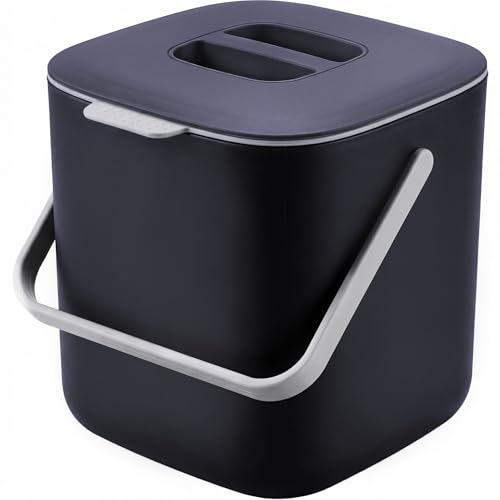
The IVWOXO 0.7-gallon bin is the smallest option here, and it solves a very specific problem: the tight galley layout where every inch of counter space is precious. This plastic bin is designed for one-handed operation, featuring a lid that opens with a thumb press, a sturdy handle, and a removable inner bucket. It is the fastest bin to use mid-task because you don’t need two hands to manage the lid.
Its standout feature is the drainable inner bucket that separates liquids from solids. This wet/dry separation slows down the decomposition process, which is what actually causes smells. Because the seal is nearly airtight, it doesn’t rely on charcoal filters that need replacing; you simply wash the plastic parts, which are dishwasher-safe, making sanitation much easier. This is a genuine advantage for a busy kitchen that needs to run bin parts through the machine at the end of the night.
The obvious trade-off is capacity. At 0.7 gallons, this is a very small bucket. It is perfect for collecting coffee grounds next to an espresso machine or eggshells during morning prep, but it will fill up fast if you try to use it for vegetable prep for a dinner service. The plastic construction, while durable, won’t have the premium feel or heat resistance of stainless steel if placed near a stove.
- One-handed lid operation speeds up scraping tasks
- Removable inner bucket separates liquids from solids
- Dishwasher-safe plastic for easy sanitation
- Airtight seal eliminates the need for carbon filters
- Very small capacity limits use to specific low-volume tasks
Best for: Espresso stations and galley prep areas where space is minimal and the bin needs to be cleaned in the dishwasher.
How We Chose These Products
We evaluated these bins based on criteria specific to commercial foodservice, not home use. The primary factors were capacity relative to footprint, durability of materials under constant use, and the effectiveness of the odor seal. We looked for bins that could handle the speed of a dinner rush, where a cook doesn’t have time to fiddle with a complicated lid or a delicate filter system.
We also considered sanitation protocols. Bins that could be hosed down, wiped out, or run through a dishwasher scored higher than those requiring delicate hand-washing. Finally, we weighed the integration with municipal waste streams; a bin is only useful if its size aligns with how often your local composter can pick up. These criteria led us to recommend different bins for different stations within the same kitchen.
Buying Guide: What Really Matters
Capacity versus footprint is the first math you need to do. A 23-gallon bin holds a lot, but it takes up floor space. Measure your prep area. A slim can fits between equipment; a wide station does not. For countertops, consider the diameter, not just the gallon rating. A 7-inch round bin fits under a wall cabinet; a 10-inch one might not. Think about how many times a day you want to walk to the dumpster versus how much space you are willing to sacrifice.
Odor control in a restaurant is about sealing mechanisms, not just filters. Charcoal filters work but they saturate quickly with high-moisture food waste and need constant replacement. Airtight rubber gaskets are more reliable for the long haul. For rodent and insect prevention, especially in urban settings, a tight-fitting lid is non-negotiable. Fruit flies will find any gap. Look for a bin where the lid creates a physical seal, not just a cover that rests on top.
Durability is about the hinges and the material. Stainless steel resists odors and looks professional but can dent. Heavy-duty plastic handles impact better but can stain. Check the hinge mechanism; the lid is the first thing to break on a bin used 20 times a day. For cleaning, consider how the bin gets sanitized. Can it go in the dishwasher? Does it have removable liners? A bin that is hard to clean will become a health code violation waiting to happen.
Our Top Recommendation
For most small restaurant kitchens, the Winco 23 Gallon Green Slim Can is the top pick. It offers the durability and volume needed for real prep work, and its slim design solves the space problem that plagues most back-of-house operations. It is a professional tool built for the abuse of a commercial kitchen. Pair it with a tight-fitting lid to control pests and odors.
If your issue is front-of-house sorting or you need a stainless look, the Zedfire 33 Gallon station is the runner-up. It is larger and more expensive, but it organizes all waste streams in one place. For a low-volume coffee bar or a small prep station, the Epica 1.3 Gallon bin is the best budget-friendly countertop choice, provided you stay on top of filter replacements. For more details on matching bin types to specific needs, see our guide on continuous compost systems.
Frequently Asked Questions
Can I put a compost bin in a dish pit area?
Yes, but it needs to be sealed. The dish pit is high-moisture and high-traffic. A bin with a lid that seals tightly is essential to keep odors from mixing with the steam and heat. The Zedfire with its removable liners is a good fit here because you can easily spray out the liners without moving the entire station.
How do I handle fruit flies around the bin?
Fruit flies come from exposed scraps and gaps in the seal. Empty the bin daily, and do not leave it open during service. For plastic bins like the Winco, ensure the lid fits snugly. For countertop bins, the airtight gasket on the IVWOXO or the charcoal filter on the Epica are your best defenses. Clean the bin edges nightly to remove sticky residue.
What size bin do I need for a 40-seat restaurant?
It depends on your menu and prep volume. A 40-seat spot doing moderate prep can usually get by with a 23-gallon bin for the back of house, emptied two to three times a day. If you are also sorting front-of-house waste, add a smaller 11-gallon stream near the dish return. Overestimating capacity leads to rotting scraps sitting for days.
Is stainless steel or plastic better for commercial compost bins?
Stainless steel resists odors and looks cleaner, but it dents and is heavier. Heavy-duty plastic is lighter, handles impacts better, and is often cheaper, but it can absorb stains and odors over time. For a bin that gets banged around in the back, plastic like the Winco is more forgiving. For a customer-facing bin, stainless steel like the Zedfire is the better look.
The Final Verdict: Balancing Cost vs. Durability
Spending more upfront on a commercial-grade bin saves money later. A cheap home bin will break in a month. The Winco offers the best balance of cost and durability for the back of the house. The Zedfire is a larger investment but replaces three separate bins and improves waste sorting compliance. For small tasks, the plastic IVWOXO offers the easiest cleaning at the lowest price point. Consider your workflow, measure your space, and choose the bin that fits the station, not just the one with the biggest capacity. For home kitchen inspiration that translates to small spaces, you might also review our small space options.


