The Best Soil Tester for Rose Gardens: A Buyer’s Matchmaker Guide
Contents
Your roses are sulking. Leaves yellow between the veins, buds ball up and refuse to open, and the new growth looks pale and weak. You water more, feed more, and nothing changes. The problem is usually underground, and guessing at it wastes a whole season.
A good soil tester for rose gardens takes the guesswork out of pH, moisture, and nutrient levels. The right pick depends on what you actually need to measure. A ten-dollar analog probe tells you moisture and rough pH in seconds. A lab kit tells you exactly how much phosphorus your bed is missing and how to fix it.
Below you’ll find five testers matched to specific rose-growing situations, from a beginner with three potted roses to a serious exhibitor with a dozen beds. Each entry leads with who it suits, then covers the honest trade-offs.
Here’s a quick look at how the five picks compare on the specs that matter most.
| Features | SONKIR 3-in-1 | Rapitest Soil Kit | MySoil Lab Kit | Buladeke 7-in-1 | YAMRON 4-in-1 |
|---|---|---|---|---|---|
| Power Source | No battery needed | No battery needed | Mail-in lab service | 4 AAA batteries | 4 AAA batteries |
| What It Measures | Moisture, pH, light | pH, N, P, K | 13 nutrients plus pH | Moisture, pH, temp, light, EC | Moisture, pH, temp, light |
| Reading Style | Analog dial | Color comparator capsules | Digital lab report | Backlit LCD screen | Backlit LCD screen |
| Tests Included | Unlimited spot checks | 20 tests total | One full lab analysis | Unlimited spot checks | Unlimited spot checks |
| Best Use Case | Quick garden checks | Budget nutrient testing | Precise rose bed diagnosis | Detailed home monitoring | Simple digital readings |
SONKIR Soil pH Meter, MS0…
1st Pick

SONKIR
SONKIR Soil pH Meter, MS02 3-in-1 Soil Moisture/Light/pH Tester Gardening Tool Kits for Plant Care, Great for Garden, Lawn, Farm, Indoor & Outdoor Use (Green)
- Kindly NOTE: This soil tester can not be applied to test pH value of any other liquid. If the soil is too dry the indicator will n…
- 3 METERS IN ONE: Soil moisture level, Soil pH value and Sunlight level could be tested easily according to your need by switching…
- NO BATTERY NEEDED: Simply insert the meter into soil, wait few minutes, accurate test results will be displayed on the readout pan…
The SONKIR MS02 suits the rose grower who wants a cheap, reliable tool for daily checks without fussing with batteries. Stick it in the soil, flip the switch to moisture, and you get a reading in a couple of minutes. It’s the tool you grab before deciding whether to water the bed or leave it alone.
What stands out is the simplicity. Three functions live on one dial, and the analog needle responds instantly once the probe is in moist soil. The probe itself is sturdy enough for repeated use in garden beds and containers. For someone growing roses in pots on a patio, this covers moisture and light checks without any setup at all. Rose roots sit shallow, so knowing the top few inches are actually damp matters more than most growers realize.
The catch is accuracy. Analog pH readings are rough estimates, not lab-grade numbers. If your soil is bone dry, the needle won’t move at all, and you’ll need to water and wait before testing. It also can’t measure nutrients, so it won’t tell you why leaves are yellowing. Treat it as a moisture and light tool first, a pH guide second.
- Three functions on one dial: moisture, pH, and light
- No batteries, no calibration, no setup
- Works in garden beds, containers, and lawns
- Needs moist soil to give a reading
- pH results are approximate, not precise
Best for: The casual rose grower who wants a no-fuss moisture and light checker for a few beds or pots.
Rapitest Soil Test Kit fo…
2nd Pick

Luster Leaf
Rapitest Soil Test Kit for Gardens, Vegetables, Flowers and Lawns. USA designed and assembled soil tester completely, quickly and accurately measures/analyzes soil pH acidity and garden nutrients.
- Quick, at home results for Soil pH, Nitrogen, Phosphorous and Potash Innovative and inexpensive soil test kit features an easy-to-…
- Contains all components needed for 20 tests. 5 for each of pH, N, P and K
- Contains all components needed to test all variables in several spots in the yard or garden
Luster Leaf’s Rapitest kit fits the gardener who suspects a nutrient problem but doesn’t want to mail samples anywhere. It uses capsule-based color comparators to test pH, nitrogen, phosphorus, and potassium. You get five tests for each of the four variables, so 20 total.
The real strength here is the included pH preference list for over 450 plants. Roses generally prefer slightly acidic soil in the 6.0 to 6.8 range, and this list helps you confirm where your bed sits. The capsule system is old-school but effective. You mix soil with water, add a capsule, and match the resulting color against a comparator chart. It’s hands-on, and beginners pick it up quickly.
Color matching takes practice. Two people can look at the same vial and see slightly different shades, so results carry some subjectivity. The 20 tests also run out fast if you’re checking multiple spots across a large rose garden. Refill capsules are available separately, which softens that limitation.
- Tests pH plus three major nutrients: N, P, and K
- 20 tests total, five for each variable
- Includes pH preference list for over 450 plants
- Color comparator system, no batteries required
- Refill capsules sold separately
Best for: The hands-on gardener who wants to diagnose nutrient deficiencies in rose beds without paying for lab analysis.
MySoil Soil Test Kit, Unl…
3rd Pick

My Soil
MySoil Soil Test Kit, Unlock Your Lawn & Garden Potential, Complete & Accurate Nutrient and pH Analysis with Recommendations Tailored to Your Soil and Plant Needs
- KNOW BEFORE YOU GROW | Grow the healthiest, sustainable lawn and garden with the most accurate and easy to use professional soil t…
- FAST & ACCURATE | Unlike at-home pH meters and test strips, our mail-in professional lab analysis accurately measures 13 plant-ava…
- FOR ANY GROWING SCENARIO | Tests any soil type and growing condition - lawn & turf, vegetable gardening, flowers, compost, trees,…
MySoil targets the serious rose grower who’s tired of guessing. You collect a soil sample, mail it in, and get a full lab report covering 13 plant-available nutrients plus pH. Results come back in six to eight days.
This is the only option here that gives you actual numbers from a professional lab rather than a needle or a color chart. The report includes custom fertilizer recommendations, both organic and synthetic, telling you what to apply, how much, and when. For rose growers dealing with stubborn problems like black spot or weak blooms, that specificity is worth the wait. It also tests any soil type, from raised beds to compost to containers.
The obvious trade-off is time. You won’t get an answer today, and you can’t retest on a whim. This is a one-shot analysis, not a reusable meter. It’s also overkill if you just want to know whether to water. But for planning a full season of rose care, the depth of information pays off.
- Mail-in lab analysis of 13 nutrients plus pH
- Results in six to eight days
- Custom organic and synthetic fertilizer recommendations
- Works for any soil type, including compost and containers
- Single-use kit, not a reusable meter
Best for: The committed rose grower who wants lab-grade data and a precise feeding plan before the season starts.
Buladeke Moisture Meter f…
4th Pick
Buladeke
Buladeke Moisture Meter for Plants,7-in-1 Digital Soil Tester Kit
- 【7-in-1 Features】This is a 7-in-1 multi-function soil tester. Our soil tester quickly measures soil moisture, pH, temperature and…
- 【Large Screen & LCD Backlight】The Soil Moisture Meter has a large LCD display with white backlight that clearly shows the numerica…
- 【Fast and accurate measurement】With the latest 2025 probe technology, it can quickly and accurately measure soil pH, moisture, tem…
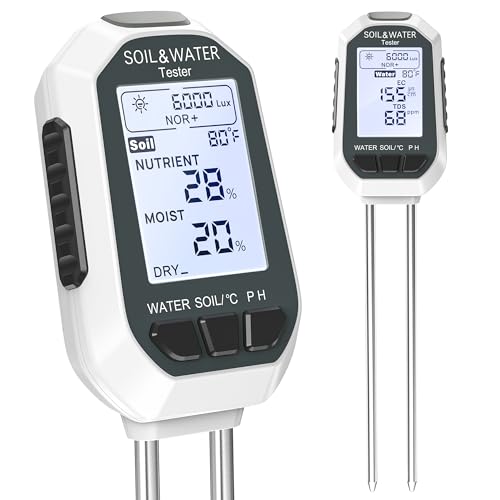
The Buladeke 7-in-1 is built for the data-hungry grower who wants more than moisture and pH. It measures soil moisture, pH, temperature, light intensity, and fertility through EC and TDS readings. That’s a lot of information from one handheld device.
The large backlit LCD screen makes it readable in bright sun or at dusk. Readings appear in about ten seconds once the probe is inserted roughly 10 cm deep. For rose growers managing different microclimates across a yard, the temperature and light readings add useful context. You can see whether a bed gets enough sun for good bloom production, or whether soil temps are too cool for root activity in early spring.
It runs on four AAA batteries, which aren’t included, and the fertility function is more of a rough indicator than a precise nutrient measurement. Dry or hard soil can damage the probe if you force it, so you’ll need to moisten the test area first. It’s also not a lab replacement, so don’t expect exact nutrient numbers.
- Seven functions including moisture, pH, temperature, light, EC, and TDS
- Large backlit LCD screen for day or night reading
- Fast readings in about ten seconds
- Requires four AAA batteries, not included
- Needs moist soil to avoid probe damage
Best for: The tech-minded rose grower who wants detailed environmental data from a single handheld device.
YAMRON 4-in-1 Soil Moistu…
5th Pick

YAMRON
4-in-1 Soil Moisture Meter Digital Plant Temperature/Soil Moisture/PH Meter/Sunlight Intensity Backlight LCD Display Soil Test Meter for Gardening, Farming and Outdoor Plants
- 【4 in 1 function】This is a 4-in-1 multifunctional soil tester.Our soil tester fastly to measure soil moisture, pH, temperature and…
- 【Large Screen & Backlight LCD Display】The Soil Tester uses a large LCD screen and white backlight to conveniently display and read…
- 【Quick Accurate measurement】The latest probe detection technology in 2026 can quickly and accurately measure the pH, moisture and…
YAMRON’s 4-in-1 covers the essentials for rose care: moisture, pH, temperature, and sunlight. It’s a straightforward digital meter for growers who want clear numbers without the extra functions of a 7-in-1.
The 45-degree rotating head is a genuinely useful design choice. You can angle the screen toward you without bending over, which matters when you’re checking a dozen rose bushes in a row. The large backlit display shows intuitive graphics alongside the numbers, so beginners can interpret readings without a manual. Insert the probe about 4 inches deep, wait ten seconds, and you have your data.
When testing pH and moisture, YAMRON recommends reading from at least five spots and averaging the results. That’s good practice for any meter, but it does mean more time per bed. Like the Buladeke, it needs moist soil and four AAA batteries, and it can’t test liquids. The 2026 probe technology is accurate for home use, though it won’t match a lab report.
- Four functions: moisture, pH, temperature, and sunlight
- 45-degree rotating head for easy viewing
- Backlit LCD with visual graphics for beginners
- Reads in about ten seconds at 4 inches deep
- Requires five readings per area for accuracy
Best for: The rose grower who wants clear digital readings with a comfortable viewing angle and no extra complexity.
How We Chose These Products
We started with what rose growers actually need: reliable pH readings, moisture tracking, and a clear picture of nutrient levels. Roses are fussy about soil pH, preferring slightly acidic conditions, so any tester that can’t give a usable pH reading was set aside. We also weighed how each tool handles the practical reality of garden soil, which is often dry, compacted, or uneven.
From there, we matched each product to a specific buyer type rather than ranking them. A lab kit and a ten-dollar analog probe serve completely different growers, so comparing them head-to-head would be misleading. We looked at power requirements, reading speed, durability concerns mentioned in the product data, and whether the tool works in containers as well as beds. If you’re also working with challenging soil types, our guide to the best soil tester for sandy conditions covers similar ground.
Buying Guide: What Really Matters
pH accuracy is the first thing to check. Roses thrive in slightly acidic soil, roughly 6.0 to 6.8. Analog meters give you a general sense of where you stand, while lab kits and digital meters offer more precision. If your roses show chronic problems, precision matters more than convenience.
Next, decide whether you need nutrients or just moisture and pH. A basic 3-in-1 tells you when to water and whether pH is in range. It won’t explain why leaves are yellowing or why blooms are small. For that, you need nitrogen, phosphorus, and potassium readings, which means a capsule kit or a lab analysis.
Finally, think about how often you’ll test. A reusable meter suits weekly checks across multiple beds. A lab kit is a once-a-season investment. Growers managing roses alongside other plants may find our roundup of testers for cottage garden soil useful for broader coverage.
Our Top Recommendation
For most rose growers, the SONKIR MS02 is the best starting point. It’s cheap, needs no batteries, and covers the two things you’ll check most often: moisture and pH. It won’t diagnose nutrient problems, but it stops you from overwatering or missing a pH shift.
If you want nutrient data without mailing samples, the Rapitest kit is the better pick. It costs more per use but gives you N-P-K readings and a plant preference list that includes roses. For growers ready to solve chronic problems once and for all, the MySoil lab kit delivers the most complete picture. The Buladeke and YAMRON meters sit in the middle, offering digital convenience and extra environmental data for growers who want more than a needle dial.
Frequently Asked Questions
Can I use a soil tester on potted roses?
Yes, most meters work fine in containers as long as the soil is moist. Insert the probe carefully to avoid hitting roots or the pot base. Lab kits also accept container soil samples.
How often should I test my rose bed soil?
Check moisture weekly during growing season. Test pH every few months, or whenever you add amendments. Full nutrient tests are worth doing once a year, ideally before spring feeding.
Why does my meter give different readings in the same bed?
Soil conditions vary across even a small area. Moisture, compaction, and organic matter differ from spot to spot. Take several readings and average them for a more accurate picture.
Do I need a lab test if I already have a digital meter?
Not always. A digital meter handles routine checks well. But if roses show persistent problems despite good moisture and pH, a lab test reveals nutrient imbalances a handheld meter can’t detect.