You bought a 150-gallon preformed pond kit, set it up on a sunny weekend, and within three days the water looked like weak tea. The culprit wasn’t the fish or the plants. It was the tiny pump that came with the kit, a unit rated for a fountain but asked to run a filter and a small waterfall. It couldn’t push water high enough, so most of it spilled over the pump’s intake instead of moving through the system.
That scenario is common. Small ponds fail because people pick pumps based on aquarium habits or the loudest wattage number on the box. This guide fixes that. You’ll learn what flow rate actually means for your pond volume, why lift height matters more than you think, and how to match a pump to your specific setup—whether that’s a simple fountain, a sponge filter, or a tiny waterfall. You’ll also see why a pump like the GROWNEER 550GPH Submersible Pump, which I’ll mention shortly, often fits the bill for smaller water features without turning your backyard into a power drain.

GROWNEER
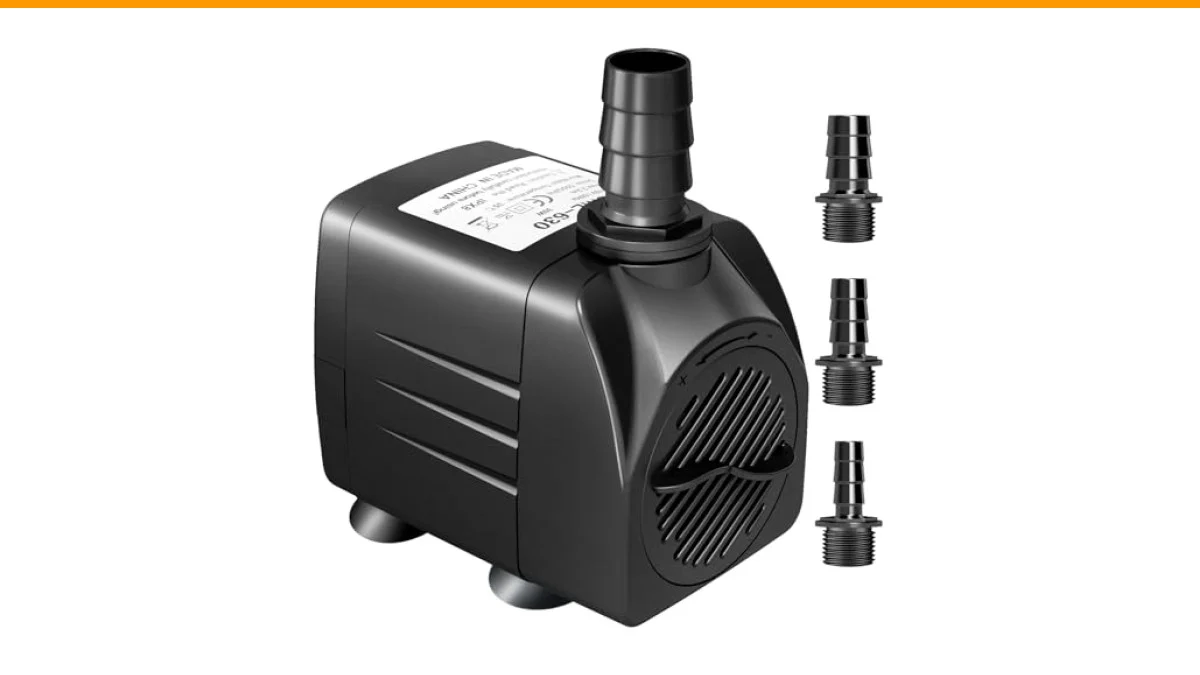
GROWNEER 550GPH Submersible Pump 30W Fountain Aquarium Water Pump | 2000L/H, with 7.2ft High Lift, 3 Nozzles for Fish Tank, Pond, Hydroponics, Statuary, Pool, Water feature, 5.9ft Power Cord
- WATER FLOW CONTROL -- The GROWNEER water pump features a control knob to adjust the flow of water, allowing you to achieve the des…
- STRONG POWER & HIGH LIFT -- Maximum Lift Height: 7.2 ft. The water submersible pump model number is SML-630. 30W high-efficiency m…
- 3 NOZZLES WATER PUMP -- Each submersible water pump has 3 nozzles to choose from: 0.51"/0.62"/0.75". Provides different water flow…
Let’s clear up the biggest misconception first: the best pond pumps for small ponds are rarely the most expensive or the most powerful ones. They are the ones that match your water volume and your head pressure. Everything else is marketing noise.
One practical option worth considering for a small pond or water feature is the GROWNEER 550GPH pump. It offers a variable flow control knob, which lets you dial back the output for a gentle stream or crank it up for a stronger display. Its 7.2-foot maximum lift gives you room to work with if your waterfall outlet sits a few feet above the water surface.
Myth #1: More Watts Means More Water Movement
Watts measure electrical consumption, not pumping performance. A 30-watt pump can move 550 gallons per hour at zero lift. A 40-watt pump from another brand might only move 300 gallons per hour because its impeller design is less efficient or the motor wastes energy as heat.
Look at flow rate at a specific lift height instead. That is the only number that tells you what will happen in your pond. A pump rated for 550 GPH at 0 feet might drop to 200 GPH at 3 feet of lift. If your waterfall outlet is 3 feet above the pond surface, you need a pump that lists its flow at that height, not just at the free-flow maximum.
For a small pond, you rarely need more than 300 to 600 GPH at the actual operating height. That range turns over a 100-gallon pond three to six times per hour, which is the sweet spot for keeping debris suspended so your filter can catch it. Running a huge pump on a small pond just blasts water around, stresses fish, and wastes electricity.
Myth #2: Any Pump Can Handle Any Filter or Waterfall
This one gets people into trouble. A pump that works great for a fountain nozzle will choke when attached to a filter with a long hose and a spray bar. Filters create back pressure. Every bend in the hose, every inch of filter media, and every narrow outlet reduces the pump’s actual output.
The fix is to measure your system’s total dynamic head. Add the vertical distance from the water surface to the highest point of discharge, plus an estimate for friction losses in the hose. A good rule of thumb: add one foot of head for every 10 feet of hose, and add another foot for each 90-degree elbow. So a waterfall that rises 2 feet with a 10-foot hose run and one elbow needs roughly 4 feet of head.
Now check the pump’s flow curve. If the pump delivers 550 GPH at 0 feet but only 250 GPH at 4 feet, that’s your real flow rate. For a 150-gallon pond, 250 GPH is still acceptable—it gives you about 1.7 turnovers per hour. For a 300-gallon pond, that’s too weak. You would need a bigger pump or a shorter hose run.
How to Match Flow Rate to Your Pond’s Volume and Feature
Start with the water volume, not the pond’s dimensions. A 6-foot by 4-foot pond that is 18 inches deep holds roughly 270 gallons, but a similar footprint with steep sides might hold 200 gallons. Measure the actual water depth and use an online volume calculator to get a reliable number.
Once you have the volume, apply these benchmarks:
- Fountain only: 100 to 200 GPH for a small decorative spray. You want a gentle arc, not a geyser that empties the pond.
- Sponge filter or small biofilter: 200 to 400 GPH for ponds up to 150 gallons. The goal is to turn the water over at least twice per hour.
- Small waterfall or stream: 300 to 600 GPH for a 2- to 3-foot-wide cascade. A wider waterfall needs more flow to avoid looking like a trickle.
- Combination of filter and waterfall: Aim for the higher end of these ranges because the filter adds resistance.
If you are running a filter and a waterfall simultaneously, you need a pump with a higher free-flow rating than you think. A pump rated at 550 GPH will likely deliver only 300 to 350 GPH through a small filter and a 2-foot lift. That works for a 150-gallon pond but falls short for a 300-gallon one.
For those with a filter-heavy setup, check out this guide on pumps for filtered ponds for more specific recommendations on handling back pressure.
Real-World Lift Height: Why the Box Lies to You
Every pump lists a maximum lift height, often called shut-off head. That is the height at which the pump produces zero flow. A pump with a 7.2-foot maximum lift will push water up 7.2 feet, but at that height, nothing comes out. The useful range is usually between 30% and 70% of the maximum lift.
So for the GROWNEER pump with a 7.2-foot max lift, the useful working range is roughly 2 to 5 feet. At 2 feet of lift, you might get 400 to 450 GPH. At 4 feet, that drops to around 250 GPH. At 6 feet, you are barely getting a trickle.
This matters more than most people expect. I have seen pond owners install a pump rated for 6 feet of max lift on a waterfall that rises 5 feet. The result was a sad drip that evaporated before it reached the bottom of the rocks. They blamed the pump, but the pump was fine—it was just operating at the edge of its capability.
Measure your actual lift before buying. If your waterfall outlet is 3 feet above the water surface, do not buy a pump with a max lift under 5 feet. Give yourself at least 2 feet of headroom above your actual vertical rise.
Comparing Pump Types for Small Ponds
Two main categories dominate the small pond market: submersible pumps and external (inline) pumps. For ponds under 500 gallons, submersible pumps win almost every time on cost, ease of installation, and maintenance. External pumps make sense for larger ponds with heavy biological loads or long plumbing runs.
| Feature | Submersible Pump (e.g., GROWNEER 550GPH) | External/Inline Pump |
|---|---|---|
| Best pond size | Up to 500 gallons | 500 gallons and up |
| Installation | Drop in water, plug in | Needs dry housing, plumbing connections |
| Maintenance | Pull out, clean impeller | Accessible but more parts to inspect |
| Heat transfer | Adds some heat to water in summer | No heat added to pond water |
| Head pressure capability | Usually 5 to 10 feet max | Often 15 to 30 feet max |
| Energy efficiency | Good for small applications | Better for high-flow, high-head situations |
| Cost | Lower upfront cost | Higher upfront cost |
| Noise | Quiet (underwater) | Audible hum outside pond |
For most small ponds, a submersible pump is the right call. The GROWNEER model fits this category well because it includes three nozzle sizes for different flow patterns and a flow control knob to fine-tune output. Its suction cups let you mount it vertically on a wall or horizontally on the floor, which helps position the intake away from debris accumulation.
One thing to note: submersible pumps do transfer a small amount of heat to the water. In a tiny pond during a heatwave, that can raise water temperature by a degree or two. It is rarely a problem for goldfish, but if you keep sensitive species like axolotls or fancy koi in a small tank, you might want to run the pump only during the day or choose a pump with a lower wattage.
What the Flow Control Knob Actually Does for You
Variable flow pumps are worth the small premium. A fixed-flow pump gives you one output level. If that level is too strong for your fountain, you have to add a valve to the discharge line, which adds back pressure and wastes energy. A flow control knob lets you reduce output at the pump head itself.
On the GROWNEER pump, that knob sits on top and adjusts output from a trickle up to the full 550 GPH. This is useful when you want to run a gentle fountain for a small container pond but then switch to a stronger flow for a filter cleaning session. Dial it down for daily operation, dial it up when you need extra circulation.
One caveat: running a pump at reduced flow for long periods can cause debris to settle in the impeller housing more easily. Check and clean the impeller every few weeks if you run it at low settings most of the time.
Myth #3: You Need a Pump Rated for Twice Your Pond’s Volume
This advice floats around forums and often leads to oversizing. The logic is that you want extra turnover for filtration, but doubling your pond’s volume in pump capacity creates a whirlpool in a small pond and pushes fish around constantly.
For a small pond with fish, aim for a turnover rate of once per hour as a baseline. That means a 100-gallon pond needs a pump that delivers 100 GPH at the actual operating head. With a filter in the system, bump that to 200 GPH to account for back pressure. You do not need 400 GPH for a 100-gallon pond unless you are running a heavy biological filter or a large waterfall.
The exception is a pond heavily stocked with fish or one that receives direct afternoon sun. In those cases, higher turnover helps keep oxygen levels up. Aeration matters more than filtration in preventing fish kills during hot weather. If you need extra oxygen without extra flow, consider a dedicated aerator or a solar aerator instead of upsizing your pump.
Choosing Between Fountain Pumps and Utility Pumps
Many pumps marketed as fountain pumps have a low maximum lift, often 3 to 4 feet. They are designed to push water through a decorative nozzle, not through a filter or up a waterfall. Utility pumps, on the other hand, typically have higher lift ratings and can handle a variety of attachments.
If you plan to run a filter, buy a utility pump or a pump explicitly rated for filter use. The GROWNEER pump sits in this utility category. It comes with three nozzle sizes for fountain use, but its 7.2-foot lift means it can push water through a small filter and up a modest waterfall without stalling.
Check the pump’s intake screen too. A fine screen keeps out small debris but clogs faster. A coarser screen lets more water through but risks pulling in small fish or tadpoles. For a pond with fry, wrap the intake in a piece of filter sponge or use a pre-filter cover.
Power Cord Length and Outdoor Safety
Pump placement often depends more on cord length than anything else. The GROWNEER includes a 5.9-foot power cord, which is enough for most small ponds placed near a house outlet. If your pond sits farther from power, you need an extension cord rated for outdoor use with a GFCI-protected outlet.
Ground fault circuit interrupters are non-negotiable for any outdoor electrical device. Water and electricity do not mix, and a GFCI outlet cuts power in milliseconds if it detects a leak. If your outdoor outlets are not GFCI-protected, hire an electrician to upgrade them before installing any pump.
Also, check the pump’s inlet strainer regularly. Leaves and string algae wrap around the impeller shaft and reduce flow dramatically. A pump that ran at 400 GPH last week might be pushing 100 GPH this week because a maple leaf jammed the impeller. Cleaning takes two minutes: unplug the pump, remove the front cover, pull out the impeller, rinse it off, and reassemble.
Frequently Asked Questions
How many GPH do I need for a 100-gallon pond?
Start with 100 GPH for basic circulation. If you run a filter, look for a pump rated around 200 GPH at your operating lift. That gives you two turnovers per hour, which keeps water clear without creating strong currents.
Can I use an aquarium pump for my small pond?
You can for a container pond or a very small water feature under 50 gallons. Most aquarium pumps have low lift heights and small intakes that clog easily outdoors. For anything larger, a pond-specific submersible pump with a higher lift rating works better.
Should I run my pond pump 24 hours a day?
Yes, if you have fish. Constant circulation keeps oxygen levels stable and prevents stagnant zones. If you have a planted pond without fish, you can run the pump on a timer for 8 to 12 hours daily to save power, but algae may grow faster during off hours.
Why is my pump making noise after a few weeks?
Almost always, debris is caught in the impeller. Unplug the pump, open the intake housing, and inspect the impeller for hair, algae, or small stones. Clean it and reassemble. If noise persists, the impeller shaft may be worn and needs replacement.
What is the difference between max flow and max lift?
Max flow is the pump’s output with no resistance, measured at the pump outlet. Max lift is the height the pump can push water before flow stops entirely. Real performance sits somewhere between those two points, so always check the flow rate at your specific lift height.
Practical Takeaways for Small Pond Owners
- Measure your pond’s actual water volume before buying anything. Guessing leads to undersized or oversized pumps.
- Ignore wattage. Compare flow rates at your specific lift height, not the free-flow maximum on the box.
- Buy a pump with at least 2 feet of lift headroom above your waterfall’s vertical rise.
- For ponds under 300 gallons, a 300 to 600 GPH submersible pump covers most fountain, filter, and small waterfall needs.
- Clean the impeller and intake screen monthly. Most pump failures are clogged impellers, not motor failures.
- Always use a GFCI-protected outlet for outdoor pumps. No exceptions.
- Choose a pump with adjustable flow if you plan to switch between fountain and filter modes. The GROWNEER 550GPH offers that flexibility at a reasonable size for small ponds.