You’ve got a lake, a pond, or a low spot that holds water, and you need to move it. The problem is the market is a mess. You find a pump claiming 3000 GPH, but it’s a no-name brand with reviews that read like they were written by the seller’s cousin. Then you find a commercial-grade pump that costs more than your first car. It’s frustrating.
A great lake water pump needs to handle debris, resist corrosion, and run for hours without overheating. The specs that matter are total head (how high it can push water), flow rate at that height, and the materials used in the impeller and housing. Most listings bury these details.
I spent weeks digging through spec sheets and owner forums to find five pumps that actually deliver. The Tsurumi 2PU is my top pick for most homeowners because it balances flow, durability, and cost. But if you need serious volume or a solar setup, there’s a better option below.
Here’s a quick spec comparison to help you see the differences at a glance.
| Features | Tsurumi 2PU | Tsurumi 8PN | TIGEROAR 12V | Hallmark MA0343X | BACOENG Solar |
|---|---|---|---|---|---|
| Power Source | 115V AC | 115V AC | 12V DC | 115V AC | 12V DC |
| Max Flow Rate | 3000 GPH | 5550 GPH | 1500 GPH | 25 GPM (1500 GPH) | 20 GPM (1200 GPH) |
| Max Head | 20 ft | 56 ft | 25 ft | 150 ft | 20 ft |
| Discharge Size | 1.25 in | 2 in | 1.25 in | 1.25 in | 1 in |
| Best Use Case | Pond/Waterfall | Large Water Transfer | Portable Drainage | Deep Well | Solar Off-Grid |
Tsurumi 2PU 1/5hp, 115V P…
This is the pump I’d recommend to most people with a residential lake or large pond. It’s a 1/5 HP submersible designed for continuous duty, meaning you can run it 24/7 without worrying about burning out the motor. The stainless steel housing and fiberglass-reinforced plastic impeller handle the grit and organic matter found in natural water sources.
What sets the 2PU apart is its efficiency. It draws only 3.2 amps while moving up to 3000 gallons per hour. That’s a rare combination. Most pumps in this class pull more power and move less water. The 20-foot max head is enough to feed a waterfall, a small irrigation zone, or a decorative stream. The white mineral oil in the oil chamber is a nice touch for pond owners because it’s non-toxic to fish and plants if a seal ever fails.
The trade-off is the discharge size. A 1.25-inch port limits the flow if you’re trying to push water through a long horizontal run. It’s also not a trash pump. The intake screen will clog if you’re pumping water with a lot of leaves or mud. You’ll need to clean it regularly in a dirty lake.
- Continuous-duty 115V motor with copper windings
- 3000 GPH max flow, 20 ft max head
- Stainless steel housing, fiberglass-reinforced impeller
- 20 ft power cord included
- 2-year warranty, UL and CSA certified
Best for: Homeowners who need a reliable, energy-efficient pump for a pond, waterfall, or small lake irrigation setup.
Tsurumi Pump 8PN (50PN2.7…

Tsurumi Pump
Tsurumi Pump 8PN (50PN2.75S) 1hp, 115V, Submersible Pond & Waterfall Pump, Stainless Steel, 5550 GPH. 2"" Discharge"
- The 8PN electric water pump has a stainless-steel housing and a fiberglass reinforced plastic impeller, volute, and top cover that…
- The white mineral oil used in the oil chamber creates a safe environment for a thriving and safe garden pond ecosystem.
- This water feature pump is rated for up to 5580 gallons per hour of water and handle solids up to 0.4 inch in diameter. It has a m…
If the 2PU felt like a commuter car, the 8PN is a pickup truck. This is a 1 HP unit that moves up to 5550 gallons per hour. It’s built for bigger jobs: draining a large section of a lake, feeding a multi-zone irrigation system, or running a serious water feature. The 2-inch discharge port makes a real difference in flow volume over distance.
The dual inside mechanical seal with silicon carbide faces is the standout feature. That’s the same seal technology used in industrial pumps. It prevents leaks and extends the life of the pump in gritty water. The 56-foot max head is also impressive. You can push water up a steep bank or to a holding tank far above the water line. The pump handles solids up to 0.4 inches, so small debris passes through without clogging.
Here’s the honest downside: it’s heavy, and it needs a dedicated 115V circuit. You can’t run this on a standard household extension cord. The 20-foot cord is standard, but you’ll likely need a longer run. And the price is significantly higher than the 2PU. It’s a professional-grade tool for people who need the volume.
- 1 HP motor, 115V, 5550 GPH max flow
- 56 ft max head, 2-inch discharge
- Handles solids up to 0.4 inches
- Dual mechanical seal with silicon carbide faces
- 20 ft cord, 2-year warranty
Best for: Large property owners or farmers who need to move serious water volume over distance or height.
TIGEROAR 12V Submersible…

TIGEROAR
TIGEROAR 12V Submersible Pump 1500 GPH Water Transfer Pump for Pool Pond | 20 ft. Cord Electric Pump Anticorrosive Plastic Housing Hose Adapter for Utility Pump Transferring Water
- Operating at 12V DC, with maximum flow of 1500 GPH. This sump pump is provided with alligator clips, 20 ft. battery cord and on/of…
- Largest height of water lifting is 25 ft.. This electric pump is equipped with a 1-1/4 in. NPT discharge port and a 3/4 in. garden…
- A removable intake screen allows solids that is large than 1/8 in. diameters to be filtered out. This filter pump is ideal for you…
Battery-powered pumps are a different animal. The TIGEROAR 12V is for people who need to move water where there’s no outlet. Think draining a boat, emptying a flooded basement, or transferring water from a lake to a remote garden plot. It runs off a 12V battery with alligator clips, so you can hook it up to a car battery or a deep-cycle marine battery.
The 1500 GPH flow rate is solid for a 12V pump. It comes with a 20-foot battery cord and an on/off switch, which sounds basic but many competitors omit the switch. The 1.25-inch NPT discharge and included 3/4-inch garden hose adapter make it flexible for different setups. The thermoplastic construction resists corrosion, and the removable intake screen keeps out debris larger than 1/8 inch.
This pump isn’t for continuous duty. It’s designed for intermittent use. The 25-foot max head is decent, but the flow drops off quickly as you add height. And it won’t last as long as an AC-powered pump if you run it every day. But for portable, off-grid water transfer, it’s a reliable workhorse.
- 12V DC operation, 1500 GPH max flow
- 25 ft max head, 1.25-inch NPT discharge
- Includes alligator clips, 20 ft cord, on/off switch
- Removable intake screen for solids over 1/8 inch
- Thermoplastic body, corrosion-resistant
Best for: Campers, boat owners, and anyone who needs to move water away from a power source. For more on this type of setup, see our guide to the best water pump for rain barrel irrigation system.
Hallmark Industries MA034…
H HALLMARK INDUSTRIES INC
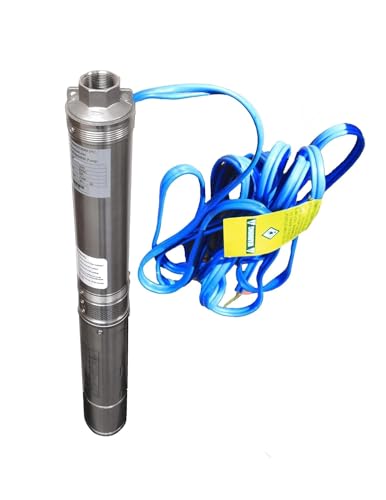
Hallmark Industries MA0343X-4 Deep Well Submersible Pump, 1/2 hp, 110V, 60 Hz, 25 GPM, 150' Head, Stainless Steel, 4"
- 4" deep well submersible pump, 115V, 6.5 Amps, 25 GPM Max, 150 Feet MAX Head, long life
This is a deep well pump, not a lake pump. But it’s worth including because many lake water setups involve a cistern or a holding tank that acts like a well. If you’re pulling water from a lake into a storage tank and then need to pressurize it for a house or irrigation system, this Hallmark unit is a proven option. It’s a 4-inch submersible, 1/2 HP, 115V pump that delivers 25 gallons per minute.
The 150-foot max head is the headline. That’s enough to lift water from a deep well or push it through a long horizontal run with elevation gain. The stainless steel construction resists corrosion, and the 6.5-amp draw is reasonable for a pump this size. It’s designed for long life in a well casing, so it handles clean water well.
The limitation is obvious: it’s not a lake pump. It will clog instantly if you put it in a muddy lake. It’s also not designed for continuous surface operation. You need to install it in a well or a clean tank. The 25 GPM flow rate is lower than the Tsurumi 8PN, but the pressure is much higher. Different tool for a different job.
- 1/2 HP, 115V, 6.5 amps
- 25 GPM max flow, 150 ft max head
- 4-inch diameter, stainless steel body
- Designed for deep well applications
- Long-life motor
Best for: Homeowners with a deep well or a clean cistern who need high-pressure water delivery.
BACOENG DC 12V Farm & Ran…
Solar pumps are a niche within a niche, but they solve a real problem. The BACOENG 12V pump is for off-grid properties, farms, and ranches where running AC power to a remote lake or pond is impractical. It runs directly off a 12V battery or solar panel setup. The 120W motor moves up to 20 GPM with a 20-foot lift.
The simple structure is a plus. Fewer components mean fewer things to break. It’s easy to maintain and repair, which matters when you’re miles from a hardware store. The 1-inch discharge is smaller than the other pumps here, but that’s typical for solar setups. The anti-corrosion ability is good for lake water, and it’s designed for aquaculture, livestock watering, and general drainage.
Solar pumps are slow. The 20 GPM flow rate is decent, but it’s dependent on sunlight. You’ll need a battery bank to run it at night or on cloudy days. The 20-foot head is also modest. It won’t push water up a steep hill. And the build quality, while adequate, isn’t in the same league as the Tsurumi pumps. It’s a budget-friendly entry point into solar pumping. If you’re considering a solar setup for a waterfall or aeration, our article on the best solar water pump for waterfall has more details.
- 12V DC, 120W, 20 GPM max flow
- 20 ft max head, 1-inch discharge
- Simple structure for easy maintenance
- Works with solar panels and 12V battery systems
- Corrosion-resistant for farm and ranch use
Best for: Off-grid homeowners, farmers, and ranchers who need a solar-powered water transfer solution.
How We Chose These Products
I started by filtering out pumps with vague specs or no name-brand recognition. A pump is a mechanical device that runs in water. If the manufacturer won’t tell you the max head, the amp draw, or the seal type, it’s a red flag. I prioritized pumps from companies with a track record in the construction, rental, or agricultural markets. Tsurumi, for example, is a world leader in submersible pumps for construction and rental. That matters.
Next, I looked at real-world use cases. A lake pump needs to handle debris, resist corrosion, and run for long periods. I checked owner feedback for common failure points: clogged impellers, failed seals, and overheated motors. The pumps on this list have a reputation for durability. I also considered the total cost of ownership. A cheap pump that dies in six months is more expensive than a quality pump that lasts five years.
Buying Guide: What Really Matters
The most important spec is total head, not flow rate. Flow rate is measured at zero height. As you push water higher or through a longer pipe, the flow drops. A pump rated for 3000 GPH might only deliver 1000 GPH at 15 feet of head. Always check the pump curve if it’s available. If it’s not, look for the max head rating and assume you’ll get about half the rated flow at half the max head.
Material quality is the second factor. Thermoplastic is fine for occasional use. Stainless steel and fiberglass-reinforced plastic are better for continuous duty in a lake. The seal type is also critical. A dual mechanical seal with silicon carbide faces will outlast a single seal in gritty water. And check the discharge size. A 2-inch port moves more water than a 1.25-inch port, but it also requires a larger hose or pipe.
Power source is the final consideration. AC pumps are more powerful and can run continuously. DC pumps are portable and work with batteries or solar. If you have power at the water’s edge, go with AC. If you don’t, a DC pump with a deep-cycle battery is your best bet. For more on matching a pump to your specific needs, see our guide to the best pump for lake water irrigation.
Our Top Recommendation
The Tsurumi 2PU is the best submersible pump for lake water for most people. It hits the sweet spot of flow, efficiency, and durability. The 3000 GPH flow rate is enough for a waterfall, a small irrigation system, or general water transfer. It runs on standard 115V power and draws only 3.2 amps, so it won’t trip a breaker. The stainless steel housing and mineral oil chamber make it safe for pond ecosystems.
If you need more power, the Tsurumi 8PN is the runner-up. It moves nearly double the water and has a much higher max head. It’s the right choice for large properties or commercial use. For portable jobs, the TIGEROAR 12V is a solid budget option. And for off-grid setups, the BACOENG solar pump is a capable entry-level choice. The Hallmark deep well pump is a specialist tool for a different application, but it’s worth considering if you have a cistern.
Frequently Asked Questions
Can I use a submersible pump in a lake with a muddy bottom?
You can, but you’ll need to protect the intake. A pump with a removable screen, like the TIGEROAR, helps, but mud will still clog it quickly. The best approach is to place the pump on a stand or in a mesh basket to keep the intake off the bottom. For very muddy water, you need a trash pump, not a standard submersible. Our article on the best submersible pump for dirty water covers those options.
How do I calculate the total head for my lake pump?
Total head is the sum of vertical lift and friction loss. Measure the vertical distance from the water surface to the highest point of discharge. Then add 1 foot of head for every 10 feet of horizontal pipe, and another foot for every fitting (elbow, tee, etc.). If the total is 15 feet, you need a pump with a max head of at least 20 feet to get decent flow.
Will a 12V pump drain a car battery?
Yes, quickly. A 12V pump like the TIGEROAR draws a significant amount of current. A typical car battery has about 50 amp-hours of capacity. If the pump draws 10 amps, it will drain the battery in 5 hours. For extended use, you need a deep-cycle marine battery or a connection to a running vehicle.
What’s the difference between a pond pump and a lake pump?
Not much, in terms of mechanics. The difference is in the duty cycle and debris handling. A lake pump often needs to handle more grit and organic matter. It also may need to run for longer periods. A pond pump is usually designed for cleaner water and decorative use. The Tsurumi 2PU and 8PN are built for both, which is why they’re on this list.