You planted the vines, built the trellis, and waited two years for that first real crop. Then summer hits and you realize the drip system you planned never got installed. Dragging a sprinkler around the vineyard means wet leaves, wasted water, and a higher chance of mildew on your clusters. It’s a classic backyard grape grower problem.
This guide covers everything about using a soaker hose for grapes: where to lay it, how long to run it, what pressure works best, and why the vine row is different from your vegetable bed. You’ll also see how a simple flat soaker hose compares to emitter drip tubing, so you can pick the right tool for your site. No fluff, just what works after years of trial and error.

koulate
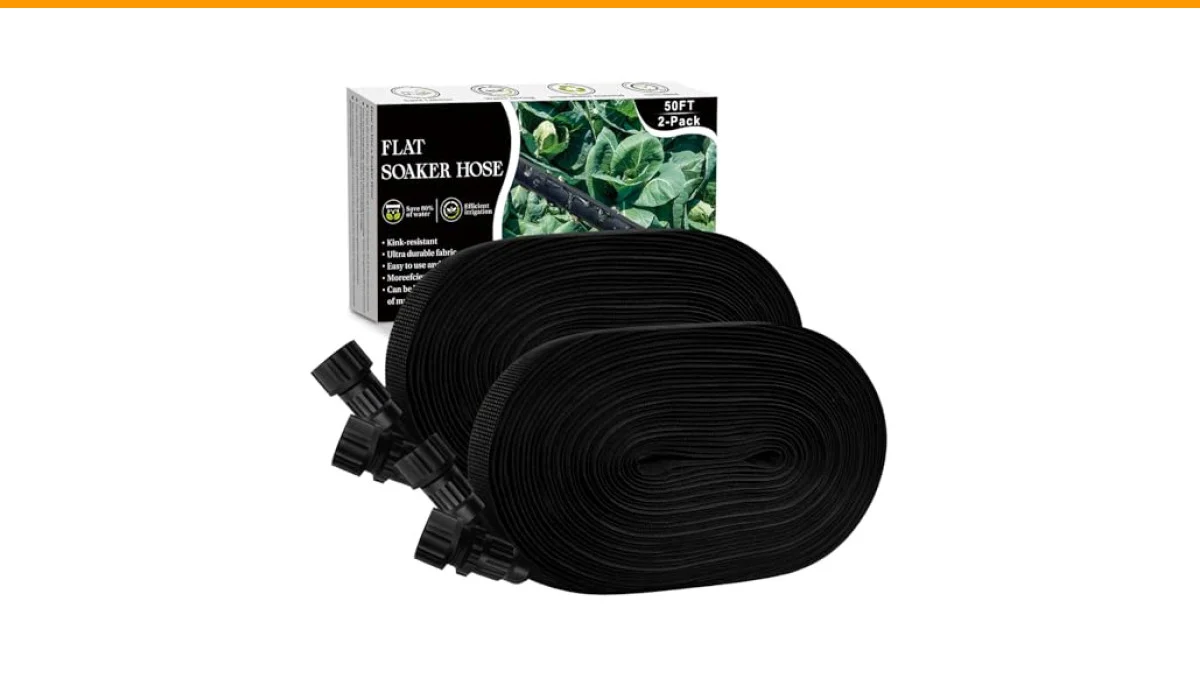
Soaker Hose 100FT, Thickened Flat Soaker Hoses for Garden 100 ft 2 pack | Drip Irrigation, Saves 80% Water, Leak-free Design, For Lawn, Flower Bed, Vegetable Field, 50 FT, black
- High quality material and performance: The soaker hose is made of high quality PVC material, its lining is reinforced with strong…
- Effective arrival of water: Flat soaker hose using porous hose, do not worry about uneven water seepage; Because it is elastic and…
- A variety of use: The garden soaker hose is light and small, flexible and multi-purpose; It is easy to deploy and secure in a gard…
One product worth considering from the start is the koulate Soaker Hose 100FT (a 2-pack of 50-foot lengths). Its fabric sleeve resists kinking, which matters when you snake it around trunks and posts. Standard threads mean you can connect it to a timer or regular garden hose without adapters.
Why Grape Vines Need a Different Watering Approach
Grape roots run deep, often 3 to 6 feet down once established. They don’t need frequent shallow drinks like lettuce or tomatoes. They need slow, deep penetration that encourages roots to chase moisture downward. A soaker hose delivers water at ground level over several hours, which does exactly that.
Overhead watering from a sprinkler wets the foliage. Wet leaves on grapevines create a playground for powdery mildew and black rot, especially in humid climates. Even in dry regions, evening sprinkling leaves moisture on the leaves overnight. A soaker hose keeps every drop on the soil, where it belongs.
There is a timing factor too. Grapes that get too much water late in the season produce watery, less flavorful fruit. With a soaker hose, you control exactly how much goes in. You stop watering entirely after veraison (when berries change color) in most regions, letting the vines concentrate sugars. That level of control is hard with any overhead method.
Setting Up a Soaker Hose in a Vineyard Row
Placement: How Close to the Trunk?
Put the hose about 12 to 18 inches away from the trunk on one side. Roots spread wider than the canopy, so you want water hitting the feeder roots, not the trunk itself. Wetting the trunk constantly can invite crown gall and other fungal issues. For a single row of vines, run one line down the row. For wider spacing (8 feet or more between rows), you may need two lines, one on each side of the row, offset so you don’t water the same spot twice.
Pressure and Flow: The 8 PSI Rule
Most soaker hoses are designed to work at 8 to 10 PSI. Household pressure is typically 40 to 60 PSI. If you connect directly to the spigot, water will blast out of the nearest pores and barely reach the end of the line. You need a pressure regulator rated for drip irrigation, usually 10 to 15 PSI, placed between the faucet and the hose.
Here is a practical benchmark: a 50-foot soaker hose at proper pressure delivers about 0.5 to 1 gallon per minute per 100 feet, depending on the brand. That means a 100-foot row might take 2 to 3 hours to put down 1 inch of water. Test your own hose by laying it out, running it for 15 minutes, and digging down to see how deep the moisture went. Adjust time from there.
Connecting Sections and Managing Slopes
If your vineyard is on a slope, run the soaker hose across the slope (along the contour), not straight down it. Water will still move downhill inside the hose, but the seepage rate stays more even. On long rows, split the run into shorter segments and connect each to a manifold. A single 100-foot hose on flat ground works fine; on a slope, you’ll get dry spots at the bottom end.
The best soaker hose options for vineyards have thicker walls and reinforced fabric. Thin rubber hoses from the big box store often develop pinhole leaks where they bend around posts. The koulate flat hose uses a fabric sleeve over PVC, which handles the repeated bending of wrapping around vine trunks without cracking.
Soaker Hose vs. Drip Tubing for Grapes: A Real Comparison
People use the terms interchangeably, but they are not the same. A soaker hose weeps along its entire length. Drip tubing has emitters at fixed intervals (often 12 or 18 inches). For row crops and orchards, drip is usually more precise. For vines spaced 6 feet apart, emitters spaced 18 inches mean water falls between vines, which is wasted. A soaker hose wets a continuous strip, which can be good or bad depending on your weed pressure.
| Feature | Soaker Hose | Drip Tubing (Emitter) |
|---|---|---|
| Water delivery | Weeps along entire length | Drips at fixed emitter points |
| Best for | Continuous rows, dense plantings | Widely spaced vines, precise zones |
| Pressure needed | Low (8-15 PSI) | Low (8-30 PSI depending on emitter) |
| Emitter clogging risk | Low (no small orifices) | Higher (minerals, algae) |
| Weed growth between emitters | Moist strip encourages weeds | Dry zones between emitters |
| Lifespan | 2-5 years typically | 5-10 years with filtration |
| Cost per 100 ft | Lower upfront | Higher, plus filter and pressure regulator |
| Repair difficulty | Cut and splice with couplers | Need to locate emitter, or replace section |
For a backyard grower with 5 to 20 vines in a single row, a soaker hose is simpler. You don’t need to measure emitter spacing or worry about clogging from hard water. For a commercial-scale vineyard with vines spaced 8 feet apart, drip with emitters placed near each vine is the better long-term investment.
How Long Should You Run a Soaker Hose for Grapes?
The answer depends on your soil, vine age, and weather. Here are starting points based on loamy soil that drains well:
- Young vines (first 2 years): 30 to 45 minutes, twice per week during dry spells. Roots are shallow, so you want moisture near the surface.
- Established vines (3+ years): 2 to 3 hours, once per week. You want water to reach 18 to 24 inches deep.
- Sandy soil: Run 1 hour twice per week. Water moves down fast and sideways slowly.
- Clay soil: Run 3 to 4 hours once per week. Water spreads horizontally, so you need less frequency but longer duration to penetrate.
Check your work. After watering, dig a small hole 12 inches deep about 18 inches from the trunk. Squeeze the soil. It should form a ball that holds together but doesn’t drip water. If it’s dry at 6 inches, increase run time by 30 minutes. If it’s soggy at the surface, you’re running too long or too often.
One caution: do not run a soaker hose every day. Constant moisture near the soil surface keeps grape roots shallow. You want them to go deep for drought resilience. Let the top inch of soil dry out between waterings.
Common Mistakes That Ruin a Soaker Hose Setup
Mistake 1: Too Much Pressure
Without a regulator, the hose acts like a sprinkler. Water sprays out of the first few inches and the rest of the row stays dry. Buy a cheap pressure regulator (10 PSI) and install it at the spigot. This is the single most common fix.
Mistake 2: Burying the Hose Too Deep
Some guides say bury soaker hoses under mulch or soil. That works in vegetable beds, but in a vineyard, you need access for repair. Vines send out new roots each year, and those roots can grow through the hose fabric. Keep the hose on the surface, covered with 2 to 3 inches of mulch. The mulch holds moisture and protects the hose from UV damage.
Mistake 3: Using Hot Water or Leaving It Pressurized
Soaker hoses are not rated for hot water. If you connect it to a hose that’s been sitting in the sun, the first rush of scalding water can damage the PVC. Flush the line with cool water first. And never leave the system pressurized when you’re done. Drain the hose and disconnect it. Water left inside during winter will freeze, expand, and crack the hose from the inside.
Mistake 4: Not Testing Emitter Uniformity
Lay the hose on flat ground, turn it on, and watch. The entire length should weep evenly. If you see dry spots, you may have a kink or a manufacturing defect. The koulate hose is designed to resist kinks, but no hose is perfect. Run your hand along the length to feel for soft spots or bulges.
Pairing a Soaker Hose with Timers and Reels
Grapes need consistent watering during the growing season. A mechanical timer costs $15 to $30 and saves you from forgetting to turn the water off. Set it to run early morning (4 AM to 7 AM). Wind is lower, evaporation is minimal, and the water has time to soak in before the sun gets intense.
If you’re running multiple rows, you’ll want a manifold to split the supply. Connect each soaker hose zone to a separate valve so you can water different blocks on different schedules. A simple Y-connector with two ball valves works fine for two rows.
Storing the hose properly extends its life. A garden hose reel for 3/4 inch hose can hold a flat soaker hose, but you need to drain it completely first. Coil it loosely to avoid sharp bends that create permanent kinks. Keep it out of direct sun when not in use; UV degrades rubber and PVC over time.
Frequently Asked Questions
Can I leave a soaker hose on all summer for grapes?
You can, but you shouldn’t. Grape vines need a dry period after veraison to concentrate sugars. Leaving the hose on all summer risks overwatering, which leads to split berries and diluted flavor. Run it during the active growth phase (spring to early summer), then taper off as harvest approaches. In most climates, stop watering entirely 2 to 3 weeks before you pick.
How many grape vines can one 100-foot soaker hose water?
If vines are spaced 6 feet apart, a 100-foot hose covers roughly 16 vines. Spacing of 8 feet means 12 vines. The limiting factor is the hose length and water pressure, not the number of vines. You can snake the hose around a curve to reach vines in a staggered layout, but keep the total length under 200 feet per connection for even flow.
Should I bury the soaker hose next to grape vines?
Surface placement with mulch is better for home vineyards. Burying the hose 2 to 4 inches deep can protect it from sun and accidental damage, but it makes repairs difficult when roots grow through it. If you bury it, use a thicker hose with a fabric sleeve. The koulate flat hose is suitable for shallow burial, but keep it above the root zone to avoid root intrusion.
What PSI should a soaker hose run at for grapes?
Most brands specify 8 to 10 PSI. You need a pressure regulator because household pressure is 40 to 60 PSI. Some hoses can handle up to 15 PSI without bursting, but higher pressure reduces uniformity. If you don’t have a regulator, you’ll see water spraying from the first few feet and nothing at the end. Spend the $10 on a regulator.
Can I connect a soaker hose to a drip irrigation system?
Yes, with the right fittings. Both use 1/2-inch or 3/4-inch threads. You can connect a soaker hose to a drip line using a female-to-female coupler or a barbed adapter. The main issue is pressure: drip systems often have a pressure regulator built into the timer, so check the output PSI. If it’s already regulated to 10-15 PSI, you’re fine. If not, add a regulator before the soaker hose.
What to Do Before You Buy
- Measure your row length and vine spacing. Buy a hose that matches the row, not the entire vineyard at once.
- Buy a pressure regulator and a timer before you buy the hose. They are not optional extras.
- Look for a hose with a fabric sleeve or reinforced wall if you plan to leave it out all season.
- Check the threads on both ends. Standard 3/4-inch threads let you connect to your existing garden hose and timer.
- Consider a 2-pack of 50-foot hoses instead of one 100-foot hose. Easier to handle, replace, and adapt to row layouts.
- Read the storage instructions. Draining and coiling the hose after each season doubles its lifespan.
- For more detailed comparisons, see our soaker hose guide for grapes and tomatoes.
Watering grapes well is less about fancy equipment and more about consistency and depth. A soaker hose gets you 80% of the way there with a simple setup. The last 20% is paying attention to your soil, your weather, and your vines. Check the moisture by hand, adjust your run times, and your vines will reward you with healthy canopies and sweeter fruit.