You finally bought that nice garden hose. Maybe it was a 5/8-inch rubber model that cost more than you planned. A few months later, you find it coiled in a tangled heap behind the garage, kinked in three places, stained with mud. You spend ten minutes every watering session wrestling it back into some kind of order. There is a better way, and it doesn’t involve a plastic wall mount that cracks after one winter.
A good hose reel cart changes your relationship with watering. The right one makes rolling up the hose faster than dragging it across the yard. It protects your investment, keeps the hose off the ground, and moves with you from the front lawn to the back garden. The catch is that most hose reels sold on Amazon come with a cheap hose bundled in, and that hose is often the first thing to fail. Buying a reel without a hose lets you pair it with the hose you already trust, or buy a quality hose separately.
This article covers exactly two products, both from Real Hose Storage. These are the two models that kept showing up in my research as the most straightforward, no-nonsense options for homeowners who want a metal cart that will last. I’ll tell you who should buy the big one, who should buy the smaller one, and why picking between them is mostly about the size of your yard and how much hose you actually need to manage.
Here is a quick look at what separates these two carts:
| Features | Real Hose 250-Ft Cart | Real Hose 175-Ft Cart |
|---|---|---|
| Material & Build | Powder-coated steel frame | Powder-coated steel frame |
| Key Specification | 250 ft of 5/8-inch hose | 175 ft of 5/8-inch hose |
| Main Feature | 4 no-flat wheels, low center of gravity | 2 no-flat wheels, stable design |
| Mobility | Four 7 3/4-inch wheels, rough terrain | Two wheels, smooth over grass and gravel |
| Best Use Case | Large yards, multiple watering zones | Medium yards, patios, residential lawns |
In this article
Real Hose 250-Ft Cart

Real Hose Storage
4-Wheel Hose Reel Cart, Heavy Duty Hose Reel, Holds 250ft of 5/8" Hose
- Fits 250 Feet Of Garden Hose: This hose reel cart stores and rolls up to 250 feet of 5/8-inch hose, so you can reach every corner…
- Rust-Resistant Powder-Coated Steel: The frame is built from powder-coated steel that stands up to sun, rain, and cold, so the cart…
- Easy E-Z Ergo Crank Handle: A comfortable grip handle winds the hose back in seconds, so you skip the hand-over-hand coiling and k…
This is the cart for someone with a serious garden or a yard that wraps around the house. If you need to water a vegetable patch in the back, shrubs along the side, and a stretch of lawn in the front, the 250-foot capacity means you can reach all those spots from a single spigot without moving the cart constantly. It is also the right pick if you own a 250-foot hose already and don’t want to cut it down or run two shorter hoses.
The four 7 3/4-inch no-flat wheels are the standout feature here. They roll over lumpy grass, gravel paths, and even soft soil without sinking. The low center of gravity keeps the cart stable when you yank the hose sideways, which is more important than it sounds. A top-heavy cart with a full hose will tip over on an incline and spill your hose into a tangled mess. This one stays planted. The E-Z Ergo grip handle makes winding up the hose genuinely easy, even when you are tired and just want to put the thing away.
Trade-off: it is big. The cart itself takes up floor space in a garage or shed. If you only have a small patio or a narrow side yard, the four-wheel footprint might feel oversized. Also, if you only own a 100-foot hose, you do not need the 250-foot capacity, and the extra cart size adds weight you will be lugging around for no reason. It is not a cart you want to carry up stairs.
- Holds up to 250 feet of 5/8-inch garden hose
- Heavy-duty powder-coated steel frame resists rust
- Four 7 3/4-inch no-flat wheels for rough terrain
- E-Z Ergo grip handle reduces effort when winding
- Low center of gravity prevents tipping when fully loaded
Best for: Homeowners with large yards, multiple watering areas, or a 250-foot hose who want maximum stability on uneven ground.
Real Hose 175-Ft Cart
Real Hose Storage
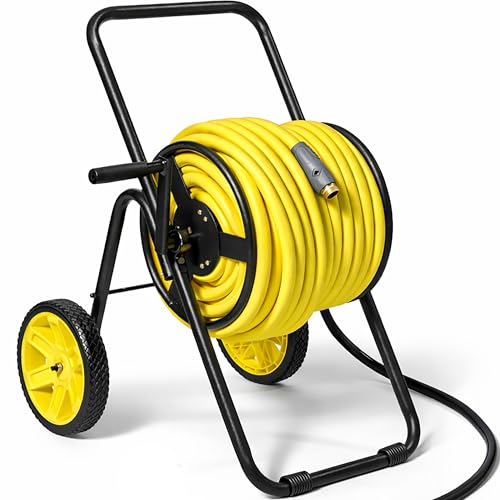
2-Wheel Garden Hose Reel Cart, Residential Duty Hose Reel,175ft Capacity | Metal Garde Hose Reel Cart with Wheels Water Hose Storage Leak-Free Rust Resistant 2 Wheels Mobile
- Heavy Duty Steel Hose Reel Cart for Long-Lasting Durability: Built with a rugged powder-coated steel frame, this heavy duty hose r…
- Large 175FT Garden Hose Capacity: This spacious water hose reel cart easily holds up to 175 feet of standard 5/8" garden hose, hel…
- Effortless Roll-up Hose: This garden hose reel cart is equipped with an easy coil grip handle, making it easy to wind up the hose…
This cart makes sense for the majority of suburban yards, city gardens, and anyone who keeps a hose for basic watering tasks. A 175-foot hose will cover most rectangular lots and reach around the average house without needing a extension. It is also the better choice if you store your cart in a garage that is already full of bikes and tools, because the two-wheel design is narrower and easier to tuck away.
What surprised me about this model is how light it feels when you maneuver it. Two no-flat wheels on a steel frame roll smoothly over grass and gravel, and the easy coil grip handle works fine for quick wind-ups. It is not as stable as the four-wheel version on sharp turns or slopes, but for typical flat yards it is completely fine. The powder-coated steel is the same quality as the bigger model, so rust resistance is not an issue. This cart is built for residential duty, not commercial landscaping, and it meets that need without overbuilding.
Trade-off: if you ever upgrade to a 250-foot hose, you will need to buy the larger cart. The 175-foot capacity is a hard limit. Also, the two-wheel design can be a bit tippy if you try to drag it sideways while the hose is fully extended. You get used to pulling it from the handle, not the reel itself. And if your terrain is consistently rough or bumpy, the four-wheel cart will be noticeably more stable.
- Holds up to 175 feet of 5/8-inch garden hose
- Rugged powder-coated steel frame designed for residential use
- Two no-flat wheels roll over grass and gravel
- Easy coil grip handle for straightforward winding
- Portable and lightweight relative to four-wheel carts
Best for: Homeowners with medium-sized yards, patios, or smaller gardens who want a practical, affordable cart that does not waste space.
How We Chose These Products
I narrowed the field by filtering for metal construction, no-flat wheels, and the ability to buy the reel without a hose. Most carts under $100 are plastic, and plastic handles crack, wheels buckle, and frames bend after two seasons. Steel is the baseline for something that lasts. No-flat wheels matter because a punctured wheel on a normal hose cart turns it into a dragging chore. And buying a reel without a hose means you avoid the cheap, stiff hose that comes with most kits.
Real Hose Storage makes exactly two models that meet those criteria. Both use the same powder-coated steel frame material and the same no-flat wheel technology. The only real difference is capacity and wheel count. That makes the decision simple: pick the capacity that matches your longest hose, and let the wheel count ride along with it.
Buying Guide: What Really Matters
Do not pay attention to fancy features like built-in spray guns or storage trays. Those break or add weight you do not need. Focus on three things: material, wheel type, and capacity. Steel frame with powder coating is the minimum. Plastic frames will flex and fatigue, especially if you leave the cart outside in hot sun. No-flat wheels eliminate one of the most common failure points on hose carts. Capacity should match the longest hose you own, not the longest hose you might buy someday. A 250-foot cart with a 100-foot hose is just extra weight.
Mobility matters more than you think. Two-wheel carts are easier to store and lighter to pull over short distances. Four-wheel carts are more stable on uneven ground but bulkier. Look at your yard. If you have slopes, soft soil, or rocks, go with four wheels. If you mostly water a flat lawn or patio, two wheels will do the job and save you garage space. Also, check the handle design. An ergonomic grip that fits your hand comfortably makes a real difference at the end of a long watering session.
Our Top Recommendation
The Real Hose Storage 250-Ft Cart is the winner for most people, assuming you have the yard to justify it. The four-wheel stability and 250-foot capacity handle everything from small gardens to large properties. It is about as close to a buy-it-for-life hose cart as I have seen at this price point. Check the current price on Amazon.
If your yard is average sized, you do not need the extra capacity, or you want something that tucks into a tight corner, the 175-Ft Cart is a smart alternative. It costs less and takes up less space, but gives you the same steel build and no-flat wheels. Either way, you end up with a reel that will outlast the hose you put on it.
Frequently Asked Questions
Can I use a 3/4-inch hose on these reels?
The specs are written for 5/8-inch hose. A 3/4-inch hose is thicker and heavier. You might squeeze it onto the reel, but the capacity in feet will drop significantly. For example, a 250-foot reel might only hold around 175 feet of 3/4-inch hose. Stick with 5/8-inch for the rated capacity.
Do the wheels lock in place so the cart does not roll away when I pull the hose?
Neither model has locking brakes on the wheels. The four-wheel cart has a low center of gravity that resists movement, but on a steep slope it can still roll. The two-wheel cart relies on its weight and the friction of the wheels. If you are on a hill, you may want to chock a wheel or anchor the cart somehow.
How hard is it to assemble the cart out of the box?
Both carts require basic assembly. You will attach the wheels, handle, and reel bracket. The instructions are clear, but you need a socket wrench or a screwdriver. Expect about 20 to 30 minutes for one person. The powder coating can chip if you overtighten bolts, so go slowly.
Can I leave this cart outside all winter?
The powder-coated steel frame resists rust, but the hose itself will freeze and crack if left full of water. Drain the hose and store the cart under a cover or in a shed during freezing months. The cart will survive rain and sun, but ice in the reel mechanism could cause problems.