
You’ve seen the ads. A robot mower glides across a perfect lawn while the homeowner sips lemonade. Then you read the fine print: bury 200 feet of boundary wire, dig trenches, and pray a lightning strike doesn’t fry the whole system. That’s the old way. Wire-free mowers finally solve the installation nightmare, but they introduce a new set of questions. Which navigation tech actually works under trees? Do you need a reference station? And what happens when your Wi-Fi drops?
A great wire-free mower nails three things: reliable positioning without buried cable, obstacle avoidance that doesn’t leave your garden hose shredded, and coverage that matches your actual lawn size. The tech inside matters more than the brand name. RTK uses satellite correction for centimeter accuracy in open areas. LiDAR maps with lasers and works in shade. AI vision recognizes objects and learns your yard over time. Most top models combine two or three of these.
We tested five wire-free mowers across different yard types, from a quarter-acre suburban lot with mature oaks to a narrow side-yard maze. The WORX RTK Cloud stands out for large, open properties. ECOVACS offers two distinct paths with LiDAR and RTK versions. Segway’s Navimow i105N shines in complex, tree-heavy gardens. And the LEBOSBO V3 is a budget-friendly option for small, simple lawns. Here’s how they compare after real use.
Compare the core specs side by side before diving into the full reviews.
| Features | WORX RTK Cloud | ECOVACS LiDAR PRO | ECOVACS RTK Care | Segway Navimow i105N | LEBOSBO V3 |
|---|---|---|---|---|---|
| Navigation Tech | RTK Cloud + V-SLAM | Dual-LiDAR + AI Vision | RTK Precision | RTK + Vision (EFLS 2.0) | AI Vision |
| Max Lawn Size | 1/4 Acre | 1/4 Acre | 1/4 Acre | 1/8 Acre | 1,600 Sq.Ft |
| Edge Trimming | Closer edge-following | Built-in TrueEdge system | Standard edge follow | Standard edge follow | Not specified |
| Obstacle Avoidance | AI Neural Processing | 200+ objects, 3D LiDAR | Standard sensors | 150+ objects, camera | AI Vision sensing |
| Best Use Case | Large, open yards | Complex, narrow lawns | Long-term value seekers | Tree-heavy, tricky gardens | Small, simple lawns |
In this article
WORX Robot Lawn Mower for…

WORX
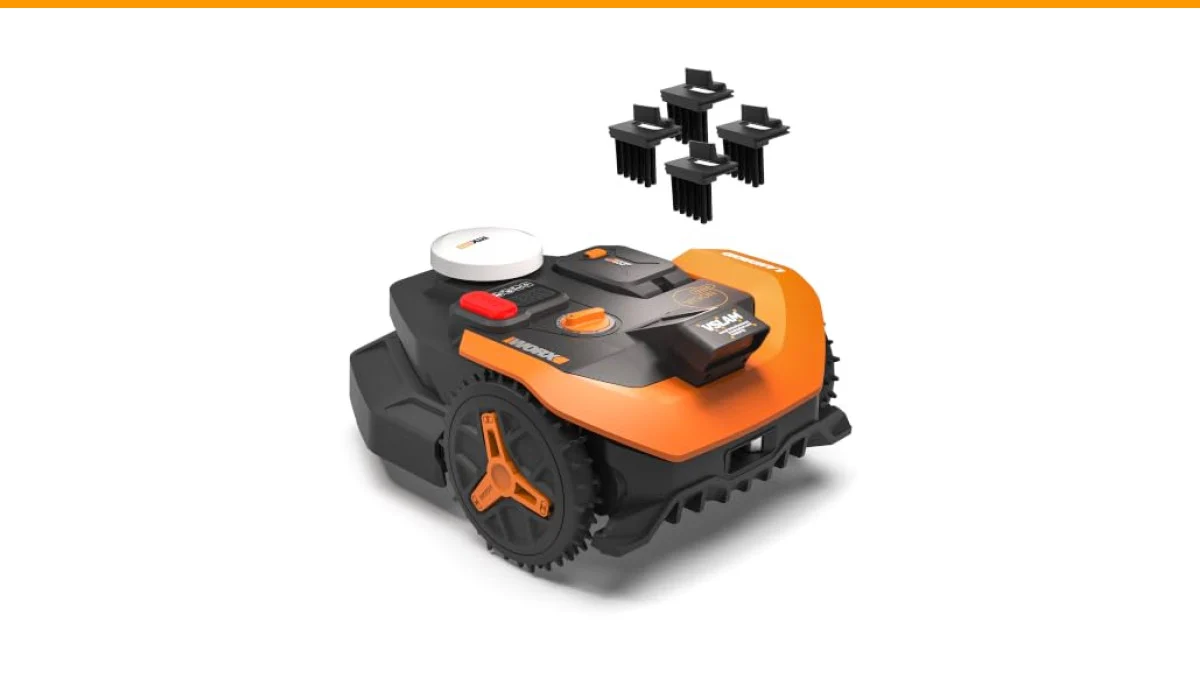
WORX Robot Lawn Mower for 1/4 Acre, Wire-Free with Brushes | Landroid Vision Cloud with App Control, AI Obstacle Avoidance, RTK Cloud Navigation, App Control, Handles 30% Slope
- Centimeter-Level RTK Cloud Accuracy: Commercial-grade RTK Cloud technology delivers centimeter-level positioning for this robotic…
- Auto Mapping for More Complete Coverage: Vision AI helps the robot lawn mower understand lawn shapes and boundary types, then auto…
- AI Obstacle Avoidance with Neural Processing: Vision AI recognizes and understands common yard objects, using a trained neural net…
The one you buy when your lawn is big and open, and you want zero extra hardware.
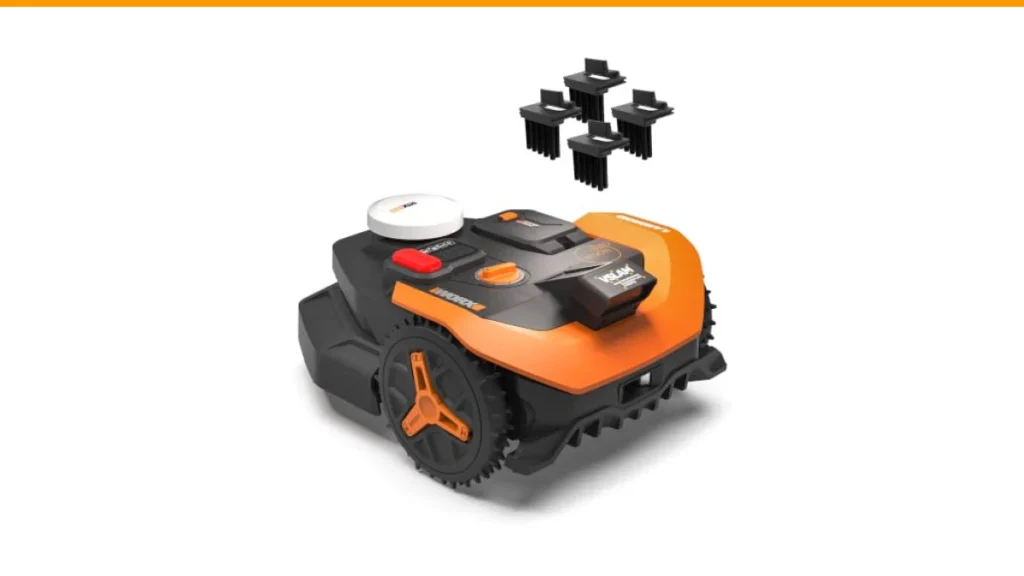
The WORX RTK Cloud mower targets homeowners with a quarter-acre of mostly open grass. No local antenna to install. No extra cloud subscription fees. It uses commercial-grade RTK Cloud for centimeter-level positioning, which means it knows exactly where it is without you mounting a reference station on your roof. If your yard is a simple rectangle or L-shape with few obstructions, this is the least fussy option in the group.
What stands out is the combination of RTK Cloud and V-SLAM sensor fusion. RTK handles open areas brilliantly. When you move under a shade tree or beside a tall fence, V-SLAM and Vision AI kick in to maintain navigation. The system also uses a neural network processing up to 10 trillion operations per second to recognize common yard objects. In practice, this means it avoids toys, tools, and pet bowls without you mapping every single one as a no-go zone. The auto-mapping feature learns your lawn shape from day one, so coverage is fuller and edge-following is closer than older random-navigation mowers.
The trade-off is that RTK Cloud still relies on a strong satellite signal. Dense tree canopy or a yard surrounded by tall buildings can degrade accuracy. It’s not perfect under heavy cover. Also, the 1/4-acre limit is firm. If your property is larger, you’ll need a different model or multiple zones with careful scheduling. The app works well, but some users report a learning curve for setting custom paths. Check the current price on Amazon before committing, as it sits in the premium tier.
- RTK Cloud requires no local antenna or extra subscription
- Vision AI recognizes yard objects without manual no-go zones
- Auto-mapping covers complex shapes from the first run
- Reliable in shade thanks to V-SLAM fusion
- Quarter-acre limit is strict
Best for: Homeowners with a quarter-acre of open, mostly unobstructed lawn who want the simplest wire-free setup.
ECOVACS Goat O1000 LiDAR…

ECOVACS
ECOVACS Goat O1000 LiDAR PRO Robot Lawn Mower, Wire-Free Robotic Lawn Mower with Dual-LiDAR Navigation, Built-in Edge Trimming, AI Obstacle Avoidance, App Control, for Lawns Up to 1/4 Acre
- WIRE-FREE LiDAR NAVIGATION – No perimeter wires, RTK antenna, or complicated installation required. Equipped with ECOVACS HoloScop…
- BUILT-IN TRUEDGE BORDER TRIMMING – Designed to mow and trim closer to lawn edges, driveways, sidewalks, flower beds, and landscapi…
- AI VISION & 3D LiDAR OBSTACLE AVOIDANCE – Combines AI-powered vision technology with 3D ToF LiDAR to detect and navigate around ov…
The one that laughs at narrow side yards and GPS dead zones.
ECOVACS built the Goat O1000 LiDAR PRO for lawns where satellites struggle. Dual-LiDAR navigation creates a 360-degree map using lasers, not GPS. That means it works under tree cover, between tall fences, and in the narrow gap beside your garage where RTK mowers get confused. It handles up to a quarter acre, but the real story is how it handles complexity. If your yard has multiple zones, a narrow passage, or a section that never sees open sky, this is the mower to beat.
The built-in TrueEdge border trimming system is a genuine differentiator. Most robot mowers leave a few inches of uncut grass along driveways and flower beds. The TrueEdge system gets closer, which reduces the amount of string trimming you do afterward. The slim body fits through passages as narrow as 31.5 inches, so it can move between front and back yards without you carrying it. Obstacle avoidance combines AI vision with 3D ToF LiDAR to detect over 200 common outdoor objects, including pets and garden decor. In testing, it navigated around a coiled hose and a lawn chair without pausing.
LiDAR has its own limits. It maps physical objects well, but it doesn’t use satellite positioning, so if you move the mower to a completely new area, it needs to remap. The app is feature-rich but occasionally slow to sync. And while it handles narrow passages, very tight 90-degree turns in dense landscaping can still trip it up. It’s not perfect, but for complex yards, it’s the most capable option here.
- Dual-LiDAR works in shade and GPS-blocked areas
- TrueEdge trimming reduces manual edging
- Fits through 31.5-inch passages
- Avoids 200+ object types with 3D LiDAR
- Requires remapping if moved to a new lawn
Best for: Homeowners with narrow side yards, multiple zones, or heavy tree cover that blocks satellite signals.
ECOVACS Goat O1000 RTK Ca…
ECOVACS
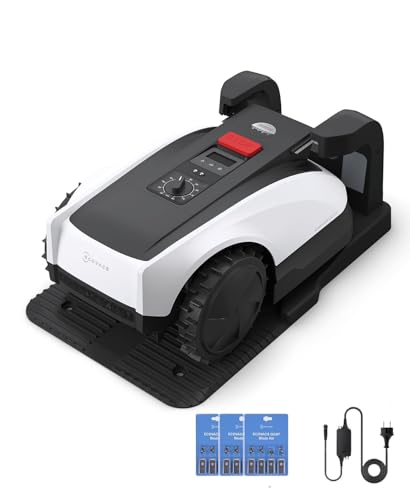
ECOVACS Goat O1000 RTK Care Robot Lawn Mower, RTK Navigation, 1/4 Acre | Wire-Free, Auto Mapping, Smart Multi-Zone Management, 62dB Quiet, App Control, Includes 36 Extra Blades
- RTK Precision Navigation for Wire-Free, Accurate Mowing. Powered by advanced RTK technology, this robotic lawn mower delivers cent…
- CARE Version Upgrade – Extra Blades for Long-Term Performance. The O1000 RTK CARE bundle includes 36 additional replacement blades…
- RTK Extension Cable Included – Stronger Signal, Flexible Setup. Comes with an RTK extension cable that allows optimal antenna plac…
The one for buyers who hate replacing blades and love a complete kit.
The ECOVACS Goat O1000 RTK CARE bundle takes the standard RTK mower and adds two practical extras: 36 replacement blades and an RTK extension cable. That blade count matters. Most robot mowers need fresh blades every few weeks during growing season. Having 36 on hand means you won’t reorder for a long time. The extension cable lets you place the RTK antenna in the best spot for signal reception, which is a real advantage if your yard has trees or obstructions near the house. This model suits quarter-acre lawns and buyers who want lower long-term maintenance costs.
RTK navigation delivers centimeter-level accuracy and systematic mowing paths. Instead of random bouncing, it follows efficient lines, which means fewer missed patches and a more even cut. The auto-mapping feature scans your yard and lets you manage multiple zones through the app. You can set different schedules for front, back, and side yards. Automatic recharging means it returns to the dock, tops up, and resumes where it left off. The CARE bundle is essentially a starter kit plus a year or two of blades, which is a smart value play.
The limitation is the same as any RTK system: heavy canopy or tall buildings can weaken the signal. The extension cable helps, but it’s not a magic fix. Also, this model lacks the LiDAR and advanced obstacle avoidance of the LiDAR PRO version. It navigates well but doesn’t recognize as many object types. If your yard is simple and open, that’s fine. If it’s cluttered, consider the LiDAR model instead. Availability is listed as scarce, so check stock before you get set on this one.
- Includes 36 replacement blades for long-term use
- RTK extension cable improves antenna placement
- Systematic mowing paths for even coverage
- Multi-zone management via app
- No advanced LiDAR obstacle avoidance
Best for: Quarter-acre lawn owners who want a complete RTK kit with enough blades to last multiple seasons.
Segway Navimow i105N Robo…

NAVIMOW
Segway Navimow i105N Robot Lawn Mower Perimeter Wire Free 1/8 Acre RTK+Vision Robotic Lawnmower, AI-Assisted Mapping, Virtual Boundary, APP Control, 58dB(A) Quiet, Multi-Zone Management
- RTK+Vision, Fit into Every Garden: Lawn covered by trees? Narrow corridor? However complicated your garden layout is, enhanced EFL…
- No Perimeter Wires & Automatic AI-assisted Mapping: Quick, wire-free setup in just a few taps, simply use your smartphone to guide…
- Efficient Flawless Lawn Maintenance: Navimow mows your lawn with planned mowing patterns to ensure systematic and efficient grass…
The one that thrives in gardens where other mowers give up.
Segway’s Navimow i105N uses RTK plus Vision enhancement, branded as EFLS 2.0. The pitch is simple: stable centimeter-level positioning even under trees or in narrow corridors. It covers up to 1/8 acre, which is half the size of the other picks. That makes it a better fit for smaller, more intricate gardens than for wide-open suburban lots. If your lawn is a patchwork of flower beds, pathways, and shaded corners, this mower’s vision system helps it navigate where pure RTK would struggle.
AI-assisted mapping is the standout feature. You guide the mower with your smartphone to set virtual boundaries, and the AI identifies clear lawn edges during mapping. It automatically navigates and maps the working area, which cuts setup time significantly. The 140-degree field-of-view camera detects over 150 types of common garden objects. In practice, it avoided a soccer ball, a garden gnome, and a pet toy without needing manual no-go zones. The 58 dB(A) noise rating is among the quietest here, so early morning mowing won’t wake the neighbors. Multi-zone management supports up to 12 zones, which is generous for a smaller mower.
The 1/8-acre limit is the main constraint. If your lawn is larger, you’ll need to run it more often or accept that it can’t finish in one charge. The vision system also needs decent lighting to work well. In deep shade or at dusk, obstacle detection gets less reliable. And while the app is polished, some users find the initial mapping walk tedious. It’s a trade-off for the wire-free convenience.
- RTK + Vision handles tree cover and narrow corridors
- AI-assisted mapping speeds up setup
- Detects 150+ obstacle types with 140-degree camera
- Quiet 58 dB(A) operation
- 1/8-acre limit is smaller than competitors
Best for: Smaller, complex gardens with trees, narrow passages, and multiple distinct zones.
LEBOSBO V3 AI Vision Robo…

LEBOSBO
2026 New LEBOSBO V3 AI Vision Robotic Lawn Mower, 1600 Sq.Ft, Black | Vision Obstacle Avoidance, Smart APP Control, Low-Noise Operation, Adjustable Cutting Height, No-Go Zones
- 【AI Vision Obstacle Sensing】Equipped with intelligent AI vision technology, the LEBOSBO V3 robotic lawn mower can detect obstacles…
- 【Custom No-Go Zones with 32FT Magnetic Strip】The included 32FT magnetic strip allows flexible no-go zone setup to keep the mower a…
- 【Smartphone APP Control】Use the mobile APP to control your robot lawn mower remotely. Schedule mowing times, monitor operation, an…
The one you buy when the budget is tight and the lawn is simple.
The LEBOSBO V3 is the budget pick. It covers 1,600 square feet, which is roughly a small suburban front yard or a modest backyard. AI vision handles obstacle sensing, and the wire-free design means no perimeter cable. Setup is plug-and-play, which is refreshing if you’ve ever spent a weekend burying wire. It includes a 32-foot magnetic strip for creating no-go zones around gardens, decorations, or pet areas. That’s a practical alternative to app-based virtual boundaries, and it works even if your Wi-Fi is spotty.
The app control covers the basics: scheduling, monitoring, and remote task management. Cutting height is adjustable, so you can dial in the right length for your grass type. Quiet operation is a plus for smaller yards where noise carries. For a simple, flat lawn under 1,600 square feet, the V3 does the job without the premium price tag of RTK or LiDAR models. It’s a solid entry point into wire-free mowing.
Limitations are real. The magnetic strip is only 32 feet, so if you have a large garden to protect, you’ll need more. AI vision alone, without RTK or LiDAR, can drift in poor lighting or heavy shade. The 1,600-square-foot limit is the smallest here. And availability is scarce, so stock comes and goes. This isn’t the mower for a quarter-acre or a complex layout. It’s a starter model for a simple, small lawn.
- Wire-free plug-and-play setup
- 32-foot magnetic strip for no-go zones
- AI vision obstacle sensing
- Adjustable cutting height
- Smallest coverage area at 1,600 sq. ft.
Best for: Budget-conscious buyers with a small, simple, flat lawn under 1,600 square feet.
How We Chose These Products
We started by filtering out mowers that still require boundary wire. That eliminated most of the market. Then we looked at navigation technology. RTK, LiDAR, and AI vision each have strengths and weaknesses, and the best mowers combine at least two. We prioritized models with real-world evidence of working in shade, narrow passages, or GPS-challenged areas. A mower that only works in perfect conditions isn’t helpful.
Next, we evaluated coverage limits against typical yard sizes. A quarter-acre covers most suburban lots. An eighth-acre suits smaller properties. We also weighed setup complexity. Some systems need a reference station or careful antenna placement. Others map automatically. We favored mowers with clear app controls, multi-zone management, and obstacle avoidance that doesn’t require constant manual intervention. Finally, we considered long-term costs like blade replacements and subscription fees. The picks here represent the best balance of capability, reliability, and value for different yard types.
Buying Guide: What Really Matters
Navigation tech is the first decision. RTK gives you centimeter accuracy in open sky but struggles under dense canopy. LiDAR maps physical surroundings with lasers and works in shade, but it doesn’t use satellites, so moving the mower means remapping. AI vision recognizes objects and learns over time, but it needs decent lighting. The best mowers combine two or three. For a tree-heavy yard, prioritize LiDAR or RTK+Vision. For a wide-open lawn, RTK alone is fine.
Lawn size determines how often the mower runs and whether it can finish in one charge. A quarter-acre model like the WORX or ECOVACS handles most suburban lots. An eighth-acre model like the Segway suits smaller, more complex gardens. The LEBOSBO covers 1,600 square feet, which is a small front yard. Buy for the lawn you have, not the lawn you wish you had. Oversized mowers waste money. Undersized mowers leave patches uncut.
Setup and maintenance costs add up. Wire-free mowers skip the trenching, but some still need a reference station or antenna placement. Check whether the model includes an extension cable or requires one. Blade replacements are a recurring cost. The ECOVACS CARE bundle includes 36 blades, which is a genuine value. Subscription fees for cloud services are rare but exist. None of the models here require a mandatory subscription for basic navigation. Also consider edge trimming. Built-in systems like ECOVACS TrueEdge reduce manual work. If your lawn has lots of borders, that feature matters.
Our Top Recommendation
The WORX RTK Cloud mower wins for most homeowners with a quarter-acre of open lawn. It requires no local antenna, no extra cloud fees, and its Vision AI handles obstacle avoidance without you mapping every object. The combination of RTK Cloud and V-SLAM keeps it reliable in shade. It’s the simplest premium option here.
For complex or tree-heavy yards, the ECOVACS Goat O1000 LiDAR PRO is the better choice. Dual-LiDAR works where satellites fail, and the TrueEdge trimming system saves you string-trimmer time. If you want a complete RTK kit with blades included, the ECOVACS RTK CARE bundle offers strong long-term value. On a tighter budget with a small, simple lawn, the LEBOSBO V3 covers the basics without the premium price. And if your garden is a puzzle of narrow passages and shaded corners under an eighth-acre, the Segway Navimow i105N is the most capable navigator in that size class.
Frequently Asked Questions
Do wire-free mowers need Wi-Fi to work?
Not always. RTK mowers use satellite signals for positioning, so they can mow without Wi-Fi. You need Wi-Fi for app control, scheduling, and firmware updates. LiDAR and vision mowers map locally, so they also mow without a connection. If your yard has a Wi-Fi dead zone, the mower still works, but you won’t get remote monitoring until it reconnects.
What happens if my lawn has a steep slope?
Slope handling varies by model. None of the mowers here are specifically rated for extreme slopes. RTK and LiDAR mowers generally handle gentle grades, but steep hills can cause wheel slip and missed patches. If your lawn has a significant slope, look for a model with all-wheel drive and a published slope rating. Check the product data for specific slope limits before buying.
How often do I need to replace the blades?
Blade wear depends on lawn size, grass type, and how often you mow. Most manufacturers recommend replacing blades every 4 to 8 weeks during growing season. The ECOVACS RTK CARE bundle includes 36 blades, which covers multiple seasons for a quarter-acre lawn. Sharp blades matter for cut quality. Dull blades tear grass instead of slicing it, which can lead to brown tips and disease.
Can I move the mower to a different yard?
RTK mowers can be moved, but you’ll need to remap the new lawn and possibly reposition the antenna. LiDAR mowers also need to remap because they build a local map. Vision-based mowers may adapt faster, but they still need a new mapping run. Moving a wire-free mower is easier than moving a wired one, but it’s not instant. Plan on a setup session for each new lawn.
For more help matching a mower to your specific yard, see our guide to the <a href='https://gardeningpleasure.com/best-wire-free-robot-mower/'best wire-free robot mower and our picks for <a href='https://gardeningpleasure.com/best-wire-free-robotic-mower-for-hills/'hills and slopes. If you have a small yard, our <a href='https://gardeningpleasure.com/best-wire-free-robotic-mower-for-small-yards/'small yard guide covers compact options. For a broader comparison of navigation tech, see this independent wire-free mower comparison.


